By Avideh Motmaen-Far, August 31, 2026
Canadian soldiers came ashore at Juno Beach on the morning of June 6, 1944. They were not there to make up the numbers. Canada had been trusted with its own stretch of the Normandy coast. By nightfall some 14,000 Canadians fought their way further inland than almost any other Allied force that day. We accepted a piece of the fight, and we held it. That is how a middle power earns its bona fides when tectonic global decisions are being made.
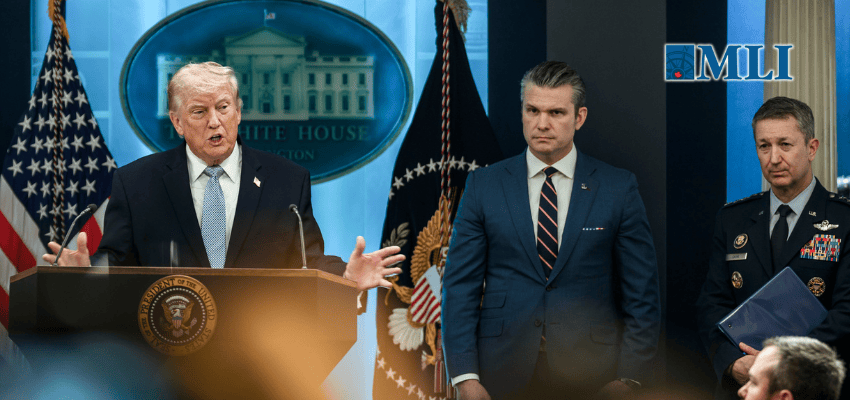
President Donald Trump has now called for an “economic D-Day” against the Islamic Republic of Iran — and he expects the United States’ allies to join the fight.
Trump promised a grand, apocalyptic gambit: “the most crushing economic operation ever taken against any country.” His Treasury Secretary, Scott Bessent, described a “one-two punch” of naval blockade and “the toughest sanctions in history,” and he was candid about the goal, which is to “collapse this regime.” It is then that a crucial line arrived for Ottawa’s consideration. Bessent’s message to the global community was simple: “You’re either with us or against us.”
Canada cannot afford to simply ignore that ultimatum. And the timing could hardly be more difficult. Relations with Washington are as strained as they’ve been in decades, with tariffs moving both ways and Mark Carney calling it an economic war.
The operation, and why it reaches Canada
The American sanctions are only part of the equation. The real weapon is secondary sanctions: the threat to punish anyone else — friend and adversary alike — who keeps buying Iranian oil, moving money, or carrying Iranian cargo. This is economic warfare that reaches across other nations’ borders, and the US deliberately designed it that way. Trump intends to force the world to choose — and some already have. The United Arab Emirates, which long served as the regime’s favourite back door, has suspended its Iran trade.
Canada needs to take Trump’s threat seriously. We are a G7 economy. We preach NATO solidarity. We have spent years branding the Islamic Republic of Iran as a malignant cancer on global stability. To treat this sudden, necessary alliance against that menace as if it were someone else’s problem is intellectually dishonest, and geopolitically perilous. We are already involved. They question is whether Canada will engage as a committed, sovereign partner on its own terms, or risk the alternative — being swept into the vortex because neutrality proves too costly.
The complication of the present moment
Bessent’s ultimatum arrives during a heated trade war between Canada and the United States. Trump has already levied crushing tariffs against Canadian goods, signalling potential 50 per cent duties on our vehicles, parts, and steel. Prime Minister Mark Carney has effectively declared the old partnership defunct; we face economic war with our closest ally, with impending retaliatory tariffs slated for September. Vice President JD Vance has folded security into the quarrel too, arguing that Canada shelters under American protection from other threats while spending far too little on its own defence. Trade, security posture, and diplomacy are all thrown into a single, volatile container.
Introducing an Iran ultimatum into that environment raises the stakes exponentially. Canadian compliance on sanctions risks becoming another bargaining chip in a much larger dispute between Ottawa and Washington. The US may treat compliance as something Canada owes, while Canada may be tempted either to yield for tariff relief or withhold it out of deep institutional resentment.
Both instincts are dangerous traps. If Canada tightens the screws on Iran purely as a concession to an American administration, it has allowed its foreign policy to become subservient to the trade file, and those transactional costs will inevitably be passed down. Conversely, if Canada drags its feet against Iran out of pique toward the Trump administration, it allows the friction of one dispute to define a question of national security.
This is where the Juno Beach parallel proves most valuable. Canada fought at Normandy not as a client state, but as a sovereign ally with its own strategic imperative. That posture is what must define our present action. The fate of the Islamic Republic is a Canadian concern, rooted in our own interests: the safety of citizens targeted by the regime; the protection of the Iranian diaspora on our soil; and upholding Canadian values when we condemn the IRGC. Acting from intrinsic conviction, rather than as a favour or an act of defiance, is the only durable path forward.
The gap between policy and practice
On paper, Canada is equipped — SEMA sanctions on Iran, a 2024 terrorist listing of the IRGC, and FINTRAC’s financial-intelligence and freezing powers. In practice, the machinery that turns those laws into charges, freezes and coordinated action has barely functioned. In 2024, Ottawa at last listed the Islamic Revolutionary Guard Corps as a terrorist entity — a step the Iranian diaspora in Canada had demanded for a decade. Canada maintains autonomous sanctions on Iran under the Special Economic Measures Act. The tools are there. But charges are almost never laid. Assets are rarely frozen. Money and people tied to the regime keep finding a comfortable home in Canadian real estate and Canadian institutions and next to nothing happens to them. A terrorist listing that is not enforced is a press release at best. A sanctions regime that is not policed is an inconvenience the regime learns to route around. If Washington is storming the beach, Canada is the unit that was handed rifles it never learned to fire. An ally that lands late and light is not a partner — it is a liability the others must cover for.
Taking the beach is not winning the war
Let’s dispense with the naive notion that sanctions alone miraculously topple a regime. The Islamic Republic has weathered four decades of siege and evolved into an armored beast, adept at turning economic pressure into political dogma. You don’t win a modern conflict with just the landing; you win it with the strategy for the advance inland. Squeeze a dictatorship with no political plan behind and you often end up with something more paranoid and more dug in, not something weaker. Even people who badly want this campaign to work admit where it gets hard. Behnam Taleblu of the Foundation for Defense of Democracies has made the point that making secondary sanctions stick means pushing Iran near the top of America’s relationship with Europe and Asia, which is a heavy diplomatic lift. Put plainly: it only works if allies actually turn up. Which brings us back to Canada.
The D-Day comparison is more useful than Trump meant it to be, because June 6 did not win the war. It was a landing. What mattered was everything that came afterward. The victory came from the plan for what followed — the advance inland, and the political order rebuilt in the ruins. An economic D-Day with no plan for the day after is merely a beachhead, and beachheads that are not exploited are lost.
This is where Canada can offer a distinct contribution: our Iranian diaspora is one of the largest and the most politically engaged in the world. We are a reservoir of legitimacy, expertise, and connection to the Iranian people whose oppression we claim to oppose. Right now, responsibility for enforcing our Iran sanctions is scattered across Global Affairs, the RCMP, the CBSA and FINTRAC, with no single agency clearly in charge — and it shows. If our resources are buried under layers of bureaucracy and poor enforcement, we aren’t just wasting potential; we are risking our countrymen. A cornered regime doesn’t suddenly care about your diaspora’s well-being; it grows more ruthless. It goes on the hunt.
What Ottawa should do
A coordinated, principled response requires deliberate action now, independent of Washington’s next pronouncement:
- Matching the new designations and own them as our policy: When Washington rolls out its fresh listings, we must mirror them under the Special Economic Measures Act. Not because we take orders, and not as a bargaining sweetener in the tariff fight, but because a net only works when the holes are covered. One country acting alone is a nuisance to Tehran. Several acting together is leverage.
- Arming the ground troops: A law is worth only as much as the people funded to apply it. Our financial watchdogs — FINTRAC, the RCMP, and the Canadian Border Servies Agency — need the mandate and the operational means to stop money laundering operations in its tracks, demanding beneficial-ownership transparency until we see through every shell company.
- Defending the home front: Sanctions against Tehran must be paired with zero-tolerance action against transnational repression on Canadian soil. Expel the agents. Protect the dual nationals. Treat the intimidation of Iranian Canadians as a national security emergency, not a local civil disturbance.
- Targeting the Islamic regime, not the Iranian people: The goal must remain laser-focused on squeezing the IRGC and its financial acolytes. That distinction — the difference between economic warfare and collective execution — is our moral compass, and it is something a country with deep ties to the victims of this regime is uniquely positioned to defend.
The ally who stands firm
Canada did not earn its seat in 1944 by standing on the far shore wishing the Allies good luck. It earned it at Juno. Our grandfathers won their place on the stage of world history by committing to the objective and fighting for it.
The modern confrontation with the Islamic Republic of Iran — what Trump describes as an economic D-Day arrives inextricably entangled with an ongoing trade war. This is precisely why Canada must be utterly clear about its motives. The target is a regime that shot its own young people in the streets, choked the world’s most important sea lane, and went to war with its neighbours. Confronting it is in Canada’s interest, regardless of the current political winds in Washington.
Avideh Motmaen-Far is the president of the Council of Iranian Canadians, a commentator on Iran and Middle Eastern affairs and Macdonald-Laurier Institute contributor.