By Bryan Gould
August 4, 2026
On July 2, Prime Minister Mark Carney and Alberta Premier Danielle Smith announced a one-million-barrel-per-day oil pipeline (Alberta 2026a) from Bruderheim, Alberta, to a VLCC (Very Large Crude Carrier)-capable terminal at Roberts Bank, south of Vancouver.
The pipeline would travel roughly 1,250 kilometres on the existing Trans Mountain corridor, at a cost the governments put at $35.2 to $43.7 billion — a figure this analysis will test. Leading the project will be the federally owned Trans Mountain Corporation with the Alberta Petroleum Marketing Commission and a ten per cent stake from Pembina Pipeline Corporation.
I run a conventional oil company in Calgary, and I want this country to build. In the wake of the announcement, I analyzed, as a private citizen, the value and worthiness of the new pipeline. My conclusion? That the pipeline project is a conditional bet — and possibly, a defensible one — being sold as a commercial certainty, and that the difference between those two things, repeated often enough across our public life, is how a country loses the ability to reason with itself. What follows is the arithmetic first and the judgment second — the order the proponents should have used.
The goals of this commentary are:
- To put on the public record the basic arithmetic of Canadian oil pricing, tolls, and the pipeline’s economics — numbers that are verifiable and that the proponents have so far largely declined to publish.
- To identify the real bet underneath the announcement — incremental production growth — and the conditions under which it succeeds or fails.
- To argue that the honest version of this project’s case is stronger than the version being presented.
- To offer four public tells — a producer deal with real terms, priced incentives, an open season, and the 2028–29 investment decision — against which readers can check my analysis, and the government’s claims, as events unfold.
(See our Oil Industry & Pipeline Economics Lexicon here[1])
What actually sets the price of a Canadian barrel
The differential between Western Canadian Select (WCS) and West Texas Intermediate (WTI) is the most politically abused number in Canadian life. Read with discipline, it has three separable components, only one of which was ever a genuine problem:
- A quality discount of roughly US$10–15 per barrel, because heavy sour crude costs more to refine than light sweet everywhere on earth.
- A transport component reflecting distance to the refinery gate.
- A congestion premium — zero when takeaway capacity is adequate, US$30 or more when it is not. (Takeaway capacity is the maximum amount of oil or natural gas that can be transported away from a producing region to refineries, storage facilities, or export terminals.)
The decisive evidence that the differential is not buyer exploitation is the 2018–19 episode: with pipelines full, the spread blew out to US$40 to $50; the moment Alberta curtailed production it collapsed back within weeks. Nothing about the American customer changed — only the congestion did.
What the Trans Mountain expansion did was help to reduce the transportation bottleneck for Canadian oil. By draining the accumulated congestion premium, the spread between WCS and WTI touched US$2.88 at the Gulf Coast in June 2025 — effectively the quality floor. That dividend has largely been collected, though it must also be noted that the system is tightening again: Trans Mountain is currently apportioned (at capacity) and the Enbridge Mainline has been apportioned for twelve months at record production, so we are starting to see congestion return, albeit marginally. The cheapest reliever, Enbridge’s sanctioned Mainline optimization, arrives in 2027; a new coastal line’s differential benefit is the avoidance of future congestion on incremental barrels (extra volume beyond the baseline) — real, but conditional on production growth beyond the cheaper expansions.
One premise deserves retiring explicitly: there is no guarantee that oil exported from the coast will consistently receive higher prices in Asia.
In 2015, the US lifted a self-imposed ban on exporting oil that had been in place since 1975 following the 1973 oil crisis and Arab oil embargo. Since then, the Gulf Coast is itself a Brent-world market (Brent crude is one of the world’s benchmark prices for crude oil). Heavy barrels at Houston price off seaborne competition, not a captive inland WTI — so a barrel at the Roberts Bank port earns world value minus three to five US dollars of Pacific freight (the tanker shipping cost), while a barrel at Houston earns world value minus nothing. At today’s prices the producer nets roughly four to five US dollars per barrel better shipping south. The Pacific route’s value is real, but it is not price: it is buyer discipline and optionality — the narrowing of the discount a second outlet enforces, and insurance against a customer, i.e., the Unites States as currently led by President Donald Trump, who has begun testing his leverage. The case must be made on those terms, because the financial return alone will not carry it.
The proponents’ own submission to the Major Projects Office offers its one quantified benefit claim in this territory, and it deserves the test it has not received. The submission asserts (Alberta 2026a) that the project will narrow the WCS–WTI differential “by as much as US$3/bbl,” boosting domestic income by up to 0.2 per cent of GDP annually at its peak (bbl = barrel). Reconstruct the arithmetic and the claim reveals its structure. A 0.2 per cent of GDP effect requires applying the US$3 to every barrel Western Canada exports — not to the pipeline’s own million — so this is a basin-wide market claim. Against the true counterfactual, in which the cheaper southern expansions proceed regardless, a permanent US$3 narrowing would have to compress the quality discount itself, which no pipeline anywhere can do: when egress was last uncongested, in mid-2025, the Gulf Coast discount touched US$2.88 — essentially the pure quality floor — leaving no US$3 of headroom to reclaim.
In other words: the new pipeline cannot create a lasting US$3-per-barrel boost for all Canadian oil, because when pipeline space was available, most of the discount already reflected the lower quality of the crude rather than a lack of market access.
Indeed, the claim sits in tension with the same submission’s assurance that the line will be fully utilized over its lifespan: differentials narrow when capacity exceeds production, and pipelines fill when it does not — the document claims both benefits at their ceilings, from opposite states of the world. The economic analysis reportedly behind these figures has not been published, and requests for it have so far been declined. Publishing it would do more for this project’s credibility than any announcement.
What Trans Mountain teaches
The expansion’s cost ran from $5.4 billion at filing to $34.2 billion at completion — a six-fold blowout, roughly four times more than comparable US pipelines even if you ignore the costs of the 2021 flooding in British Columbia (IEEFA 2025). The fact that construction began before the design was fully realized further exacerbated the expense. That is a Canadian execution-environment gap, not a geography gap: Canada’s problem is not that Canadian oil is too far away from customers; the problem is that Canadian infrastructure projects are harder and more expensive to execute.
The toll arithmetic — the fees charged to shippers for using the pipeline — must then be allocated correctly. Each capital case recovered from the volume it serves. At a nine per cent investor return, twenty-five-year amortization, and ninety-five per cent utilization:
Figure 1: The shipping fee (toll) required to earn a fair return on the Trans Mountain system, under four ways of allocating its cost.
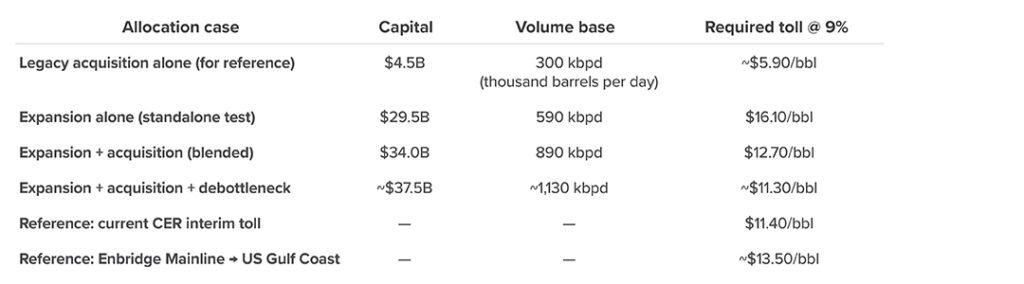
The table — a “ladder” that simply stacks four ways of assigning the system’s capital to the barrels that use it — tells three stories at once. The expansion on its own merits does not pencil — the legacy line cross-subsidizes its overruns at roughly $4.70 per barrel. The combined old-and-new system (“blended”) roughly works. And the proposed debottleneck — low-cost upgrades that remove chokepoints in the existing line — is the quiet star: some 240,000 barrels per day for $3–4 billion would bring the entire federal investment to cost recovery at today’s toll. The sunk losses sit elsewhere and the toll structure was never designed to recover them — the Parliamentary Budget Officer’s valuation puts the tolls’ present value at $29.6–33.4 billion against $34.2 billion spent (PBO 2024). And on July 7, after eighteen months of dispute, Trans Mountain filed a negotiated tolling settlement (Trans Mountain 2026): fifteen- and twenty-year commitments covering most contracted volumes, firm capacity rising to ninety per cent. Shippers will commit for decades, in writing, to operating pipe at negotiated market tolls. The dispute was never about willingness to pay for the pipe; it was about being asked to pay for the overruns.
The menu, and where firm commitment is actually going
The realistic alternatives are dramatically cheaper per barrel. Enbridge’s sanctioned Mainline optimization adds 250,000 barrels per day for about $1.9 billion; its second phase and a Trans Mountain debottleneck add similar volumes for $3–4 billion each; South Bow’s Prairie Connector adds 450,000 for $10–12 billion. Combined: over 1.1 million barrels per day of new egress for roughly $18–22 billion — less than the TMX expansion cost alone, for nearly double the capacity, all privately funded. Because these increments fold into existing toll structures, the all-in toll for an incremental barrel clusters at $11–15 regardless of route. And the market state shows where conviction lies: the first Mainline phase was sanctioned in November on long-term take-or-pay contracts (Enbridge 2025); the second is in binding “open seasons” — the industry’s standard auction, in which shippers bid long-term contracts for space; Trans Mountain’s own firm-contracting open season cleared this spring, with another launching this month for debottleneck capacity. Firm commitment is materializing — to the cheaper continental routes, and to the existing coastal line at market tolls. What no one has signed, anywhere, is a binding commitment to pay shipping fees set high enough to repay the cost of building an entirely new line.
The new line’s arithmetic
Apply the same disciplined methodology to the announced project and the required toll at the stated $35–44 billion is approximately $11.80–14.30 per barrel — toll-competitive with the Mainline’s $13.50 to the Gulf Coast. That finding cuts both ways: at the announced cost, the pipeline works commercially; the real debate is whether people should trust an early-stage cost estimate that is based on assumptions rather than a fully designed project. The companion analysis builds the more probable range from the ground up, applying the drivers that produced the TMX outcome: a base case near $60 billion, a fully loaded case near $80 billion, an adverse outcome approaching $100 billion. And a toll the market will not pay cannot be charged: with southbound alternatives at $13–15 all-in and the settled framework on the existing line, the market-clearing toll for a new coastal barrel is roughly $11. At that toll, net present value at the government’s own cost of capital is negative in every scenario:
Figure 2: What the pipeline would be worth to taxpayers under different construction-cost outcomes (net present value)
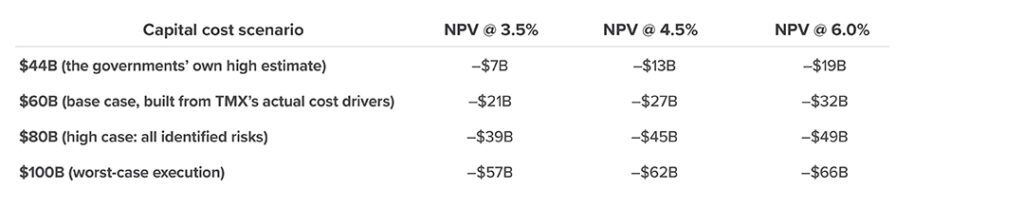
Assumptions: six-year construction; seven-year ramp-up of shipments to 950,000 barrels per day; 95 per cent utilisation to 2073; toll $11/bbl; operating costs $500M/yr. The sign survives tolls of $10–12, ramps of five to ten years, and discount rates of three to seven per cent.
A natural objection is that the government’s low cost of capital changes the economics. It is why the table already uses the Crown’s own rates rather than the higher return a private investor would demand — and the project is negative anyway; the interest bill during construction, the slow build-up of shipments, and the market-capped toll do damage no discount rate can undo. The deeper point is that the Crown borrows cheaply not because the risk vanished but because taxpayers absorb it involuntarily and uncompensated: risk transferred, not destroyed, which is why Treasury Board’s own guidance prescribes a higher social discount rate. And the argument proves too much — if cheap federal debt justified negative-return infrastructure, it would justify Ottawa building nearly everything. What the numbers say is precise: the project acquires positive value only if its non-financial goods — such as helping to preserve Canada’s sovereignty, or unify the country — are credited at $10–20 billion of present value at the announced cost, and $30–50 billion or more at the likely one — a range independently corroborated by separate economic analysis putting required government support at $19 billion to as much as $60 billion (St-Arnaud 2026). That would be a reasonable policy decision if the government openly admitted it was paying extra for broader public or strategic benefits and clearly state how much that extra cost was. It is not a commercial proposition, and presenting it as one is where the quarrel begins.
The hinge: incremental barrels, and only incremental barrels
Since the pipeline’s standalone economics are negative, its national value rests entirely on what it causes: production that would not otherwise exist. The discipline matters. Barrels merely diverted from the cheaper southern routes create no new value — they destroy some, moving on a worse-netback path. The southern expansions are not this project’s alternative; they are its baseline — superior economics, privately financed, proceeding regardless. The case is both-and, never either-or: the coastal line must be incremental to them, justified by a further tranche of growth beyond what fills them, plus whatever diversification is worth.
Independent arithmetic frames the gap: S&P Global expects roughly half a million barrels per day of Canadian growth over five to six years (Varcoe 2026) — which fits inside the cheaper capacity with room to spare — while the government’s own July 13 release concedes the framework exists to enable the production increase “necessary to filling” the new line. The barrels are not in the base; they must be purchased into existence. The inventory for the purchase genuinely exists — some 1.5 million barrels per day of named projects, most already approved by the regulator, all shelved (Chin 2026) — which sharpens rather than softens the test: geology and permits were never the constraint; the corporate decision to invest is the single missing act. And that exposes the awkward truth of timing: the project’s political moment may genuinely be now, but its economic sequence is out of order — southern expansions first, new project approvals second, the coastal line third, built when the second tranche is visible rather than hoped for. Politics has inverted the order.
On demand, epistemic humility is owed in both directions. I have lived through every cycle since the 1980s and not one was predicted; the 2003 consensus was “peak supply” — the belief that the world was running out of oil — and the US shale boom annihilated it; today’s reference outlooks disagree by twenty years on when demand crests. So, I do not claim demand plateaus, and I distrust anyone who claims to know it grows. The current year is no different from 2003 in what can be known. The differences lie elsewhere: the last boom’s overruns were rescued by an upside surprise no one forecast, and a plan cannot budget for a repeat of good luck; and the party exposed to being wrong has changed — shareholders chose that bet then; the taxpayer carries this one.
Uncertainty this deep is not an argument for the pipeline or against it. Instead, decisions should be based on real commitments from companies willing to risk their own money and on a staged process that gathers information before spending large sums. The strongest proponents and the staunchest opponents can make the same mistake if they claim they can predict the future with certainty.
Whose ledger?
The structure can leave Alberta better off while Canada carries the loss. Alberta’s ledger collects the royalty upside on any incremental barrels and pays little of the capital; the federal ledger supplies the Crown capital, absorbs the toll gap, and defers its own tax capture through accelerated write-offs. British Columbia’s ledger is the cleanest of all — the itemized price of its consent (LNG acceleration, the Massey Tunnel, and reportedly a per-barrel levy on throughput in federal jurisdiction) is all receipts and no exposure. And there is already talk of the exit: selling portions of the asset to the 125 Indigenous communities along the route, with a federal backstop (with Ottawa, and ultimately, taxpayers, still holding some of the risk if things go badly) conceded in parentheses. Indigenous equity participation deserves the highest regard — which is precisely why the arithmetic must be said aloud: a backstopped sale at cost does not transfer the exposure, it renames it — while scoring the transaction publicly as “reconciliation.” The honest version — equity at fair value, real upside, capacity built alongside ownership — requires marking the asset honestly first. Partnership means sharing value, not warehousing loss by asking one party to shoulder the financial risk.
The one thing that cannot lie
Through every layer of this file, there is one indicator that carries information that cannot be faked: creditworthy producers signing firm, long-term, take-or-pay commitments bearing genuine downside, at a toll honestly related to cost. None exist for this project. But the silence must be read carefully, because the reason is structure, not duplicity. The industrial carbon price and the Pathways commitment are real drags on the underlying economics; before any producer commits capital, the investment must clear an attractive risk-reward threshold, and past that threshold a company with alternatives will optimize among them. That is free enterprise doing what it should — these companies are fiduciaries, not villains. And the shareholders complete the picture: producers now return roughly twelve per cent of revenues to owners — five times the 2014 proportion — while reinvesting about twelve, down from nearly thirty a decade ago, and roughly three-quarters of those owners are non-Canadian (St-Arnaud, quoted in Chin 2026): an ownership base in dividend mode that is not asking for the growth this bargain assumes. It is the governments who painted themselves into the corner: once it was apparent neither Ottawa nor Alberta could tolerate another failed pipeline, no producer had reason to commit early, and every new route announced strengthens the optimizing hand.
History deepens the point. The oil producers in Western Canada never failed to coordinate: the market responded with strong long-term commitments — Trans Mountain’s expansion was oversubscribed with fifteen- and twenty-year commitments — and the cancelled lines carried real commercial backing. What broke was delivery: projects with cleared support could not get built through the political system, — Northern Gateway, Energy East, Keystone XL (Snyder and Taylor 2026) — and those lessons taught producers that a firm commitment to Canadian egress was a hostage to the next election. The signatures stopped because governments taught them to stop. Seen honestly, the Crown’s capital is not the state solving a market failure; it is the state self-insuring a risk of its own manufacture — the one risk only the federal government can bear. That is the most coherent theory of this ownership structure, and it is telling that the government has not claimed it, since claiming it would require admitting whose risk is being insured. It also yields the cleanest test: a government that trusted its own fixes — the new legislation, the Major Projects Office — would run an open season behind it. However, so far, none has been announced.
An asymmetry follows that I do not like: southbound capacity proceeds on pure free-enterprise terms while the westward alternative can exist only if the taxpayer funds it. That asymmetry is itself information — the market will build the route that deepens dependence on one customer and will not pay for the one that diversifies away from it. Whether the diversification is worth buying at public expense is a legitimate national question. It should be asked as that question, priced as that premium, and not dressed as a commercial proposition the market declined to make.
On July 13, Ottawa and Alberta announced a memorandum (Alberta 2026b) with the five-producer Oil Sands Alliance — a framework that will enable growth, incentives to be implemented, everything subject to the execution of definitive agreements. The announcement cited four milestones, but conspicuously absent were any commitments on barrels produced, dollars of producer capital invested, or firm dates for measuring progress. The step deserves honest credit — getting the right people to the table matters — but the tools needed to share information remain absent, and by the proponents’ own reported schedule the final investment decision does not come until 2028 or 2029: the certainty was announced five years before the commitment, safely past the looming Alberta independence referendum, the fall federal budget, and the pending producer agreements. The promised incentives also reveal a cycle worth measuring as a whole: the state will pay producers to grow the very production that fills the state’s pipeline, accept that the pipeline’s fees may never repay its cost, and finance the climate conditions attached to the project. Each step can be justified alone. The full cycle is where the harder questions begin.
The project isn’t the biggest problem — it’s the presentation
Everything above could have been said by the governments themselves — and the strangest part is that the honest version is more defensible than the one presented. “We are buying sovereignty insurance and federation cohesion at a price we will state, on a bet about production growth we will test through staged commitments, with off-ramps we will honour” is a speakable sentence, and a strong one. Instead, the public received a rough cost estimate based on a set of assumptions; certainty language wrapped around a conditional chain; a bundle in which the pipeline, the promised withdrawal of Ottawa’s proposed cap on oil and gas emissions, carbon pricing and Pathways justify one another without any leg being priced; and a schedule whose rational stage-gates — visible in the gap between “construction next year” and a 2029 investment decision — are built in but never described. Classical project management has an unforgiving triangle of cost, schedule, and quality: anchor the schedule in public while the estimate sits at concept maturity, and the strain goes to cost, quietly to scope. The political rhetoric that feeds the public appetite for speed will invariably intersect that window, with repercussions as predictable as they are unpriced.
The calendar explains what incompetence cannot: the Canada Investment Summit convenes in September (Ivison 2026), one month before Albertans vote on whether to begin the legal process that could lead to a binding referendum on leaving Canada, and the national-interest designation is expected right before the vote. The announcement’s first audience was never the shippers; it was the referendum. That is at once more charitable than this critique implies — holding the country together is a genuine emergency — and more damning, because it means the certainty was calibrated to a vote rather than to the truth. Even the project’s champions concede the point: The Globe and Mail’s editorial board, endorsing the project, wrote that the justifying benefits are political rather than fiscal (Globe and Mail 2026a); Alberta’s own commissioned economic analysis reportedly finding tens of billions in differential benefit has never been published; and the Globe’s Tony Keller, the project’s most prominent editorial advocate, moved within eleven days from “build it and the oil will come” to “if this one condition is met” (Keller 2026a; 2026b). The discourse is correcting itself toward the form the announcement should have taken.
One smaller specimen completes the picture. The province’s companion growth estimate — a boost of 0.7 per cent of GDP by the 2040s — was rendered in the same endorsing editorial as roughly $232 billion a year, some ten times what that percentage computes to on current GDP, and it passed the country’s flagship opinion page unexamined. The habit of not checking is part of what this piece is about.
And on July 21 came the sharpest exhibit of all. The US ambassador disclosed that, at the White House last October, Prime Minister Mark Carney offered to ship three to four million additional barrels of oil per day to the United States as part of a preliminary trade agreement — roughly doubling the volume flowing south (Globe and Mail 2026b). Set that against Alberta’s stated goal of growing production from 4.8 to 8 million barrels per day and the numbers align: the growth wave and the trade offer are the same barrels. The referendum audience hears independence from a single customer; Washington hears deeper supply; the same production program is sold as each. The second door to Asia is real — but it is the side door on a house whose front door is being widened, and the case for it deserves to be stated that way.
As Macdonald-Laurier Institute Energy Director Heather Exner-Pirot (2026) observed within days of the announcement, the politics may be ahead of the economics — offered cheerfully, as the welcome inverse of a decade in which the economics had to drag the politics along. The description is exactly right and deserves more weight than the celebration gives it: the gap between political will and commercial commitment has not closed; it has changed sign, and by the one test that cannot be gamed, it has not been closed by capital. A politics ahead of its economics is not an achievement to bank. It is an exposure to manage. And the abundance of proposals — five or more concepts alive at once — has accomplished something real, moving the national default from we do not build to of course we build; but announcements are promises, and a rational portfolio will not honour them all. Unless someone finds the courage to describe the funnel as a funnel, the sensible attrition ahead will be read as another generation of broken promises — and the disappointment will land on the country’s belief in its own capacity to build, re-arming the very paralysis this abundance was meant to end. Overpromising does not merely risk under-delivery; it defines delivery as failure in advance.
Of course, none of this is easy. Conveying genuine uncertainty to a public conditioned to expect certainty is among the hardest tasks in democratic communication. But truth is essential, however it lands, because trust is the keystone of our society — and trustworthiness suffers every time truth is denied. Every simplification sold today as certainty becomes tomorrow’s deception to manage, and the managing compounds, until the web itself is the policy.
What to watch
The virtue of stating a case this way is that it can be checked — and a veil, unlike a vault, can be lifted. Four public tells will do the lifting within the next two years:
- The definitive agreements with producers: Do they ever contain volumes, terms, dates and genuine downside?
- The fall budget’s production incentives: Are they priced, and is the fiscal circle acknowledged?
- An open season for the new line: Is one ever run behind the government’s repaired delivery system, as the mechanism demonstrably still works on the existing one?
- The 2028–29 investment decision: Do the stage-gates quietly built into the schedule turn out to be real gates that can be failed, or ceremonies that cannot?
Canadians would genuinely welcome — and indeed, deserve — being answered. A defensible bet, named as a bet, staged and priced and honestly described, would be something this country has not seen in a generation: nation-building conducted in the language of adults. The pipeline may well deserve to be built. The case for it deserves to be made.
About the author
Bryan Gould is the founder and executive chair of Aspenleaf Energy Limited, a Calgary-based conventional oil producer, and a director of the Macdonald-Laurier Institute. This commentary is adapted from a longer analytical note published by the author in July 2026..
References
Canada–Alberta Memorandum of Understanding (November 2025) and Implementation Agreement (May 2026); Canada–British Columbia agreement and backgrounder (July 2026)
Chin, Falice. 2026. “8 Burning Questions About Alberta’s Pathways Deal and the Future of the Oilsands.” The Hub, July 20. Available at https://thehub.ca/2026/07/20/8-burning-questions-about-albertas-pathways-deal-and-the-future-of-the-oilsands/.
Ebel, Greg. 2026. “In the Money with Amber Kanwar.” Live episode at the Calgary Stampede, July. Available at https://podcastaddict.com/episode/https%3A%2F%2Fmedia.transistor.fm%2F94e4a1cb%2Fa95479e0.mp3&podcastId=5603457.
Enbridge Inc. 2025. “Enbridge Adding Canadian Egress to Key U.S. Refining Markets, Enhancing North American Energy Security.” News release, November 14. Available at https://www.enbridge.com/media-center/news/details?id=123867&lang=en
Exner-Pirot, Heather. 2026. “Canada Is Finally Embracing Its Energy Potential.” The Hub, July 10. Available at https://macdonaldlaurier.ca/canada-is-finally-embracing-its-energy-potential-heather-exner-pirot-in-the-hub/.
Government of Alberta. 2026a. “West Coast Oil Pipeline Project: Submission to the Major Projects Office.” July 2. Available at https://open.alberta.ca/dataset/a529e3da-6368-43d7-af43-74b1773be517/resource/6e43e4b4-3dfe-4c28-b723-116b6cab19ea/download/west-coast-oil-pipeline-project-submission-to-mpo.pdf.
Government of Alberta. 2026b. “Major Milestone for Oilsands Production and Pathways.” News release, July 13. Available at https://ebs.publicnow.com/view/B2707596DC7F5AC15146F9E2B8084671B9600E98.
IEEFA (Institute for Energy Economics and Financial Analysis). 2025. “Canada Should Learn from the Trans Mountain Expansion Pipeline’s Fiscal Issues.” Report by Mark Kalegha and Suzanne Mattei, September 16. Available at https://ieefa.org/resources/canada-should-learn-trans-mountain-expansion-pipelines-fiscal-issues
Ivison, John. 2026. “Carney’s Oil Patch Wishes Might Really Come True.” National Post, July 8. Available at https://nationalpost.com/opinion/john-ivison-carneys-oil-patch-wishes-might-really-come-true.
Keller, Tony. 2026a. “Should Taxpayers Build an Oil Pipeline to the Pacific? Yes.” The Globe and Mail, July 6. Available at https://www.theglobeandmail.com/business/commentary/article-taxpayers-build-west-coast-oil-pipeline-pacific/.
Keller, Tony. 2026b. “Math Don’t Lie: If This One Condition Is Met, a New Pacific Pipeline Will Be a Winner — for Taxpayers.” The Globe and Mail, July 13. Available at https://www.theglobeandmail.com/business/commentary/article-government-investments-why-pipeline-to-the-pacific-is-different/.
PBO (Office of the Parliamentary Budget Officer). 2024. “Trans Mountain Corporation: Valuation Update.” November. Available at https://publications.gc.ca/collections/collection_2024/dpb-pbo/YN5-292-2024-eng.pdf.
Snieckus, Darius. 2026. “Flagship $20B-plus carbon capture project lowered goals in Ottawa-Alberta oilsands deal.” Canada’s National Observer, May 20. https://www.nationalobserver.com/2026/05/20/news/flagship-20b-plus-carbon-capture-project-lowered-goals-ottawa-alberta-oilsands-deal.
Snyder, Jesse, and Stephanie Taylor. 2026. “Carney Was Iffy on a Pipeline. Now His Government’s Building One Itself.” National Post, July 16. Available at https://nationalpost.com/news/carney-was-iffy-on-a-pipeline-now-his-governments-building-one-itself-heres-what-changed-his-mind.
St-Arnaud, Charles. 2025. “Year One of TMX: Increased Export Diversification, Disappearing Oil Discount, and C$13bn in Extra Revenues.” Alberta Central. Available at https://albertacentral.com/intelligence-centre/economic-news/year-one-of-tmx-increased-export-diversification-disappearing-oil-discount-and-c13bn-in-extra-revenues/
St-Arnaud, Charles. 2026. “Commentary: A Successful MoU Will Require Tens of Billions in Government Support.” Alberta Central, via EnergyNow. Available at https://energynow.ca/2026/05/commentary-a-successful-mou-will-require-tens-of-billions-in-government-support/
The Globe and Mail. 2026a. “The Ends of the Pacific Pipeline Justify the Path.” Editorial, July. Available at https://www.theglobeandmail.com/opinion/editorials/article-the-ends-of-the-pacific-pipeline-justify-the-path/.
The Globe and Mail. 2026b. “Carney Offered to Double Oil Exports to U.S. as Part of Potential Deal, Hoekstra Says.” July 21. Available at https://www.theglobeandmail.com/world/us-politics/article-carney-offered-to-double-oil-exports-to-us-as-part-of-potential-deal/.
Trans Mountain Corporation. 2026. “Trans Mountain Files Negotiated Tolling Settlement Agreement with Shippers.” News release, July 7. Available at https://www.transmountain.com/news/trans-mountain-reaches-settlement-agreement-with-shippers.
Varcoe, Chris. 2026. “Pipelines Aplenty, but More Alberta Oil Production Needed to Fill Them.” Calgary Herald, July 6. Available at https://calgaryherald.com/opinion/columnists/varcoe-more-alberta-oil-production-needed-fill-pipelines-aplenty
Oil Industry & Pipeline Economics Lexicon [1]
All-in toll
The total cost per barrel to transport oil through a pipeline, including all applicable fees.
Apportioned pipeline / pipeline apportionment
A pipeline operating at full capacity where customers cannot ship all the oil they want because demand exceeds available space. Each shipper receives only a percentage of the capacity they requested.
Asset ownership transfer
The sale or transfer of ownership of an infrastructure asset, such as a pipeline, to another party.
Base case
The scenario considered most likely when estimating a project’s costs, revenues, and financial performance.
Base production forecast
The expected level of oil production without including the impact of a new project.
Benchmark price
A reference oil price used to determine the value of other crude oils. Examples include WTI and Brent.
Basin
A large underground geological area where oil and gas deposits are found.
Basin-wide market claim
A claim that applies to an entire oil-producing region rather than only one company or one project.
Binding open season
A pipeline capacity bidding process where companies make legally enforceable commitments to use and pay for pipeline space.
Blended project
A financial analysis that combines multiple parts of a project together, such as an existing pipeline and a new expansion.
Bottom-up estimate
A cost estimate created by adding up individual costs such as labour, materials, equipment, engineering, and construction requirements.
Brent crude / Brent-world market
A global oil pricing system based on Brent crude, one of the world’s major benchmark oil prices.
Buyer discipline
The negotiating advantage created when producers have multiple customers or markets available rather than being dependent on one buyer.
Canada Energy Regulator
Canada’s federal regulator for interprovincial and international pipelines, power lines, and energy trade.
Captive inland market
A market where producers have limited access to buyers because geography or transportation limitations restrict their options.
Commercial commitment
A real financial commitment from companies, usually through contracts or invested capital, rather than a public statement of support.
Congestion premium
The additional price discount that appears when pipeline space runs short — called a ‘premium’ because it is the extra amount, on top of quality and transport costs, that congestion adds. It disappears when adequate capacity exists.
Conventional oil company
An oil company that produces oil using traditional drilling methods rather than specialized extraction methods such as oil sands mining.
Contracted volume
The amount of oil a company has legally agreed to ship through a pipeline.
Creditworthy producer
An oil company considered financially strong enough that lenders, investors, and pipeline companies trust it can meet its financial commitments.
Crude differential / oil differential
The difference in price between two types of crude oil. Example: the difference between Western Canadian Select (WCS) and West Texas Intermediate (WTI).
Debottleneck / debottlenecking
Increasing the capacity of an existing pipeline or infrastructure system by removing limitations. This is usually done through upgrades such as adding pumps, improving equipment, or modifying operations rather than building a completely new pipeline.
Definitive agreements
Final legally binding contracts that specify exact obligations, payment terms, volumes, timelines, and responsibilities.
Decline rate
The rate at which an oil well’s production decreases over time after production begins.
Demand plateau / demand crest
The point where global oil demand stops increasing and levels off or begins declining.
Differential / crude differential
The difference between the price of one type of crude oil and another benchmark crude price. Example: Western Canadian Select (WCS) compared with West Texas Intermediate (WTI). A wider differential means Canadian producers receive a larger discount compared with the US benchmark.
Differential narrowing
A reduction in the price gap between Canadian crude and benchmark crude prices.
Discount rate
The rate used to convert future financial benefits or costs into their value today. It reflects factors such as risk, inflation, and the value of money over time.
Egress
The ability to move oil out of a producing region to refineries, storage facilities, or export markets.
Egress capacity
The total amount of oil that can leave a producing region through pipelines, rail, or other transportation systems.
Execution environment
The practical conditions that determine how easily and cheaply a major project can be built, including regulations, permitting, labour availability, construction conditions, and political stability.
Execution-environment gap
The difference between regions or countries in their ability to successfully complete large infrastructure projects.
FID (Final Investment Decision)
The formal decision by a company or project owner to proceed with major spending after evaluating costs, risks, contracts, and expected returns. Before FID, a project is being studied. After FID, major capital is committed.
Firm capacity
Pipeline capacity that is guaranteed to a customer through a contract.
Firm commitment
A legally binding promise by a company to use and pay for pipeline capacity.
Firm contracting
The process of securing long-term customer agreements before building or expanding infrastructure.
Heavy crude
Crude oil that is dense and thick. It generally requires more processing in a refinery and usually sells at a discount compared with lighter crude.
Hurdle rate
The minimum financial return an investor requires before deciding that a project is worth funding.
Incremental barrels
New barrels of oil production that would not exist without a particular project. This is a key concept in pipeline economics because moving existing oil through a new route does not necessarily create new economic value.
Incremental production growth
Additional oil production above current levels.
Industrial carbon price
A carbon pricing system applied to large industrial emitters, creating an additional operating cost for companies.
Interim toll
A temporary processing fee charged for transporting, handling, or refining petroleum products until a final, approved, or negotiated toll rate is established.
kbpd (thousand barrels per day)
A measurement used for oil production and pipeline capacity.
Light crude
Crude oil that is less dense and generally easier and cheaper to refine than heavy crude.
Major Projects Office
The new federal government office responsible for reviewing, coordinating, and supporting major infrastructure projects.
Market-clearing toll
The highest transportation fee that customers will accept before choosing another route or alternative.
Market toll
A pipeline fee determined through negotiation with customers and market conditions rather than government subsidy.
Netback
The amount of money an oil producer actually receives after subtracting transportation costs, quality discounts, and other expenses from the market price. Example: Oil price − pipeline toll − other costs = producer netback.
NPV (Net Present Value)
A financial calculation that determines whether a project creates or destroys value. A positive NPV means expected benefits exceed costs. A negative NPV means the project is expected to lose money financially.
Open season
A formal pipeline industry process where potential customers commit to using and paying for pipeline capacity before a project is built. An open season is essentially a market test: it asks, “Will companies actually sign contracts and pay for this infrastructure?”
Oversubscribed pipeline
A pipeline where demand for transportation capacity exceeds the available capacity. The term also applies to an open season when shipper commitments exceed the capacity being offered.
Pathways commitment
A reference to the Canadian oil industry’s emissions-reduction initiative, the Pathways Alliance, focused on lowering greenhouse gas emissions through technology and investment.
Pipeline bottleneck
A situation where transportation capacity is insufficient to move all available oil production to markets.
Pipeline optimization
Improving an existing pipeline system to increase capacity or efficiency without building an entirely new pipeline. Examples include adding pumps, removing operational constraints, or upgrading equipment.
Pipeline toll
The fee charged to companies for transporting oil through a pipeline.
Pipeline toll structure
The system used to determine how pipeline fees are calculated and allocated among users.
Production curtailment
A deliberate reduction in oil production, usually used to manage oversupply, transportation constraints, or market conditions.
Quality discount
A lower price applied to crude oil because of characteristics that make it less valuable or more expensive to process. Examples:
- Heavy crude receives a discount compared with light crude.
- Sour crude receives a discount compared with sweet crude.
Quality floor
The minimum discount caused by the physical characteristics of crude oil itself after transportation problems have been removed.
Ramp / ramp period
The period when a new project gradually increases production or usage after beginning operations. A pipeline may be designed for one million barrels per day but take years to reach that level.
Ramp to capacity
The process of increasing pipeline usage until it reaches its intended operating volume.
Real commitment
A measurable financial promise, such as a signed contract or investment, rather than a public announcement or expression of support.
Reference outlook
A published forecast used as a benchmark for future expectations about energy demand, prices, or production.
Refinery gate
The point where crude oil arrives at a refinery and is valued before being processed into fuel products.
Royalty upside
Additional government revenue generated when oil production increases and royalty payments rise.
Sour crude
Crude oil with relatively high sulphur content. It requires more complex and expensive refining than sweet crude.
Stage-gates
Decision points built into a major project where leaders review progress and decide whether to continue, modify, delay, or cancel the project.
Take-or-pay contract
A contract requiring a customer to pay for reserved pipeline capacity whether or not they actually use it. This provides revenue certainty for pipeline owners.
Takeaway capacity
The ability of a producing region to transport oil away to refineries, storage facilities, or export markets.
Throughput
The amount of oil moved through a pipeline, terminal, or processing facility over a specific period. Example: A pipeline’s throughput may be measured in barrels per day.
Toll structure
The rules and pricing system used to determine pipeline transportation fees.
Transport component
The portion of the difference between two oil prices caused by the cost of moving oil from one location to another.
Tranche of growth
A specific portion or stage of future production growth. The first tranche of growth might fill existing pipelines; a second tranche might justify new infrastructure.
Upstream
The part of the oil industry involved in finding and producing oil and gas. Includes:
- exploration
- drilling
- extraction
- production
Utilization rate
The percentage of available capacity that is actually being used. Example:
A pipeline operating at 90 per cent utilization is using 90 per cent of its available capacity.
VLCC (Very Large Crude Carrier)
A very large oil tanker capable of carrying roughly two million barrels of crude oil. Ports must have sufficient depth and infrastructure to load these ships.
WCS (Western Canadian Select)
A benchmark price for Canadian heavy crude oil. It reflects the value of a common blend of Canadian oil after accounting for quality and transportation factors.
WTI (West Texas Intermediate)
A major North American benchmark crude oil price used as a reference for oil markets.