By Avideh Motmaen-Far, June 29, 2026
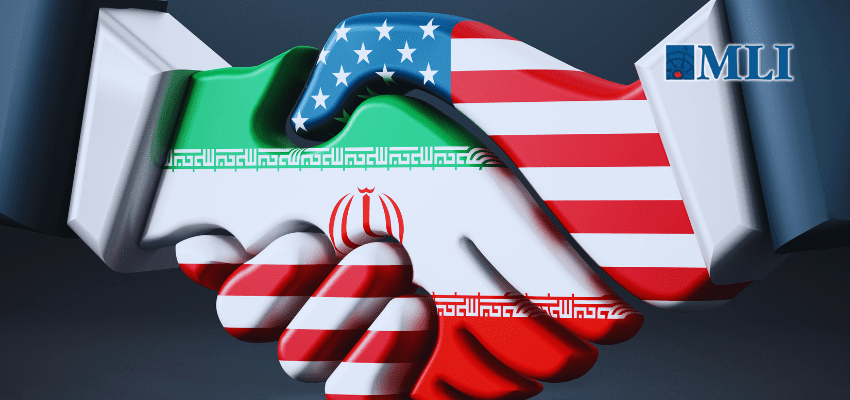
The talks were going well, everyone said — yet the two sides could not even agree on what they had agreed to, and within days they were trading fire. After the first round of US–Iran negotiations at a Swiss resort last week, mediators announced a “roadmap” to a final deal within sixty days, and Washington waived sanctions on Iranian oil.
Then the accounts split.
US Vice-President JD Vance said Iran had agreed to readmit UN nuclear inspectors — “the first step in permanently” ending its weapons program. Within a day, Tehran said there was “no clear schedule” for any such thing. Iran’s chief negotiator, parliament speaker Mohammad Bagher Ghalibaf, announced that $12 billion in frozen assets had been freed for Tehran to spend “with absolute liberty”; Washington said the money sits in a US-controlled escrow to buy American grain. And after President Donald Trump threatened to “hit Iran very hard again,” Ghalibaf delivered his own message: “No matter what they say, we are the ones who act.”
He was not posturing. In the days after those talks, the threats turned to fire. On June 26, US forces struck Iranian missile and radar sites — the first American strikes since the ceasefire was extended — after Revolutionary Guard drones had hit a cargo ship in the Strait of Hormuz to enforce Tehran’s claim that it alone governs the waterway. Iran escalated rather than retreated: a second drone strike on a loaded oil tanker, a second round of US strikes on June 27, and then, on June 28, Iranian missiles and drones against American bases in Kuwait and Bahrain, drawing condemnation from across the Gulf, where Qatar reported one of its own citizens killed by shrapnel. Tehran now threatens a “complete halt” to the talks it signed days ago. Trump himself has abandoned the word: there “may come a point,” he wrote, “when we are no longer able to be reasonable,” after which the Islamic Republic “will no longer exist.” The roadmap was barely a week old.
This is the man Trump calls “the most respected” figure in Tehran, the one Washington is counting on to be reasonable. He is not. On the first real questions — inspectors, money — the reasonable man’s government is already denying what Washington believes it bought, even as its negotiator threatens. “Reasonable” is doing the heaviest lifting in this diplomacy, and it is a trap — one history has sprung before. The case against it is not speculation about Ghalibaf’s intentions. It is his own record, much of it in his own voice.
A résumé written in other people’s blood
Ghalibaf joined the Islamic Revolutionary Guard Corps in 1980, commanded units in the Iran–Iraq war, and rose to lead the IRGC’s air force by 1997. In July 1999, when students at Tehran University mounted the largest protests the Islamic Republic had yet seen, the state answered with batons and bullets: several killed, hundreds wounded, thousands arrested. Ghalibaf was no bystander. In a recording that later surfaced, he bragged that the notorious letter in which IRGC commanders threatened reformist President Khatami — warning they would act on their own if he did not crush the students — was his and Qasem Soleimani’s. Then he went further: “Photographs of me are available,” he said, “showing me on the back of a motorbike … beating the protesters with wooden sticks … I was among those carrying out beatings on the street level, and I am proud of that.”
I am proud of that. That is not a man who privately doubted the system he served. It is a man who offers the beating of unarmed students as a credential. Khamenei understood the value of such a man and made him national police chief from 2000 to 2005. When students rose again in 2003, Ghalibaf was, by his own boast, in the room arguing for force and ordering police to open fire.
His twelve years as mayor of Tehran produced the metros and tunnels he still campaigns on — and what Iranians call “the astronomical corruption” of the municipality: more than a million square metres of public property funnelled to insiders and IRGC-linked entities at fire-sale prices. The scandal jailed his deputy for twenty years while he walked free. As speaker, he has perfected the technocrat’s final art: sounding moderate. After the 2022 Woman, Life, Freedom uprising that followed the killing of Mahsa Amini, he mused that the hijab law might be enforced “more softly,” then shepherded one of the Republic’s most punitive veiling laws into force. The soft word, the hard law. That is the whole man.
The Speer trap
History has met this figure before. Albert Speer was Hitler’s architect and armaments minister — the technocrat who kept the war machine running. At Nuremberg, while the true believers raged, Speer did something cleverer. He performed reasonableness. He cast himself as the apolitical professional who accepted vague “general responsibility” while disclaiming the specifics. It worked. He escaped the gallows, served twenty years, and dined out for decades as “the good Nazi,” the one the West could talk to — until historians and his own records exposed the act and a man complicit to the marrow in slave labour and deportation. The contrition was strategy. The reasonableness was camouflage.
That is the trap. The most dangerous figure in an ideological dictatorship is rarely the one who looks the part. It is the competent administrator who makes the machinery work, and who knows that a measured tone is the best solvent for an adversary’s resolve. Ghalibaf is Tehran’s Speer: the pilot, the manager, the builder of metros who can sit at a table and lend the regime a human face. When Trump calls him “the most respected,” he recites Speer’s old verdict almost word for word.
The comparison must be made carefully. The Nazi state’s crimes were genocidal on a scale Ghalibaf has not approached, and the analogy is to an archetype, not an equivalence. But on one axis it flatters him. Speer at least feigned remorse. Ghalibaf is proud. We are being asked to extend to an unrepentant man the credulity a repentant one did not deserve.
Why this is Canada’s problem
Here the Canadian stake is sharper than the American one. On June 19, 2024, the Government of Canada listed the Islamic Revolutionary Guard Corps as a terrorist entity under the Criminal Code. Ghalibaf is a former senior IRGC commander and the Guard’s one-time enforcer-in-chief. Put plainly: the man Washington calls “respected,” Canadian law treats as a leader of a terrorist organization. No diplomatic phrasing dissolves that.
Canadians have already paid the IRGC’s price in blood. On January 8, 2020, IRGC crews shot down Ukraine International Airlines Flight PS752 minutes after take-off from Tehran, killing all 176 aboard — among them 55 Canadian citizens and 30 permanent residents. Ottawa is still pursuing accountability at the International Court of Justice. The same organization Ghalibaf helped command killed scores of people tied to this country and has never faced a reckoning. When Canada acted, Tehran answered with contempt, branding the Royal Canadian Navy a “terrorist organization” in retaliation for the listing. This is the regime now repackaged as a partner one can reason with.
Canada is also home to one of the world’s largest Iranian diasporas, and that community lives under the long arm of the same security state — surveilled and intimidated on Canadian soil. The work is carried out by the IRGC’s intelligence arm and Iran’s Ministry of Intelligence and Security, often through criminal proxies; CSIS has confirmed credible death threats here — former federal justice minister Irwin Cotler was the target of an Iranian assassination plot — and scholars who track transnational repression warn it is intensifying against Iranian-Canadians. For these Canadians, “Ghalibaf the reasonable” is no abstraction. He is the man who wrote the threatening letter, swung the stick, and ordered the volley.

There is no reasonable man in that building
The deeper error is to think the problem is Ghalibaf alone — that a better interlocutor might be trusted. There is none. The Islamic Republic does not merely contain hardliners; it is built to select for them. The recent war hardened it further. In June 2025, Israeli strikes killed much of the senior military leadership — IRGC commander Hossein Salami, armed forces chief Mohammad Bagheri, and others. Consider the replacements: By March 2026 the Guard was handed to Ahmad Vahidi, a hardliner even by the standards of those he succeeded, and a man wanted by Interpol over the 1994 AMIA bombing in Buenos Aires that killed 85 people. This is the upgrade. The generation rising behind the dead is harder, younger, and convinced their elders erred only in insufficient ruthlessness. The reflex Ghalibaf showed at Bürgenstock — answering Trump’s threats with threats of his own, even as the cameras rolled — is not bluster he has been talked out of; within days it had hardened into drones and missiles across the Gulf. It is the settled worldview of the survivors, voiced by its most presentable member.
What Canada should do
Canada cannot dictate Washington’s diplomacy. But it can decline to follow the United States into rehabilitating a man its own law treats as a terrorist leader, and it can act on the distinct interests of Canadians. Four steps follow:
- Hold the line on the IRGC listing. Whatever emerges from Switzerland, the terrorist designation must not become a bargaining chip. It reflects a documented record, not a diplomatic mood. Reversing it to smooth a deal Canada did not negotiate would betray the PS752 families and the diaspora alike.
- Sanction Ghalibaf by name. Canada has imposed eighteen rounds of measures on roughly 200 Iranian individuals and 250 entities under the Special Economic Measures Act and the Magnitsky-style Justice for Victims of Corrupt Foreign Officials Act. A self-confessed perpetrator of violent repression, and the central figure in a vast corruption scandal, is a textbook candidate for personal designation. His title as negotiator is not a shield; it is a reason.
- Make any relief conditional and verifiable. If allied pressure eases as part of a settlement, Canada should tie relief to verifiable, irreversible behaviour — on weapons, on transnational repression, on the treatment of dissidents — never to assurances from men who are, this week, denying assurances they gave days ago.
- Protect the diaspora and pursue PS752 to judgment. Ottawa should sharpen its tools against transnational repression at home and press the ICJ case to its end. Accountability for the murder of Canadians is not a favour to be traded away in a thaw.
There is no version of reality in which Mohammad Bagher Ghalibaf — or anyone the Islamic Republic elevates to that table — earns Canada’s trust. One can sign agreements with regimes one does not trust; sometimes one must. But “reasonable” smuggles in something diplomacy never requires: belief. The men who beat students and were proud of it, who looted a city and walked free, who promised “soft” enforcement and delivered iron, have told us on tape exactly who they are. Albert Speer fooled a generation by pretending to be ashamed. Ghalibaf is not even pretending. Canada, of all countries, has been given too many reasons to know better.
Avideh Motmaen-Far is an Iranian-Canadian writer and commentator on Iran and Middle East policy.