By Ryan Manucha and Joe Noss
May 6, 2026
Executive Summary | Sommaire (le français suit)
Canada’s declining productivity and weak competitiveness are increasingly tied to structural barriers that limit competition in domestic markets.
One of the most consequential – and overlooked – of these barriers lies in public procurement. Accounting for 13.4 per cent of GDP, or roughly $350 billion annually – government purchasing should exert strong downward pressure on costs and expand opportunities for firms. Instead, transparency failures and fragmented systems are inflating public spending and restricting access to government contracts.
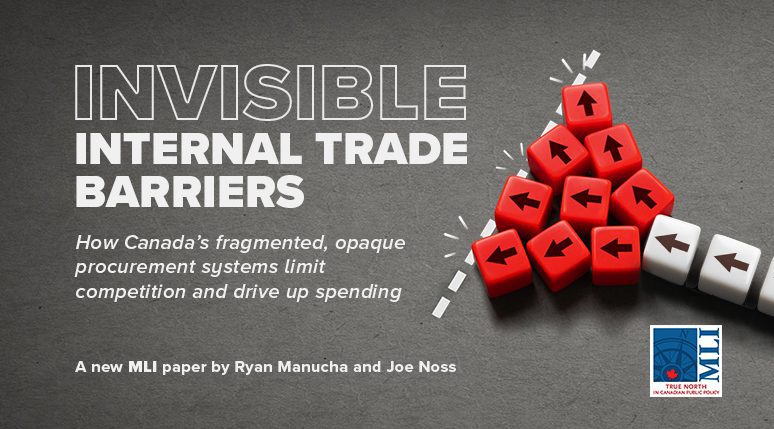
The evidence is clear: when procurement processes are opaque or difficult to manage, fewer firms participate and prices rise. In Canada, these effects are amplified by inconsistent disclosure practices and the absence of a coherent national approach. Fourteen separate procurement systems – each with its own platform, standards, and rules – impose unnecessary burdens, discourage new entrants, and entrench incumbents. The result is weaker competition, higher public expenditures, and reduced innovation.
These inefficiencies have taken on greater urgency amid efforts to strengthen Canada’s economic resilience. In 2025, an outpouring of interprovincial collaboration emerged in Canada in response to US President Donald Trump’s overhaul of the global trading system. While governments moved to reduce visible trade barriers, less attention has been paid to embedded constraints within procurement systems. Reform must extend to these less visible barriers.
Current procurement practices often function as de facto internal trade barriers. Protectionism in procurement can anoint industrial winners and losers without regard to merit, with outsized consequences for the economy’s competitiveness.
Transparency and disclosure are central to addressing this problem. When governments fail to publish clear, accessible procurement information, fewer firms bid and prices rise – imposing a direct fiscal burden on taxpayers.
To assess the adherence of Canada’s federal, provincial, and territorial governments to their procurement transparency obligations under the Canadian Free Trade Agreement, we developed a scoring framework for four key areas: ease of use, data quality, coverage, and accessibility.
The results reveal stark variation, ranging from world-class open data practices to systems that barely meet the threshold of meaningful disclosure. Nova Scotia, Quebec, British Columbia, and the federal government are highly compliant. New Brunswick, Manitoba, and Yukon are in weak compliance. The remaining provinces and territories fall in between.
A few serious problems must be addressed:
• Several provinces store public procurement data on privately owned platforms, effectively outsourcing transparency to entities that control access without democratic accountability. Any credible transparency framework must require data portability and open access.
• Pre-qualified vendor lists, used to streamline routine purchasing, often operate with minimal disclosure. Contracts awarded through these channels are frequently invisible, reinforcing closed networks and weakening competitive pressure.
• Fragmentation remains a core problem. Firms must navigate 14 portals with different formats, rules, and systems, incurring significant administrative and legal overhead that adds no productive value.
We offer specific remedial recommendations for each government and propose three system-level reforms:
• Establish a common procurement data standard.
• Create a Canadian “procurement passport” that enables firms that establish financial standing, regulatory compliance, and technical qualifications in one province to port those credentials into procurement processes in other jurisdictions.
• Provide a genuine single point of access.
The European Union provides a useful benchmark. Through its Tenders Electronic Daily portal and the European Single Procurement Document, it has built a far more transparent and interoperable system. Canada remains fragmented, rewarding incumbency and obscuring opportunity.
Canadians are currently incurring billions of dollars in avoidable costs. The reforms proposed here are achievable, require no amendments to the CFTA, and are grounded in proven models. They would reduce spending, expand market access for firms of all sizes, strengthen accountability, and support more effective, data-driven procurement.
Without action, these costs will continue to compound. Canada will entrench a fragmented, opaque system that weakens competition, limits opportunity, and drives higher spending at a time when Canadians can least afford it.
Les barrières structurelles qui entravent la concurrence sur le marché intérieur nuisent de plus en plus à la productivité et la compétitivité du Canada.
Un des défis majeurs – fréquemment sous-estimé – réside dans l’approvisionnement public. Comptant pour 13,4 % du PIB, soit environ 350 milliards de dollars par an, les achats gouvernementaux devraient fortement réduire les coûts et élargir les débouchés pour les entreprises. Or, le manque de transparence et la fragmentation des systèmes gonflent les dépenses publiques tout en limitant l’accès aux contrats.
Les preuves sont claires : l’opacité et l’ingouvernabilité des processus de passation des marchés nuisent à la participation des entreprises et augmentent les prix. Ces effets sont amplifiés par des pratiques de divulgation incohérentes et l’absence d’une approche nationale unifiée. Quatorze systèmes distincts – avec leurs propres plateformes, normes et règles – imposent des contraintes inutiles, découragent les nouveaux entrants et favorisent les opérateurs établis. Il en résulte une concurrence affaiblie, des dépenses publiques plus élevées et moins d’innovation.
Ces inefficacités exigent une action immédiate, alors que l’on s’efforce de solidifier la résilience économique du Canada. En 2025, une vague de coopération interprovinciale a pris forme en réponse à la révision complète du système commercial international par le président américain Donald Trump. Les gouvernements ont réagi en abaissant les barrières commerciales visibles, mais ont négligé les contraintes inhérentes aux systèmes d’approvisionnement. La réforme doit englober ces barrières cachées.
Les pratiques d’approvisionnement actuelles font souvent office de barrières commerciales internes. Ce type de protectionnisme peut favoriser certains secteurs industriels sans considération du mérite, ce qui a des conséquences disproportionnées sur la compétitivité.
Surmonter ces obstacles requiert transparence et divulgation stricte. Lorsque les gouvernements ne fournissent pas d’informations claires et accessibles sur les marchés publics, moins d’entreprises présentent des soumissions et les coûts grimpent, d’où une imposition directe pour les contribuables.
Dans ce contexte, pour évaluer la conformité des divers paliers de gouvernement à leurs obligations de transparence aux termes de l’Accord de libre-échange canadien (ALEC), nous avons conçu un système de notation fondé sur quatre piliers : la convivialité, la qualité des données, le champ d’application et l’accessibilité.
Les résultats révèlent des écarts considérables, allant de pratiques exemplaires en matière de données ouvertes à des systèmes de divulgation à peine adéquats. La Nouvelle-Écosse, le Québec, la Colombie-Britannique et le gouvernement fédéral sont tout à fait conformes. Le Nouveau-Brunswick, le Manitoba et le Yukon le sont moins. Le reste des provinces et territoires se situent entre les deux.
Quelques problèmes graves doivent être résolus :
• Plusieurs provinces entreposent les données sur des plateformes privées, externalisant de fait la transparence à des entités qui contrôlent l’accès sans reddition de comptes. Tout système transparent crédible doit permettre la portabilité des données et un accès ouvert.
• Les listes de fournisseurs préqualifiés, souvent soustraits à des exigences de divulgation minimales, sont utilisées pour simplifier les achats courants. Les contrats attribués via ces canaux sont fréquemment invisibles, ce qui renforce le cloisonnement des réseaux et nuit à la concurrence.
• La fragmentation persiste. Les entreprises doivent composer avec 14 portails comportant des formats, des règles et des systèmes différents, ce qui entraîne d’importants frais administratifs et légaux sans valeur ajoutée.
Nous offrons des recommandations précises pour chaque gouvernement et proposons trois réformes à l’échelle du système :
• L’établissement d’une norme commune pour les données dans le domaine de l’approvisionnement.
• La création d’un « passeport » canadien qui permet aux entreprises à solvabilité financière, conformité réglementaire et qualifications techniques reconnues dans une province de transférer leurs accréditations ailleurs au pays.
• La présence d’un véritable point d’accès unique.
L’Union européenne offre un modèle utile. Grâce à son portail TED (Supplément au Journal officiel de l’UE) et au DUME (Document unique de marché européen), elle a mis en place un système bien plus transparent et interopérable. Le Canada reste fragmenté : il privilégie les opérateurs établis et obscurcit les possibilités.
Les Canadiennes et Canadiens supportent des coûts évitables de plusieurs milliards de dollars. Les réformes proposées sont réalisables sans modifier l’ALEC et reposent sur des modèles éprouvés. Elles réduiraient les dépenses, élargiraient l’accès au marché pour les entreprises de toutes tailles, renforceraient l’imputabilité et favoriseraient des passations de marchés plus efficaces et rentables.
Sans intervention, les coûts continueront de grimper. En effet, le pays ne pourra qu’enraciner un système fragmenté et opaque qui affaiblit la concurrence, limite les possibilités offertes et relève les coûts à un moment où la population est le moins en mesure de les supporter.