Wednesday, April 29, 2026
No Result
View All Result
  • Media
Macdonald-Laurier Institute
  • Home
  • About
    • Who We Are
    • Who Makes MLI Work
    • Fifteenth Anniversary
  • Experts
    • Experts Directory
    • In Memoriam
  • Issues
    • Domestic Policy
      • Economic Policy
      • Justice
      • Rights and Freedoms
      • Assisted Suicide (MAID)
      • Health Care
      • COVID-19
      • Gender Identity
      • Canada’s Political Tradition
      • AI, Technology and Innovation
      • Media and Telecoms
      • Housing
      • Immigration
      • Agriculture and Agri-Food
      • Competition Policy
    • Energy Policy
      • Energy
      • Environment
    • Foreign Policy
      • Israel-Hamas War
      • Ukraine
      • Taiwan
      • China
      • Europe and Russia
      • Indo-Pacific
      • Middle East and North Africa
      • North America
      • Foreign Interference
      • National Defence
      • National Security
      • Foreign Affairs
    • Indigenous Affairs
  • Projects
    • CNAPS (Center for North American Prosperity and Security)
    • Justice Report Card
    • The Promised Land
    • Voices that Inspire: The Macdonald-Laurier Vancouver Speaker Series
    • Dragon at the door
    • Canada on top of the world
    • Letter to a minister
    • The Great Energy Crisis
    • DisInfoWatch.org
    • Managing Indigenous Prosperity
    • Judicial Foundations
    • Landmark Cases Council
    • Defending The Marketplace of Ideas
    • Reforming the University
    • Past Projects
      • Digital Policy & Connectivity
      • Double Trouble
      • Canada and the Indo-Pacific Initiative
      • The Transatlantic Program
      • COVID Misery Index
        • Provincial COVID Misery Index
        • Beyond Lockdown
        • COVID and after: A mandate for recovery
      • Speak for Ourselves
      • The Eavesdropping Dragon: Huawei
      • Talkin’ in the Free World with Mariam Memarsadeghi
      • An Intellectual Property Strategy for Canada
      • Munk Senior Fellows
      • A Mandate for Canada
      • Confederation Series
      • Fiscal Reform
      • The Canadian Century project
      • Fixing Canadian health care
      • Internal trade
      • From a mandate for change
      • Size of government in Canada
      • Straight Talk
      • Labour Market Report
      • Leading Economic Indicator
      • Centre for Advancing Canada’s Interests Abroad
      • Indigenous Prosperity at a Crossroads
        • Aboriginal Canada and Natural Resources
  • Events
    • Upcoming Events
    • Past Events
      • MLI Dinners
      • Great Canadian Debates
  • Latest News
  • Libraries
    • Columns
    • Commentary
    • Papers
    • Books
    • Video
  • Donate
  • Home
  • About
    • Who We Are
    • Who Makes MLI Work
    • Fifteenth Anniversary
  • Experts
    • Experts Directory
    • In Memoriam
  • Issues
    • Domestic Policy
      • Economic Policy
      • Justice
      • Rights and Freedoms
      • Assisted Suicide (MAID)
      • Health Care
      • COVID-19
      • Gender Identity
      • Canada’s Political Tradition
      • AI, Technology and Innovation
      • Media and Telecoms
      • Housing
      • Immigration
      • Agriculture and Agri-Food
      • Competition Policy
    • Energy Policy
      • Energy
      • Environment
    • Foreign Policy
      • Israel-Hamas War
      • Ukraine
      • Taiwan
      • China
      • Europe and Russia
      • Indo-Pacific
      • Middle East and North Africa
      • North America
      • Foreign Interference
      • National Defence
      • National Security
      • Foreign Affairs
    • Indigenous Affairs
  • Projects
    • CNAPS (Center for North American Prosperity and Security)
    • Justice Report Card
    • The Promised Land
    • Voices that Inspire: The Macdonald-Laurier Vancouver Speaker Series
    • Dragon at the door
    • Canada on top of the world
    • Letter to a minister
    • The Great Energy Crisis
    • DisInfoWatch.org
    • Managing Indigenous Prosperity
    • Judicial Foundations
    • Landmark Cases Council
    • Defending The Marketplace of Ideas
    • Reforming the University
    • Past Projects
      • Digital Policy & Connectivity
      • Double Trouble
      • Canada and the Indo-Pacific Initiative
      • The Transatlantic Program
      • COVID Misery Index
        • Provincial COVID Misery Index
        • Beyond Lockdown
        • COVID and after: A mandate for recovery
      • Speak for Ourselves
      • The Eavesdropping Dragon: Huawei
      • Talkin’ in the Free World with Mariam Memarsadeghi
      • An Intellectual Property Strategy for Canada
      • Munk Senior Fellows
      • A Mandate for Canada
      • Confederation Series
      • Fiscal Reform
      • The Canadian Century project
      • Fixing Canadian health care
      • Internal trade
      • From a mandate for change
      • Size of government in Canada
      • Straight Talk
      • Labour Market Report
      • Leading Economic Indicator
      • Centre for Advancing Canada’s Interests Abroad
      • Indigenous Prosperity at a Crossroads
        • Aboriginal Canada and Natural Resources
  • Events
    • Upcoming Events
    • Past Events
      • MLI Dinners
      • Great Canadian Debates
  • Latest News
  • Libraries
    • Columns
    • Commentary
    • Papers
    • Books
    • Video
  • Donate
No Result
View All Result
Macdonald-Laurier Institute

The perils of speaking out of turn: Geoffrey Sigalet in the Constitutional Theory Monitor

Declarations are likely to involve highly politically volatile matters where the reputation of the judiciary hangs in a delicate balance.

April 29, 2026
in Domestic Policy, Latest News, Columns, In the Media, Justice, Judicial Foundations, Geoffrey Sigalet
Reading Time: 6 mins read
A A
The perils of speaking out of turn: Geoffrey Sigalet in the Constitutional Theory Monitor

Image via Canva.

This piece originally appeared in the Notwithstanding Clause Appeals Symposium at the Constitutional Theory Monitor.

By Geoffrey Sigalet, April 29, 2026

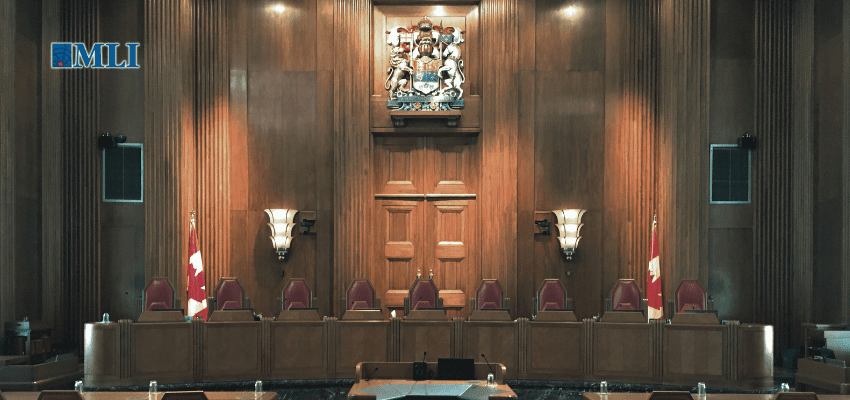
One of the most important questions raised in the Supreme Court of Canada’s EMSB v. Quebec hearing concerning Bill 21 and section 33 of the Canadian Charter of Rights and Freedoms (the ‘notwithstanding clause’) was this:

What is the problem with Canadian courts making declarations of incompatibility about laws that invoke the notwithstanding clause without striking them down?

At one point, Justice Nicholas Kasirer asked Quebec’s lawyers about the academic debate on the legal effect of section 33 and pressed for answers about the problem with declarations. He was clearly intrigued about whether laws invoking section 33 “suspended” Canadian Charter rights and if the notwithstanding clause really amounted to an “ouster clause.” Quebec’s lawyers pointed to the precedent set by Ford v. Quebec as blocking declarations and stressed the dangerously political nature of directly questioning the policy choices of the legislature notwithstanding their constitutionally secure status. Neither this defence of section 33, nor the attempts by other interveners to justify declarations, proved quite satisfactory.

In this short post, I will review the legal reason section 33(2) prohibits declarations and then unpack the proper answer to Justice Kasirer’s question: making declarations about laws invoking section 33 would jeopardize the legitimacy that the court relies on to ensure that its holdings are respected and implemented. I will also note a second concern that was only touched on cursorily in the hearing: a declarations power will expand the Supreme Court’s workload and increase the burden of policing trial courts.

The answer to Justice Kasirer’s question about whether section 33 is an “ouster clause” is that it is not expressly worded to prohibit all judicial review because doing so may have prevented the procedural judicial review of the manner and form of laws invoking section 33. The drafters likely did not use blunt ouster clause language because they thought it reasonable for courts to ensure that laws invoking section 33 followed the procedural requirements of the provision. Interpreting section 33 as allowing procedural but not substantive judicial review is consistent with Ford v. Quebec and this has been the clear constitutional practice accepted by Canadian courts and legislatures ever since.

It was advocates of the previously unheard-of practice of courts making judicial declarations about the Canadian Charter consistency of laws invoking section 33 who first grounded their argument on a narrow textualist reading of one term in section 33(2). As I have argued elsewhere, the answer to Justice Kasirer’s understandable puzzlement about how rights can be “suspended” but continue to “exist” is that section 33(2) does not technically suspend or override rights, but instead requires laws to operate as though the relevant Canadian Charter provisions do not apply to them. That is, section 33(2) prohibits substantive judicial review. Section 33(2) states:

An Act or a provision of an Act in respect of which a declaration made under this section is in effect shall have such operation as it would have but for the provision of this Charter referred to in the declaration.

Section 33(2) instructs the courts to treat laws invoking section 33 as operating as they would have but for the relevant Canadian Charter provisions. This means that the laws operate as though the relevant Canadian Charter sections do not apply to them, even though of course the provision continue to exist and it remains open to the people themselves to question the consistency of the laws with the Canadian Charter.

Courts may not review laws invoking section 33 as they impact the substance of selected Canadian Charter provisions because that fails to treat the laws as they would operate but for such Canadian Charter provisions.

The rival reading offered by Prof. Grégoire Webber, which is undeniably creative, is that section 33(2) protects only the operation of unconstitutional laws. This view is not merely academic as it undergirds many of the arguments made by the parties and interveners seeking new limits on section 33. Webber’s reading fails to fit the text of section 33(2), but also jars with section 1 and the section 52 supremacy clause.

Webber fails to account for section 33(2) guaranteeing that a law operates “as it would but for the [Charter] provision” and reads the clause as though it stated instead that laws “only operate” in the face of inconsistencies with the provisions. But words along the lines of “shall only operate” or “shall operate but for” are not there, nor is there anything about permitting inconsistencies with the Constitution.

Section 1 guarantees all rights subject only to “reasonable limits”, whereas Webber’s view would allow unreasonable limits that operate as unconstitutional exceptions to section 52’s requirement that all laws inconsistent with the Constitution are “of no force or effect.” If there were an exception to section 52, it would probably be explicitly written into section 52. Webber’s reading is ingeniously inventive but semantically sterile. As the Deputy Attorney General of Alberta Malcolm Lavoie aptly noted, the very idea of an operable but unconstitutional law is repugnant to our constitutional concept of repugnancy (1:03:07 – 1:18:12).

Now we can unpack the political reasons for avoiding judicial declarations about the Canadian Charter consistency of laws that properly invoke section 33.

Let us imagine that the trial and appellate courts in Quebec had made declarations that Quebec’s secularism law violated the Canadian Charter’s section 2(a) freedom of religion of the public servants it applied to. Let us say that both courts followed Webber’s reading of section 33(2) and declared that the laws unconstitutionally violate religious freedom but operate notwithstanding.

There has already been significant controversy and criticism of the courts over the question of whether judicial declarations are even possible. In one scenario, it is possible that such declarations pour more nationalist fuel onto the fire and further distract from the rights issue at hand by turning the debate to focus on the legitimacy of the declarations, the federal appointment of section 96 courts, etc. Declarations could become a gift to provincial politicians seeking to delegitimize judges as Ottawa’s pawns.

Let us further imagine that these declarations took place in the wake of a hypothetical previous Supreme Court of Canada decision on a different rights issue, where the court upheld Webber’s view that courts can declare laws invoking section 33 to operate notwithstanding their unconstitutional violation of rights.

In that scenario, it is possible that Quebec could follow its own example in the 1998 Reference re Secession of Quebec and refuse to participate in the proceedings. Perhaps the lower courts could appoint representation for Quebec as in 1998? In that case, the declarations would be made as a result of litigation where only one side of the debate truly presented its arguments. The declarations could then be used by proponents of Bill 21 to showcase the willingness of their opponents to use unfair procedures that undermine the key part of the Canadian Charter meant to help protect provincial autonomy. If provinces refuse to participate in litigation seeking declarations of incompatibility against laws invoking section 33, the declarations could damage rather than inform free and fair deliberation on the rights issue in question.
Or imagine that a majority of the Supreme Court of Canada disagreed with the declarations made by the lowers courts and finds no Canadian Charter violation in the case of Quebec’s Bill 21. What happens if the advocates of declarations get their wish and Quebec’s National Assembly repeals the law as the declarations swing popular opinion in Quebec against the secularism law? In that case, it could be too late for the Supreme Court to stop the lower court declarations from misinforming and warping public debate about a crucial rights issue.

What happens if trial courts, appellate courts, and the Supreme Court of Canada all make sweeping declarations and the political process ignores them? Would that not damage the institutional legitimacy of the courts in other cases? The threat of under-implementation or non-implementation lingers in Canadian Charter cases where section 33 is not invoked, and so developing a new form of ineffectual jurisprudence seems strategically misguided for an institution that relies on others to carry out its will.

This thought experiment leads to my final point. If the Supreme Court of Canada mistakenly grants constitutional benediction to judicial declarations about laws invoking section 33, then it could be making considerably more work for itself.

Declarations are likely to involve highly politically volatile matters where the reputation of the judiciary hangs in a delicate balance, and the fact that declarations will not render laws invoking section 33 inoperable may embolden lower courts to set out on wild adjudicative adventures. Advocates of declarations underestimate the possibility that declarations could cyclically lead to yet more invocations of section 33, and then more declarations, with the result that it would fall to the Supreme Court of Canada to police lower court declarations that could misinform voters or unwisely tarnish the judiciary as an institution.

Such are the perils of speaking out of turn.


Geoffrey Sigalet is the Director of the UBC Research Group for Constitutional Law and an Assistant Professor of Political Science at the University of British Columbia’s Okanagan Campus.

Source: Constitutional Theory Monitor

Related Posts

From “living tree” to dead metaphor – Recharacterizing Canadian constitutional interpretation: Dylan R. Clarke
Justice

From “living tree” to dead metaphor – Recharacterizing Canadian constitutional interpretation: Dylan R. Clarke

April 29, 2026
Canada’s free and independent press is (mostly) dead—now what?: Peter Menzies in The Hub
Media and Telecoms

The media is begging for even more money. Here’s why the government keeps giving it to them: Peter Menzies in The Hub

April 28, 2026
China is knocking at the trans-Pacific trade door—Canada must not swing it wide open: Ed Fast in The Hub
Indo-Pacific

China is knocking at the trans-Pacific trade door—Canada must not swing it wide open: Ed Fast in The Hub

April 28, 2026

Newsletter Signup

  Thank you for Signing Up
  Please correct the marked field(s) below.
Email Address  *
1,true,6,Contact Email,2
First Name *
1,true,1,First Name,2
Last Name *
1,true,1,Last Name,2
*
*Required Fields

Follow us on

Macdonald-Laurier Institute

323 Chapel Street, Suite #300
Ottawa, Ontario, K1N 7Z2 Canada

613.482.8327

info@macdonaldlaurier.ca
MLI directory

Support Us

Support the Macdonald-Laurier Institute to help ensure that Canada is one of the best governed countries in the world. Click below to learn more or become a sponsor.

Support Us

  • Inside Policy Magazine
  • Annual Reports
  • Jobs
  • Privacy Policy

© 2023 Macdonald-Laurier Institute. All Rights reserved.

No Result
View All Result
  • Home
  • About
    • Who We Are
    • Who Makes MLI Work
    • Fifteenth Anniversary
  • Experts
    • Experts Directory
    • In Memoriam
  • Issues
    • Domestic Policy
      • Economic Policy
      • Justice
      • Rights and Freedoms
      • Assisted Suicide (MAID)
      • Health Care
      • COVID-19
      • Gender Identity
      • Canada’s Political Tradition
      • AI, Technology and Innovation
      • Media and Telecoms
      • Housing
      • Immigration
      • Agriculture and Agri-Food
      • Competition Policy
    • Energy Policy
      • Energy
      • Environment
    • Foreign Policy
      • Israel-Hamas War
      • Ukraine
      • Taiwan
      • China
      • Europe and Russia
      • Indo-Pacific
      • Middle East and North Africa
      • North America
      • Foreign Interference
      • National Defence
      • National Security
      • Foreign Affairs
    • Indigenous Affairs
  • Projects
    • CNAPS (Center for North American Prosperity and Security)
    • Justice Report Card
    • The Promised Land
    • Voices that Inspire: The Macdonald-Laurier Vancouver Speaker Series
    • Dragon at the door
    • Canada on top of the world
    • Letter to a minister
    • The Great Energy Crisis
    • DisInfoWatch.org
    • Managing Indigenous Prosperity
    • Judicial Foundations
    • Landmark Cases Council
    • Defending The Marketplace of Ideas
    • Reforming the University
    • Past Projects
      • Digital Policy & Connectivity
      • Double Trouble
      • Canada and the Indo-Pacific Initiative
      • The Transatlantic Program
      • COVID Misery Index
      • Speak for Ourselves
      • The Eavesdropping Dragon: Huawei
      • Talkin’ in the Free World with Mariam Memarsadeghi
      • An Intellectual Property Strategy for Canada
      • Munk Senior Fellows
      • A Mandate for Canada
      • Confederation Series
      • Fiscal Reform
      • The Canadian Century project
      • Fixing Canadian health care
      • Internal trade
      • From a mandate for change
      • Size of government in Canada
      • Straight Talk
      • Labour Market Report
      • Leading Economic Indicator
      • Centre for Advancing Canada’s Interests Abroad
      • Indigenous Prosperity at a Crossroads
  • Events
    • Upcoming Events
    • Past Events
      • MLI Dinners
      • Great Canadian Debates
  • Latest News
  • Libraries
    • Columns
    • Commentary
    • Papers
    • Books
    • Video
  • Donate

© 2023 Macdonald-Laurier Institute. All Rights reserved.