By Joe Varner, March 30, 2026
The war against Iran has already demonstrated the overwhelming military power of the United States and Israel.
However, the conflict now exposes a deeper strategic dilemma: how to translate battlefield success into a political outcome that prevents the Iranian regime from eventually rebuilding the capabilities that produced the war.
The strategic challenge now emerging in the war against Iran is no longer primarily military. It is conceptual. The United States, Israel, and Iran are operating according to fundamentally different assumptions about how the conflict should end, and that mismatch may determine whether the coalition’s early battlefield successes translate into a lasting strategic outcome – or merely a temporary pause in a longer confrontation.
The opening phase of the campaign demonstrated the scale of Western military superiority. United States and Israeli strikes rapidly dismantled significant elements of Iran’s regime leadership and conventional military infrastructure. The campaign also targeted missile launch sites, drone production facilities, command centres, and elements of the country’s nuclear program. The strikes reached beyond operational units in the field. The US and Israel also targeted industrial facilities responsible for producing missiles and unmanned systems, including infrastructure tied to Iran’s ballistic missile and drone programs. Analysts at the International Institute for Strategic Studies note that Iran has invested heavily in these production networks over the past decade in order to sustain its missile arsenal and regional proxy forces.
These operations therefore aimed at more than the destruction of weapons already deployed in the field. They sought to degrade Iran’s ability to regenerate military power over time. The US and Israel struck missile factories, drone assembly plants, and logistical infrastructure alongside air defence systems and command facilities. From a strategic perspective, the coalition targeted both Iran’s existing capabilities and its ability to rebuild them.
Such an approach reflects a principle long recognized in strategic theory. Military operations are meaningful only as far as they serve political objectives. The Prussian strategist Carl von Clausewitz famously argued that war is a continuation of politics by other means and that battlefield victories must ultimately translate into political outcomes that resolve the conflict itself. That is where the strategic divergence now appears. One of the central challenges of modern warfare lies not in winning the opening battles but in defining the conditions under which a war can end. As strategic theorists have long observed, military success must produce a political settlement that both sides recognize as decisive. Without that alignment between battlefield results and political objectives, conflicts often drift toward prolonged stalemate.
For Israel, the war has always been about more than halting a single nuclear cycle or degrading Iran’s missile forces temporarily. Israeli strategy is oriented toward preventing Iran from rebuilding the military and proxy architecture that has allowed Tehran to threaten Israel across multiple fronts. Israeli planners have long focused on the problem of regeneration. Even after severe battlefield losses, adversaries can rebuild their capabilities if the political system and industrial base that produced them remain intact. Israel’s experience with Hezbollah and Hamas has reinforced this concern. Both organizations have repeatedly reconstituted their arsenals after suffering military setbacks. Israeli strategists tend to view the Iranian threat through the very same lens. The central question is not simply whether Iranian missiles and nuclear infrastructure can be damaged in the short-term. It is whether the regime can rebuild those capabilities once the war ends. Israel’s position is complicated by the fact that it possesses extraordinary military reach but limited capacity to sustain a prolonged regional war without continued American support. For that reason, Israeli strategy depends heavily on maintaining American alignment through the later stages of the conflict.
The United States appears to be approaching the conflict from a unique perspective. At the outset of the war Washington described a set of military objectives that were operational rather than political: the destruction of Iran’s missile capabilities and naval forces, the degradation of its drone and defence industrial base, the prevention of a nuclear weapons capability, and the protection of United States partners across the Middle East. Recent diplomatic activity suggests that Washington may be exploring a negotiated off-ramp to a ceasefire. Reports indicate that proposals transmitted through intermediaries would require Iran to halt uranium enrichment, surrender highly enriched uranium stockpiles, limit ballistic missile development, and curtail support for regional proxy forces. Such conditions would impose substantial constraints on Iranian military power. Yet the very existence of negotiations suggests that Washington may be seeking a limited settlement that freezes the conflict rather than fundamentally transforming the regional balance of power. Iran meanwhile is operating according to a third theory of victory altogether.
Tehran does not need to defeat the United States or Israel in conventional battle. It only needs to ensure that the war ends without regime collapse and without accepting the coalition’s most demanding strategic conditions. From the perspective of the Iranian leadership, survival itself constitutes success. If the Islamic Republic remains intact, its leadership can rebuild damaged capabilities over time. Iran’s strategy therefore emphasizes endurance and escalation management rather than battlefield dominance. Over the past two decades Tehran has constructed a network of allied militias and partner forces across the Middle East, including Hamas in Gaza, Hezbollah in Lebanon, and armed groups operating in Iraq, Syria, and the Houthis in Yemen. Scholars at the Washington Institute for Near East Policy describe this network as the core of Iran’s regional deterrence architecture, allowing Tehran to exert influence across the region without relying solely on its own conventional forces.
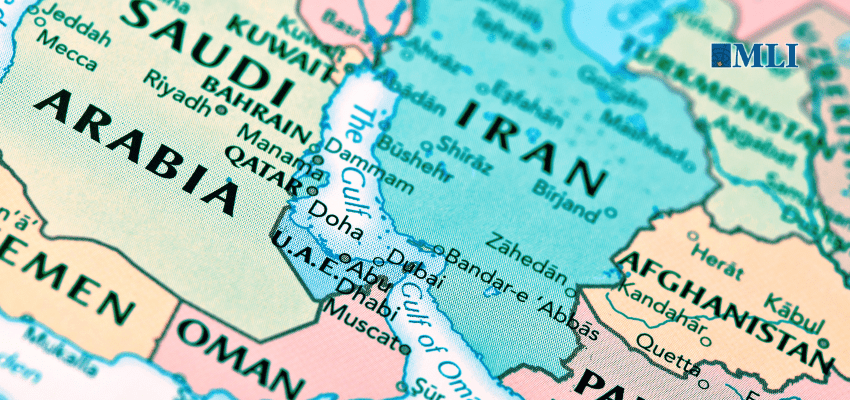
Iran never intended these organizations to defeat Western militaries directly. Their purpose was to expand any confrontation geographically and impose costs on Iran’s adversaries through indirect warfare. The widening of the conflict now reflects that approach. Iranian-linked attacks and maritime threats have reverberated through the Mediterranean Sea and the Persian Gulf to the Indian Ocean while regional militias continue to pressure Israeli and Western interests. Disruptions to shipping lanes and energy markets have already affected global trade and energy prices. Roughly one-fifth of the world’s oil supply passes through the Strait of Hormuz each day, making the stability of that waterway central to the global economy. Iranian leaders have historically assumed that Western coalitions possess superior military power but limited political patience. Tehran’s strategy has therefore often focused on absorbing initial punishment while widening the conflict and waiting for external pressure to produce negotiations.
These developments illustrate the strategic mismatch shaping the war. Washington increasingly is asking how the conflict can end. Israel is asking how the threat can be prevented from returning. Iran is asking how long it must endure before the United States prioritizes the first question over the second. If Washington now prioritizes an off-ramp before those military gains are translated into a durable political outcome, it risks granting Tehran the strategic victory it has been seeking: survival of the regime, avoidance of the coalition’s most consequential demands, and the ability to rebuild its military power after the conflict subsides.
Within this strategic triangle the issue of regime change inevitably arises. Some analysts argue that sustained military and economic pressure could destabilize the Islamic Republic itself. Iran has experienced periodic waves of domestic unrest over the past decade driven by economic hardship and political repression. Demonstrations following the death of Mahsa Amini in 2022 represented one of the largest protest movements in the country in decades and highlighted the regime’s internal vulnerabilities. The country has recently experienced another wave of violent demonstrations in several major cities, underscoring the depth of public anger over economic decline and political repression.
Severe battlefield losses combined with prolonged economic disruption could intensify those internal pressures. Neither Washington nor Jerusalem formally declared regime change as the objective of the campaign at the outset, but both have clearly left strong suggestions and the possibility in play. American officials have tended to frame the war in terms of degrading Iran’s military and nuclear capabilities rather than removing the regime outright, reflecting the political legacy of earlier interventions in Iraq and Afghanistan. Yet the scale of the strikes against Iran’s military and industrial infrastructure inevitably raises the question of whether the conflict can truly resolve the Iranian challenge if the political system that produced it survives intact.
This ambiguity lies at the centre of the current strategic debate. If regime change is not the objective, the war must end with some form of negotiated arrangement with the existing Iranian government. But if that government remains in power, it will certainly attempt to rebuild the military and nuclear capabilities that made this war possible in the first place. A settlement that leaves the regime intact while only temporarily constraining enrichment could leave Iran closer to the nuclear threshold than before the war. In that case the conflict might paradoxically accelerate the very proliferation risks it was meant to prevent. Iran’s nuclear program magnifies this strategic dilemma because the survival of the regime combined with renewed enrichment activity would place Tehran closer to a nuclear threshold state. The implications of this dilemma extend well beyond Iran itself.
The widening of the war introduces a clear alliance dimension. Iranian missile development has steadily expanded its reach over the past decade. Analysts at the Center for Strategic and International Studies note that several Iranian missile systems now place large portions of Europe within range. This development means that the strategic geography of the conflict already overlaps with NATO territory. At the same time disruptions to shipping routes in the Red Sea and the Strait of Hormuz directly affect European energy security and global trade flows. Military installations operated by NATO members across the eastern Mediterranean and Middle East are therefore part of the broader strategic landscape of the conflict even if the alliance itself is not formally engaged. The result is that the war increasingly sits at the intersection of regional security and great power competition.
For Canada, the implications are equally significant. As a NATO member and a long-standing participant in coalition operations in the Middle East, Canada has a stake in both regional stability and the credibility of Western deterrence. Canadian Forces have deployed to Iraq and other regional missions supporting international security operations, and Canadian naval assets have participated in multinational efforts to protect maritime commerce in the Persian Gulf and Arabian Sea.

Prime Minister Mark Carney has recently indicated that Canada would be prepared to work with allied partners after a ceasefire to help safeguard shipping routes through the Strait of Hormuz. The challenge for Ottawa is therefore not only how it might contribute to maritime security or postwar stabilization efforts but how it understands the broader strategic stakes of the conflict itself. Canada has historically devoted limited attention to its strategic positioning for major geopolitical conflicts. Canadian foreign policy has often focused more on diplomacy, multilateral institutions, and peacekeeping than on sustained strategic competition. The Iran war sits at the intersection of regional security, alliance credibility, and great power competition. For Canada, as for other NATO members, the outcome will shape perceptions of Western resolve and the durability of the international security system on which Canadian prosperity and security depend.
Russia and China have avoided direct involvement in the fighting, yet both have strong incentives to prevent the collapse of the Iranian regime. Tehran remains a strategic partner for Moscow in the war in Ukraine and an important energy supplier and geopolitical counterweight for Beijing. Both powers therefore have an interest in an outcome in which the regime survives, even if its military capabilities are temporarily weakened. Another dimension of the conflict lies in the precedent it may establish for other states that are closely observing the outcome. Wars are rarely watched only by the participants themselves. Rival powers study them as demonstrations of how alliances function, how long Western coalitions sustain military pressure, and how conflicts conclude. In this sense the Iran war is being observed as closely in Moscow and Beijing as it is in Tehran. If the United States were to end the conflict before translating battlefield gains into a durable strategic outcome, the lesson drawn elsewhere may not concern the strength of Western military power but the limits of Western political endurance.
The challenge confronting Washington and its allies is therefore not merely how to end the war but how to ensure that its outcome addresses the strategic problem that produced it. Military operations can degrade Iran’s missile forces, damage its nuclear infrastructure, and disrupt its proxy networks. Yet, unless the political conditions that allow those capabilities to be regenerated are addressed, the conflict may simply postpone the next confrontation. The ultimate measure of success will not be the scale of destruction inflicted during the war’s opening phase but whether the settlement that follows prevents Iran from rebuilding the military architecture that made the conflict possible.
The consequences of that outcome extend beyond the Middle East. A widening war that disrupts maritime commerce, energy markets, or allied military infrastructure would inevitably involve alliance commitments across the Western security system. For Canada, as a NATO member and participant in coalition operations in the region, those implications are direct. The stability of shipping routes through the Strait of Hormuz, the security of allied forces in the eastern Mediterranean, and the credibility of Western deterrence all intersect with Canadian strategic interests. For Ottawa, the outcome of the conflict will therefore matter not only for regional stability but for the credibility of the alliance system on which Canadian security depends.
Joe Varner is a senior fellow at the Macdonald-Laurier Institute and the Center for North American Prosperity and Security in Washington, D.C.