By Jeffrey F. Collins, March 16, 2026
On August 5, 2000, one of the strangest peacetime episodes in Canadian military history took place: the seizure, at sea, of a US-owned cargo ship, the GTS Katie. But this was not any ship. The Soviet-built vessel carried an estimated ten per cent of the Canadian army’s armoured vehicle fleet, plus tanks and ammunition coming from a recently concluded deployment to Kosovo. The incident, triggered over a contract dispute, not only grabbed headlines but more importantly highlighted the risks that come with the absence of a Canadian-owned amphibious sea transport capability, something lost with the retirement of the aircraft carrier HMCS Bonaventure in 1970.
In the aftermath of the Katie incident, the Department of National Defence and the Canadian Armed Forces advanced a myriad of ideas to avoid repeating such an embarrassing tactical and potentially strategic failure. One solution involved incorporating amphibious capability into the next generation of fuel replenishment ships, the Joint Support Ships. Another idea, echoed in 2005 by then Chief of Defence Staff General Rick Hillier, was to acquire a “big honking” amphibious ship equipped to carry troops, equipment, and helicopters. In 2015, the Stephen Harper government even entertained the notion of buying such a vessel. A French-built Mistral class formerly ordered by Russia became available for purchase following Moscow’s seizure of Crimea in 2014. All these proposals came to nought, thanks to budget restraints, election impacts, and competing naval procurement priorities.
Now, in 2026, with a prime minister committed to spending up to five per cent of GDP on defence, the amphibious ship idea has resurfaced, this time from the Royal Canadian Navy’s (RCN) leadership. Seemingly not on the table – at least publicly – to address this capability gap is utilizing a civilian crewed and commercially owned merchant navy akin to that used by Canada in the first half of the 20th century. This would ostensibly be a cheaper and faster acquisition than attempting to build such a naval vessel at home. Notably, this option is being pursued by Australia.
Such a fleet provides more than military reinforcement. It also enables wider government policies in responding to emergencies at home (e.g. hurricanes cutting off communities), alliance building, and international trade, offering a means to deliver Canadian goods to markets in which there initially may be little private sector interest. Afterall, as the RCN states in its 2016 strategy, “Canada is a maritime nation because it trades.”
What is a Merchant Navy?
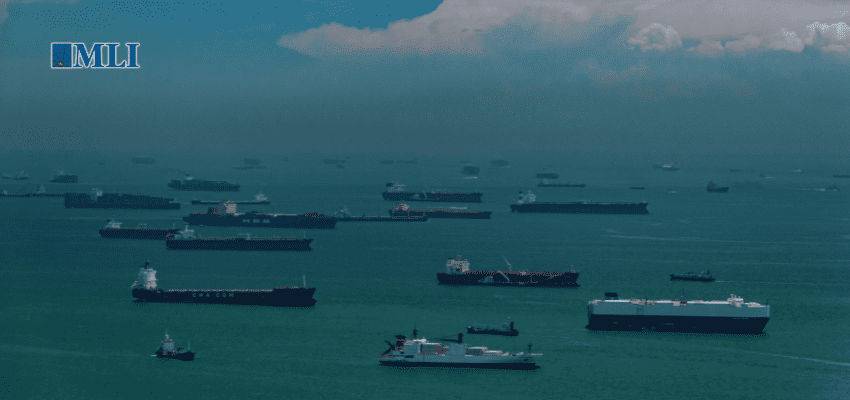
Fortunately, this idea has historical precedence. Canada pursued and established some of the world’s largest merchant fleets at three different periods, from the late 19th century through to the Second World War. In general, a merchant navy refers to those commercial ships registered with a specific country. These ships are not grey-hulled naval vessels but dedicated, instead, to moving manufactured goods, commodities, and people.
Merchant fleets are categorized by one of five types: bulk carrier, container ship, general cargo, oil tanker, and other (e.g. LNG, chemical, passenger vessels, offshore supply ships). By virtue of being registered, or “flagged,” with a specific country, that country’s government can call on these vessels for support during times of national emergencies, be it wars or disasters.
It’s important to distinguish here that registration is not the same as ownership. In fact, it is quite common today for ships to be registered in one country – usually for lower tax and less burdensome regulatory reasons – with ownership residing in another. The GTS Katie for example, was owned by a US firm but registered in St. Vincent and the Grenadines. In 2024, the top five flagged countries were Panama, Libera, the Marshall Islands, the Bahamas, and Singapore. Hardly great powers. These five account for half of all global registered vessels. The top three account for 37 per cent. In contrast, the top five countries for ownership were Greece, China, Japan, the United States, and Singapore. Canada comes in at 30th.
The concept of a merchant navy stems from an age-old practice now codified in the United Nations Convention on the Law of the Sea (UNCLOS). Articles 91 and 94 grant a country the right to affix its nationality to ships and the ability to “exercise its jurisdiction and control” over said ships, including administrative matters like officers and crew certifications and technical aspects of the ships including their seaworthiness.
Under the rules of customary international humanitarian law, attacking merchant ships is generally prohibitive. However, merchant ships can become legitimate military targets when “directly participating” in hostilities. This can take the form, for example, of spying on behalf of a government, transporting troops and material, or sailing in a convoy under protection from military aircraft and naval ships. Conflicts like the 1982 Falklands War, the Iran-Iraq War of the 1980s, and the ongoing wars in Ukraine and the Middle East show that merchant navies are not ancient history but integral to understanding modern sea power.
Countries, large and small, with registered ships under the UNCLOS provisions in effect have their own respective merchant navies. Singapore, a wealthy and geostrategic placed city-state near the world’s busiest shipping lanes, the Malacca Strait, oversees a merchant fleet of more than 4,400 ships (equivalent to 100 million gross tons) through the government administered Singapore Registry of Ships. Even landlocked Switzerland maintains a small fleet of 15 vessels, stemming from its experiences in the Second World War of losing access to supplies during a crisis. The United States fields an actual organization, the US Merchant Marine, which can draw on 188 commercial ships in excess of 1,000 gross tons to support the movement of troops and cargo in the event of hostilities or humanitarian disasters.
A merchant navy is legally and functionally distinct from naval auxiliaries. A naval auxiliary is a government owned or leased vessel that supports naval combatants. The British Royal Fleet Auxiliary (RFA) remains a standout example of this and grew out of the British merchant navy after the Second World War to become a distinct organization within the Royal Navy. As of 2025, the mostly civilian crewed RFA operates 11 vessels (a mix of tankers, landing dock ships, and amphibious ships) and comprises five per cent of all Royal Navy personnel.
Indeed, Canada’s lease of an interim auxiliary oil replenishment ship, the MV Asterix, since 2018 arguably qualifies as a Canadian fleet auxiliary vessel although the RCN does not make such a distinction. The RCN refers to the Asterix as a “short-term commercial solution” until the new Protecteur class Joint Support Ships enter service late this decade.
Canadian Maritime Security Challenges
For most countries, being surrounded by three oceans would breed a familiarity with maritime security and trade links. But Canada is different. Since the Second World War, there has existed a state of “sea blindness” above the 49th parallel. Geography and alliances can largely account for this.
Sitting atop North America, far removed from geopolitical hotspots and sheltered by the United States’s nuclear umbrella, Canada enjoyed an enviable position (although ongoing annexationist rhetoric from the second Trump administration could change this calculus). Canada’s population centres, and with it, its economic engines and political power, remain either landlock (Alberta) or located in the interior (the Windsor-Quebec City corridor), far from the reaches of the sea.
Yet, climate change in the Arctic opening up waterways to shipping, resource competition, and renewed great power contestation have shattered the long-standing illusion of Canadian security/ Nearly a century ago, Senator Raoul Dandurand famously summed it up – Canadians “live in a fireproof house far from inflammable materials.” US President Donald Trump’s threats on Greenland, turning Canada into a “51st state,” and mistrust of alliances have only added to this sense of unease leading to what Prime Minister Mark Carney termed a “rupture” in international relations. Middle powers like Canada, he states, “must develop greater strategic autonomy.”
In this new era, Canadian defence policy can no longer speak of a post-Cold War peace dividend or prioritizing the security of the Winter Olympics as the biggest defence issues of the day. Canada now “lies at the geographic middle” of the contest between China, Russia, and allies in the Euro-Atlantic and Indo-Pacific regions. Even the use of the terms Euro-Atlantic and Indo-Pacific, first mentioned in the 2024 defence policy, Our North, Strong and Free, implicitly capture the notion that today’s threat environment is very much rooted in the sea.
The focus of much government defence investment to date and for the foreseeable future is to build up Canada’s naval and coast guard fleets. A completely understandable position given the aging state of current fleets like the Victoria class submarines and the Halifax class frigates and the need to plug capability gaps like an Arctic capable corvette class.
However, there is a wider range of maritime security infrastructure that needs attention beyond simply the military, serving as a reminder that maritime security also must include commercial assets and non-military supporting infrastructure like ports, navigational aids, canals, and commercial shipping. Fifteen years ago, a Transport Canada report saw a spectrum of emerging threats representing such risks. That report noted that Canada’s sea lines of communication are effectively in foreign hands with 99.9 per cent of all of Canada’s deep-sea (i.e. non-US cargo) moved on foreign flagged ships. This cargo – constituting dry bulk shipping, liquid bulk, and containers – are the lifeblood of a nation keen to reduce its economic dependence on the United States.
What Canadian flagged vessels do exist are a mix of government owned roll on/roll off ferries on the East and West Coasts (e.g. BC Ferries, Marine Atlantic), Great Lakes bulk cargo shippers (e.g. Canada Steamship Lines), and coastal trade container and fuel vessels (e.g. Oceanex) – few of which are either available in emergency to be allocated to defence or national security needs or capable of repeat and strenuous trans-Pacific and trans-Atlantic deployments. Absent buying a more expensive strategic air lift fleet (beyond the current five C-17s), this situation leaves Ottawa at the mercy of utilizing foreign owned vessels like the GTS Katie that are subject to availability and price spikes in charters and freight.

Canada’s First Merchant Navies
Canada may lack a formal merchant navy today, but the country is not new to the concept. On three separate occasions since Confederation in 1867 Ottawa stood up and operated a merchant navy to meet the country’s economic security interests. In the late 19th century, the country fielded one of the world’s largest by measure of hulls with 6,991 vessels registered in the 1890s. The rise of that fleet coincided with the country’s economic growth in late-era industrialization but also the emergence of a unique Canadian national identity. The first use of a distinct Canadian Red Ensign flag, for example, resulted from Canadian ships traversing world ports. Both government and business alike were keen to link economic growth with overseas markets and the recently completed, and costly, transcontinental railway.
In what would prove to be a pattern, Canadian shipyards and owners could not keep up to expensive developments in steam power and steel hulls. By the early 20th century, Canada’s large number of locally built, smaller wooden sailing ships were commercially uncompetitive and technologically out of date.
The First World War became the impetus for the next era. In 1917, German U-boat attacks on Allied merchant shipping reached a fever pitch, forcing Prime Minister Robert Borden’s government to establish the Canadian Government Merchant Marine (CGMM) Limited, a government-owned shipping company. The CGMM was in part a means to address the lack of maritime commercial carrying capacity for Canadian exports and reinvigorate the domestic shipbuilding from its downfall in the 19th century. The war made it clear that Canadian commercial and wartime interests took second place in favour of Britain’s. Indeed, in the face of staggering losses to U-boats, London requisitioned both Canadian-flagged and -owned ships for the British war effort. The Borden government sought the CGMM to build a new Canadian-owned fleet and stimulate the shipbuilding sector.
By some measures the CGMM was a success, at least in the early years. On the shipbuilding side, 63 ships representing six standard types were built in Canadian yards between 1918 and 1920, totaling a deadweight of more than 380,000 tons. By 1922, CGMM employed over 2,300 officers, 80 per cent Canadian. Likewise, the company employed an all-Canadian shore staff of 1,150 people. In terms of service and addressing Canadian commercial needs, the CGMM focused on niche, lesser-used lines (e.g. between Eastern Canada and Wales, potato exports to Cuba) and proved useful in plugging supply chain holes when periodic crises emerged like in 1919 and 1921 with US and UK coal disruptions. Other notable successes include breaking the monopoly on Great Lakes shipping, transporting Canadian-made tanker rail cars in what became the first large-scale commercial transaction between Canada and the Soviet Union (when other fleets did not want to take on the risk), and enabling the doubling of British Columbia’s lumber exports to Asia, at the expense of American competition.
The momentum behind the CGMM petered out by the early 1930s. Companies in the Maritime provinces began opposing CGMM on the basis that it had monopolized shipping to the Caribbean, a significant regional export destination. Public reports of the company charging unremunerative rates and keeping crews on the payroll even during lulls only served to irritate Canadian manufacturers and other producers with the onset of the Great Depression. In the end, fleet obsolescence in combination with the reorientation in the 1920s of the Canadian economy to its southern neighbour and away from UK and Europe – plus the return of post-war competition by established players like Norway – doomed the CGMM as a commercial enterprise. Ottawa sold off or transferred much of the fleet to British interests. By 1936, amid the depths of the Great Depression, Ottawa wound down the company and sold its remaining vessels to British firms.
Canada’s Last Merchant Navy
If Ottawa officialdom hoped for the 1914–18 war to be a one-off on the need for a merchant navy the events of the Second World War proved to be a much starker lesson. Just three years after the federal government dissolved the CGMM, war broke out again, and Canada had a mere 38 ocean going merchant ships on hand. Ten of these were oilers (tasked with importing oil from Latin America) and 11 were cargo ships. Total DWT was 290,000 (less than the CGMM fleet at its high point) and crewed with 1,450 seamen and officers. Aided by new designs, Hitler’s U-boats under the overall command of Admiral Karl Dönitz pursued Allied shipping with relish and to their advantage until mid-1943. From January to July 1942 alone over 400 ships off the North American coast were lost to the U-boats. By the end of the war in 1945 some 72 Canadian merchant ships had been lost to enemy action, at the cost of over 1,600 lives.
The 1939–45 war demonstrated how reliant and vulnerable Canada remained despite its economic continental orientation away from Britain and Europe towards the United States. The Battle of the St. Lawrence, waged by the RCN, the Royal Canadian Air Force (RCAF) and the merchant navy, was the first direct enemy attack on Canada’s inland waters since the War of 1812. It was, in short, a wake-up call to a nation that no longer remembered what maritime vulnerability looked like. Over a series of campaigns from May 1942 to October 1944, Nazi U-boats made it into Canadian and Newfoundland (being a separate Dominion at the time) waters, sinking 26 vessels, including the passenger ferry The Caribou as it left Port-aux-Basques, Newfoundland, with the loss of 137 lives, including 11 children. U-boats killed more Canadians in the St. Lawrence then on the first day of the D-Day landings on Juno Beach in 1944.
And the Nazis did not just target merchant ships: U-boats laid sea mines off the harbours of Halifax and St. John’s, deposited secret agents in Quebec, sunk multiple RCN warships (5/14 of all combat losses were in Canadian waters), and effectively closed off the Gulf for overseas shipping for two years. The latter impact meant losing access to the Port of Montreal and a reduction of Canadian outbound shipping by 25 per cent.
If the steep losses at home and abroad did not spur the Liberal government of William Lyon Mackenzie King to action, then the global, war-driven demand on merchant shipping certainly did. By the end of 1940 just eight per cent of ocean-going tonnage remained available for charter. In response, Ottawa initiated a two-prong approach: build more commercial ships at home and operate them under Canadian flags. On the latter count, a mix of public and privately owned shipyards across the country met the challenge, producing nearly 400 by 1945, or 10 times that which existed at the outbreak of war six years previously, and five times the number lost to enemy action. Some 126,000 people were employed in 90 shipbuilding facilities. Canadian shipbuilding proved so efficient at production that in 1943 workers built a 10,000-tonne freighter in just 58 days.
Regarding the former, Ottawa established several government-owned shipping companies: Canadian National Steamship, Park Steamship Company, and a revived CGMM. Through the Canadian Shipping Priorities Board, these companies could assign ships to private firms to operate. At one point, the Park Steamship Company controlled 176 ships and 12,000 personnel but even when the ships were assigned to an allied firm Canada retained ownership of the vessel. So successful was Ottawa’s answers to the shipping shortage and U-boat threat that by end of the war Canada fielded the world’s third-largest merchant navy. What to do with all of this capacity became the next challenge.
After the war the King government created a Canadian Maritime Commission to advise on both the future of the merchant navy and shipbuilding sector. Its 1948 report called for a modernized Canadian flagged fleet to ensure competitiveness and the provision of subsidies to leverage the shipyards and workforce stood up in the war years to manufacture larger, faster vessels. But alas this was not to be. A devaluation of the British pound in 1949 immediately put Canada’s ships at a competitive disadvantage with the large British owned fleet – which itself had rebounded from steep war losses.
Postwar competition from allies would undercut the case even more. The US government voluntarily gave up 2,000 Liberty ships to prevent the collapse of European commercial shipping powerhouses Greece, Denmark, and Norway. The sense of stability, a return to prosperity, and a North Atlantic alliance (NATO) with pooled shipping assets, made it a hard sell for Ottawa to continue subsidizing a Canadian merchant fleet. Canada’s sea blindness returned. Eventually, in the early 1950s, The St. Laurent government decided to sell-off what remained to a mix of Canadian and foreign-owned Canadian shell companies.
The Australian Approach
As an island country comparatively isolated from major world markets, Australia is by default more reliant and vulnerable to disruptions in maritime trade than Canada. Today, in the 2020s, some 99 per cent of all Australian goods, by volume, move by ship, accounting for 79 per cent of the country’s trade revenues. The Second World War proved how vulnerable this geographical reality can be when Japanese mines, bombs, and submarines sunk 29 Australian registered ships. Like Canada, Australia’s merchant mariners paid a steep price: an estimated 845 of 3,500 sailors lost their lives.
Due to this history, successive Australian governments sought to maintain a merchant fleet after 1945 through direct government ownership or subsidies. In the 1980s, Australia still had a fleet of more than 120 international trading ships, representing one of the world’s largest merchant navies. But the next decade was its undoing. With privatization in vogue across much of the Western world and threats now seemingly remote, the last of the government owned, operated or subsidized ships were privatized and sold off in 1998.
It took a deteriorating regional maritime security environment and a series of natural disasters in 2022–23 to pivot back to a merchant navy-like fleet capability. Then Labor Party Leader and now Prime Minister Anthony Albanese committed in the 2022 federal election to create an “independent Strategic Fleet to secure our ongoing access to fuel supplies and other essential imports.” His government’s subsequent 2023 Strategic Defence Review recommended “establishing a civil maritime strategic fleet” to ensure “protecting our way of life, prosperity, institutions, and economy.”
A sovereign fleet task force born out of the review came up with a two-pronged solution: 1) establish a strategic fleet of up to 12 vessels; 2) and utilize a serious of tax incentives and regulatory amendments to get industry to own and operate the ships under Australian registration. The tri-fold goals of this fleet are to respond to disruptions, support domestic manufacturing, and support the armed forces. To meet these goals the dozen ships should be a privately owned and operated mix of designs and capabilities, including RO/RO and roll-on/load-off, smaller container vessel, break-bulk, liquid bulk (e.g. fuels and chemicals), and multi-purpose vessels.
Identified barriers, similar to Canada’s situation, include labour and acquisition costs, regulations, and training. Overcoming them, requires tax incentives to make ownership and operations competitive, legislative and regulatory amendments, education and training subsidies, and a new foreign flagged vessel levy to fund the strategic fleet. The total annual cost gap to make the strategic fleet doable is estimated at A$5 to A$8 million (C$7.7 million).
As of 2026 the fleet is not yet a reality. The Albanese government half-heartedly endorsed the task force’s recommendations. Instead of a dozen ships it’s “up to” 12. As for fleet mix and capabilities, it will “target the most appropriate vessel types” and the fleet will operate commercially with no direct government ownership. Yes, the government supports strengthening legislation and regulations but it is apprehensive on implementing a foreign-vessel levy. Still, the Albanese government agreed to fund a five-year, three-ship pilot for A$21.7 million but missed the deadline for awarding a tender.
Conclusion
When great power conflict broke out in the 20th century, Canadian governments had to scramble to rebuild a merchant marine capability that had lapsed. Both world wars show how commercial shipping vessels become a highly sought after asset – by allies who seek to retain as much capability as possible to sustain their economies and defence industrial base, and by adversaries who seek to sink them. And it’s not just submarines that pose a threat to such vessels and therefore our sea lines of communication. In the age of drones, hypersonic missiles, and an abundance of relatively cheap but effective anti-ship missiles, both states and their proxies can disrupt supply chains and damage commercial ships (e.g. Iran and its allies the Houthis in Yemen or Hezbollah in Lebanon).
Canada’s attempts during the world wars to use investment in the merchant navy to boost domestic shipbuilding and, to a degree, compete against larger establish merchant sea powers, proved to be a weakness – it was unsustainable once hostilities ended. Moreover, for the foreseeable future, Canada’s three key National Shipbuilding Strategy yards – Seaspan in Vancouver, Irving Shipbuilding in Halifax, and Davie in Lévis, Quebec – have decades of work orders on naval and coast guard projects. That strategy and those yards, plus some smaller yards throughout the country, are the linchpin for avoiding a “boom and bust” cycle in Canadian shipbuilding.
The Australian (planned) approach to fund private operators to own and operate a mix of up to a dozen ships capable of RO/RO, container cargo, break-bulk, liquid, and multi-purpose uses is worth examining for Canada. That the Australian plan views a trifold role – respond to supply chain disruptions, support domestic manufacturing (or in the case of Canada, liquid and bulk transport of commodities), and supporting the armed forces – ensures the ship owners have multiple revenue streams. Notably, Canada already uses a version of this publicly funded, privately operated model on the east coast with Transport Canada’s “Ferry Services Contribution Program.”
With a clear aim to diversify Canada’s alliances, pursuing arrangements with commercial shipping powers like South Korea and Denmark, for example, could offer a model in which Canada enters arrangements in a timely manner to secure the use of commercial ships. To ensure access the ships would need to be registered in Canada (“flagged”). But an initial five-to-seven-year trial period can be implemented to assess the demand and utility of a scaled-down but flexible modern merchant navy model for the government’s wider maritime security objectives. At least this way, the RCN and wider Canadian Armed Forces would not have to worry about seizing foreign-owned-and-operated vessels at sea carrying their own weapons and supplies.
Jeffrey F. Collins is an assistant professor of Political Science at the University of Prince Edward Island and author of the 2024 book, Canada’s Defence Procurement Woes.