Tuesday, March 3, 2026
No Result
View All Result
  • Media
Macdonald-Laurier Institute
  • Home
  • About
    • Who We Are
    • Who Makes MLI Work
    • Fifteenth Anniversary
  • Experts
    • Experts Directory
    • In Memoriam
  • Issues
    • Domestic Policy
      • Economic Policy
      • Justice
      • Rights and Freedoms
      • Assisted Suicide (MAID)
      • Health Care
      • COVID-19
      • Gender Identity
      • Canada’s Political Tradition
      • AI, Technology and Innovation
      • Media and Telecoms
      • Housing
      • Immigration
      • Agriculture and Agri-Food
      • Competition Policy
    • Energy Policy
      • Energy
      • Environment
    • Foreign Policy
      • Israel-Hamas War
      • Ukraine
      • Taiwan
      • China
      • Europe and Russia
      • Indo-Pacific
      • Middle East and North Africa
      • North America
      • Foreign Interference
      • National Defence
      • National Security
      • Foreign Affairs
    • Indigenous Affairs
  • Projects
    • CNAPS (Center for North American Prosperity and Security)
    • The Promised Land
    • Voices that Inspire: The Macdonald-Laurier Vancouver Speaker Series
    • Dragon at the door
    • Canada on top of the world
    • Letter to a minister
    • Justice Report Card
    • The Great Energy Crisis
    • DisInfoWatch.org
    • Managing Indigenous Prosperity
    • Judicial Foundations
    • Landmark Cases Council
    • Defending The Marketplace of Ideas
    • Reforming the University
    • Past Projects
      • Digital Policy & Connectivity
      • Double Trouble
      • Canada and the Indo-Pacific Initiative
      • The Transatlantic Program
      • COVID Misery Index
        • Provincial COVID Misery Index
        • Beyond Lockdown
        • COVID and after: A mandate for recovery
      • Speak for Ourselves
      • The Eavesdropping Dragon: Huawei
      • Talkin’ in the Free World with Mariam Memarsadeghi
      • An Intellectual Property Strategy for Canada
      • Munk Senior Fellows
      • A Mandate for Canada
      • Confederation Series
      • Fiscal Reform
      • The Canadian Century project
      • Fixing Canadian health care
      • Internal trade
      • From a mandate for change
      • Size of government in Canada
      • Straight Talk
      • Labour Market Report
      • Leading Economic Indicator
      • Centre for Advancing Canada’s Interests Abroad
      • Indigenous Prosperity at a Crossroads
        • Aboriginal Canada and Natural Resources
  • Events
    • Upcoming Events
    • Past Events
      • MLI Dinners
      • Great Canadian Debates
  • Latest News
  • Libraries
    • Columns
    • Commentary
    • Papers
    • Books
    • Video
  • Donate
  • Home
  • About
    • Who We Are
    • Who Makes MLI Work
    • Fifteenth Anniversary
  • Experts
    • Experts Directory
    • In Memoriam
  • Issues
    • Domestic Policy
      • Economic Policy
      • Justice
      • Rights and Freedoms
      • Assisted Suicide (MAID)
      • Health Care
      • COVID-19
      • Gender Identity
      • Canada’s Political Tradition
      • AI, Technology and Innovation
      • Media and Telecoms
      • Housing
      • Immigration
      • Agriculture and Agri-Food
      • Competition Policy
    • Energy Policy
      • Energy
      • Environment
    • Foreign Policy
      • Israel-Hamas War
      • Ukraine
      • Taiwan
      • China
      • Europe and Russia
      • Indo-Pacific
      • Middle East and North Africa
      • North America
      • Foreign Interference
      • National Defence
      • National Security
      • Foreign Affairs
    • Indigenous Affairs
  • Projects
    • CNAPS (Center for North American Prosperity and Security)
    • The Promised Land
    • Voices that Inspire: The Macdonald-Laurier Vancouver Speaker Series
    • Dragon at the door
    • Canada on top of the world
    • Letter to a minister
    • Justice Report Card
    • The Great Energy Crisis
    • DisInfoWatch.org
    • Managing Indigenous Prosperity
    • Judicial Foundations
    • Landmark Cases Council
    • Defending The Marketplace of Ideas
    • Reforming the University
    • Past Projects
      • Digital Policy & Connectivity
      • Double Trouble
      • Canada and the Indo-Pacific Initiative
      • The Transatlantic Program
      • COVID Misery Index
        • Provincial COVID Misery Index
        • Beyond Lockdown
        • COVID and after: A mandate for recovery
      • Speak for Ourselves
      • The Eavesdropping Dragon: Huawei
      • Talkin’ in the Free World with Mariam Memarsadeghi
      • An Intellectual Property Strategy for Canada
      • Munk Senior Fellows
      • A Mandate for Canada
      • Confederation Series
      • Fiscal Reform
      • The Canadian Century project
      • Fixing Canadian health care
      • Internal trade
      • From a mandate for change
      • Size of government in Canada
      • Straight Talk
      • Labour Market Report
      • Leading Economic Indicator
      • Centre for Advancing Canada’s Interests Abroad
      • Indigenous Prosperity at a Crossroads
        • Aboriginal Canada and Natural Resources
  • Events
    • Upcoming Events
    • Past Events
      • MLI Dinners
      • Great Canadian Debates
  • Latest News
  • Libraries
    • Columns
    • Commentary
    • Papers
    • Books
    • Video
  • Donate
No Result
View All Result
Macdonald-Laurier Institute

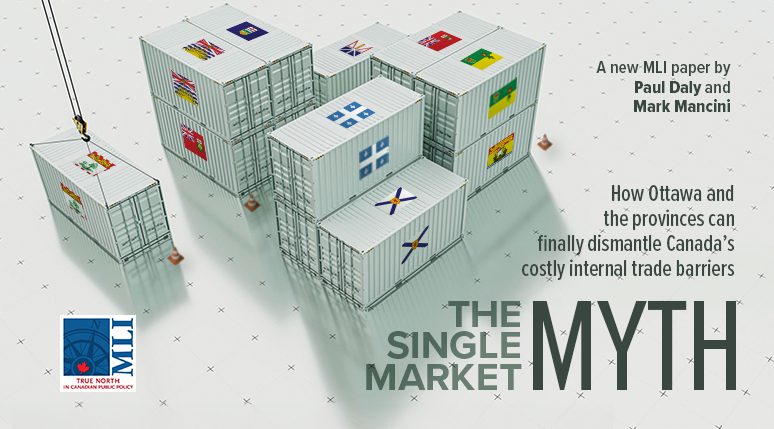
The single market myth: How Ottawa and the provinces can finally dismantle Canada’s costly internal trade barriers

It is often easier to sell goods, provide services, or move professional credentials across national borders in the European Union than across provincial borders in Canada.

March 3, 2026
in Domestic Policy, Latest News, Papers, Economic Policy, Mark Mancini
Reading Time: 6 mins read
A A
The single market myth: How Ottawa and the provinces can finally dismantle Canada’s costly internal trade barriers

By Paul Daly and Mark Mancini
March 3, 2026

PDF of paper

Executive Summary | Sommaire (le français suit)

We Canadians like to think that we live in a single national market – we don’t. Our country’s greatest untapped trade opportunity is not abroad. It is at home.

It is often easier to sell goods, provide services, or move professional credentials across national borders in the European Union than across provincial borders in Canada.

This is not merely embarrassing. It is economically dangerous.

Canada is now confronting serious external trade uncertainty. If Canada is serious about resilience, productivity, and growth, it must finally confront a long-ignored problem: the self-inflicted wound caused by our internal trade barriers.

The common response is to say, “Ottawa should fix it.” Constitutionally, that instinct is wrong.

That is because Canada’s constitutional structure makes unilateral federal action largely impossible. Parliament’s “trade and commerce” power is not a general licence to impose a national economic code country-wide. The day-to-day regulation of goods, services, labour, and professions lies primarily with the provinces. Nor does the Charter rescue us. Courts have consistently refused to treat the Constitution’s mobility or liberty rights as also protecting economic freedom. On the contrary: provincial regulation is constitutionally permissible and, indeed, expected in many areas of economic activity, even when it fragments the national market.

This means that obvious, intuitive solutions – federal legislation or constitutional litigation – cannot deliver true economic integration.

But that does not mean nothing can be done.

Canada already possesses a powerful, underused constitutional tool: co-operative federalism through inter-delegation. Parliament and the provinces cannot trade legislative powers. But they can jointly empower administrative institutions. They can create shared bodies, give them real authority, and require governments to participate in coordinated regulatory schemes. This is not theory. It is how Canada built its national agricultural marketing systems. And it is how we could finally dismantle internal trade barriers.

What would this look like?

We propose the creation of a joint federal-provincial economic integration agency, mandated by matching legislation across participating jurisdictions. This body would not replace governments; it would coordinate them. It would be empowered to do three things:

• First, it would mandate mutual recognition. If a good, service, or professional qualification is lawful in one province, it should presumptively be lawful in all.

• Second, where mutual recognition is insufficient, it would develop harmonized national standards. Provinces would remain free to regulate. But in defined areas they would commit to building common frameworks instead of 10 different ones.

• Third, it would systematically identify and remove unnecessary regulatory barriers. This may require carefully circumscribed executive powers to repeal or modify outdated restrictions, subject to legislative supervision and judicial review.

Canada already gestures in this direction. The Canada Free Trade Agreement proclaims lofty goals, though in fact it must rely on voluntary reconciliation, sprawling exceptions, and weak enforcement. The result has been incrementalism, not integration. Real economic union cannot be built on polite requests and explanatory memos. It requires binding coordination.

Some will object that this proposal threatens provincial autonomy. In fact, the opposite is true.

The greatest threat to autonomy is not coordination, but fragmentation. When each province regulates in isolation, its choices inevitably burden the citizens and businesses of other provinces. A national coordinating body will not erase provincial power; what it will do is manage the collisions between provincial regimes. It will ensure that autonomy exercised in one jurisdiction will not disable autonomy elsewhere.

Others will worry about technocracy. But we should be honest: Canada already lives under dense and multi-layered regulation. The status quo is not laissez-faire. It is 10 overlapping regulatory states that unintentionally block one another. The question is not whether government will structure the economy. It is whether it will do so incoherently or intelligently.

The drafters of our Constitution envisioned an economic union. They constitutionally guaranteed free trade in goods between provinces. But courts have since drained that promise of force. We cannot litigate our way back to it. But we can legislate our way forward – together – with a joint federal-provincial economic integration agency.


Au Canada, nous pensons souvent à tort que notre marché national est isolé – c’est faux. Les possibilités commerciales inexploitées les plus intéressantes sont chez nous, pas à l’étranger.

Or, il est généralement plus aisé de commercialiser des produits, offrir des services ou faire valoir des compétences au sein de l’Union européenne qu’à travers nos frontières provinciales : une source de malaise et une menace économique.

L’avenir de notre commerce international est empreint d’incertitudes. Si le Canada tient vraiment à renforcer sa résilience, sa productivité et sa croissance, il doit enfin s’attaquer à un enjeu trop longtemps négligé : les obstacles intérieurs auto-infligés.

La réponse habituelle est de supposer que : « C’est à Ottawa de résoudre le problème ». D’un point de vue constitutionnel, cette réaction est inappropriée.

Effectivement, notre Constitution rend presque impossible toute initiative fédérale unilatérale. L’autorité du Parlement en matière de « commerce et d’échange » ne lui permet pas d’imposer un même code économique à travers le pays. Les provinces contrôlent quotidiennement les produits, services, mains-d’œuvre et compétences. Et la Charte n’apporte point de salut. Les tribunaux n’ont jamais voulu confirmer que le droit à la liberté et la mobilité garantissait également la liberté économique. À l’opposé, la réglementation provinciale est constitutionnellement admissible et, d’ailleurs, anticipée dans bon nombre de secteurs, même si elle divise le marché national.

En clair,  les solutions automatiques – législation fédérale ou contentieux constitutionnel – ne sauraient produire une véritable intégration économique.

Cela ne signifie nullement qu’on ne peut rien faire.

Le Canada possède déjà un outil constitutionnel puissant et peu utilisé : le fédéralisme coopératif par délégation réciproque. Le Parlement et les provinces ne peuvent échanger leurs pouvoirs législatifs. Cependant, ils peuvent conjointement habiliter des institutions administratives, créer des entités communes disposant d’une véritable autorité et encourager les gouvernements à participer à des mécanismes de régulation coordonnés. Et pas qu’en théorie. Voilà comment le Canada a mis en place ses systèmes nationaux de commercialisation des produits agricoles. Et voici comment nous pourrions finalement abolir les barrières intérieures au commerce.

Où cela nous mènerait-il?

Nous proposons la création d’une agence fédérale-provinciale dédiée à l’intégration économique, encadrée par une loi type que chaque région partenaire s’engagerait à transposer. Au lieu de remplacer les gouvernements, cette entité devrait les coordonner. Elle aurait trois rôles :

• Elle jetterait d’abord les bases d’une reconnaissance mutuelle. Si une compétence professionnelle, un service ou un produit est légal dans une province, il doit présumément l’être partout.

• Puis, lorsque la reconnaissance mutuelle fait défaut, elle instaurerait des normes nationales harmonisées. Les provinces conserveraient leur liberté de réglementer, mais elles s’engageraient, dans certains secteurs précis, à mettre sur pied des structures communes au lieu de dix distinctes.

• Cette entité chercherait enfin à identifier et à supprimer systématiquement les contraintes réglementaires inutiles, en définissant les pouvoirs exécutifs nécessaires pour abroger ou modifier les restrictions obsolètes, sous un contrôle législatif et judiciaire.

Le Canada est déjà engagé dans cette voie. L’Accord de libre-échange canadien, malgré ses objectifs ambitieux, repose en réalité sur le principe du volontariat, des exceptions étendues et une application peu rigoureuse, s’approchant davantage d’un «  gradualisme  » que d’une intégration. Or, il est impossible de construire une union économique efficace avec des sollicitations courtoises et des notes explicatives. Une union efficace exige une coordination stricte.

De l’avis de certains, notre proposition menace l’indépendance des provinces. En fait, c’est tout le contraire.

Contrairement à la fragmentation, la coordination n’est pas le principal risque pour l’autonomie. Quand chaque province réglemente seule, ses décisions pèsent inévitablement sur les citoyens et les entreprises hors province. Un organisme national de coordination ne saurait abroger l’autorité provinciale, mais réduirait les risques de chevauchements. Il veillerait à ce que l’indépendance observée dans un domaine précis ne compromette pas l’autonomie de la majorité.

D’autres encore s’inquiètent de la technocratie. Soyons francs : le Canada fait face à un régime réglementaire complexe et stratifié. Le statu quo n’est pas synonyme de laissez-faire, considérant qu’actuellement, dix autorités se superposent et, non intentionnellement, se nuisent mutuellement. La problématique ne tient pas à la structure de l’économie, mais plutôt à la capacité du gouvernement à agir avec cohérence et discernement.

Les créateurs de notre Constitution ont assuré la libre circulation des biens entre les provinces pour promouvoir l’union économique. Cependant, les tribunaux ont depuis vidé cette promesse de sens. Il nous est impossible de faire marche arrière par la voie judiciaire. Cependant, il est possible de progresser – par le biais de démarches législatives concertées  – en s’appuyant sur une agence d’intégration économique fédérale-provinciale.

 

Tags: Paul Daly

Related Posts

How Canada can prepare for high-pressure U.S. demands on sovereignty and trade: Jerome Gessaroli in Policy Options
Economic Policy

How Canada can prepare for high-pressure U.S. demands on sovereignty and trade: Jerome Gessaroli in Policy Options

March 3, 2026
Who should choose Canada’s judges? – Provincial power and the future of judicial appointments: Troy Riddell for Inside Policy
Justice

Who should choose Canada’s judges? – Provincial power and the future of judicial appointments: Troy Riddell for Inside Policy

March 3, 2026
Iran’s war is not distant for Canada: Joe Varner in the Western Standard
National Security

Iran’s war is not distant for Canada: Joe Varner in the Western Standard

March 3, 2026
Next Post
Who should choose Canada’s judges? – Provincial power and the future of judicial appointments: Troy Riddell for Inside Policy

Who should choose Canada’s judges? - Provincial power and the future of judicial appointments: Troy Riddell for Inside Policy

Newsletter Signup

  Thank you for Signing Up
  Please correct the marked field(s) below.
Email Address  *
1,true,6,Contact Email,2
First Name *
1,true,1,First Name,2
Last Name *
1,true,1,Last Name,2
*
*Required Fields

Follow us on

Macdonald-Laurier Institute

323 Chapel Street, Suite #300
Ottawa, Ontario, K1N 7Z2 Canada

613.482.8327

info@macdonaldlaurier.ca
MLI directory

Support Us

Support the Macdonald-Laurier Institute to help ensure that Canada is one of the best governed countries in the world. Click below to learn more or become a sponsor.

Support Us

  • Inside Policy Magazine
  • Annual Reports
  • Jobs
  • Privacy Policy

© 2023 Macdonald-Laurier Institute. All Rights reserved.

No Result
View All Result
  • Home
  • About
    • Who We Are
    • Who Makes MLI Work
    • Fifteenth Anniversary
  • Experts
    • Experts Directory
    • In Memoriam
  • Issues
    • Domestic Policy
      • Economic Policy
      • Justice
      • Rights and Freedoms
      • Assisted Suicide (MAID)
      • Health Care
      • COVID-19
      • Gender Identity
      • Canada’s Political Tradition
      • AI, Technology and Innovation
      • Media and Telecoms
      • Housing
      • Immigration
      • Agriculture and Agri-Food
      • Competition Policy
    • Energy Policy
      • Energy
      • Environment
    • Foreign Policy
      • Israel-Hamas War
      • Ukraine
      • Taiwan
      • China
      • Europe and Russia
      • Indo-Pacific
      • Middle East and North Africa
      • North America
      • Foreign Interference
      • National Defence
      • National Security
      • Foreign Affairs
    • Indigenous Affairs
  • Projects
    • CNAPS (Center for North American Prosperity and Security)
    • The Promised Land
    • Voices that Inspire: The Macdonald-Laurier Vancouver Speaker Series
    • Dragon at the door
    • Canada on top of the world
    • Letter to a minister
    • Justice Report Card
    • The Great Energy Crisis
    • DisInfoWatch.org
    • Managing Indigenous Prosperity
    • Judicial Foundations
    • Landmark Cases Council
    • Defending The Marketplace of Ideas
    • Reforming the University
    • Past Projects
      • Digital Policy & Connectivity
      • Double Trouble
      • Canada and the Indo-Pacific Initiative
      • The Transatlantic Program
      • COVID Misery Index
      • Speak for Ourselves
      • The Eavesdropping Dragon: Huawei
      • Talkin’ in the Free World with Mariam Memarsadeghi
      • An Intellectual Property Strategy for Canada
      • Munk Senior Fellows
      • A Mandate for Canada
      • Confederation Series
      • Fiscal Reform
      • The Canadian Century project
      • Fixing Canadian health care
      • Internal trade
      • From a mandate for change
      • Size of government in Canada
      • Straight Talk
      • Labour Market Report
      • Leading Economic Indicator
      • Centre for Advancing Canada’s Interests Abroad
      • Indigenous Prosperity at a Crossroads
  • Events
    • Upcoming Events
    • Past Events
      • MLI Dinners
      • Great Canadian Debates
  • Latest News
  • Libraries
    • Columns
    • Commentary
    • Papers
    • Books
    • Video
  • Donate

© 2023 Macdonald-Laurier Institute. All Rights reserved.