This article originally appeared in the National Post.
By Richard Shimooka, Alexander Lanoszka, and Balkan Devlen, March 2, 2026
Over the past several months, the Trump administration has employed military force to spectacular effect — against Iranian nuclear facilities, Venezuelan President Nicolás Maduro, and Boko Haram targets in Nigeria. Many observers have interpreted these events as an escalating cycle of force by the White House, one that will inevitably reach Greenland and ultimately Canada. Such fears are understandable given the administration’s inflammatory rhetoric, but the record suggests something quite different. The common thread connecting these operations is not escalation, but political opportunism: applying force only where the political and military costs appear low, in pursuit of quick wins that serve a limited foreign policy agenda.
The central tenet of U.S. President Donald Trump’s second-term approach to the world appears to remain what it was at the outset: retrenching American power to its hemisphere, building up homeland defences and limiting foreign expenditures. As we argued early in this administration’s tenure, the president’s budget priorities indicated an insular America, not an imperial one. The military operations of recent months have confirmed that assessment. What is most striking about these interventions is just how limited they are in terms of commitment.
Consider the record. Operation Midnight Hammer — the joint Israeli-American strike against Iran’s nuclear facilities — was a one-day raid conducted largely with airpower. The Christmas Day cruise missile attack against Boko Haram in Nigeria followed a similar template. And the operation to remove Maduro from Venezuela, though dramatic, saw limited force being used. Beginning with legally dubious strikes on alleged smuggling vessels and culminating in the 12-hour operation to capture and extradite Maduro to the United States, the White House has relied on tools that avoid any long-term commitment of forces to the region. None of these operations entailed open-ended commitments, particularly involving boots on the ground, up front.
This pattern is not new. The first Trump administration exhibited similar tendencies. Though the president inherited the wars in Afghanistan and Syria, his overarching impulse was to withdraw from those conflicts. When he deployed force, it took the form of short, largely airpower-driven operations designed to achieve fast, politically favourable outcomes.
Domestic politics likely explains this restraint. American public polling shows persistently low support for military interventions, reflecting both an enduring reticence toward foreign military engagements and the overall unpopularity of the administration itself. Congress has shown growing skepticism of the president’s authority to use force. Last month, Trump narrowly avoided a Senate vote that would have further restricted his ability to employ military force in Venezuela, a measure the White House lobbied intensively to prevent. The administration recognizes these constraints. As we have argued, the underlying unpopularity of Trump’s foreign policy positions limits his room to manoeuvre, regardless of how aggressively the White House frames its actions.
One paradoxical feature of Trump’s approach to force is its conspicuous lack of discretion. Unlike predecessors who frequently conducted covert campaigns to advance foreign policy objectives, this White House publicizes every operation for maximum political effect. Indeed, this administration conducts foreign policy primarily through coercion and the threat of force. When combined with over-the-top rhetoric and bluster, the pattern becomes clear: Trump’s military doctrine is designed to project strength while avoiding the political costs of sustained engagement.

The president has shown himself relatively malleable in pursuing his goals, withdrawing from positions or changing course when the political costs grow too steep. Nevertheless, one must ask what happens when he confronts an obstinate actor unwilling to bend to his wishes, even under military pressure. Would the administration respond by escalating?
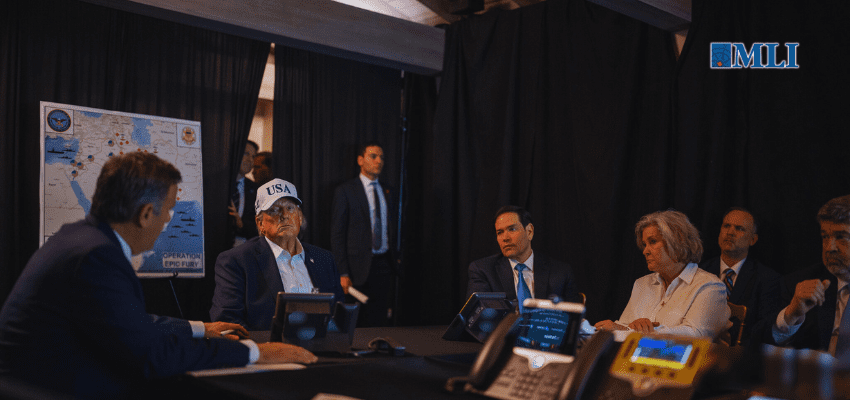
This question matters given the start of military operations by the U.S. and Israel against Iran on Saturday. We are still in the initial stages of this military campaign and the fog of war makes it difficult to assess its effectiveness right now. However, a couple of points are important to keep in mind. Unlike Maduro, the Islamic Republic is deeply entrenched. While extremely unpopular among its own population, the Iranian regime is unlikely to be dislodged by limited military strikes. The administration has not provided a credible justification for how its current approach will produce meaningful political change in Tehran. The historical record does not preclude a change in tack once the limits of these methods become apparent. A parallel can be found in Trump’s first-term crisis with North Korea, which escalated through major threats and military redeployments before the administration pivoted abruptly toward accommodation. By providing no clear justification for military action, the administration can continue the strikes until it achieves some limited political gains or incurs unacceptable costs. Then Washington can retroactively state it achieved victory.
For Canada, this pattern carries a clear implication. The use of military force to advance American objectives in Greenland or against Canada is extraordinarily unlikely given these constraints. An administration that narrowly avoids congressional censure over Venezuela, that conducts only brief airpower-driven raids, and that retreats when political costs mount is not one poised to undertake military action against a NATO ally and its largest trading partner. Canadians should not allow the White House’s rhetorical provocations to distort their assessment of actual strategic risk. As we have stressed throughout this period, reacting to every pronouncement as though it were already policy is corrosive to strategic thinking.
Canada’s response should be grounded in sober analysis of what this administration does — not what it says.
Richard Shimooka is senior fellow at the Macdonald-Laurier Institute and a contributing writer to The Hub.
Alexander Lanoszka is senior fellow at the Macdonald-Laurier Institute and Associate Professor at the University of Waterloo.
Balkan Devlen is senior fellow at the Macdonald-Laurier Institute and co-founder of Pendulum Geopolitical Advisory.