
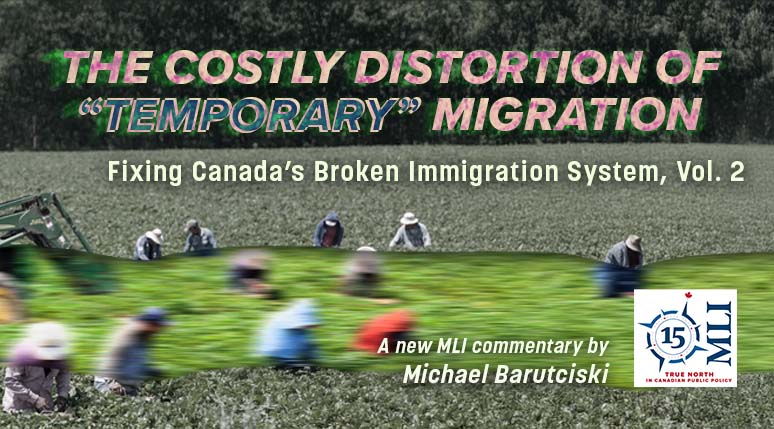
By Michael Barutciski
February 5, 2026
Introduction
While Canada is fortunate to have enjoyed a pro-immigration consensus for decades, it is no longer possible to be complacent or insist on the status quo. Public polling is showing a marked change in attitudes towards immigration. This recent shift is not surprising since less than two years ago former Prime Minister Justin Trudeau and his immigration minister began conceding that various parts of the system were being abused and were “out of control.” The federal government had no choice but to announce a course correction.
After being sworn into office less than a year ago, Prime Minister Mark Carney issued a mandate letter that instructs his immigration minister to attract “the best talent in the world to help build our economy, while returning our overall immigration rates to sustainable levels.” The minister, Lena Metlege Diab, is on the record as clarifying that “we have a mandate and commitment to repair our immigration system and we’re doing just that.” Most Canadians would agree these statements provide a sensible overall policy direction. Achieving the government’s stated goal, however, will be harder than people think.
The federal budget defends cuts to immigration by admitting that the system has been poorly controlled and abused – indeed, one of the country’s greatest public policy failures this century – and by pledging to take “back control over the immigration system” and put Canada on a trajectory to return immigration to “sustainable levels.”
This policy shift reflects broad agreement that recent intake levels were simply too large and must be significantly reduced. The post-pandemic immigration surge created problems beyond housing supply, including business models overly reliant on foreign workers and students.
The recent budget also highlights a new complication created by the unprecedented influx of temporary migrants. The complexities of the relationship between temporary and permanent immigration, along with the introduction of many pathways linking these categories, have contributed to undermining what was once seen as a global model of orderly migration. As explained on page 95 of the budget:
Our immigration system was built to standardise [sic] and evaluate newcomers so that admission was based on a person’s merits. Over time, this system has evolved—its complexity has grown and its efficiency has waned. In recent years, the system became even harder to manage and less functional, and the pace of arrivals began to exceed Canada’s capacity to absorb and support newcomers in the way we are used to doing.
The government is acknowledging what many Canadians have intuitively felt for a while: we are admitting far more foreign residents than we can screen, monitor, and integrate. This represents an astounding development for a country that supposedly takes immigration seriously.
To understand the current predicament, we need to appreciate the extent to which the new reliance on temporary migration represents a significant break from Canada’s historical approach to immigration policy. The budget recognizes that reining in this aspect is particularly important: “Canada’s new government recognises that this [temporary resident] system is no longer sustainable.”
From an operational perspective, it should be noted that the federal government has struggled with managing the various immigration categories even though relevant institutions such as Immigration, Refugees and Citizenship Canada (IRCC) and the Immigration and Refugee Board (IRB) have benefitted from a doubling of their expenditures and personnel over the last decade. Given anticipated budget cuts, it is difficult to imagine how the government will be more effective in assessing applications, examining cases, selecting migrants and enforcing rules to maintain the system’s integrity.
Canada’s immigration system clearly needs serious reorientation and multifaceted reforms. Such changes will be challenging due to the current economic and political environment, which may limit what can realistically be implemented. The importance of immigration for Canada’s future, however, requires bold and intentional direction that will restore public confidence.
Constraining ministerial ad hoc powers
A key first step is to address how some ministerial powers have recently been used. The immigration minister can change immigration policies without parliamentary approval in part because the traditional Westminster parliamentary system provides large discretionary powers in this area. Although the immigration minister was given explicit legislative authority to issue temporary directives nearly two decades ago as a practical measure, that authority has been used in ways that affect key aspects of the candidate selection process, as pointed out by immigration lawyer Mario Bellissimo. Given the failings of policy decision-making in recent years, legislative parameters need to be established to constrain the immigration minister’s ability to change intake plans and processing on an ad hoc basis. By amending the relevant legislation to limit the ministerial instructions that can be issued, the immigration minister would be obliged to proceed more often via the regulatory process. The drafting of regulations allows more transparency, which can help avoid some of the improvisational nature of various recent policy decisions.
Recommendation: To reduce the type of disorder introduced in the system over recent years, section 14.1 of the Immigration and Refugee Protection Act should be amended to limit the use of Ministerial Instructions to establish a class of permanent residents as part of the economic class.
Reconsidering the temporary-permanent linkages
Addressing the problems created by the growing links between temporary and permanent migration requires a rethink of how the system is designed. Canada’s points-based immigration system developed out of specific geographic and historic realities. Indeed, the country has historically avoided temporary resident programs largely because of its geography. The general idea was that if a migrant makes it to faraway Canada, he or she was typically encouraged to integrate as an immigrant who could help the growing country. For practical reasons that reflected the country’s general goal of maintaining immigrants, a culture of removals and deportations never developed.
Yet we clearly need to adapt to changing circumstances. While the globalization of recent decades has resulted in more foreigners from diverse regions being able to travel to Canada, an essential corollary needs to be accepted if we are to recognize the importance of immigration control in maintaining public trust. Namely, it is impossible to have extensive temporary resident programs accompanied by complex pathways to permanent resident status while also being reluctant to conduct removals. A sustainable fix will have to reconsider these issues in a comprehensive way.
At the same time, we need to appreciate the extent to which the recent use of temporary resident programs has distorted the permanent resident programs. By emphasizing Canadian experience and credentials, we have incentivized migrants to arrive as temporary residents while preparing their transition to permanent resident status. As summarised in the Toronto Star:
Canada has been viewed as one of the world’s most welcoming countries, with relatively clear pathways for permanent residence. However, over time, the system has put more weight on immigration candidates’ Canadian education credentials and job experience, creating an incentive for migrants to come as temporary residents to study and work.
This explanation in no way excuses the abuse by employers and leaders of education institutions who capitalized on the short-term benefits associated with relying on foreign workers and students.
We need to be lucid about the socio-economic impacts, including the effects on Canadian demographic trends. As pointed out in an internal discussion paper published by the Bank of Canada, new temporary residents tend to be young low-skilled migrants from poor countries:
Not only has Canada experienced an unprecedented surge in immigration, but the composition of recent newcomers has been markedly different than in the past. Recent Canadian immigration has been driven mostly by NPRs [non-permanent residents] that have different socio-economic characteristics compared with previous waves. For instance, recent NPRs are younger and less experienced, and have seen their share in skilled occupations fall modestly. The distribution of NPRs across birth regions has also shifted toward lower-income countries, which correlates with lower entry wages in the domestic labour market.
Along with the challenges posed by the different cultural values that come with this massive labour supply growth, we also need to be clear about the risk that young Canadians lose out in the competition for typical youth jobs.
To re-establish a coherent and effective system that serves Canadians, the distinction between temporary and permanent resident status should be reaffirmed. Implicit promises of transition should be avoided because they tend to blur the legal categories and to increase tolerance for ambiguous in-between statuses. In other words, the general approach should be refocused on the points-based model known as the Comprehensive Ranking System (CRS) so that the long-term interests of the country are being served, as opposed to those of lobbyists who want to fill specific and immediate labour market needs.
To achieve this goal, two-step or transition pathways to permanent resident status should generally be phased out. Enforcement challenges can be mitigated by a reconceptualization of international solidarity that emphasizes the positive aspects of return to the country of origin. Indeed, a case can be made that a returning migrant with Canadian experience helps to address the “brain drain” experienced by poorer countries, which is an inevitable, albeit oft-ignored, aspect of Canada’s point-system.
To address the problem in a comprehensive way, we need to clarify the role Express Entry has played in the informal conflation of temporary and permanent statuses. When the federal government introduced Express Entry in 2015, it put us on a path that increasingly prioritized “Canadian experience.” The previous vision of CRS, emphasizing human capital and the ability to adapt to changing socio-economic circumstances, was gradually replaced by this supposedly more pragmatic vision. Following the spread of this new approach, it has become clear over the years that foreign economic candidates have a better chance of gaining permanent resident status by obtaining a job offer or studying in Canada. In other words, by transforming CRS into a “locally groomed” or “in-house” process, we have an example of how the road to hell can be paved with good intentions.
Recommendation: The government should generally avoid making implicit promises of transition between temporary and permanent resident status. The role of Express Entry should be re-examined within the context of a purposeful refocus on the points-based Comprehensive Ranking System.
A similar problem appears to be developing in the way Express Entry is used to further bilingualism rather than encouraging the open competition underlying CRS. By favouring francophone candidates who are willing to settle outside Quebec, less permanent resident spots are available for other highly qualified applicants. While expanding bilingualism and protecting minorities is admirable, the rationale presented by the former immigration minister who developed the policy appears to be at odds with Prime Minister Mark Carney’s mandate letter:
[T]he Government of Canada recognizes the demographic decline of Francophone and Acadian minority communities over the past decades (dropping from 6.1% in 1971 to 3.5% of the Canadian population outside Quebec in 2021). There is an urgent need to address this decline, particularly by leveraging Francophone immigration. The Government’s commitment to restoring and increasing the demographic weight of Francophone and Acadian minority communities is now enshrined in the modernized Official Languages Act.
The emphasis promoted by this policy needs to be reconsidered given the clear instructions to reduce overall intakes while attracting the best talent to build the economy.
Recommendation: The government should reconsider the IRCC policy that has encouraged the use of Express Entry to favour francophone candidates who settle outside Quebec. It should also amend section 2(b) of the Official Languages Act to limit the justification for this form of social engineering through immigration intake.
Reaffirming the raison-d’être of foreign worker streams
There are two primary streams for temporary foreign workers and both experienced huge growth in recent years. The first stream requires employers to get a labour market impact assessment (LMIA), to confirm a need for the worker. As recommended below, LMIA rules should be tightened.
The other stream promotes exchanges through the somewhat opaque International Mobility Program (IMP). The vast majority of the 905,440 migrants who began working in Canada on new work permits in 2024 came from this program. Along with clarifying the intended purpose and use of the IMP stream, the numbers need to be reduced even beyond what is proposed by the government.
Recent TFWP enforcement data on the scale of violations and penalties suggest it has become a business model for some economic actors. Key sectors such as the food industry and construction, as well as the long-haul trucking industry, rely on this form of migrant labour in a way that does not respect the government’s vision of TFWP as “a last resort option for employers who cannot find qualified Canadians and permanent residents to fill job vacancies.”
As mentioned above, young Canadians also end up having less access to typical youth jobs because the foreign labour is concentrated in low-wage entry-level jobs. This disproportionate impact will likely be amplified as AI complicates youth access to employment opportunities that would normally develop basic skills that help them become future economic contributors. The potential alienation is not purely economic.
Even more generally, the problems created by imported cheap labour affect not only low-wage sectors: the negative dynamic described above plays out in higher-wage sectors to the extent that foreign workers can also be used to lower salaries through competition. As argued by The Globe and Mail’s editorial board, the overall result from a national perspective is that TFWP keeps wages low while easing pressure on businesses to innovate and invest. Meanwhile, Canadians are experiencing lower living standards as the country’s GDP per capita has dropped, which prompted the National Bank of Canada to suggest a year ago that we may find ourselves in a population trap.
It is strange that a country known for its sophisticated immigration model would have a government that over the last few years kept repeating the simplistic argument that admitting more migrants leads to higher aggregate GDP numbers. While it is true that Canada’s economy has grown, this was due to population increases far outpacing all other OECD member states. To highlight the related unhealthy demographic trends, it should be noted that at the same time the country’s fertility rate plunged to the historic “ultra-low” level of 1.25 children per woman. Put bluntly, the historic population growth, which was the result of a record number of immigrants, has contributed to lower Canadian living standards. It is no wonder that the public mood towards immigration has soured.
A sensible general response to the basic policy challenge is outlined by Macdonald-Laurier Institute contributor Michael Bonner:
We can begin by phasing out and abolishing easy access to the low-wage portion of our labour market. The only exception to this approach would be in areas such as seasonal agricultural or fisheries work, where the TFWP has proven uncontroversial. This process would not be without pain, obviously, but gradually phasing out would alleviate much of it. Businesses that have become addicted to cheap foreign labour certainly would object and probably resist being forced to pay higher wages and invest in a domestic workforce. But the moral problem of continuing a form of indentured servitude and the pain of depriving young people of career-starting jobs would be worse in the long run.
According to the immigration minister’s latest Annual Report, there were 191,630 migrants with new work permits under the TFWP in 2024. The government is planning to reduce new arrivals under the TFWP to 60,000 in 2026, and 50,000 in 2027 and 2028. Canada has not seen such low numbers of TFWP admissions since the beginning of the century.
Closing the TFWP completely would be too drastic for employers and industries reliant on this cheap labour. Given the competing interests, an appropriate compromise to avoid sudden disruptions would be to warn businesses by gradually phasing out the program following the planning reductions of the next few years. The government could incentivize employers in certain sectors who commit to improving work conditions and enhancing domestic recruitment by helping them shift to automation with technology investments. The gradual winding down of the program would also give current foreign workers time to continue working until the expiration of their permits.
In the meantime, several ways can be encouraged to restore integrity to the original idea that focused on authorizing limited numbers of foreign workers under exceptional circumstances. In general, the federal government should be exploring safeguards to protect worker rights so that employers are not simply seeking cheap labour. To make sure that the LMIA is issued only when Canadians are genuinely not available, its price can be increased to reflect the actual demand for foreign workers to replace locals. As reported in The Hill Times, the price of a LMIA has not increased from $1,000 in over a decade.
Similarly, efforts should be made to address fraud allegations and negligence involving employers, third parties and even government gatekeepers. Although it is difficult to punish fraudulent activity that occurs overseas, the documents used in the application can be monitored and reported in order to sanction any potential involvement of local employers.
The above two issues are relatively straightforward in the sense that most Canadians would normally expect the rules to be respected and enforced by the government. Overly lenient practices have undoubtedly contributed in undermining public confidence.
In terms of establishing future planning levels beyond the government’s proposed reductions for the next three years, it is useful to consider the broad historical evolution of the TFWP. Following its inception with the creation of the seasonal agricultural worker program in 1966, the next decades saw the introduction of the high-skilled worker component followed by the live-in caregiver program. However, it is the introduction of the low-skilled workers component in 2002 that triggered the significant expansion of the TFWP this century. To the extent that it has been used for low-skilled entry-level jobs in the service industry, this controversial component arguably represents the straw that broke the camel’s back.
The government could demonstrate that it is serious about addressing the growing unemployment rate for young Canadians by winding down access to the TFWP for this component as quickly as possible. Given that it accounted for more than half the TFWP admissions as soon as it was introduced, the government’s future planning could be halved so that new arrivals following the initial planned reductions can be limited to 25,000.
Recommendation: As the federal government’s planned reductions are implemented over the next three years, the TFWP’s integrity should be restored by returning to a strict approach in the issuance of the LMIA. Allegations of fraud by potential employers and negligence by government controllers should be addressed with stiffer penalties.
Recommendation: The size of the TFWP should be further reduced by eliminating the low-skilled workers component so that admissions following the current levels plan will drop to 25,000 for 2029.
Recommendation: The federal government should establish an additional precondition for participating in the TFWP by obliging potential employers in certain sectors to attend high school recruitment sessions and to offer training and jobs to Canadian students. This new procedural step to qualify for TFWP would be applied in addition to a revamped and strictly enforced LMIA process.
Focusing on labour conditions and protecting specific sectors
The extent to which temporary resident programs have allowed the government to stray off course deserves to be underlined. Canada’s economic immigration system was never intended to supply businesses with legions of low-skilled, supposedly temporary workers from faraway lands filling what would typically be considered permanent jobs in non-critical sectors, such as food services or accommodation.
Yet the pushback from businesses relying on foreign workers needs to be addressed in a serious way given that part of the service sector can only presently survive with low-wage, low-skilled foreign workers. This issue is not unique to Canada, though, and it will not disappear tomorrow, so new ways of approaching the dependency on cheap labour need to be considered.
If we recognize that massive low-skilled migration has disproportionately harmed the most vulnerable and poorest Canadians by limiting their access to services, schools and housing, some peer countries are showing how it is possible to gain support for restraining immigration programs by appealing to traditional labour movement concerns.
This is the argument that has allowed Denmark’s socio-democrats to justify their recent tightening of immigration policies, as reflected in the following statement by the country’s immigration minister during the pandemic: “The social democratic welfare state can only survive if we have migration under control.” As suggested in The New York Times, the Danish lesson is relevant to our policymakers to the extent that massive immigration from diverse cultural backgrounds makes it difficult to maintain the solidarity that allows welfare states to be funded with progressive taxation. It should not be controversial to suggest that the high taxes underpinning collective approaches require a sense of solidarity or shared community, which is particularly jeopardized by uncontrolled migration.
If the Canadian government is concerned that waning public support will complicate future policymaking, then it should acknowledge the trade-off in terms of social cohesion and focus on preventing the suppression of wages. By exploring the link between high immigration and economic inequality at the national level, we can consider new ways of encouraging the labour movement to serve as an ally in the national strategy to return immigration to more sustainable levels.
Recommendation: The federal government should explore how unionization of workers in specific sectors that rely largely on foreign workers could become a program prerequisite to ensure wages and conditions are acceptable.
The issue of labour conditions is crucial when protecting some designated sectors by allowing them access to temporary foreign workers. The government has indicated that access to the TWFP should be calibrated to Canada’s geographic and economic circumstances as announced on page 96 of the recent budget:
The government recognises the role temporary foreign workers play in some sectors of the economy and in some parts of the country. To that end, the 2026-2028 Immigration Levels Plan will consider industries and sectors impacted by tariffs and the unique needs of rural and remote communities.
There appears to be a consensus that some sectors, such as seasonal agriculture and fisheries, should be able to continue hiring temporary foreign workers. Migrant workers in these sectors typically have a natural termination date for their employment term and accompanying accommodation that is provided by the employer. This allows them to be flown back to their country of origin, often on chartered flights. Moreover, these jobs are less attractive to many Canadians given that they are seasonal. Employers also have reasonable concerns about finding available workers given that these jobs are often in rural parts of the country.
Recommendation: Certain specific seasonal sectors such as agriculture and fisheries should continue to be allowed to participate in the TFWP, as they have for decades. The federal government, however, should explore ways to improve work conditions and reduce the provincial obstacles to unionization and collective bargaining.
When considering cuts to the TFWP, we need to remember that most foreign workers in Canada obtained new work permits under a different program, the IMP. This latter program was introduced in 2014 and it was originally intended to help support and advance Canada’s broad economic and cultural national interests. However, the data included in an evaluation of the program suggest that it has increasingly been used for migrants who are mainly advancing their own personal interests. For example, the largest categories of beneficiaries are foreign students who have been granted work permits after graduating, as well as foreign students who are working while studying. How they benefit Canada is somewhat unclear if potential harm to the domestic labour market is considered. Given that the federal government has issued more than 700,000 of these work permits under the IMP in both 2023 and 2024, the purpose of this program needs to be re-evaluated. The country’s evolving economic situation, as well as the government’s apparent willingness to correct previous policy mistakes, suggest this program may need to be cut more than the annual targets of 170,000 for the next three years.
Recommendation: The future of the IMP should be re-evaluated with a view to limiting its use in a way that clearly advances Canada’s broad economic and cultural interests.
Ending higher education financing with foreign students
The problems regarding foreign students relate not only to employment, but also more generally to how they have been used to finance cash-strapped institutions of higher education.
Recent commentaries have explained the dilemmas faced by universities and criticized how international students have become part of a business model. These critical opinions have suggested that a significant portion of operating budgets and revenues (e.g. 22–43%) at our top universities come from international student tuition fees. Put in other words, some provinces are limiting their funding to universities and freezing tuition fees for domestic students, yet they somehow believe it is acceptable policy to ask foreign students to cover the shortfalls.
Similarly to foreign workers, the economic policy behind this questionable development has evolved in a bi-partisan manner over the last couple of decades, with IRCC occupying an important but discreet position by facilitating its institutionalization and expansion. By continually expanding the number of hours foreign students could work, and then by authorizing off-campus employment, the ground was set for integration into the central part of Canada’s immigration system through linkage to Express Entry.
From a system that accepted foreign students with the financial means (or assistance) to cover high tuition fees, it evolved into a system that allowed poorer students to work in Canada while preparing their applications for permanent resident status. This was not a glitch in the system but rather the logical outcome.
The result is that foreign students have been indirectly integrated into the system as “de facto economic immigrants.” The transition to de jure status was dangled as a carrot to potential candidates.
Recommendation: The practice of issuing work permits to foreign students should be limited to allow only on-campus work up to a maximum of ten hours per week.
Yet the consequences go well beyond the initial goals underlying the policy. While education institutions have enjoyed massive revenues from foreign students for many years, a new form of worker exploitation has been normalized and the country now faces more asylum claims from migrants with expired student visas who are desperate to prolong their stay in Canada. MLI’s David Thomas offers the following critical analysis of the new rules for higher education: “Their primary purpose was not to educate people but to facilitate their admission into Canada on student visas.”
A controlled flow of foreign students surely brings benefits that go beyond the revenues that come with tuition fees. The presence of foreign students ideally exposes Canadians to different perspectives, although this upbeat and unidimensional interpretation can be contested. Princeton’s David Bell has questioned in The New York Times whether “we need to turn university economics departments into mini-Davoses, in which future officials of the International Monetary Fund from different countries reinforce one another’s opinions about global trade.” This type of critique regarding global academic communities applies to other fields, particularly in the social sciences and humanities. Regardless of the intellectual and ideological groupthink potentially encouraged by the internationalization of Canadian universities, they can also become instruments of soft power in a way that is clearly distinct from their roles as generators of knowledge or engines of economic growth.
However, Canadians have never really debated this global vision of higher education that affects the makeup of their campuses. Amongst the various consequences, some domestic applicants risk having fewer (potentially life-changing) opportunities to study and to benefit from social mobility. To fully appreciate the context of the current predicament, we cannot ignore that Canada deliberately chose to fund higher education with disproportionately more foreign students than peer countries (e.g. United States, United Kingdom, and Australia).
A change in terminology is required to move towards a different mindset. The first step is to clarify that foreign students are temporary residents who do not have a right to stay in Canada. Their procedural rights in any potential immigration legal case are limited. To the extent that the expression “international student” is ambiguous, it would be helpful to return to the older expression “foreign students.” By emphasizing the term “foreign,” the next step in recognizing the moral problem of relying on non-Canadian funding of higher education in Canada would become clearer.
At the same time, the federal government can promote a policy shift by reframing the issue in terms of international solidarity. The current challenges to globalization may indeed prove fertile ground for the development of a different approach highlighting the “brain drain” that weakens human capital in less affluent countries of origin. From this perspective, one way of sharing the benefits of a Canadian education is to oblige foreign students to return home and to apply newly acquired skills in their country of origin. Any continued immigration status in Canada would depend on the completion of this requirement.
Recommendation: Sections 211.1, 220.1 and 299 of the Immigration and Refugee Protection Regulations should be amended to refer to “foreign students” instead of “international students.” The regulations should also oblige foreign students to return to their country of origin for at least two years before obtaining a post-graduate work permit or applying for permanent residence.
Eliminating the so-called “interim” status
With the regrettable development of a system centred around maintaining large numbers of temporary residents who can eventually transition to permanent residency, the administrative challenge has turned into a quagmire that is further undermining institutional credibility.
In essence, the recently developed bureaucratic practice of allowing work permit applications from within Canada has led to huge backlogs due to the overwhelming number of applicants. These bureaucratic backlogs to the renewal process often result in migrants losing status during the long waiting periods. From an IRCC perspective, there is a logic in avoiding disruption by allowing foreigners with work or study permits to stay even after the expiration of their visa. This pragmatic “solution” was implemented by a new practice that maintains their supposed “interim” status while waiting for renewal.
Yet we cannot lose sight of the larger issue involving the system’s overall credibility. To put it plainly, this leniency is an example of sending the wrong signal at a particular time when various unprecedented backlogs are contributing to one of the country’s worst public policy failures this century. Indeed, this tolerance of so-called “maintained” status symbolizes the laxism that needs to stop.
One simple way to re-establish integrity is for IRCC to clarify that renewal is not guaranteed and that it is a temporary resident’s responsibility to make sure it is completed on time. Processing delays should not justify de jure or even de facto authorization of those waiting for renewal and we need to incentivize temporary residents to make sure their renewal is in order.
If IRCC is so ineffective that it cannot process these applications on time despite the doubling of its budget and personnel in recent years, then it is unwise to pretend we have a “solution” by simply tolerating migrants who overstay their visas. In other words, if the bureaucracy is unable to handle the quantity of applications, then we need no further proof that we are pushing the limits of our capacity.
As astonishing as it may seem to many Canadians, these migrants with expired visas are actually authorized to stay as a result of a regulatory change that allows this practice. Even though this amendment to the Immigration and Refugee Protection Regulations has a profound impact on the enabling legislation and the overall immigration system, it was never debated and approved by Parliament. The legal basis for this dubious and misguided practice should be eliminated.
Recommendation: The government should consider rescinding any provision in the Immigration and Refugee Protection Regulations that allows temporary residents with expired visas to benefit from a so-called “maintained” status.
Conclusion
In recent years, the federal government has purposefully conflated the permanent and temporary categories of residents, apparently underestimating the impact this would have on the immigration system. Revisiting past approaches can help restore integrity to the system. However, further targeted reforms are necessary so that Canada can refocus on selecting the best permanent residents who can help the country evolve in the 21st century.
Recent controversial changes that have jeopardized the pro-immigration consensus did not occur in isolation but as a part of a broader shift that now calls for new thinking. Enforcement is one area that needs attention. Preserving the system’s integrity will be impossible without new and sustained efforts at ensuring the rules are respected. This will require a coordinated, government-wide response, including institutional changes, with a clear emphasis on restoring public confidence. Ultimately, Canadians must be confident that reforms to the immigration system are designed to earn back their trust. A deliberate and transparent policy agenda will help rebuild that confidence and preserve immigration as one of Canada’s greatest strengths.
About the author
Michael Barutciski is a professor at York University’s Glendon School of Public and International Affairs and a senior fellow at the Macdonald-Laurier Institute.