Friday, December 5, 2025
No Result
View All Result
  • Media
Macdonald-Laurier Institute
  • Home
  • About
    • Who We Are
    • Who Makes MLI Work
    • Fifteenth Anniversary
  • Experts
    • Experts Directory
    • In Memoriam
  • Issues
    • Domestic Policy
      • Economic Policy
      • Justice
      • Rights and Freedoms
      • Assisted Suicide (MAID)
      • Health Care
      • COVID-19
      • Gender Identity
      • Canada’s Political Tradition
      • AI, Technology and Innovation
      • Media and Telecoms
      • Housing
      • Immigration
      • Agriculture and Agri-Food
      • Competition Policy
    • Energy Policy
      • Energy
      • Environment
    • Foreign Policy
      • Israel-Hamas War
      • Ukraine
      • Taiwan
      • China
      • Europe and Russia
      • Indo-Pacific
      • Middle East and North Africa
      • North America
      • Foreign Interference
      • National Defence
      • National Security
      • Foreign Affairs
    • Indigenous Affairs
  • Projects
    • CNAPS (Center for North American Prosperity and Security)
    • The Promised Land
    • Voices that Inspire: The Macdonald-Laurier Vancouver Speaker Series
    • Dragon at the door
    • Canada on top of the world
    • Letter to a minister
    • Justice Report Card
    • The Great Energy Crisis
    • DisInfoWatch.org
    • Managing Indigenous Prosperity
    • Judicial Foundations
    • Landmark Cases Council
    • Defending The Marketplace of Ideas
    • Reforming the University
    • Past Projects
      • Digital Policy & Connectivity
      • Double Trouble
      • Canada and the Indo-Pacific Initiative
      • The Transatlantic Program
      • COVID Misery Index
        • Provincial COVID Misery Index
        • Beyond Lockdown
        • COVID and after: A mandate for recovery
      • Speak for Ourselves
      • The Eavesdropping Dragon: Huawei
      • Talkin’ in the Free World with Mariam Memarsadeghi
      • An Intellectual Property Strategy for Canada
      • Munk Senior Fellows
      • A Mandate for Canada
      • Confederation Series
      • Fiscal Reform
      • The Canadian Century project
      • Fixing Canadian health care
      • Internal trade
      • From a mandate for change
      • Size of government in Canada
      • Straight Talk
      • Labour Market Report
      • Leading Economic Indicator
      • Centre for Advancing Canada’s Interests Abroad
      • Indigenous Prosperity at a Crossroads
        • Aboriginal Canada and Natural Resources
  • Events
    • Upcoming Events
    • Past Events
      • MLI Dinners
      • Great Canadian Debates
  • Latest News
  • Libraries
    • Columns
    • Commentary
    • Papers
    • Books
    • Video
  • Donate
  • Home
  • About
    • Who We Are
    • Who Makes MLI Work
    • Fifteenth Anniversary
  • Experts
    • Experts Directory
    • In Memoriam
  • Issues
    • Domestic Policy
      • Economic Policy
      • Justice
      • Rights and Freedoms
      • Assisted Suicide (MAID)
      • Health Care
      • COVID-19
      • Gender Identity
      • Canada’s Political Tradition
      • AI, Technology and Innovation
      • Media and Telecoms
      • Housing
      • Immigration
      • Agriculture and Agri-Food
      • Competition Policy
    • Energy Policy
      • Energy
      • Environment
    • Foreign Policy
      • Israel-Hamas War
      • Ukraine
      • Taiwan
      • China
      • Europe and Russia
      • Indo-Pacific
      • Middle East and North Africa
      • North America
      • Foreign Interference
      • National Defence
      • National Security
      • Foreign Affairs
    • Indigenous Affairs
  • Projects
    • CNAPS (Center for North American Prosperity and Security)
    • The Promised Land
    • Voices that Inspire: The Macdonald-Laurier Vancouver Speaker Series
    • Dragon at the door
    • Canada on top of the world
    • Letter to a minister
    • Justice Report Card
    • The Great Energy Crisis
    • DisInfoWatch.org
    • Managing Indigenous Prosperity
    • Judicial Foundations
    • Landmark Cases Council
    • Defending The Marketplace of Ideas
    • Reforming the University
    • Past Projects
      • Digital Policy & Connectivity
      • Double Trouble
      • Canada and the Indo-Pacific Initiative
      • The Transatlantic Program
      • COVID Misery Index
        • Provincial COVID Misery Index
        • Beyond Lockdown
        • COVID and after: A mandate for recovery
      • Speak for Ourselves
      • The Eavesdropping Dragon: Huawei
      • Talkin’ in the Free World with Mariam Memarsadeghi
      • An Intellectual Property Strategy for Canada
      • Munk Senior Fellows
      • A Mandate for Canada
      • Confederation Series
      • Fiscal Reform
      • The Canadian Century project
      • Fixing Canadian health care
      • Internal trade
      • From a mandate for change
      • Size of government in Canada
      • Straight Talk
      • Labour Market Report
      • Leading Economic Indicator
      • Centre for Advancing Canada’s Interests Abroad
      • Indigenous Prosperity at a Crossroads
        • Aboriginal Canada and Natural Resources
  • Events
    • Upcoming Events
    • Past Events
      • MLI Dinners
      • Great Canadian Debates
  • Latest News
  • Libraries
    • Columns
    • Commentary
    • Papers
    • Books
    • Video
  • Donate
No Result
View All Result
Macdonald-Laurier Institute

A pivot to China would be a disaster for Canada: Joe Varner in The Line

Beijing won't protect us from foreign threats. Washington might.

November 27, 2025
in Foreign Affairs, Columns, Foreign Policy, Latest News, In the Media, Indo-Pacific, North America, Joe Varner
Reading Time: 4 mins read
A A
A pivot to China would be a disaster for Canada: Joe Varner in The Line

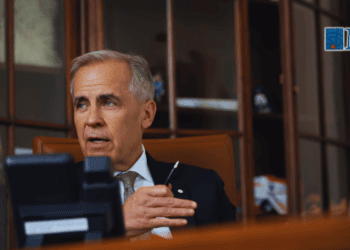
Official White House Photo by Daniel Torok.

This article originally appeared in The Line.

By Joe Varner, November 27, 2025

In what may prove the most self-defeating act of Canadian diplomacy in a generation, the Carney government’s overture toward a trade deal with China signals a dangerous retreat from the Western alliance — and from reality itself.

This latest flirtation with Beijing marks another profound miscalculation in Canadian foreign policy, compounding the diplomatic damage already inflicted by its ill-timed recognition of a Palestinian state. Taken together, these moves suggest a government adrift from the geopolitical realities shaping the 21st century: a world defined not by moral posturing or mercantilist improvisation, but by alliance discipline, deterrence credibility, and economic security within a rapidly fragmenting rules-based order.

At the strategic level, the notion that Canada can meaningfully diversify its trade toward the People’s Republic of China is detached from history, geography, economics, and intelligence reality. Beijing remains under Western sanctions, is actively decoupling from U.S.-led supply chains, and has intensified grey-zone operations against allied interests from the Indo-Pacific to the Arctic.

Aligning Ottawa’s trade calculus with such an adversarial power — at the very moment Washington, Tokyo, Seoul, and Canberra are tightening containment frameworks — signals a failure to grasp Canada’s own position within the Western alliance. It risks eroding American confidence in Canada as a reliable continental defence and economic partner precisely when NORAD modernization, North American energy integration, and Arctic deterrence demand unity. Trying to trade with China while turning our back on the U.S. is like patching the roof while the foundation crumbles beneath us. The irony is unmistakable — just six months ago, during the election campaign, Prime Minister Mark Carney himself described China as “Canada’s greatest threat.”

Those who defend this trade pivot may say that Ottawa’s hands are tied by a Trump administration whose behaviour is at best erratic and at worst hostile towards Canada. They argue that in a world where Washington weaponizes tariffs, threatens supply chains, and uses economic leverage to force concessions, Canada must broaden its options or risk being held hostage by a single market. From this perspective, engaging China — however uncomfortable — offers diversification, access to a massive consumer base, and a hedge against American volatility. Proponents frame it as pragmatic statecraft: if the U.S. is no longer predictable, then Canada must secure new partners to protect its own prosperity.

But the risks are significant, and they cut far deeper than economics. Politically, this renewed openness towards China mirrors the government’s earlier recognition of a Palestinian state — a gesture applauded by anti-Western blocs at the United Nations but viewed by Ottawa’s traditional strategic and economic partner, the United States, as a gratuitous break with consensus. Both policies betray a similar pattern: short-term domestic symbolism overriding long-term strategic coherence. Recognizing a Palestinian state that has no defined borders, no constitution, no functioning institutions, no democratic mandate, no credible body of law, and no industrial base is not diplomacy — it is strategic stupidity. It legitimizes a vacuum certain to be filled by Iran-backed extremists and signals to allies that Canada no longer understands the difference between statehood and chaos.

Each foreign-policy blunder has alienated allies, emboldened adversaries, and weakened Canada’s credibility in the very forums that once amplified its influence. Where previous governments sought to synchronize trade, diplomacy, and defence with Washington and NATO, the Carney administration seemingly mistakes contrarianism for independence.

Economically, China offers neither stability nor transparency. Beijing’s use of trade as coercive leverage — from tariffs on Australia’s wine to punitive restrictions on Canadian canola and fisheries exports — illustrates that Beijing treats commerce as an instrument of state power, not free exchange. A Canada–China trade initiative would expose critical sectors — energy, agriculture, and technology — to the kind of political manipulation Ottawa once condemned. In contrast, the U.S. remains Canada’s indispensable trading partner, innovation ecosystem, and defence industrial anchor. Undermining that relationship amid escalating U.S. tariffs and protectionist sentiment is reckless at best, and self-defeating at worst. If we lose American markets, we won’t get them back — and China welcomes that newfound dependence.

Even with the turbulence of the Trump administration, history suggests that Canada and the U.S. eventually find their way back to the negotiating table. The two economies are simply too integrated, the continental supply chains too interdependent, and the political incentives on both sides too strong for a prolonged rupture. Engaging China as a strategic counterweight to an unpredictable U.S. exposes Canada to a full spectrum of security, political, and economic vulnerabilities.

Beyond economics, this drift reflects a broader failure to anchor foreign policy in realism. The international system is hardening into rival blocs. Democracies are consolidating around deterrence, energy resilience and industrial security, while authoritarian powers weaponize trade, technology, and migration. In this environment, Canada’s foreign policy cannot afford to indulge in gestures untethered from capability or consequence. Ottawa’s recognition of a Palestinian state and its pursuit of a trade pact with Beijing both signal to allies that Canada has lost sight of its strategic identity: a democratic trading nation whose prosperity and security depend on the credibility of the Western alliance.

The strategic conclusion is clear: Canada’s future does not lie across the Pacific under the shadow of an authoritarian regime, but across a shared border within the world’s largest democratic economy.

Beijing is not going to defend Ottawa from Russian incursions in the Arctic. China will not protect us from North Korea’s nuclear brinkmanship. President Xi Jinping will not shield us from Iranian foreign interference operations. But Washington just might — and that is the alliance logic the Carney government seems determined to forget in its dangerously adrift foreign policy strategy.


Joe Varner is deputy director of the Conference of Defence Associations and a senior fellow at the Macdonald-Laurier Institute.
Source: The Line

Related Posts

Property rights are “precarious” in Canada: Paul Warchuk and Peter Copeland for Inside Policy Talks
Domestic Policy

Property rights are “precarious” in Canada: Paul Warchuk and Peter Copeland for Inside Policy Talks

December 4, 2025
Harvard eschews ingrained ideology in order to tackle ‘genuinely hard problems’: Peter MacKinnon in the National Post
Reforming Universities

Harvard eschews ingrained ideology in order to tackle ‘genuinely hard problems’: Peter MacKinnon in the National Post

December 3, 2025
Risking public backlash? Canadian universities and demographic-based faculty hiring
Education

Risking public backlash? Canadian universities and demographic-based faculty hiring

December 3, 2025
Next Post
The Liberal prime minister Pierre Poilievre should emulate: Christopher Dummitt in the National Post

The Liberal prime minister Pierre Poilievre should emulate: Christopher Dummitt in the National Post

Newsletter Signup

  Thank you for Signing Up
  Please correct the marked field(s) below.
Email Address  *
1,true,6,Contact Email,2
First Name *
1,true,1,First Name,2
Last Name *
1,true,1,Last Name,2
*
*Required Fields

Follow us on

Macdonald-Laurier Institute

323 Chapel Street, Suite #300
Ottawa, Ontario, K1N 7Z2 Canada

613.482.8327

info@macdonaldlaurier.ca
MLI directory

Support Us

Support the Macdonald-Laurier Institute to help ensure that Canada is one of the best governed countries in the world. Click below to learn more or become a sponsor.

Support Us

  • Inside Policy Magazine
  • Annual Reports
  • Jobs
  • Privacy Policy

© 2023 Macdonald-Laurier Institute. All Rights reserved.

No Result
View All Result
  • Home
  • About
    • Who We Are
    • Who Makes MLI Work
    • Fifteenth Anniversary
  • Experts
    • Experts Directory
    • In Memoriam
  • Issues
    • Domestic Policy
      • Economic Policy
      • Justice
      • Rights and Freedoms
      • Assisted Suicide (MAID)
      • Health Care
      • COVID-19
      • Gender Identity
      • Canada’s Political Tradition
      • AI, Technology and Innovation
      • Media and Telecoms
      • Housing
      • Immigration
      • Agriculture and Agri-Food
      • Competition Policy
    • Energy Policy
      • Energy
      • Environment
    • Foreign Policy
      • Israel-Hamas War
      • Ukraine
      • Taiwan
      • China
      • Europe and Russia
      • Indo-Pacific
      • Middle East and North Africa
      • North America
      • Foreign Interference
      • National Defence
      • National Security
      • Foreign Affairs
    • Indigenous Affairs
  • Projects
    • CNAPS (Center for North American Prosperity and Security)
    • The Promised Land
    • Voices that Inspire: The Macdonald-Laurier Vancouver Speaker Series
    • Dragon at the door
    • Canada on top of the world
    • Letter to a minister
    • Justice Report Card
    • The Great Energy Crisis
    • DisInfoWatch.org
    • Managing Indigenous Prosperity
    • Judicial Foundations
    • Landmark Cases Council
    • Defending The Marketplace of Ideas
    • Reforming the University
    • Past Projects
      • Digital Policy & Connectivity
      • Double Trouble
      • Canada and the Indo-Pacific Initiative
      • The Transatlantic Program
      • COVID Misery Index
      • Speak for Ourselves
      • The Eavesdropping Dragon: Huawei
      • Talkin’ in the Free World with Mariam Memarsadeghi
      • An Intellectual Property Strategy for Canada
      • Munk Senior Fellows
      • A Mandate for Canada
      • Confederation Series
      • Fiscal Reform
      • The Canadian Century project
      • Fixing Canadian health care
      • Internal trade
      • From a mandate for change
      • Size of government in Canada
      • Straight Talk
      • Labour Market Report
      • Leading Economic Indicator
      • Centre for Advancing Canada’s Interests Abroad
      • Indigenous Prosperity at a Crossroads
  • Events
    • Upcoming Events
    • Past Events
      • MLI Dinners
      • Great Canadian Debates
  • Latest News
  • Libraries
    • Columns
    • Commentary
    • Papers
    • Books
    • Video
  • Donate

© 2023 Macdonald-Laurier Institute. All Rights reserved.