Friday, December 5, 2025
No Result
View All Result
  • Media
Macdonald-Laurier Institute
  • Home
  • About
    • Who We Are
    • Who Makes MLI Work
    • Fifteenth Anniversary
  • Experts
    • Experts Directory
    • In Memoriam
  • Issues
    • Domestic Policy
      • Economic Policy
      • Justice
      • Rights and Freedoms
      • Assisted Suicide (MAID)
      • Health Care
      • COVID-19
      • Gender Identity
      • Canada’s Political Tradition
      • AI, Technology and Innovation
      • Media and Telecoms
      • Housing
      • Immigration
      • Agriculture and Agri-Food
      • Competition Policy
    • Energy Policy
      • Energy
      • Environment
    • Foreign Policy
      • Israel-Hamas War
      • Ukraine
      • Taiwan
      • China
      • Europe and Russia
      • Indo-Pacific
      • Middle East and North Africa
      • North America
      • Foreign Interference
      • National Defence
      • National Security
      • Foreign Affairs
    • Indigenous Affairs
  • Projects
    • CNAPS (Center for North American Prosperity and Security)
    • The Promised Land
    • Voices that Inspire: The Macdonald-Laurier Vancouver Speaker Series
    • Dragon at the door
    • Canada on top of the world
    • Letter to a minister
    • Justice Report Card
    • The Great Energy Crisis
    • DisInfoWatch.org
    • Managing Indigenous Prosperity
    • Judicial Foundations
    • Landmark Cases Council
    • Defending The Marketplace of Ideas
    • Reforming the University
    • Past Projects
      • Digital Policy & Connectivity
      • Double Trouble
      • Canada and the Indo-Pacific Initiative
      • The Transatlantic Program
      • COVID Misery Index
        • Provincial COVID Misery Index
        • Beyond Lockdown
        • COVID and after: A mandate for recovery
      • Speak for Ourselves
      • The Eavesdropping Dragon: Huawei
      • Talkin’ in the Free World with Mariam Memarsadeghi
      • An Intellectual Property Strategy for Canada
      • Munk Senior Fellows
      • A Mandate for Canada
      • Confederation Series
      • Fiscal Reform
      • The Canadian Century project
      • Fixing Canadian health care
      • Internal trade
      • From a mandate for change
      • Size of government in Canada
      • Straight Talk
      • Labour Market Report
      • Leading Economic Indicator
      • Centre for Advancing Canada’s Interests Abroad
      • Indigenous Prosperity at a Crossroads
        • Aboriginal Canada and Natural Resources
  • Events
    • Upcoming Events
    • Past Events
      • MLI Dinners
      • Great Canadian Debates
  • Latest News
  • Libraries
    • Columns
    • Commentary
    • Papers
    • Books
    • Video
  • Donate
  • Home
  • About
    • Who We Are
    • Who Makes MLI Work
    • Fifteenth Anniversary
  • Experts
    • Experts Directory
    • In Memoriam
  • Issues
    • Domestic Policy
      • Economic Policy
      • Justice
      • Rights and Freedoms
      • Assisted Suicide (MAID)
      • Health Care
      • COVID-19
      • Gender Identity
      • Canada’s Political Tradition
      • AI, Technology and Innovation
      • Media and Telecoms
      • Housing
      • Immigration
      • Agriculture and Agri-Food
      • Competition Policy
    • Energy Policy
      • Energy
      • Environment
    • Foreign Policy
      • Israel-Hamas War
      • Ukraine
      • Taiwan
      • China
      • Europe and Russia
      • Indo-Pacific
      • Middle East and North Africa
      • North America
      • Foreign Interference
      • National Defence
      • National Security
      • Foreign Affairs
    • Indigenous Affairs
  • Projects
    • CNAPS (Center for North American Prosperity and Security)
    • The Promised Land
    • Voices that Inspire: The Macdonald-Laurier Vancouver Speaker Series
    • Dragon at the door
    • Canada on top of the world
    • Letter to a minister
    • Justice Report Card
    • The Great Energy Crisis
    • DisInfoWatch.org
    • Managing Indigenous Prosperity
    • Judicial Foundations
    • Landmark Cases Council
    • Defending The Marketplace of Ideas
    • Reforming the University
    • Past Projects
      • Digital Policy & Connectivity
      • Double Trouble
      • Canada and the Indo-Pacific Initiative
      • The Transatlantic Program
      • COVID Misery Index
        • Provincial COVID Misery Index
        • Beyond Lockdown
        • COVID and after: A mandate for recovery
      • Speak for Ourselves
      • The Eavesdropping Dragon: Huawei
      • Talkin’ in the Free World with Mariam Memarsadeghi
      • An Intellectual Property Strategy for Canada
      • Munk Senior Fellows
      • A Mandate for Canada
      • Confederation Series
      • Fiscal Reform
      • The Canadian Century project
      • Fixing Canadian health care
      • Internal trade
      • From a mandate for change
      • Size of government in Canada
      • Straight Talk
      • Labour Market Report
      • Leading Economic Indicator
      • Centre for Advancing Canada’s Interests Abroad
      • Indigenous Prosperity at a Crossroads
        • Aboriginal Canada and Natural Resources
  • Events
    • Upcoming Events
    • Past Events
      • MLI Dinners
      • Great Canadian Debates
  • Latest News
  • Libraries
    • Columns
    • Commentary
    • Papers
    • Books
    • Video
  • Donate
No Result
View All Result
Macdonald-Laurier Institute

Is Ontario’s Ring of Fire overhyped?: Heather Exner-Pirot in The Hub

The Ring of Fire will be a welcome addition, but is unlikely to reach the same status of these world-class mining jurisdictions.

October 31, 2025
in Energy Policy, Resources, Latest News, Columns, In the Media, Heather Exner-Pirot
Reading Time: 4 mins read
A A
Is Ontario’s Ring of Fire overhyped?: Heather Exner-Pirot in The Hub

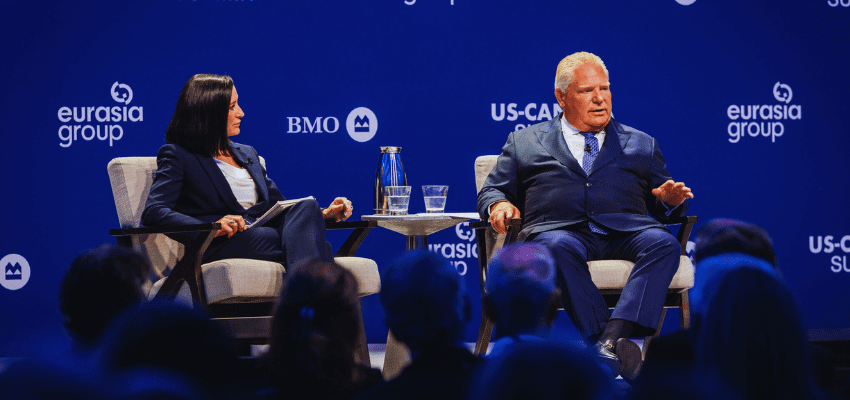
Photo by the office of the Premier of Ontario, via Flickr.

This article originally appeared in The Hub.

By Heather Exner-Pirot, October 31, 2025

If, like most Canadians, you are glued to your TV watching the Blue Jays in the World Series, you might have noticed an ad from the Government of Ontario promoting the incredible economic and human potential of the Ring of Fire, the natural resource-rich area in the north of the province.

Or you might have heard Prime Minister Carney or Premier Ford speak about it as a nation-building project and its likely designation as a Nation Building Project.

Or you might just conflate all of Canada’s critical minerals potential with ongoings in the Ring of Fire due to years of its being centred in natural resource stories by the media.

I have nothing against the Ring of Fire and hope we can secure the Indigenous partnerships and build the infrastructure we need to develop its resources. It’s been going through a painful, multi-decade process just to get a road to the deposit, let alone build a mine. Some important advances were made this week that promise to finally move the project ahead, and that is to be applauded.

But in some ways, it has never deserved the hype it receives, from being described as a “trillion dollar project” and “the next oilsands,” or heralded as “the most significant mineral development in Canada in more than a century.”

That can be problematic when it sucks up scarce political attention and public resources. There are other, more prolific mineral basins in Canada that better suit the designation of “nation-building” or “critical”, but seem to fall under the radar.

In the context of seeking to double our non-U.S. exports (from $300 billion to $600 billion), and in light of the federal government’s intention to commit billions of dollars to enabling infrastructure for that purpose, it’s essential that we understand where Canada’s mineral wealth comes from and prioritize accordingly.

The Ring of Fire is a non-producing but promising mineral jurisdiction in northern Ontario. First and foremost, it is a world-class deposit of chromite. Chromite is used primarily to turn steel into stainless steel, and is useful for its resistance to rust, shiny appearance, and very high melting point.

Chromite is not particularly scarce, and the commodity price is not particularly strong right now. While it is essential, for example, in the aerospace sector, chromite is suffering none of the same supply challenges of more prominent critical minerals as rare earth elements, germanium, and gallium, all of which China has a near monopoly on and has put export restrictions on. In that sense, the Ring of Fire is not critical to national security.

The Ring of Fire, which also has meaningful deposits of copper, nickel, platinum, and titanium, seems to have gained prominence as part of Ontario’s efforts to develop a vertically integrated EV battery supply chain. A few years ago, there was significant political concern that a shortage of battery metals would be a significant bottleneck in the energy transition, and the Ring of Fire was a solution.

That has not elapsed. But at any rate, Ontario already has a mature, producing, and prolific mining jurisdiction for many battery metals: the Sudbury Basin.

The Sudbury Basin is a geological unicorn: an impact structure produced by a meteorite blast 1.8 billion years ago that left behind rich deposits of nickel, as well as copper, gold, silver, platinum, palladium, rhodium, iridium, and ruthenium. It has spawned dozens of mines and produces high-purity, Class 1 nickel suitable for batteries. It is arguably Canada’s most important base metals mining jurisdiction.

But in terms of economic activity, even it pales in comparison to the Abitibi Gold Belt. The Abitibi straddles northeast Ontario and northwest Quebec and hosts Canada’s richest gold mines, amongst the highest producing in the world.

If Ontario’s economic news seems bleak these days, its gold rush has acted as a pretty good counterweight. In the wake of excessive Western deficit spending and Trump tariff turmoil, gold has soared as a safe haven asset. It keeps breaking price records and is now reliably over $4000/ounce.

Ontario is Canada’s largest gold producer, and Canada is the world’s fourth-largest producer, having increased output by 31 percent in the past 10 years. Half of Ontario’s mines—18 out of 36—are for gold. The vast majority of these precious ounces comes from the Abitibi. Over half of Ontario’s mineral value comes from gold. In 2024, this amounted to a market value of $7 billion, and it will surely be higher this year. By comparison, copper added about $1.6 billion, nickel about $1 billion, and platinum group metals just under $800 million.

The Government of Ontario estimates that the Ring of Fire will generate $22 billion over 30 years for the Ontario economy, or an average of $730 million a year.

For comparison, the Detour Lake gold mine in the Abitibi should bring in close to $4 billion in revenues this year alone.

When assessing big nation-building projects—items to be advanced by the Major Projects Office, protected by Bill C-5, and presumably endowed with federal subsidies—the federal government must understand what drives GDP and exports in Canada. Any mine for any commodity has the potential to grow regional economies, create good jobs, and enhance our ability to supply raw materials to our allies. These should be supported with competitive policy and regulatory frameworks.

But it’s important to know what our best mining jurisdictions are. The Elk Point potash jurisdiction (SK), the Abitibi gold district ON/QC), the Athabasca uranium basin (SK), the Elk Valley coal district (BC), the Sudbury Basin (ON), the Golden Triangle (BC), and the Labrador Trough (NL/QC) should be household names in Canada.

The Ring of Fire will be a welcome addition, but is unlikely to reach the same status of these world-class mining jurisdictions.


Heather Exner-Pirot is the director of energy, natural resources and environment at the Macdonald-Laurier Institute.
Source: The Hub

Related Posts

Iran pushing the Middle East to the brink of war: Joe Varner for National Security Journal
Middle East and North Africa

Iran pushing the Middle East to the brink of war: Joe Varner for National Security Journal

December 5, 2025
Property rights are “precarious” in Canada: Paul Warchuk and Peter Copeland for Inside Policy Talks
Domestic Policy

Property rights are “precarious” in Canada: Paul Warchuk and Peter Copeland for Inside Policy Talks

December 4, 2025
Harvard eschews ingrained ideology in order to tackle ‘genuinely hard problems’: Peter MacKinnon in the National Post
Reforming Universities

Harvard eschews ingrained ideology in order to tackle ‘genuinely hard problems’: Peter MacKinnon in the National Post

December 3, 2025
Next Post
Can the new Defence Investment Agency fix Canada’s procurement problems—or will politics slow that down too?: Richard Shimooka in The Hub

Can the new Defence Investment Agency fix Canada’s procurement problems—or will politics slow that down too?: Richard Shimooka in The Hub

Newsletter Signup

  Thank you for Signing Up
  Please correct the marked field(s) below.
Email Address  *
1,true,6,Contact Email,2
First Name *
1,true,1,First Name,2
Last Name *
1,true,1,Last Name,2
*
*Required Fields

Follow us on

Macdonald-Laurier Institute

323 Chapel Street, Suite #300
Ottawa, Ontario, K1N 7Z2 Canada

613.482.8327

info@macdonaldlaurier.ca
MLI directory

Support Us

Support the Macdonald-Laurier Institute to help ensure that Canada is one of the best governed countries in the world. Click below to learn more or become a sponsor.

Support Us

  • Inside Policy Magazine
  • Annual Reports
  • Jobs
  • Privacy Policy

© 2023 Macdonald-Laurier Institute. All Rights reserved.

No Result
View All Result
  • Home
  • About
    • Who We Are
    • Who Makes MLI Work
    • Fifteenth Anniversary
  • Experts
    • Experts Directory
    • In Memoriam
  • Issues
    • Domestic Policy
      • Economic Policy
      • Justice
      • Rights and Freedoms
      • Assisted Suicide (MAID)
      • Health Care
      • COVID-19
      • Gender Identity
      • Canada’s Political Tradition
      • AI, Technology and Innovation
      • Media and Telecoms
      • Housing
      • Immigration
      • Agriculture and Agri-Food
      • Competition Policy
    • Energy Policy
      • Energy
      • Environment
    • Foreign Policy
      • Israel-Hamas War
      • Ukraine
      • Taiwan
      • China
      • Europe and Russia
      • Indo-Pacific
      • Middle East and North Africa
      • North America
      • Foreign Interference
      • National Defence
      • National Security
      • Foreign Affairs
    • Indigenous Affairs
  • Projects
    • CNAPS (Center for North American Prosperity and Security)
    • The Promised Land
    • Voices that Inspire: The Macdonald-Laurier Vancouver Speaker Series
    • Dragon at the door
    • Canada on top of the world
    • Letter to a minister
    • Justice Report Card
    • The Great Energy Crisis
    • DisInfoWatch.org
    • Managing Indigenous Prosperity
    • Judicial Foundations
    • Landmark Cases Council
    • Defending The Marketplace of Ideas
    • Reforming the University
    • Past Projects
      • Digital Policy & Connectivity
      • Double Trouble
      • Canada and the Indo-Pacific Initiative
      • The Transatlantic Program
      • COVID Misery Index
      • Speak for Ourselves
      • The Eavesdropping Dragon: Huawei
      • Talkin’ in the Free World with Mariam Memarsadeghi
      • An Intellectual Property Strategy for Canada
      • Munk Senior Fellows
      • A Mandate for Canada
      • Confederation Series
      • Fiscal Reform
      • The Canadian Century project
      • Fixing Canadian health care
      • Internal trade
      • From a mandate for change
      • Size of government in Canada
      • Straight Talk
      • Labour Market Report
      • Leading Economic Indicator
      • Centre for Advancing Canada’s Interests Abroad
      • Indigenous Prosperity at a Crossroads
  • Events
    • Upcoming Events
    • Past Events
      • MLI Dinners
      • Great Canadian Debates
  • Latest News
  • Libraries
    • Columns
    • Commentary
    • Papers
    • Books
    • Video
  • Donate

© 2023 Macdonald-Laurier Institute. All Rights reserved.