Friday, December 5, 2025
No Result
View All Result
  • Media
Macdonald-Laurier Institute
  • Home
  • About
    • Who We Are
    • Who Makes MLI Work
    • Fifteenth Anniversary
  • Experts
    • Experts Directory
    • In Memoriam
  • Issues
    • Domestic Policy
      • Economic Policy
      • Justice
      • Rights and Freedoms
      • Assisted Suicide (MAID)
      • Health Care
      • COVID-19
      • Gender Identity
      • Canada’s Political Tradition
      • AI, Technology and Innovation
      • Media and Telecoms
      • Housing
      • Immigration
      • Agriculture and Agri-Food
      • Competition Policy
    • Energy Policy
      • Energy
      • Environment
    • Foreign Policy
      • Israel-Hamas War
      • Ukraine
      • Taiwan
      • China
      • Europe and Russia
      • Indo-Pacific
      • Middle East and North Africa
      • North America
      • Foreign Interference
      • National Defence
      • National Security
      • Foreign Affairs
    • Indigenous Affairs
  • Projects
    • CNAPS (Center for North American Prosperity and Security)
    • The Promised Land
    • Voices that Inspire: The Macdonald-Laurier Vancouver Speaker Series
    • Dragon at the door
    • Canada on top of the world
    • Letter to a minister
    • Justice Report Card
    • The Great Energy Crisis
    • DisInfoWatch.org
    • Managing Indigenous Prosperity
    • Judicial Foundations
    • Landmark Cases Council
    • Defending The Marketplace of Ideas
    • Reforming the University
    • Past Projects
      • Digital Policy & Connectivity
      • Double Trouble
      • Canada and the Indo-Pacific Initiative
      • The Transatlantic Program
      • COVID Misery Index
        • Provincial COVID Misery Index
        • Beyond Lockdown
        • COVID and after: A mandate for recovery
      • Speak for Ourselves
      • The Eavesdropping Dragon: Huawei
      • Talkin’ in the Free World with Mariam Memarsadeghi
      • An Intellectual Property Strategy for Canada
      • Munk Senior Fellows
      • A Mandate for Canada
      • Confederation Series
      • Fiscal Reform
      • The Canadian Century project
      • Fixing Canadian health care
      • Internal trade
      • From a mandate for change
      • Size of government in Canada
      • Straight Talk
      • Labour Market Report
      • Leading Economic Indicator
      • Centre for Advancing Canada’s Interests Abroad
      • Indigenous Prosperity at a Crossroads
        • Aboriginal Canada and Natural Resources
  • Events
    • Upcoming Events
    • Past Events
      • MLI Dinners
      • Great Canadian Debates
  • Latest News
  • Libraries
    • Columns
    • Commentary
    • Papers
    • Books
    • Video
  • Donate
  • Home
  • About
    • Who We Are
    • Who Makes MLI Work
    • Fifteenth Anniversary
  • Experts
    • Experts Directory
    • In Memoriam
  • Issues
    • Domestic Policy
      • Economic Policy
      • Justice
      • Rights and Freedoms
      • Assisted Suicide (MAID)
      • Health Care
      • COVID-19
      • Gender Identity
      • Canada’s Political Tradition
      • AI, Technology and Innovation
      • Media and Telecoms
      • Housing
      • Immigration
      • Agriculture and Agri-Food
      • Competition Policy
    • Energy Policy
      • Energy
      • Environment
    • Foreign Policy
      • Israel-Hamas War
      • Ukraine
      • Taiwan
      • China
      • Europe and Russia
      • Indo-Pacific
      • Middle East and North Africa
      • North America
      • Foreign Interference
      • National Defence
      • National Security
      • Foreign Affairs
    • Indigenous Affairs
  • Projects
    • CNAPS (Center for North American Prosperity and Security)
    • The Promised Land
    • Voices that Inspire: The Macdonald-Laurier Vancouver Speaker Series
    • Dragon at the door
    • Canada on top of the world
    • Letter to a minister
    • Justice Report Card
    • The Great Energy Crisis
    • DisInfoWatch.org
    • Managing Indigenous Prosperity
    • Judicial Foundations
    • Landmark Cases Council
    • Defending The Marketplace of Ideas
    • Reforming the University
    • Past Projects
      • Digital Policy & Connectivity
      • Double Trouble
      • Canada and the Indo-Pacific Initiative
      • The Transatlantic Program
      • COVID Misery Index
        • Provincial COVID Misery Index
        • Beyond Lockdown
        • COVID and after: A mandate for recovery
      • Speak for Ourselves
      • The Eavesdropping Dragon: Huawei
      • Talkin’ in the Free World with Mariam Memarsadeghi
      • An Intellectual Property Strategy for Canada
      • Munk Senior Fellows
      • A Mandate for Canada
      • Confederation Series
      • Fiscal Reform
      • The Canadian Century project
      • Fixing Canadian health care
      • Internal trade
      • From a mandate for change
      • Size of government in Canada
      • Straight Talk
      • Labour Market Report
      • Leading Economic Indicator
      • Centre for Advancing Canada’s Interests Abroad
      • Indigenous Prosperity at a Crossroads
        • Aboriginal Canada and Natural Resources
  • Events
    • Upcoming Events
    • Past Events
      • MLI Dinners
      • Great Canadian Debates
  • Latest News
  • Libraries
    • Columns
    • Commentary
    • Papers
    • Books
    • Video
  • Donate
No Result
View All Result
Macdonald-Laurier Institute

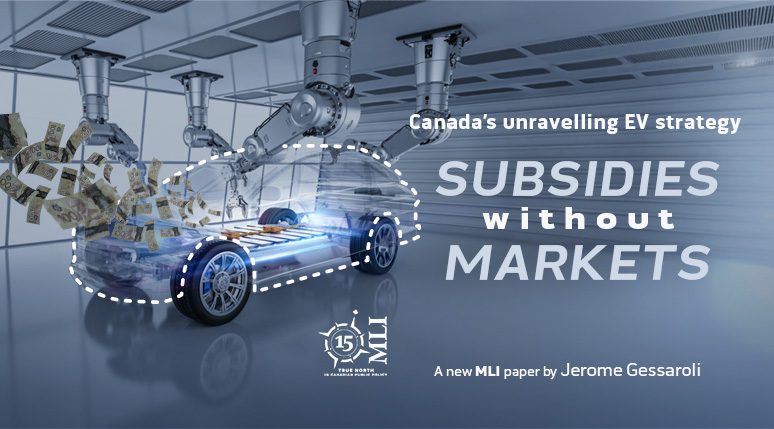
Subsidies without markets: Canada’s unravelling EV strategy

Canada's EV strategy risks becoming a case study in how not to do industrial policy.

September 25, 2025
in Energy, Environment, Energy Policy, Latest News, Papers, Jerome Gessaroli
Reading Time: 5 mins read
A A
Subsidies without markets: Canada’s unravelling EV strategy

By Jerome Gessaroli

September 25, 2025

PDF of paper

Executive Summary | Sommaire (le français suit)

Canada’s $52-billion effort to build a domestic electric vehicle (EV) industry has so far failed to deliver on its promises. Designed as a bold plan to secure a full EV supply chain, from mining and processing to batteries and assembly, the strategy has stumbled under the weight of subsidy-driven, top-down industrial policy.

The federal, Ontario, and Quebec governments set out to transform Canada’s auto sector, leveraging critical minerals and clean electricity. Large projects included Stellantis-LG’s NextStar plant, Volkswagen’s gigafactory, Honda’s EV supply chain, and Northvolt’s battery facility. Cathode and materials plants from Ford, GM, and Umicore were also part of this transition initiative, with bold job creation forecasts for 2030. Yet as of 2025, many projects have been delayed, downsized, or cancelled.

Northvolt’s collapse cost Quebec over $300 million, Honda postponed its project by at least two years, and Lion Electric entered creditor protection. The Parliamentary Budget Office estimates that federal subsidies for major plants could take 20 years to break even, not the five years earlier promised. With public spending averaging $4.5 million per direct job, the fiscal returns are far weaker than advertised.

The EV market remains subsidy dependent. When federal and provincial purchase incentives were paused in 2025, sales dropped from 18.3 to 8.7 per cent of new registrations. Surveys show Canadians view EVs as unaffordable without rebates, raising doubts about mandates leading to rapid adoption. Ottawa has already delayed the 2026 zero-emission vehicle mandate by a year, acknowledging that sales cannot meet targets under current conditions.

North American battery production costs remain 20 per cent higher than China’s, while global manufacturing capacity exceeds demand. As a late entrant, Canada lacks both cost advantages and scale. By tying its strategy to US incentives under the Inflation Reduction Act, it has exposed itself to foreseeable risks from policy reversals south of the borders.

Beyond subsidies, the plan ignored structural barriers. Mining projects critical to EV batteries remain stalled by permitting delays averaging nearly 18 years. Workforce shortages persist, while colleges are still trying to expand training programs. Governments attempted to build the entire EV ecosystem at once rather than sequencing it around strengths. Politicians received immediate credit from headline announcements, while costs fell on taxpayers. Bureaucracies were rewarded for program size rather than outcomes, encouraging over-optimistic forecasts and weak accountability.

Early warning signs, such as sales collapses after rebate pauses, cancelled projects, mirror patterns from failed past industrial policies worldwide. Subsidies distorted market signals, encouraging investment driven by government support rather than consumer demand. Entering a mature industry already dominated by global incumbents, Canada positioned itself as a subsidy-dependent follower rather than a competitive leader.

A fundamental policy shift is needed. Instead of steering industries from the top down, governments should create conditions for competitive and self-sustaining investment. This means concentrating on a few priorities:

• Fix bottlenecks: Streamline permitting and approvals to shorten project timelines and create a level playing field.

• Build foundations: Invest in enabling infrastructure and workforce training that support productivity across multiple sectors.

• Foster innovation: Direct R&D support toward early-stage technologies, not subsidies tied to specific firms.

• Keep interventions disciplined: Use targeted, temporary measures only when foreign subsidies distort markets, with clear sunset clauses.

By moving away from subsidies and mandates toward enabling conditions and selective, time-limited interventions, Canada can encourage investment that is economically viable and more politically resilient. As it stands, its EV plan risks becoming a case study in how not to do industrial policy.


Les 52 milliards de dollars investis par le Canada en vue de développer une industrie des véhicules électriques n’ont pas encore répondu aux attentes. Le projet ambitieux de concevoir une chaîne d’approvisionnement intégrée  – englobant l’extraction et le traitement des minerais, la fabrication de batteries et l’assemblage – vacille sous le poids d’une politique industrielle imposée d’en haut et tributaire des subventions.

Ottawa et les gouvernements de l’Ontario et du Québec devaient transformer le secteur en tirant parti des minéraux critiques et de l’électricité propre. Parmi les grands projets, citons l’usine NextStar (Stellantis et LG), la « gigafactory » de Volkswagen, la chaîne de Honda et l’usine de Northvolt (batteries). Les usines de cathodes et de matériel de Ford, GM et Umicore contribuent aussi à cette transition avec de vastes objectifs d’emplois pour 2030. Or, en 2025, il y a eu de multiples retards, restructurations ou annulations.

La faillite de Northvolt a coûté plus de 300 millions de dollars au Québec, Honda a reporté son projet d’au moins deux ans et Lion Electric a demandé la protection contre ses créanciers. Selon le Bureau parlementaire du budget, les subventions accordées aux principales usines pourraient mettre 20 ans à devenir rentables, au lieu des cinq escomptés. Comme les dépenses publiques atteignent 4,5 millions de dollars par emploi direct créé, les retombées fiscales sont considérablement inférieures aux promesses.

Ce marché reste tributaire des subventions. En 2025, après la mise sur pause des incitations gouvernementales, les ventes sont passées de 18,3 % à 8,7 % des nouvelles immatriculations. Selon les sondages, les véhicules électriques sont inabordables sans rabais à l’achat – ce qui suscite des doutes quant à leur adoption rapide. Le reconnaissant, Ottawa a déjà reporté d’un an son mandat de 2026 sur les véhicules zéro émission.

Les batteries coûtent 20 % de plus qu’en Chine à produire, malgré la surcapacité mondiale. Le Canada, dernier venu sur ce marché, n’a donc bénéficié d’aucun avantage de coûts ou d’économies d’échelle. En liant sa stratégie aux incitations de la Loi sur la réduction de l’inflation américaine, il s’est exposé au risque d’un éventuel renversement de politique au sud.

L’objectif fait aussi abstraction des obstacles structurels : on accorde aux mines près de 18 ans pour soutenir la production de batteries, et la pénurie de main-d’œuvre persiste, tout comme les reports des programmes de formation. Les gouvernements ont tenté de bâtir l’écosystème d’un coup, plutôt que de le synchroniser avec les forces en place. Puis, on a immédiatement applaudi les annonces politiques, alors que les coûts incombent aux contribuables. Enfin, on a récompensé les bureaucraties pour la taille des programmes plutôt que pour leurs résultats – suscitant trop d’optimisme et pas suffisamment d’obligation redditionnelle.

L’effondrement des ventes et l’annulation des projets après la mise sur pause nous rappellent les échecs des politiques industrielles mondiales précédentes. Les subventions faussent les signaux du marché en favorisant les investissements motivés par le financement public plutôt que par la demande. En entrant dans un secteur mature déjà dominé par des acteurs mondiaux, le Canada est devenu un suiveur subventionné plutôt qu’un meneur concurrentiel.

La politique doit changer du tout au tout. Au lieu de diriger les industries, les gouvernements doivent favoriser les investissements concurrentiels et autosuffisants en se concentrant sur quelques priorités seulement :

• Éliminer les goulots d’étranglement : rationaliser les processus d’approbation pour accélérer les projets et instaurer des règles du jeu équitables.

• Poser les fondations : investir dans les infrastructures et la formation aptes à stimuler la productivité multisectorielle.

• Promouvoir l’innovation : orienter la R&D de manière à appuyer des technologies émergentes et non pas des entreprises précises.

• Assurer la discipline des interventions : en usant de mesures ciblées temporaires – accompagnées de dispositions de caducité – uniquement pour les marchés distordus par des subventions étrangères.

En remplaçant les subventions et les mandats par des modalités et des interventions sélectives et limitées dans le temps, le Canada arrivera à favoriser des investissements économiquement viables et politiquement solides. Sinon, son plan actuel risque d’être un très mauvais exemple de politique industrielle.


 

Related Posts

Property rights are “precarious” in Canada: Paul Warchuk and Peter Copeland for Inside Policy Talks
Domestic Policy

Property rights are “precarious” in Canada: Paul Warchuk and Peter Copeland for Inside Policy Talks

December 4, 2025
Harvard eschews ingrained ideology in order to tackle ‘genuinely hard problems’: Peter MacKinnon in the National Post
Reforming Universities

Harvard eschews ingrained ideology in order to tackle ‘genuinely hard problems’: Peter MacKinnon in the National Post

December 3, 2025
Risking public backlash? Canadian universities and demographic-based faculty hiring
Education

Risking public backlash? Canadian universities and demographic-based faculty hiring

December 3, 2025
Next Post
Israel’s strike on Doha was legal and justified — Canada should support it: Casey Babb and Avraham Russell Shalev in the National Post

Israel's strike on Doha was legal and justified — Canada should support it: Casey Babb and Avraham Russell Shalev in the National Post

Newsletter Signup

  Thank you for Signing Up
  Please correct the marked field(s) below.
Email Address  *
1,true,6,Contact Email,2
First Name *
1,true,1,First Name,2
Last Name *
1,true,1,Last Name,2
*
*Required Fields

Follow us on

Macdonald-Laurier Institute

323 Chapel Street, Suite #300
Ottawa, Ontario, K1N 7Z2 Canada

613.482.8327

info@macdonaldlaurier.ca
MLI directory

Support Us

Support the Macdonald-Laurier Institute to help ensure that Canada is one of the best governed countries in the world. Click below to learn more or become a sponsor.

Support Us

  • Inside Policy Magazine
  • Annual Reports
  • Jobs
  • Privacy Policy

© 2023 Macdonald-Laurier Institute. All Rights reserved.

No Result
View All Result
  • Home
  • About
    • Who We Are
    • Who Makes MLI Work
    • Fifteenth Anniversary
  • Experts
    • Experts Directory
    • In Memoriam
  • Issues
    • Domestic Policy
      • Economic Policy
      • Justice
      • Rights and Freedoms
      • Assisted Suicide (MAID)
      • Health Care
      • COVID-19
      • Gender Identity
      • Canada’s Political Tradition
      • AI, Technology and Innovation
      • Media and Telecoms
      • Housing
      • Immigration
      • Agriculture and Agri-Food
      • Competition Policy
    • Energy Policy
      • Energy
      • Environment
    • Foreign Policy
      • Israel-Hamas War
      • Ukraine
      • Taiwan
      • China
      • Europe and Russia
      • Indo-Pacific
      • Middle East and North Africa
      • North America
      • Foreign Interference
      • National Defence
      • National Security
      • Foreign Affairs
    • Indigenous Affairs
  • Projects
    • CNAPS (Center for North American Prosperity and Security)
    • The Promised Land
    • Voices that Inspire: The Macdonald-Laurier Vancouver Speaker Series
    • Dragon at the door
    • Canada on top of the world
    • Letter to a minister
    • Justice Report Card
    • The Great Energy Crisis
    • DisInfoWatch.org
    • Managing Indigenous Prosperity
    • Judicial Foundations
    • Landmark Cases Council
    • Defending The Marketplace of Ideas
    • Reforming the University
    • Past Projects
      • Digital Policy & Connectivity
      • Double Trouble
      • Canada and the Indo-Pacific Initiative
      • The Transatlantic Program
      • COVID Misery Index
      • Speak for Ourselves
      • The Eavesdropping Dragon: Huawei
      • Talkin’ in the Free World with Mariam Memarsadeghi
      • An Intellectual Property Strategy for Canada
      • Munk Senior Fellows
      • A Mandate for Canada
      • Confederation Series
      • Fiscal Reform
      • The Canadian Century project
      • Fixing Canadian health care
      • Internal trade
      • From a mandate for change
      • Size of government in Canada
      • Straight Talk
      • Labour Market Report
      • Leading Economic Indicator
      • Centre for Advancing Canada’s Interests Abroad
      • Indigenous Prosperity at a Crossroads
  • Events
    • Upcoming Events
    • Past Events
      • MLI Dinners
      • Great Canadian Debates
  • Latest News
  • Libraries
    • Columns
    • Commentary
    • Papers
    • Books
    • Video
  • Donate

© 2023 Macdonald-Laurier Institute. All Rights reserved.