
This article originally appeared in the Japan Times.
By Stephen Nagy, September 3, 2025
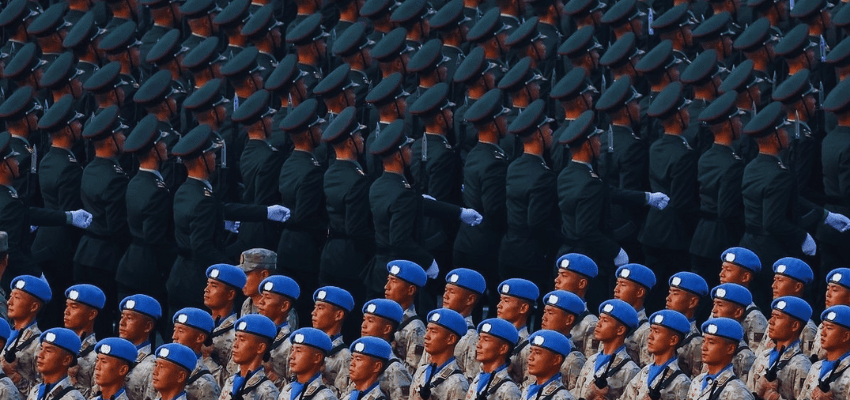
The attendance this week of Russian President Vladimir Putin, North Korean leader Kim Jong Un, Myanmar’s ruling general, Min Aung Hlaing, and Cuban President Miguel Diaz-Canel at China’s “grand parade” commemorating the end of World War II transformed what ostensibly celebrated the defeat of fascism into something far more revealing about contemporary geopolitics.
These leaders collectively preside over states engaged in active warfare, internal repression or serial human-rights violations, a stark irony given the parade’s stated purpose of commemorating liberation from tyranny.
Consider Chinese President Xi Jinping’s guest of honor, Putin, whose Russian and mercenary forces continue their assault on Ukraine in Europe’s largest conflict since the very war this parade commemorates. Or Kim, whose dynastic, dictatorial North Korean regime maintains perhaps the world’s most comprehensive system of political oppression.
Min Aung Hlaing oversees a military junta that has plunged Myanmar into civil war, while Diaz-Canel perpetuates Cuba’s one-party state apparatus. The common thread binding these leaders isn’t their commitment to fighting fascism, it’s their shared dedication to concentrated state power, suppression of dissent and rejection of democratic accountability.
This international gathering in the Chinese capital’s Tiananmen Square illuminated what might be termed the “Beijing Consensus” in its starkest form, a preference for authoritarianism over representative government, state power over citizen rights and rule by man over rule of law. While China has long promoted its development model as an alternative to “Western” liberal democracy, this parade crystallizes that vision through the physical presence of leaders who embody its core principles.
The contrast with the postwar trajectories of Japan and Germany could hardly be more pronounced. Both former Axis powers underwent profound transformations, emerging as rule-of-law democracies with robust checks on executive power, independent judiciaries and deep commitments to international institutions.
Japan’s pacifist postwar Constitution and Germany’s integration into the European project represent conscious choices to embed themselves within multilateral frameworks that constrain unilateral action. Their leaders today stand as advocates for the very international legal order that Beijing’s parade guests systematically undermine.
Beijing’s historical narrative around World War II has always been selective, emphasizing Chinese suffering under Japanese occupation while minimizing the Nationalist government’s role in the resistance and elevating the Communist Party’s contributions. This 80th anniversary parade extended that revisionism into the present, suggesting that the true inheritors of the anti-fascist struggle are today’s authoritarian states rather than the democracies that actually defeated fascism and built the postwar order.
The symbolism extends beyond mere historical interpretation. By assembling this particular coalition of leaders, Beijing signals its vision for an alternative international system, one where sovereignty trumps human rights, where might makes right and where international law bends to accommodate authoritarian prerogatives. This isn’t merely about challenging American hegemony; it’s about fundamentally rewriting the rules that have governed international relations since 1945.
The timing is hardly coincidental. As China faces mounting international criticism over its actions in Xinjiang, Hong Kong and the South China Sea, this parade offers a counternarrative — China stands not isolated but at the center of a coalition of states that reject Western liberal values. The message to developing nations is clear: There exists an alternative path to modernization that doesn’t require democratic reform or adherence to universal human-rights norms.
Yet this display of authoritarian solidarity masks significant vulnerabilities. The very need to stage such a demonstration reflects anxiety about the durability of these regimes. Putin faces a grinding war and international isolation. Kim confronts a perpetual economic crisis. Myanmar’s junta struggles to control territory. These aren’t confident powers celebrating shared values but embattled regimes seeking mutual validation.
Moreover, the parade’s guest list reveals the limitations of China’s international appeal. Notable absences will likely include leaders from India, Indonesia, Brazil, South Africa and other major developing democracies that Beijing courts through BRICS and other forums. While these nations may share China’s critiques of Western dominance, they stop short of embracing its authoritarian model.
The implications for regional security are profound. As Beijing celebrates victory over “Japanese aggression,” while hosting leaders actively engaged in aggression against their neighbors, it sends a chilling message about how historical grievances might justify contemporary revisionism. Japan, watching this spectacle, will reasonably question whether China’s invocation of wartime suffering serves less as historical remembrance than as preparation for future confrontation.
For policymakers in Washington, Tokyo, Canberra and other democratic capitals, this parade should clarify the stakes of strategic competition with China. This isn’t simply about trade balances or military capabilities, but about fundamentally different visions of international order. One celebrates constraints on power, protection of individual rights and peaceful resolution of disputes. The other, embodied in this anniversary gathering, elevates state power, collective submission and the legitimacy of force.
As the world watches Beijing’s parade, we would do well to remember that the real victory over fascism came not just from military defeat but from building institutions and norms that prevent its recurrence. That the war’s end is now being celebrated by leaders who systematically dismantle these safeguards in their own countries represents not historical continuity but its betrayal. In hosting this gathering, Beijing reveals more about its future ambitions than its past struggles — and democratic nations should take note.
This juxtaposition of Beijing’s revisionist historical narrative with its contemporary authoritarian coalition reveals a profound challenge for liberal democracies. While the parade’s contradictions are evident, commemorating victory over fascism while celebrating leaders who embody authoritarian principles, the effectiveness of this counternarrative depends not merely on pointing out hypocrisy but on demonstrating the superiority of democratic alternatives.

The looming contradiction, however, extends beyond Beijing’s Tiananmen Square spectacle to the internal contradictions within liberal democracies themselves. As the Trump 2.0 administration continues to implement policies that include punitive tariffs against allies, dehumanizing treatment of migrants, military deployments in U.S. cities, systematic vilification of LGBT communities and erosion of democratic norms, the moral authority required to effectively counter Beijing’s authoritarian model becomes increasingly tenuous.
The implementation of economic nationalism, identity-based exclusion and executive overreach within democracies fundamentally undermines the argument that liberal systems inherently produce more just, stable and prosperous societies.
This represents the central challenge for the U.S. and its allies in confronting the “Beijing Consensus” — not merely articulating the theoretical superiority of democratic governance but demonstrating its practical advantages through policy outcomes. When democratic nations engage in behavior that mirrors authoritarian tendencies, they validate Beijing’s central claim: that liberal democracy represents a procedural facade rather than a substantively different approach to organizing society.
The erosion of democratic norms within established democracies provides potent propaganda material for Beijing’s information campaigns targeting developing nations considering their own governance trajectories.
For liberal democracies to effectively counter China’s alternative vision, they must reckon with their own institutional vulnerabilities and policy contradictions. The most compelling argument against authoritarian systems comes not from rhetorical condemnation, but from demonstrating that democratic systems can deliver inclusive prosperity, protect vulnerable populations, maintain institutional integrity and foster international cooperation, even during periods of domestic political polarization.
The battle for global influence will ultimately be won not through parades and proclamations but through governance models that deliver tangible benefits while preserving human dignity and individual freedom. This requires democratic nations to address their own governance deficits with the same scrutiny they apply to Beijing’s historical revisionism and authoritarian coalition-building.
Stephen R. Nagy is a professor of politics and international studies at the International Christian University in Tokyo, a visiting fellow with the Japan Institute for International Affairs, and a senior fellow with the Macdonald-Laurier Institute.