Friday, December 5, 2025
No Result
View All Result
  • Media
Macdonald-Laurier Institute
  • Home
  • About
    • Who We Are
    • Who Makes MLI Work
    • Fifteenth Anniversary
  • Experts
    • Experts Directory
    • In Memoriam
  • Issues
    • Domestic Policy
      • Economic Policy
      • Justice
      • Rights and Freedoms
      • Assisted Suicide (MAID)
      • Health Care
      • COVID-19
      • Gender Identity
      • Canada’s Political Tradition
      • AI, Technology and Innovation
      • Media and Telecoms
      • Housing
      • Immigration
      • Agriculture and Agri-Food
      • Competition Policy
    • Energy Policy
      • Energy
      • Environment
    • Foreign Policy
      • Israel-Hamas War
      • Ukraine
      • Taiwan
      • China
      • Europe and Russia
      • Indo-Pacific
      • Middle East and North Africa
      • North America
      • Foreign Interference
      • National Defence
      • National Security
      • Foreign Affairs
    • Indigenous Affairs
  • Projects
    • CNAPS (Center for North American Prosperity and Security)
    • The Promised Land
    • Voices that Inspire: The Macdonald-Laurier Vancouver Speaker Series
    • Dragon at the door
    • Canada on top of the world
    • Letter to a minister
    • Justice Report Card
    • The Great Energy Crisis
    • DisInfoWatch.org
    • Managing Indigenous Prosperity
    • Judicial Foundations
    • Landmark Cases Council
    • Defending The Marketplace of Ideas
    • Reforming the University
    • Past Projects
      • Digital Policy & Connectivity
      • Double Trouble
      • Canada and the Indo-Pacific Initiative
      • The Transatlantic Program
      • COVID Misery Index
        • Provincial COVID Misery Index
        • Beyond Lockdown
        • COVID and after: A mandate for recovery
      • Speak for Ourselves
      • The Eavesdropping Dragon: Huawei
      • Talkin’ in the Free World with Mariam Memarsadeghi
      • An Intellectual Property Strategy for Canada
      • Munk Senior Fellows
      • A Mandate for Canada
      • Confederation Series
      • Fiscal Reform
      • The Canadian Century project
      • Fixing Canadian health care
      • Internal trade
      • From a mandate for change
      • Size of government in Canada
      • Straight Talk
      • Labour Market Report
      • Leading Economic Indicator
      • Centre for Advancing Canada’s Interests Abroad
      • Indigenous Prosperity at a Crossroads
        • Aboriginal Canada and Natural Resources
  • Events
    • Upcoming Events
    • Past Events
      • MLI Dinners
      • Great Canadian Debates
  • Latest News
  • Libraries
    • Columns
    • Commentary
    • Papers
    • Books
    • Video
  • Donate
  • Home
  • About
    • Who We Are
    • Who Makes MLI Work
    • Fifteenth Anniversary
  • Experts
    • Experts Directory
    • In Memoriam
  • Issues
    • Domestic Policy
      • Economic Policy
      • Justice
      • Rights and Freedoms
      • Assisted Suicide (MAID)
      • Health Care
      • COVID-19
      • Gender Identity
      • Canada’s Political Tradition
      • AI, Technology and Innovation
      • Media and Telecoms
      • Housing
      • Immigration
      • Agriculture and Agri-Food
      • Competition Policy
    • Energy Policy
      • Energy
      • Environment
    • Foreign Policy
      • Israel-Hamas War
      • Ukraine
      • Taiwan
      • China
      • Europe and Russia
      • Indo-Pacific
      • Middle East and North Africa
      • North America
      • Foreign Interference
      • National Defence
      • National Security
      • Foreign Affairs
    • Indigenous Affairs
  • Projects
    • CNAPS (Center for North American Prosperity and Security)
    • The Promised Land
    • Voices that Inspire: The Macdonald-Laurier Vancouver Speaker Series
    • Dragon at the door
    • Canada on top of the world
    • Letter to a minister
    • Justice Report Card
    • The Great Energy Crisis
    • DisInfoWatch.org
    • Managing Indigenous Prosperity
    • Judicial Foundations
    • Landmark Cases Council
    • Defending The Marketplace of Ideas
    • Reforming the University
    • Past Projects
      • Digital Policy & Connectivity
      • Double Trouble
      • Canada and the Indo-Pacific Initiative
      • The Transatlantic Program
      • COVID Misery Index
        • Provincial COVID Misery Index
        • Beyond Lockdown
        • COVID and after: A mandate for recovery
      • Speak for Ourselves
      • The Eavesdropping Dragon: Huawei
      • Talkin’ in the Free World with Mariam Memarsadeghi
      • An Intellectual Property Strategy for Canada
      • Munk Senior Fellows
      • A Mandate for Canada
      • Confederation Series
      • Fiscal Reform
      • The Canadian Century project
      • Fixing Canadian health care
      • Internal trade
      • From a mandate for change
      • Size of government in Canada
      • Straight Talk
      • Labour Market Report
      • Leading Economic Indicator
      • Centre for Advancing Canada’s Interests Abroad
      • Indigenous Prosperity at a Crossroads
        • Aboriginal Canada and Natural Resources
  • Events
    • Upcoming Events
    • Past Events
      • MLI Dinners
      • Great Canadian Debates
  • Latest News
  • Libraries
    • Columns
    • Commentary
    • Papers
    • Books
    • Video
  • Donate
No Result
View All Result
Macdonald-Laurier Institute

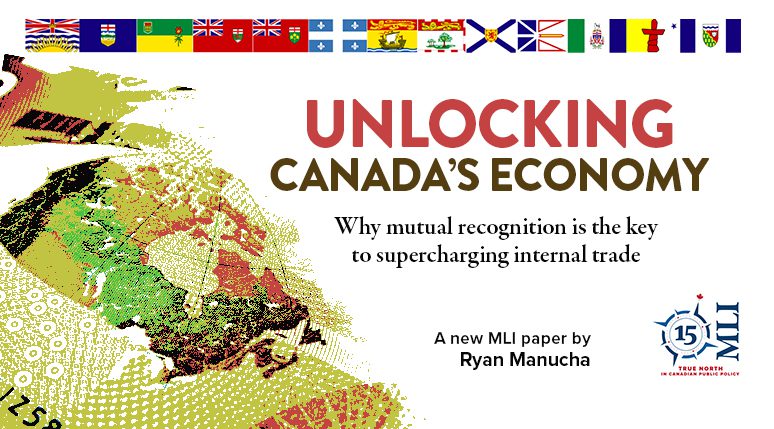
Unlocking Canada’s economy: Why mutual recognition is the key to supercharging internal trade

The need for Canada to break down its domestic trade barriers has never been more urgent.

April 8, 2025
in Domestic Policy, Latest News, Intergovernmental Affairs, Papers, Economic Policy
Reading Time: 3 mins read
A A
Unlocking Canada’s economy: Why mutual recognition is the key to supercharging internal trade

By Ryan Manucha
April 8, 2025

PDF of paper

Executive Summary

US President Donald Trump’s tariff threats seem to have reminded Canadians that we don’t even trade well with each other. We self-sabotage through domestic trade obstacles that hinder economic growth and security.

Right now, Canada’s interprovincial trade barriers are a patchwork of conflicting laws and regulations that impose undue restraint on goods, services, and labour seeking to cross an internal frontier. It impacts everything from high-visibility safety apparel to electrical codes to health care professionals. These barriers harm Canadian growth and prosperity: by one estimate they add between 7.8 and 14.5 per cent to the price of goods and services.

Over the past thirty years, the federal and provincial governments have tried to tackle this issue via domestic trade agreements. These include the pan-national Canadian Free Trade Agreement (CFTA) and Western Canada’s New West Partnership Trade Agreement (NWPTA) among several others. These agreements offer various tools to reduce trade barriers but among the most important is “mutual recognition.”

Mutual recognition (MR) is an arrangement where two or more governments agree to accept each other’s standards, regulations or laws in respect of goods, labour, and services without the need for additional testing or compliance checks. This approach stands in contrast to that of harmonization, which requires uniform rules. Governments find MR more attractive than harmonization because they can preserve their own standards and then choose to recognize those of others, thereby retaining greater local autonomy and policy flexibility.

Enshrining broad-based mutual recognition via provincial and territorial legislation would massively advance freer internal trade, unlocking Canada’s full economic potential. To achieve this, the author recommends the following:

• A single legislative instrument for mutual recognition of goods, jobs, and services, with adjustments for their unique needs.

• For jobs, adopt a system similar to Australia’s that accepts qualifications from other provinces and territories by default, with 30 days for regulators to reject.

• Ensure clear and transparent rules to operationalize mutual recognition, e.g. imposing response time limits and laying out the precise procedure to deny mutual recognition.

• Include inter-regulator trust-building mechanisms such as verification procedures, notification protocols, and reason-giving obligations when denying mutual recognition.

• Allow for appeals of mutual recognition decisions, with rules in place to ensure fairness.

• Incorporate a process for governments to escalate discrepancies for common standards.

• Permit exceptions and exemptions but in a way that furthers overall trade liberalization.

• Require regular reporting to ensure the proper functioning of the mutual recognition arrangement.

The evidence clearly shows that provinces and territories would benefit even if they adopted unilateral mutual recognition. Canada can also learn from the experiences of Australia and the European Union, which both adopted forms of mutual recognition. These lessons should be applied to the foundation established by Nova Scotia’s precedent setting legislation, the Free Trade and Mobility within Canada Act.

As other countries – particularly the United States – embrace economic isolationism, the need for Canada to break down its domestic trade barriers has never been more urgent. Now is the time for bold reforms that will remove these obstacles and drive prosperity for all Canadians.

Read the full paper here:

Tags: Ryan Manucha

Related Posts

Property rights are “precarious” in Canada: Paul Warchuk and Peter Copeland for Inside Policy Talks
Domestic Policy

Property rights are “precarious” in Canada: Paul Warchuk and Peter Copeland for Inside Policy Talks

December 4, 2025
Harvard eschews ingrained ideology in order to tackle ‘genuinely hard problems’: Peter MacKinnon in the National Post
Reforming Universities

Harvard eschews ingrained ideology in order to tackle ‘genuinely hard problems’: Peter MacKinnon in the National Post

December 3, 2025
Risking public backlash? Canadian universities and demographic-based faculty hiring
Education

Risking public backlash? Canadian universities and demographic-based faculty hiring

December 3, 2025
Next Post
Unlocking Canada’s economy: Why mutual recognition is the key to supercharging internal trade

Break the trade gridlock: Canada needs one market, not thirteen

Newsletter Signup

  Thank you for Signing Up
  Please correct the marked field(s) below.
Email Address  *
1,true,6,Contact Email,2
First Name *
1,true,1,First Name,2
Last Name *
1,true,1,Last Name,2
*
*Required Fields

Follow us on

Macdonald-Laurier Institute

323 Chapel Street, Suite #300
Ottawa, Ontario, K1N 7Z2 Canada

613.482.8327

info@macdonaldlaurier.ca
MLI directory

Support Us

Support the Macdonald-Laurier Institute to help ensure that Canada is one of the best governed countries in the world. Click below to learn more or become a sponsor.

Support Us

  • Inside Policy Magazine
  • Annual Reports
  • Jobs
  • Privacy Policy

© 2023 Macdonald-Laurier Institute. All Rights reserved.

No Result
View All Result
  • Home
  • About
    • Who We Are
    • Who Makes MLI Work
    • Fifteenth Anniversary
  • Experts
    • Experts Directory
    • In Memoriam
  • Issues
    • Domestic Policy
      • Economic Policy
      • Justice
      • Rights and Freedoms
      • Assisted Suicide (MAID)
      • Health Care
      • COVID-19
      • Gender Identity
      • Canada’s Political Tradition
      • AI, Technology and Innovation
      • Media and Telecoms
      • Housing
      • Immigration
      • Agriculture and Agri-Food
      • Competition Policy
    • Energy Policy
      • Energy
      • Environment
    • Foreign Policy
      • Israel-Hamas War
      • Ukraine
      • Taiwan
      • China
      • Europe and Russia
      • Indo-Pacific
      • Middle East and North Africa
      • North America
      • Foreign Interference
      • National Defence
      • National Security
      • Foreign Affairs
    • Indigenous Affairs
  • Projects
    • CNAPS (Center for North American Prosperity and Security)
    • The Promised Land
    • Voices that Inspire: The Macdonald-Laurier Vancouver Speaker Series
    • Dragon at the door
    • Canada on top of the world
    • Letter to a minister
    • Justice Report Card
    • The Great Energy Crisis
    • DisInfoWatch.org
    • Managing Indigenous Prosperity
    • Judicial Foundations
    • Landmark Cases Council
    • Defending The Marketplace of Ideas
    • Reforming the University
    • Past Projects
      • Digital Policy & Connectivity
      • Double Trouble
      • Canada and the Indo-Pacific Initiative
      • The Transatlantic Program
      • COVID Misery Index
      • Speak for Ourselves
      • The Eavesdropping Dragon: Huawei
      • Talkin’ in the Free World with Mariam Memarsadeghi
      • An Intellectual Property Strategy for Canada
      • Munk Senior Fellows
      • A Mandate for Canada
      • Confederation Series
      • Fiscal Reform
      • The Canadian Century project
      • Fixing Canadian health care
      • Internal trade
      • From a mandate for change
      • Size of government in Canada
      • Straight Talk
      • Labour Market Report
      • Leading Economic Indicator
      • Centre for Advancing Canada’s Interests Abroad
      • Indigenous Prosperity at a Crossroads
  • Events
    • Upcoming Events
    • Past Events
      • MLI Dinners
      • Great Canadian Debates
  • Latest News
  • Libraries
    • Columns
    • Commentary
    • Papers
    • Books
    • Video
  • Donate

© 2023 Macdonald-Laurier Institute. All Rights reserved.