This article originally appeared in The Hub.
By Richard Shimooka and Alexander Lanoszka, May 21, 2026
This past weekend, the Pentagon announced its decision to pause its participation in the Permanent Joint Board on Defence (PJBD), a senior advisory body that the United States and Canada had established in 1940 to consult bilaterally on continental military matters. In making this announcement, Undersecretary of Defense for Policy Elbridge Colby posted on social media that “Canada has failed to make credible progress on its defense commitments” and so a reappraisal of the PJBD was necessary.
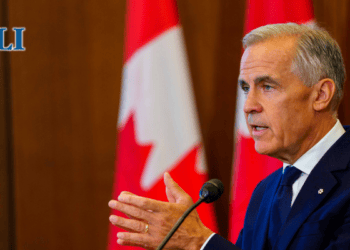
Although Prime Minister Mark Carney minimized the impact of this suspension, the reactions on the part of many expert commentators and former policymakers ranged from negative to outright bewilderment.
Professor Fen Osler Hampson called the decision “ominous.” Professors Justin Massie and Stéphane Roussel agree that it is a “bad omen” for North American defence cooperation because it suggests how Washington wishes to vassalize Ottawa. Former Conservative leader Erin O’Toole described the Pentagon’s decision as “profoundly misguided.” One historian who has studied the PJBD is paraphrased as saying that the suspension “sends a strong signal,” given the functional work that the advisory body does.
Already reeling from President Donald Trump’s past annexationist rhetoric and the ongoing trade dispute, the bilateral relationship has suffered another blow.
But rather than interpreting the PJBD decision as yet another manifestation of the Trump administration’s single-minded pursuit of dismantling long-standing institutions and traditions, we suggest an alternative perspective. The PJBD decision seems more reflective of a broken policymaking process within the U.S. government and the particular interests of Colby, a senior Department of Defense official who is deeply unpopular within his own administration, which is itself deeply unpopular with the American public.
When we shift our aperture accordingly, we see a dysfunctional presidential administration wracked by discord. For over a year, the president has not had a proper national security advisor (NSA), having handed over responsibility for the position to Secretary of State Marco Rubio on an “interim” basis.
Alas, the NSA plays a critical role: historically, it manages the inter-agency process, as it is known, which ensures policy coordination between the many parts of the U.S. government. Unfortunately, the past year has seen multiple failures of this process, with a recent one being a reversal of a deployment of U.S. troops to Poland that the president himself had supported.
Instead of a programmatic effort led by the top to reshape international politics, we see policy entrepreneurs exploit that dysfunctionality to go about their own freelancing, with the PJBD being the latest victim.
Thankfully, it is merely a legacy organization overtaken by the Military Cooperation Committee (1946), NATO (1949), and NORAD (1958). Despite its founding intent to ensure policy and military coordination between the two countries, it has been superseded by those other organizations, giving it only a minimal role in actual policy formation. It last met in 2024.
Former acting secretary of the PJBD and Kingston-based academic Joseph Jockel has called it the Permanent Joint Boondoggle due to its infrequent meetings and low impact. That it has very little policy relevance today may explain why Colby was even able to suspend it. Few bureaucratic or political actors resisted his efforts.
The prime minister’s contention that the significance of the decision should not be overplayed in regards to North American security cooperation is correct. As such, the PJBD decision should focus our attention on what it says about the Trump administration’s own internal dynamics and how Canada should respond.
Who is Elbridge Colby?
Colby, who boasts a Yale law degree and a grandfather who once served as CIA director, joined the Pentagon as a deputy assistant secretary of defense and contributed to several important policy documents. Colby quit the Pentagon thereafter and started offering extensive public commentary on global events, as well as apologia for the January 6 insurrection. His public efforts paid off, with Trump nominating Colby to his current role in December 2024.
Many of his policy positions were not well received by the president’s allies and power groups, which led to a deeply contentious Senate confirmation process that nearly led to him being withdrawn as a candidate. Once in the role, he, at times, advanced policy positions, such as on the withdrawal of aid from Ukraine, that the administration or even the president himself had to walk back later.
Colby finds himself in a precarious position: neither a part of Trump’s inner circle nor accepted by many mainstream Republicans.
Given Colby made the PJBD announcement on X while Secretary of Defence Pete Hegseth was out of Washington campaigning, it is fair to wonder how much attention the president or his secretary even gave the suspension amid the ongoing war against Iran, the summit in Beijing, and the affordability crisis gripping the country.
Overall, the major theme of Colby’s work has been to try to reduce the burden of the transatlantic alliance and elsewhere so that the U.S. military can focus on the challenge of China in the Indo-Pacific. It is in this light that his recent initiative with Canada should be understood.
Implications for Canada
Overreacting to the suspension of the PJBD does not benefit Canada. Raising a stink, while also failing to adequately raise defence spending, only validates Colby’s position. And, to a lesser extent, it plays into the president’s vague preference to sow discord among allies. Canadians must not be baited into outrage about a body that few knew existed prior to its dissolution, especially one that has little contemporary relevance to the current bilateral defence relationship.
Fighting to keep a largely irrelevant institution on simple principle would play into the Trump administration’s hands, allowing them to dictate the debate and use the PJBD against Canada—if it is treated as such a valuable chip, they might just cash it in.
That said, Colby’s criticisms are not necessarily unwarranted. Canada’s military modernization must be accelerated. Reaching the threshold of 2 percent of GDP on defence spending, as Ottawa announced this past year, is no great accomplishment. Canada had pledged to do so within 10 years at the 2014 Wales NATO Summit. All other NATO states achieved that benchmark already, with many states averaging well over 2.5 percent.
Crucially, the country’s actual military capabilities remain limited. It depends on Washington to cover even the most basic security needs. Although Colby has been the most vocal about this reality, this view is one that national security officials from both major political parties in the United States have held for over a decade.
Making concrete steps to address this gap much more quickly is the best way to inoculate Canada from such mercurialism and policy freelancing by Colby and others like him.
Richard Shimooka is senior fellow at the Macdonald-Laurier Institute and a contributing writer to The Hub.
Alexander Lanoszka is senior fellow at the Macdonald-Laurier Institute and Associate Professor at the University of Waterloo.