Wednesday, February 11, 2026
No Result
View All Result
  • Media
Macdonald-Laurier Institute
  • Home
  • About
    • Who We Are
    • Who Makes MLI Work
    • Fifteenth Anniversary
  • Experts
    • Experts Directory
    • In Memoriam
  • Issues
    • Domestic Policy
      • Economic Policy
      • Justice
      • Rights and Freedoms
      • Assisted Suicide (MAID)
      • Health Care
      • COVID-19
      • Gender Identity
      • Canada’s Political Tradition
      • AI, Technology and Innovation
      • Media and Telecoms
      • Housing
      • Immigration
      • Agriculture and Agri-Food
      • Competition Policy
    • Energy Policy
      • Energy
      • Environment
    • Foreign Policy
      • Israel-Hamas War
      • Ukraine
      • Taiwan
      • China
      • Europe and Russia
      • Indo-Pacific
      • Middle East and North Africa
      • North America
      • Foreign Interference
      • National Defence
      • National Security
      • Foreign Affairs
    • Indigenous Affairs
  • Projects
    • CNAPS (Center for North American Prosperity and Security)
    • The Promised Land
    • Voices that Inspire: The Macdonald-Laurier Vancouver Speaker Series
    • Dragon at the door
    • Canada on top of the world
    • Letter to a minister
    • Justice Report Card
    • The Great Energy Crisis
    • DisInfoWatch.org
    • Managing Indigenous Prosperity
    • Judicial Foundations
    • Landmark Cases Council
    • Defending The Marketplace of Ideas
    • Reforming the University
    • Past Projects
      • Digital Policy & Connectivity
      • Double Trouble
      • Canada and the Indo-Pacific Initiative
      • The Transatlantic Program
      • COVID Misery Index
        • Provincial COVID Misery Index
        • Beyond Lockdown
        • COVID and after: A mandate for recovery
      • Speak for Ourselves
      • The Eavesdropping Dragon: Huawei
      • Talkin’ in the Free World with Mariam Memarsadeghi
      • An Intellectual Property Strategy for Canada
      • Munk Senior Fellows
      • A Mandate for Canada
      • Confederation Series
      • Fiscal Reform
      • The Canadian Century project
      • Fixing Canadian health care
      • Internal trade
      • From a mandate for change
      • Size of government in Canada
      • Straight Talk
      • Labour Market Report
      • Leading Economic Indicator
      • Centre for Advancing Canada’s Interests Abroad
      • Indigenous Prosperity at a Crossroads
        • Aboriginal Canada and Natural Resources
  • Events
    • Upcoming Events
    • Past Events
      • MLI Dinners
      • Great Canadian Debates
  • Latest News
  • Libraries
    • Columns
    • Commentary
    • Papers
    • Books
    • Video
  • Donate
  • Home
  • About
    • Who We Are
    • Who Makes MLI Work
    • Fifteenth Anniversary
  • Experts
    • Experts Directory
    • In Memoriam
  • Issues
    • Domestic Policy
      • Economic Policy
      • Justice
      • Rights and Freedoms
      • Assisted Suicide (MAID)
      • Health Care
      • COVID-19
      • Gender Identity
      • Canada’s Political Tradition
      • AI, Technology and Innovation
      • Media and Telecoms
      • Housing
      • Immigration
      • Agriculture and Agri-Food
      • Competition Policy
    • Energy Policy
      • Energy
      • Environment
    • Foreign Policy
      • Israel-Hamas War
      • Ukraine
      • Taiwan
      • China
      • Europe and Russia
      • Indo-Pacific
      • Middle East and North Africa
      • North America
      • Foreign Interference
      • National Defence
      • National Security
      • Foreign Affairs
    • Indigenous Affairs
  • Projects
    • CNAPS (Center for North American Prosperity and Security)
    • The Promised Land
    • Voices that Inspire: The Macdonald-Laurier Vancouver Speaker Series
    • Dragon at the door
    • Canada on top of the world
    • Letter to a minister
    • Justice Report Card
    • The Great Energy Crisis
    • DisInfoWatch.org
    • Managing Indigenous Prosperity
    • Judicial Foundations
    • Landmark Cases Council
    • Defending The Marketplace of Ideas
    • Reforming the University
    • Past Projects
      • Digital Policy & Connectivity
      • Double Trouble
      • Canada and the Indo-Pacific Initiative
      • The Transatlantic Program
      • COVID Misery Index
        • Provincial COVID Misery Index
        • Beyond Lockdown
        • COVID and after: A mandate for recovery
      • Speak for Ourselves
      • The Eavesdropping Dragon: Huawei
      • Talkin’ in the Free World with Mariam Memarsadeghi
      • An Intellectual Property Strategy for Canada
      • Munk Senior Fellows
      • A Mandate for Canada
      • Confederation Series
      • Fiscal Reform
      • The Canadian Century project
      • Fixing Canadian health care
      • Internal trade
      • From a mandate for change
      • Size of government in Canada
      • Straight Talk
      • Labour Market Report
      • Leading Economic Indicator
      • Centre for Advancing Canada’s Interests Abroad
      • Indigenous Prosperity at a Crossroads
        • Aboriginal Canada and Natural Resources
  • Events
    • Upcoming Events
    • Past Events
      • MLI Dinners
      • Great Canadian Debates
  • Latest News
  • Libraries
    • Columns
    • Commentary
    • Papers
    • Books
    • Video
  • Donate
No Result
View All Result
Macdonald-Laurier Institute

The mainstream media failed Canadians during the Freedom Convoy: Peter Menzies in The Hub

Four years later, media complicity in government overreach is one of the lasting lessons of the protests.

February 11, 2026
in Domestic Policy, Latest News, Columns, In the Media, Media and Telecoms, Peter Menzies
Reading Time: 5 mins read
A A
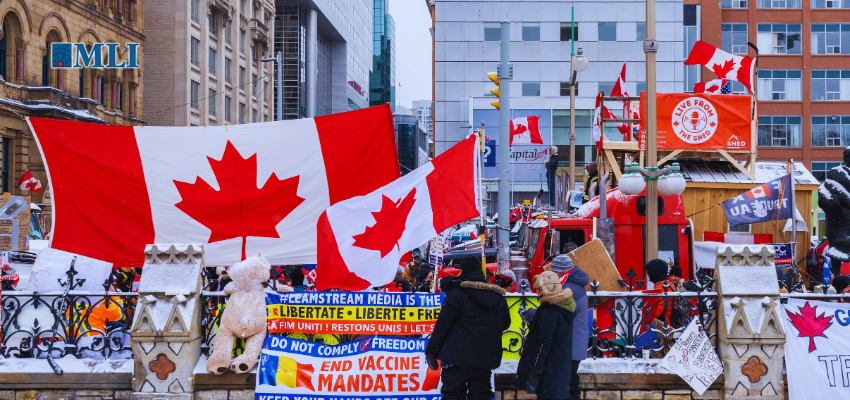
The mainstream media failed Canadians during the Freedom Convoy: Peter Menzies in The Hub

Photo by Maksim Sokolov (Maxergon) via Wikimedia Commons.

This article originally appeared in The Hub.

By Peter Menzies, February 11, 2026

Four years ago, armed and mounted police officers, backed by the since-discredited imposition of the Emergencies Act, shut down the Freedom Convoy protest and arrested about 170 of its participants while banks froze the accounts of those who organized it.

After weeks of downtown Ottawa being overtaken by big truck horn-honkers opposed to the government’s COVID-19 pandemic restrictions, life returned to its normal, quiet, and compliant state. The streets, once again, were empty by 6 p.m.

The subsequent inquiry into these affairs, led by Justice Paul Rouleau, found that, on balance, the government was justified in suspending civil liberties in a fashion not employed in more than 50 years since Prime Minister Pierre Trudeau invoked the War Measures Act. That particular invocation was done to stifle the terrorist actions of Quebec separatists engaged in the kidnapping of a diplomat—Britain’s James Cross—and the abduction and murder of Quebec cabinet minister Pierre Laporte, a former Le Devoir journalist.

Plans by the terrorist Front de Liberation du Quebec (FLQ) to kidnap other diplomats were uncovered, as were firearms and explosives. Close to 500 arrests were made, Cross was released, and, in exchange, the Government of Canada flew five terrorists to freedom in Cuba. The cabinet minister was buried following a funeral at Notre Dame Basilica. The streets were lined with hundreds of soldiers. Snipers were on rooftops.

The Freedom Convoy arrests, in contrast, led to the convictions of two of its leaders, Tamara Lich and Chris Barber, for mischief. No one died. No guns were fired or found in Ottawa, bouncy castles and hot tubs were in abundance, and Lich and Barber will complete their house arrest sentences—imposed after a lengthy trial—at some point this fall.

A Federal Court Justice ruled that the government, then led by Justin Trudeau, acted without appropriate justification when it invoked the Emergencies Act (the War Measures Act’s successor). His decision was upheld unanimously in January by three justices on the Federal Court of Appeal.

And yet, just as Canada has not, as other countries have done, held an inquiry into its handling of the pandemic, there’s no evidence media have taken time to reflect on their coverage of the invocation of the Emergencies Act and the shutdown of bank accounts, which includeda Globe and Mail op-ed penned by our current prime minister, Mark Carney, when he was a private citizen concerned about “sedition.”

Instead, a chilling overreach has been greeted with a collective shrug by people who convinced the government they must be subsidized due to their vital role as defenders of democracy.

There’s little doubt the protesters had abandoned faith in legacy media and developed some unorthodox interpretations of the nation’s Constitution. How they came to do that is worthy of inquiry. It is also worth examining how multiple media reports, often quoting unnamed sources, incorrectly reported that protesters were equipped with firearms, led by white supremacists, committed arson, threatened rape, supported neo-Nazis, were funded by Russia, invaded office buildings, etc. Some of those bogus reports, the Rouleau inquiry heard, influenced the decision to invoke the Emergencies Act.

To be clear, there were and still are voices within the journalism community that opposed the government’s actions. While grudging in their initial disapproval, the Globe and Mail and Toronto Star editorial boards have, to their credit, put more spine behind their opposition with the passage of years. The Hub has been unequivocal in its opposition, and columnists such as Robyn Urback and Gary Mason (Globe), Don Martin (CTV), and Althia Raj (The Star) did not support the government’s actions.

But there were many that did, including Lawrence Martin (Globe), Max Fawcett (National Observer), Justin Ling (Star), Andrew Coyne (Globe), and Chantal Hebert (Star/Le Devoir). The views of the latter two dominated the CBC’s flagship At Issue panel throughout the protest.

Donor button.

Of those, Ling certainly built a shoot first and ask questions later reputation among his social media detractors, while Fawcett was consistently aggressive, praising Rouleau’s report and posting a haughty “Are we done now?” when it was released.

Nothing wrong with a diversity of opinion, but what should be of concern to all is how journalists may have been manipulated to heighten public fear to justify the suppression of liberties.

The COVID-19 pandemic inspired a lot of fear. Some of us lost friends. During times like that, it is more important than ever for news organizations and their employees to reflect upon how they, in their own fear, may have become tools in what eventually became the greatest single act suppressing civil rights in Canada in more than half a century.

As it stands, there is little public evidence that such serious consideration has occurred. Instead, those whose distrust of and sense of abandonment by legacy media likely remain more convinced than ever of the veracity of their views. And those whose lives were disrupted by the protesters will remain just as convinced that their fears were justified.

One can only hope that the nation’s newsrooms have reflected upon how they managed fear of COVID and the Freedom Convoy and whether it contributed to an astonishing and unjustified suppression of human rights.

Because there’s going to be a next time.


Peter Menzies is a commentator and consultant on media, a Macdonald-Laurier Institute Senior Fellow, a past publisher of the Calgary Herald, and a former vice chair of the CRTC.
Source: The Hub

Related Posts

Charting uncertain waters – Facts vs. fears in indigenous land claim rulings: Panel discussion
Indigenous Affairs

Charting uncertain waters – Facts vs. fears in indigenous land claim rulings: Panel discussion

February 11, 2026
Press conference ss.
China: The dragon at the door

U.S. think tank links CCP groups to entities in Canada

February 11, 2026
A simple test for Canada-China trade: Stephen Nagy in the Hamilton Spectator
Indo-Pacific

A simple test for Canada-China trade: Stephen Nagy in the Hamilton Spectator

February 11, 2026
Next Post
Charting uncertain waters – Facts vs. fears in indigenous land claim rulings: Panel discussion

Charting uncertain waters – Facts vs. fears in indigenous land claim rulings: Panel discussion

Newsletter Signup

  Thank you for Signing Up
  Please correct the marked field(s) below.
Email Address  *
1,true,6,Contact Email,2
First Name *
1,true,1,First Name,2
Last Name *
1,true,1,Last Name,2
*
*Required Fields

Follow us on

Macdonald-Laurier Institute

323 Chapel Street, Suite #300
Ottawa, Ontario, K1N 7Z2 Canada

613.482.8327

info@macdonaldlaurier.ca
MLI directory

Support Us

Support the Macdonald-Laurier Institute to help ensure that Canada is one of the best governed countries in the world. Click below to learn more or become a sponsor.

Support Us

  • Inside Policy Magazine
  • Annual Reports
  • Jobs
  • Privacy Policy

© 2023 Macdonald-Laurier Institute. All Rights reserved.

This site uses cookies. By continuing to browse the site you are agreeing to our use of cookies.

Privacy Preference Center

Consent Management

Necessary

Advertising

Analytics

Other

No Result
View All Result
  • Home
  • About
    • Who We Are
    • Who Makes MLI Work
    • Fifteenth Anniversary
  • Experts
    • Experts Directory
    • In Memoriam
  • Issues
    • Domestic Policy
      • Economic Policy
      • Justice
      • Rights and Freedoms
      • Assisted Suicide (MAID)
      • Health Care
      • COVID-19
      • Gender Identity
      • Canada’s Political Tradition
      • AI, Technology and Innovation
      • Media and Telecoms
      • Housing
      • Immigration
      • Agriculture and Agri-Food
      • Competition Policy
    • Energy Policy
      • Energy
      • Environment
    • Foreign Policy
      • Israel-Hamas War
      • Ukraine
      • Taiwan
      • China
      • Europe and Russia
      • Indo-Pacific
      • Middle East and North Africa
      • North America
      • Foreign Interference
      • National Defence
      • National Security
      • Foreign Affairs
    • Indigenous Affairs
  • Projects
    • CNAPS (Center for North American Prosperity and Security)
    • The Promised Land
    • Voices that Inspire: The Macdonald-Laurier Vancouver Speaker Series
    • Dragon at the door
    • Canada on top of the world
    • Letter to a minister
    • Justice Report Card
    • The Great Energy Crisis
    • DisInfoWatch.org
    • Managing Indigenous Prosperity
    • Judicial Foundations
    • Landmark Cases Council
    • Defending The Marketplace of Ideas
    • Reforming the University
    • Past Projects
      • Digital Policy & Connectivity
      • Double Trouble
      • Canada and the Indo-Pacific Initiative
      • The Transatlantic Program
      • COVID Misery Index
      • Speak for Ourselves
      • The Eavesdropping Dragon: Huawei
      • Talkin’ in the Free World with Mariam Memarsadeghi
      • An Intellectual Property Strategy for Canada
      • Munk Senior Fellows
      • A Mandate for Canada
      • Confederation Series
      • Fiscal Reform
      • The Canadian Century project
      • Fixing Canadian health care
      • Internal trade
      • From a mandate for change
      • Size of government in Canada
      • Straight Talk
      • Labour Market Report
      • Leading Economic Indicator
      • Centre for Advancing Canada’s Interests Abroad
      • Indigenous Prosperity at a Crossroads
  • Events
    • Upcoming Events
    • Past Events
      • MLI Dinners
      • Great Canadian Debates
  • Latest News
  • Libraries
    • Columns
    • Commentary
    • Papers
    • Books
    • Video
  • Donate

© 2023 Macdonald-Laurier Institute. All Rights reserved.