
Thursday, February 19, 2026
No Result
View All Result
  • Media
Macdonald-Laurier Institute
  • Home
  • About
    • Who We Are
    • Who Makes MLI Work
    • Fifteenth Anniversary
  • Experts
    • Experts Directory
    • In Memoriam
  • Issues
    • Domestic Policy
      • Economic Policy
      • Justice
      • Rights and Freedoms
      • Assisted Suicide (MAID)
      • Health Care
      • COVID-19
      • Gender Identity
      • Canada’s Political Tradition
      • AI, Technology and Innovation
      • Media and Telecoms
      • Housing
      • Immigration
      • Agriculture and Agri-Food
      • Competition Policy
    • Energy Policy
      • Energy
      • Environment
    • Foreign Policy
      • Israel-Hamas War
      • Ukraine
      • Taiwan
      • China
      • Europe and Russia
      • Indo-Pacific
      • Middle East and North Africa
      • North America
      • Foreign Interference
      • National Defence
      • National Security
      • Foreign Affairs
    • Indigenous Affairs
  • Projects
    • CNAPS (Center for North American Prosperity and Security)
    • The Promised Land
    • Voices that Inspire: The Macdonald-Laurier Vancouver Speaker Series
    • Dragon at the door
    • Canada on top of the world
    • Letter to a minister
    • Justice Report Card
    • The Great Energy Crisis
    • DisInfoWatch.org
    • Managing Indigenous Prosperity
    • Judicial Foundations
    • Landmark Cases Council
    • Defending The Marketplace of Ideas
    • Reforming the University
    • Past Projects
      • Digital Policy & Connectivity
      • Double Trouble
      • Canada and the Indo-Pacific Initiative
      • The Transatlantic Program
      • COVID Misery Index
        • Provincial COVID Misery Index
        • Beyond Lockdown
        • COVID and after: A mandate for recovery
      • Speak for Ourselves
      • The Eavesdropping Dragon: Huawei
      • Talkin’ in the Free World with Mariam Memarsadeghi
      • An Intellectual Property Strategy for Canada
      • Munk Senior Fellows
      • A Mandate for Canada
      • Confederation Series
      • Fiscal Reform
      • The Canadian Century project
      • Fixing Canadian health care
      • Internal trade
      • From a mandate for change
      • Size of government in Canada
      • Straight Talk
      • Labour Market Report
      • Leading Economic Indicator
      • Centre for Advancing Canada’s Interests Abroad
      • Indigenous Prosperity at a Crossroads
        • Aboriginal Canada and Natural Resources
  • Events
    • Upcoming Events
    • Past Events
      • MLI Dinners
      • Great Canadian Debates
  • Latest News
  • Libraries
    • Columns
    • Commentary
    • Papers
    • Books
    • Video
  • Donate
  • Home
  • About
    • Who We Are
    • Who Makes MLI Work
    • Fifteenth Anniversary
  • Experts
    • Experts Directory
    • In Memoriam
  • Issues
    • Domestic Policy
      • Economic Policy
      • Justice
      • Rights and Freedoms
      • Assisted Suicide (MAID)
      • Health Care
      • COVID-19
      • Gender Identity
      • Canada’s Political Tradition
      • AI, Technology and Innovation
      • Media and Telecoms
      • Housing
      • Immigration
      • Agriculture and Agri-Food
      • Competition Policy
    • Energy Policy
      • Energy
      • Environment
    • Foreign Policy
      • Israel-Hamas War
      • Ukraine
      • Taiwan
      • China
      • Europe and Russia
      • Indo-Pacific
      • Middle East and North Africa
      • North America
      • Foreign Interference
      • National Defence
      • National Security
      • Foreign Affairs
    • Indigenous Affairs
  • Projects
    • CNAPS (Center for North American Prosperity and Security)
    • The Promised Land
    • Voices that Inspire: The Macdonald-Laurier Vancouver Speaker Series
    • Dragon at the door
    • Canada on top of the world
    • Letter to a minister
    • Justice Report Card
    • The Great Energy Crisis
    • DisInfoWatch.org
    • Managing Indigenous Prosperity
    • Judicial Foundations
    • Landmark Cases Council
    • Defending The Marketplace of Ideas
    • Reforming the University
    • Past Projects
      • Digital Policy & Connectivity
      • Double Trouble
      • Canada and the Indo-Pacific Initiative
      • The Transatlantic Program
      • COVID Misery Index
        • Provincial COVID Misery Index
        • Beyond Lockdown
        • COVID and after: A mandate for recovery
      • Speak for Ourselves
      • The Eavesdropping Dragon: Huawei
      • Talkin’ in the Free World with Mariam Memarsadeghi
      • An Intellectual Property Strategy for Canada
      • Munk Senior Fellows
      • A Mandate for Canada
      • Confederation Series
      • Fiscal Reform
      • The Canadian Century project
      • Fixing Canadian health care
      • Internal trade
      • From a mandate for change
      • Size of government in Canada
      • Straight Talk
      • Labour Market Report
      • Leading Economic Indicator
      • Centre for Advancing Canada’s Interests Abroad
      • Indigenous Prosperity at a Crossroads
        • Aboriginal Canada and Natural Resources
  • Events
    • Upcoming Events
    • Past Events
      • MLI Dinners
      • Great Canadian Debates
  • Latest News
  • Libraries
    • Columns
    • Commentary
    • Papers
    • Books
    • Video
  • Donate
No Result
View All Result
Macdonald-Laurier Institute

The good (and lots of bad) in Canada’s new defence industrial strategy: Richard Shimooka in The Hub

Tellingly, the word “war” rarely appears in the strategy.

February 19, 2026
in National Defence, Latest News, Columns, Foreign Policy, In the Media, Richard Shimooka
Reading Time: 5 mins read
A A
The good (and lots of bad) in Canada’s new defence industrial strategy: Richard Shimooka in The Hub

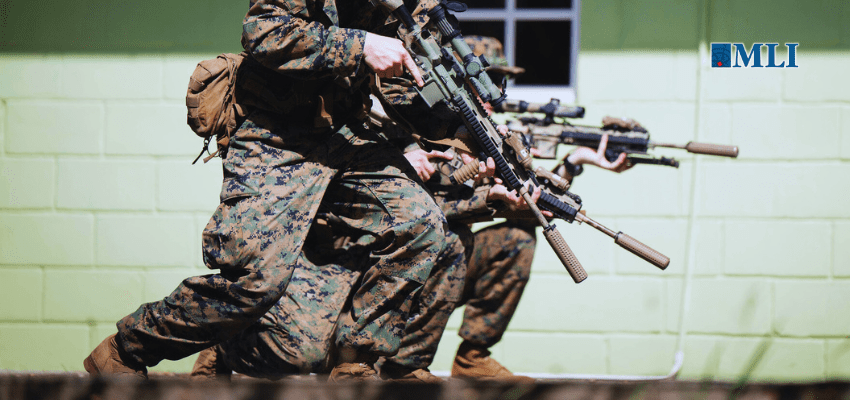
Photo by Master Corporal Stéphanie Labossière, Imagery Technician, Canadian Armed Forces | Combat Camera via Flickr.

This article originally appeared in The Hub.

By Richard Shimooka, February 19, 2026

On Tuesday, the government released its delayed defence industrial strategy, which featured a number of major headline goals. The two most significant are an effort to source 70 percent of Canada’s defence goods domestically and raising employment in the sector to 125,000 jobs. These are lofty ambitions, but what does it mean for the Canadian Armed Forces or the security of the country?

While its title is a defence industrial strategy, this plan is probably more accurately described as an industrial strategy for defence spending, because there is a high risk that significant proportions of the intended spending will not have the desired effects.

Ottawa’s effort to develop a strategy follows many of Canada’s allies in this area, which started to consider the need to support their respective militaries through industrial reorganization and spending. Interest in this aspect of policy significantly expanded as a result of the COVID-19 pandemic (and resulting supply chain disruptions), as well as the expansion of the war in Ukraine.

The key driving question has become: Could your national industries, in concert with your allies, sustain the necessary productive capacities required to sustain a war effort?

For most, Canada included, the answer was a resounding “No.”

This industrial reorganization is in effect two components: supply chain assurance and ensuring the ability to mobilize at scale during the time of war. The reality about supply chains is that they are vast and multifaceted—building secure ones that can produce defence materiel and key services (such as cyber and software capabilities) —is difficult and realistically can’t be done in an autarky.

A line in a 1947 white paper succinctly captures how the Canadian supply chain supported the Second World War effort:

What we did was make more of the things we could make the best, and exchange these for the things other nations could make more economically or more quickly than we could: consequently we did not make all of our own arms.

This lesson appears to have been forgotten.

The second component is the demand-signal from the CAF. This often comes down to fairly straightforward questions—what are the requirements for the military or our close allies for the missions that are assigned to them? This is further broken down into the individual use and attrition rates of munitions and platforms.

For example, what are the anticipated Royal Canadian Air Force’s air-to-air missile usage rates or the number of small drones the Army expects to lose over the course of a high-intensity military activity?

Canada has historically been fairly neglectful of this process of stockpiling supplies. This has been a deliberate choice made by successive governments after the 1960s to decrease the focus on war-preparedness in an effort to reduce military expenditures. This became substantially worse after the Cold War ended, as Canada simply stopped serious industrial planning.

The new defence industrial strategy is basically the Canadian Government’s first attempt to rectify this deficiency in over 30 years. However, it reflects the competing mandates between extracting maximum economic benefits and the more immediate and, arguably, more critical military concerns. One would assume that, after Prime Minister Carney’s Davos speech outlining how Canada now faces a dramatically different international system, there would be greater alacrity towards actually modernizing the CAF.

Unfortunately, the recently released strategy does not provide the critical foundations to shape the defence industry to meet this effort. The two key determinants—a clear demand signal for defence, and achieving supply chain resilience and capacity for wartime requirements—are not addressed. If there was anything that better illustrated its lack of focus on the needs of the CAF, is that the words “war” or “warfighting” are conspicuously few and far between in the strategy.

Certainly, it identifies areas of sovereign capabilities, and a new mechanism for communicating the government’s priorities to industry—the latter through a multi-departmental Defence Advisory Forum. However, that body is co-chaired by the ministers of national defence and industry, as well as the secretary of state for the Defence Investment Agency. This unnecessarily crowded structure reflects the muddled approach towards the priorities for defence spending.

The concept of “sovereign capabilities” is equally problematic. As discussed several weeks ago regarding the aerospace sector, the idea that Canada (or any country other than the United States and China) can maintain domestic production capability for many sectors is patently unachievable. Canada will need to partner heavily with allies to effectively meet its peacetime military modernization goals, to speak nothing of potentially scaling for wartime production.

That is why stating that it is the government’s intention to have 70 percent of the goods the CAF acquires come from domestic sources is arbitrary and potentially counterproductive. It will encourage the country to invest in small, inefficient domestic suppliers, which will not be able to scale up easily if the demand arises from a major conflict.

Furthermore, it will potentially squander resources that could have been put to more productive endeavours. While the effort to vastly increase R&D spending and better harness Canadian industry is welcome and desperately necessary, more can be done to focus it on specific areas that meet the CAF requirements.

To be sure, Carney is operating in a constrained environment, given the political landscape, where public support for defence spending is hard to come by. This has been a longstanding issue governments of all stripes have had to vie with. Positioning this new defence spending as a domestic investment effort might just be the transaction cost an “Elbows Up” population requires to swallow the increase. But that does not mean that, ultimately, it is the most economic or strategic approach.

Will Canada’s industrial strategy help improve the output of the defence sector? Yes, but it’s a missed opportunity to get the focus and policy right. As seeds spread over a wide terrain, many will not find fertile ground, whereas a targeted approach would provide a better yield.

Given the immense resources Ottawa is prepared to invest in the area, building a foundation on solid first principles should have been the focus of the strategy, not an afterthought.

Richard Shimooka is a Hub contributing writer and a senior fellow at the Macdonald-Laurier Institute who writes on defence policy.

Source: The Hub

Related Posts

Canadian Medical Association wants to force Alberta to ignore science on gender care: Mia Hughes in the National Post
Economic Policy

How the risk of separation could cost Alberta thousands of jobs: Trevor Tombe in The Hub

February 19, 2026
Canada should be a mining superpower, too: Heather Exner-Pirot in The Hill Times
Resources

Critical minerals get a nod, steel and aluminium get a push in new Defence Industrial Strategy: Heather Exner-Pirot for The Walrus

February 18, 2026
Trump’s Most Favoured Nation drug pricing risks further delays in Canada for pharmaceuticals: Nigel Rawson in National Newswatch
Health

Trump’s Most Favoured Nation drug pricing risks further delays in Canada for pharmaceuticals: Nigel Rawson in National Newswatch

February 18, 2026
Next Post
Canadian Medical Association wants to force Alberta to ignore science on gender care: Mia Hughes in the National Post

How the risk of separation could cost Alberta thousands of jobs: Trevor Tombe in The Hub

Newsletter Signup

  Thank you for Signing Up
  Please correct the marked field(s) below.
Email Address  *
1,true,6,Contact Email,2
First Name *
1,true,1,First Name,2
Last Name *
1,true,1,Last Name,2
*
*Required Fields

Follow us on

Macdonald-Laurier Institute

323 Chapel Street, Suite #300
Ottawa, Ontario, K1N 7Z2 Canada

613.482.8327

info@macdonaldlaurier.ca
MLI directory

Support Us

Support the Macdonald-Laurier Institute to help ensure that Canada is one of the best governed countries in the world. Click below to learn more or become a sponsor.

Support Us

  • Inside Policy Magazine
  • Annual Reports
  • Jobs
  • Privacy Policy

© 2023 Macdonald-Laurier Institute. All Rights reserved.

This site uses cookies. By continuing to browse the site you are agreeing to our use of cookies.

Privacy Preference Center

Consent Management

Necessary

Advertising

Analytics

Other

No Result
View All Result
  • Home
  • About
    • Who We Are
    • Who Makes MLI Work
    • Fifteenth Anniversary
  • Experts
    • Experts Directory
    • In Memoriam
  • Issues
    • Domestic Policy
      • Economic Policy
      • Justice
      • Rights and Freedoms
      • Assisted Suicide (MAID)
      • Health Care
      • COVID-19
      • Gender Identity
      • Canada’s Political Tradition
      • AI, Technology and Innovation
      • Media and Telecoms
      • Housing
      • Immigration
      • Agriculture and Agri-Food
      • Competition Policy
    • Energy Policy
      • Energy
      • Environment
    • Foreign Policy
      • Israel-Hamas War
      • Ukraine
      • Taiwan
      • China
      • Europe and Russia
      • Indo-Pacific
      • Middle East and North Africa
      • North America
      • Foreign Interference
      • National Defence
      • National Security
      • Foreign Affairs
    • Indigenous Affairs
  • Projects
    • CNAPS (Center for North American Prosperity and Security)
    • The Promised Land
    • Voices that Inspire: The Macdonald-Laurier Vancouver Speaker Series
    • Dragon at the door
    • Canada on top of the world
    • Letter to a minister
    • Justice Report Card
    • The Great Energy Crisis
    • DisInfoWatch.org
    • Managing Indigenous Prosperity
    • Judicial Foundations
    • Landmark Cases Council
    • Defending The Marketplace of Ideas
    • Reforming the University
    • Past Projects
      • Digital Policy & Connectivity
      • Double Trouble
      • Canada and the Indo-Pacific Initiative
      • The Transatlantic Program
      • COVID Misery Index
      • Speak for Ourselves
      • The Eavesdropping Dragon: Huawei
      • Talkin’ in the Free World with Mariam Memarsadeghi
      • An Intellectual Property Strategy for Canada
      • Munk Senior Fellows
      • A Mandate for Canada
      • Confederation Series
      • Fiscal Reform
      • The Canadian Century project
      • Fixing Canadian health care
      • Internal trade
      • From a mandate for change
      • Size of government in Canada
      • Straight Talk
      • Labour Market Report
      • Leading Economic Indicator
      • Centre for Advancing Canada’s Interests Abroad
      • Indigenous Prosperity at a Crossroads
  • Events
    • Upcoming Events
    • Past Events
      • MLI Dinners
      • Great Canadian Debates
  • Latest News
  • Libraries
    • Columns
    • Commentary
    • Papers
    • Books
    • Video
  • Donate

© 2023 Macdonald-Laurier Institute. All Rights reserved.