Thursday, March 26, 2026
No Result
View All Result
  • Media
Macdonald-Laurier Institute
  • Home
  • About
    • Who We Are
    • Who Makes MLI Work
    • Fifteenth Anniversary
  • Experts
    • Experts Directory
    • In Memoriam
  • Issues
    • Domestic Policy
      • Economic Policy
      • Justice
      • Rights and Freedoms
      • Assisted Suicide (MAID)
      • Health Care
      • COVID-19
      • Gender Identity
      • Canada’s Political Tradition
      • AI, Technology and Innovation
      • Media and Telecoms
      • Housing
      • Immigration
      • Agriculture and Agri-Food
      • Competition Policy
    • Energy Policy
      • Energy
      • Environment
    • Foreign Policy
      • Israel-Hamas War
      • Ukraine
      • Taiwan
      • China
      • Europe and Russia
      • Indo-Pacific
      • Middle East and North Africa
      • North America
      • Foreign Interference
      • National Defence
      • National Security
      • Foreign Affairs
    • Indigenous Affairs
  • Projects
    • CNAPS (Center for North American Prosperity and Security)
    • Justice Report Card
    • The Promised Land
    • Voices that Inspire: The Macdonald-Laurier Vancouver Speaker Series
    • Dragon at the door
    • Canada on top of the world
    • Letter to a minister
    • The Great Energy Crisis
    • DisInfoWatch.org
    • Managing Indigenous Prosperity
    • Judicial Foundations
    • Landmark Cases Council
    • Defending The Marketplace of Ideas
    • Reforming the University
    • Past Projects
      • Digital Policy & Connectivity
      • Double Trouble
      • Canada and the Indo-Pacific Initiative
      • The Transatlantic Program
      • COVID Misery Index
        • Provincial COVID Misery Index
        • Beyond Lockdown
        • COVID and after: A mandate for recovery
      • Speak for Ourselves
      • The Eavesdropping Dragon: Huawei
      • Talkin’ in the Free World with Mariam Memarsadeghi
      • An Intellectual Property Strategy for Canada
      • Munk Senior Fellows
      • A Mandate for Canada
      • Confederation Series
      • Fiscal Reform
      • The Canadian Century project
      • Fixing Canadian health care
      • Internal trade
      • From a mandate for change
      • Size of government in Canada
      • Straight Talk
      • Labour Market Report
      • Leading Economic Indicator
      • Centre for Advancing Canada’s Interests Abroad
      • Indigenous Prosperity at a Crossroads
        • Aboriginal Canada and Natural Resources
  • Events
    • Upcoming Events
    • Past Events
      • MLI Dinners
      • Great Canadian Debates
  • Latest News
  • Libraries
    • Columns
    • Commentary
    • Papers
    • Books
    • Video
  • Donate
  • Home
  • About
    • Who We Are
    • Who Makes MLI Work
    • Fifteenth Anniversary
  • Experts
    • Experts Directory
    • In Memoriam
  • Issues
    • Domestic Policy
      • Economic Policy
      • Justice
      • Rights and Freedoms
      • Assisted Suicide (MAID)
      • Health Care
      • COVID-19
      • Gender Identity
      • Canada’s Political Tradition
      • AI, Technology and Innovation
      • Media and Telecoms
      • Housing
      • Immigration
      • Agriculture and Agri-Food
      • Competition Policy
    • Energy Policy
      • Energy
      • Environment
    • Foreign Policy
      • Israel-Hamas War
      • Ukraine
      • Taiwan
      • China
      • Europe and Russia
      • Indo-Pacific
      • Middle East and North Africa
      • North America
      • Foreign Interference
      • National Defence
      • National Security
      • Foreign Affairs
    • Indigenous Affairs
  • Projects
    • CNAPS (Center for North American Prosperity and Security)
    • Justice Report Card
    • The Promised Land
    • Voices that Inspire: The Macdonald-Laurier Vancouver Speaker Series
    • Dragon at the door
    • Canada on top of the world
    • Letter to a minister
    • The Great Energy Crisis
    • DisInfoWatch.org
    • Managing Indigenous Prosperity
    • Judicial Foundations
    • Landmark Cases Council
    • Defending The Marketplace of Ideas
    • Reforming the University
    • Past Projects
      • Digital Policy & Connectivity
      • Double Trouble
      • Canada and the Indo-Pacific Initiative
      • The Transatlantic Program
      • COVID Misery Index
        • Provincial COVID Misery Index
        • Beyond Lockdown
        • COVID and after: A mandate for recovery
      • Speak for Ourselves
      • The Eavesdropping Dragon: Huawei
      • Talkin’ in the Free World with Mariam Memarsadeghi
      • An Intellectual Property Strategy for Canada
      • Munk Senior Fellows
      • A Mandate for Canada
      • Confederation Series
      • Fiscal Reform
      • The Canadian Century project
      • Fixing Canadian health care
      • Internal trade
      • From a mandate for change
      • Size of government in Canada
      • Straight Talk
      • Labour Market Report
      • Leading Economic Indicator
      • Centre for Advancing Canada’s Interests Abroad
      • Indigenous Prosperity at a Crossroads
        • Aboriginal Canada and Natural Resources
  • Events
    • Upcoming Events
    • Past Events
      • MLI Dinners
      • Great Canadian Debates
  • Latest News
  • Libraries
    • Columns
    • Commentary
    • Papers
    • Books
    • Video
  • Donate
No Result
View All Result
Macdonald-Laurier Institute

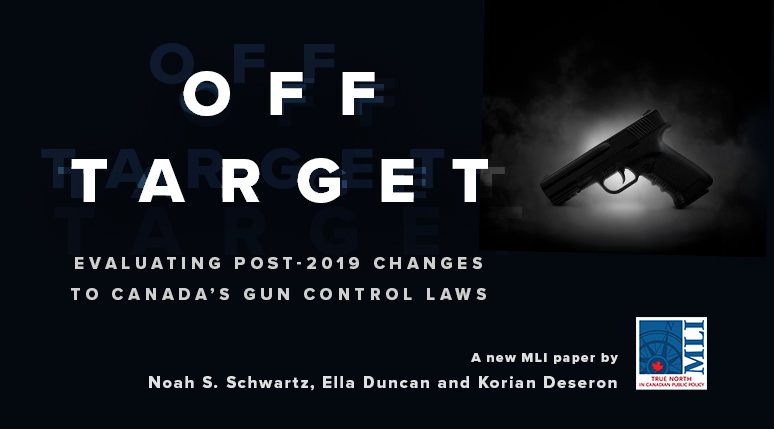
Off Target: Evaluating post-2019 changes to Canada’s gun control laws

The federal government has a choice – it can continue with restrictive measures that offer diminishing returns and deepen social divisions, or it can adopt a strategy that targets illicit smuggling and 3-D-printed firearms.

March 26, 2026
in Domestic Policy, Latest News, Papers, Rights and Freedoms
Reading Time: 5 mins read
A A
Off Target: Evaluating post-2019 changes to Canada’s gun control laws

By Noah S. Schwartz, Ella Duncan, and Korian Deseron
March 26, 2026

PDF of paper

Executive Summary | Sommaire (le français suit)

Since 2019, the landscape of Canadian firearms legislation has undergone a seismic shift. Through a series of sweeping executive and legislative actions, the federal government has implemented a national freeze on legal handgun sales, banned thousands of models of so-called “assault-style” weapons, and tightened administrative requirements for licensing and transfers.

While these measures are often framed as essential for public safety, they have remained largely unexamined by independent researchers – until now.

Using the Firearms Policy Evaluation Framework, our study provides a rigorous assessment of these policy shifts. Drawing on a deep dive into the literature on gun control policy, as well as interviews with law enforcement, community workers, and stakeholders, we found that:

• There is no evidence to support a prohibition or confiscation (buyback) of assault-style weapons in the Canadian context.
• There is no evidence to support a freeze on the legal sales of handguns to licensed gun owners.
• Police are concerned with smuggled firearms from the United States and privately manufactured firearms (PMFs), not legal gun owners.

These policies are causing real harm to communities of hunters and sports shooters, Indigenous people, and Canada’s economy and heritage. For instance, the tighter gun restrictions impact small businesses, shooting ranges, historical re-enactors, and the competitive sport shooting community. For Indigenous communities, firearms are essential tools for subsistence and traditional ways of life. Meanwhile, the gun control debate is pitting rural Canadians – who are more likely to use legal long guns for hunting and recreational shooting – against urbanites who may not own guns themselves, but whose communities suffer higher levels of gun violence from gangs and criminals wielding illicit and/or smuggled firearms.

At the same time, there is mounting institutional opposition to Ottawa’s mandatory buyback program from provincial governments, territorial leaders, and police unions across the country, who say limited policing resources should focus on actual criminals.

To enhance safety and national unity, the federal government must pivot toward “precision policy,” targeting the root causes of violence rather than the activities of legal gun owners, by:

• Investing in intelligence and intervention: Shift resources from prohibitions to border integrity and community programs. This includes disrupting US smuggling routes and providing sustained funding for violence interruption and community policing.
• Improving data transparency: Oversight is impossible without information. The federal government should publish anonymized data on “red flag” petitions and licence revocations to ensure the system is effective, accountable, and free from abuse.
• Modernizing classification: The current politicized classification system should be replaced with a transparent, evidence-based model similar to the one used in Czechia. Reversing the “assault-style” ban would respect the rights of vetted shooters without compromising public safety.
• Ending the handgun freeze: The freeze provides no measurable safety benefit to an already strictly regulated sector. Restoring a legal handgun market would save businesses and heritage sports while allowing police to focus on actual criminal threats.

The federal government has a choice – it can continue with restrictive measures that offer diminishing returns and deepen social divisions, or it can adopt a strategy that targets illicit smuggling and 3-D-printed firearms. By prioritizing legitimate community violence prevention over symbolic bans, the government can protect both public safety and the rights of law-abiding citizens.


Depuis 2019, le cadre législatif en matière d’armes à feu a drastiquement changé au Canada. Par une série d’interventions fortes sur les plans exécutif et juridique, le gouvernement fédéral a mis en place un gel national des ventes légales d’armes de poing, interdit des milliers de modèles d’armes dites « d’assaut » et durci les règles pour l’obtention des permis et les transferts.

Bien que ces mesures soient souvent vues comme essentielles pour la sécurité publique, elles sont encore peu examinées par des chercheurs indépendants – jusqu’à aujourd’hui.

Notre étude se penche sur le cadre d’évaluation des politiques en matière d’armes à feu pour dûment évaluer ces changements politiques. Après avoir rigoureusement étudié la littérature sur le sujet et discuté avec des policiers, des travailleurs communautaires et d’autres intervenants, nous tirons les conclusions suivantes :

• Rien ne justifie d’interdire ou de confisquer (rachat) les armes dites « d’assaut » au Canada.
• Rien ne justifie non plus le gel des ventes légales d’armes de poing aux titulaires d’un permis.
• La police s’inquiète des armes à feu entrant clandestinement des États-Unis ou fabriquées par des particuliers –  les armes fantômes – et non pas des propriétaires d’armes légales.

Ces politiques nuisent réellement aux communautés de chasseurs et de tireurs sportifs, aux peuples autochtones, ainsi qu’à l’économie et à notre patrimoine. Le durcissement des restrictions affecte donc les petites entreprises, les champs de tir, les passionnés d’histoire recréateurs et les tireurs de compétition. Pour les collectivités autochtones, les armes à feu sont des outils indispensables à la subsistance et à un mode de vie traditionnel.

Parallèlement, le débat creuse un fossé entre les gens des campagnes – où on chasse fréquemment au moyen d’armes d’épaule et où le tir est un passe-temps – et les citadins qui, souvent sans armes, vivent dans leurs quartiers la violence des gangs et des criminels bien pourvus en armes de contrebande. Parallèlement, le programme de rachat obligatoire d’Ottawa se bute à l’opposition croissante des gouvernements provinciaux, des dirigeants territoriaux et des syndicats de policiers à travers le pays. Pour eux, les ressources policières, limitées, doivent se concentrer sur les vrais criminels.

Pour renforcer la sécurité et l’unité du pays, le fédéral doit adopter une « politique de précision » en s’attaquant aux causes profondes de la violence plutôt que de viser les propriétaires d’armes légales, en prenant les mesures que voici :

• Investir dans le renseignement et l’intervention : Il faut réorienter les ressources vers la sécurité des frontières et les programmes communautaires, en ciblant notamment la contrebande qui passe par les routes américaines, et en finançant durablement la police de proximité et la lutte contre la violence.
• Rendre les données plus transparentes : On ne peut pas surveiller sans données. Pour assurer efficacité, responsabilisation et justice, le fédéral doit rendre ses données publiques  – tout en préservant l’anonymat – sur les ordonnances d’interdiction d’urgence (mesures  drapeau rouge) et les révocations de permis.
• Moderniser la classification : On doit remplacer le système actuel, trop politisé, par un modèle transparent, fondé sur des preuves, comme en Tchéquie. Renverser l’interdiction des armes «  d’assaut » respecterait les droits des tireurs accrédités, sans compromettre la sécurité publique.
• Mettre fin au gel des armes de poing : Ce gel n’apporte aucun bénéfice net pour la sécurité d’un secteur déjà très réglementé. Rétablir un marché légal permettrait de protéger les entreprises et le patrimoine sportif tout en recentrant la police sur les menaces criminelles réelles.

Le gouvernement fédéral a deux options : maintenir des règles qui ne fonctionnent plus et divisent la société ou choisir une approche qui combat la contrebande et les armes à feu fabriquées en 3D. En privilégiant la prévention réelle de la violence plutôt que des interdictions symboliques, le gouvernement peut assurer à la fois la sécurité publique et les droits des citoyens respectueux de la loi.


 

Tags: Ella DuncanKorian DeseronNoah S. Schwartz

Related Posts

The free and open Indo-Pacific – Challenges and prospects ahead: Panel discussion
Indo-Pacific

The free and open Indo-Pacific – Challenges and prospects ahead: Panel discussion

March 26, 2026
Alberta’s MAiD legislation applies some common-sense limits—but will Ottawa leave them alone?: Shawn Whatley in The Hub
Assisted Suicide (MAID)

Alberta’s MAiD legislation applies some common-sense limits—but will Ottawa leave them alone?: Shawn Whatley in The Hub

March 26, 2026
Bill 21 and the revolutionary imperative: Shawn Whatley in Without Diminishment
Rights and Freedoms

Bill 21 and the revolutionary imperative: Shawn Whatley in Without Diminishment

March 26, 2026
Next Post
Alberta’s MAiD legislation applies some common-sense limits—but will Ottawa leave them alone?: Shawn Whatley in The Hub

Alberta’s MAiD legislation applies some common-sense limits—but will Ottawa leave them alone?: Shawn Whatley in The Hub

Newsletter Signup

  Thank you for Signing Up
  Please correct the marked field(s) below.
Email Address  *
1,true,6,Contact Email,2
First Name *
1,true,1,First Name,2
Last Name *
1,true,1,Last Name,2
*
*Required Fields

Follow us on

Macdonald-Laurier Institute

323 Chapel Street, Suite #300
Ottawa, Ontario, K1N 7Z2 Canada

613.482.8327

info@macdonaldlaurier.ca
MLI directory

Support Us

Support the Macdonald-Laurier Institute to help ensure that Canada is one of the best governed countries in the world. Click below to learn more or become a sponsor.

Support Us

  • Inside Policy Magazine
  • Annual Reports
  • Jobs
  • Privacy Policy

© 2023 Macdonald-Laurier Institute. All Rights reserved.

No Result
View All Result
  • Home
  • About
    • Who We Are
    • Who Makes MLI Work
    • Fifteenth Anniversary
  • Experts
    • Experts Directory
    • In Memoriam
  • Issues
    • Domestic Policy
      • Economic Policy
      • Justice
      • Rights and Freedoms
      • Assisted Suicide (MAID)
      • Health Care
      • COVID-19
      • Gender Identity
      • Canada’s Political Tradition
      • AI, Technology and Innovation
      • Media and Telecoms
      • Housing
      • Immigration
      • Agriculture and Agri-Food
      • Competition Policy
    • Energy Policy
      • Energy
      • Environment
    • Foreign Policy
      • Israel-Hamas War
      • Ukraine
      • Taiwan
      • China
      • Europe and Russia
      • Indo-Pacific
      • Middle East and North Africa
      • North America
      • Foreign Interference
      • National Defence
      • National Security
      • Foreign Affairs
    • Indigenous Affairs
  • Projects
    • CNAPS (Center for North American Prosperity and Security)
    • Justice Report Card
    • The Promised Land
    • Voices that Inspire: The Macdonald-Laurier Vancouver Speaker Series
    • Dragon at the door
    • Canada on top of the world
    • Letter to a minister
    • The Great Energy Crisis
    • DisInfoWatch.org
    • Managing Indigenous Prosperity
    • Judicial Foundations
    • Landmark Cases Council
    • Defending The Marketplace of Ideas
    • Reforming the University
    • Past Projects
      • Digital Policy & Connectivity
      • Double Trouble
      • Canada and the Indo-Pacific Initiative
      • The Transatlantic Program
      • COVID Misery Index
      • Speak for Ourselves
      • The Eavesdropping Dragon: Huawei
      • Talkin’ in the Free World with Mariam Memarsadeghi
      • An Intellectual Property Strategy for Canada
      • Munk Senior Fellows
      • A Mandate for Canada
      • Confederation Series
      • Fiscal Reform
      • The Canadian Century project
      • Fixing Canadian health care
      • Internal trade
      • From a mandate for change
      • Size of government in Canada
      • Straight Talk
      • Labour Market Report
      • Leading Economic Indicator
      • Centre for Advancing Canada’s Interests Abroad
      • Indigenous Prosperity at a Crossroads
  • Events
    • Upcoming Events
    • Past Events
      • MLI Dinners
      • Great Canadian Debates
  • Latest News
  • Libraries
    • Columns
    • Commentary
    • Papers
    • Books
    • Video
  • Donate

© 2023 Macdonald-Laurier Institute. All Rights reserved.