Tuesday, December 9, 2025
No Result
View All Result
  • Media
Macdonald-Laurier Institute
  • Home
  • About
    • Who We Are
    • Who Makes MLI Work
    • Fifteenth Anniversary
  • Experts
    • Experts Directory
    • In Memoriam
  • Issues
    • Domestic Policy
      • Economic Policy
      • Justice
      • Rights and Freedoms
      • Assisted Suicide (MAID)
      • Health Care
      • COVID-19
      • Gender Identity
      • Canada’s Political Tradition
      • AI, Technology and Innovation
      • Media and Telecoms
      • Housing
      • Immigration
      • Agriculture and Agri-Food
      • Competition Policy
    • Energy Policy
      • Energy
      • Environment
    • Foreign Policy
      • Israel-Hamas War
      • Ukraine
      • Taiwan
      • China
      • Europe and Russia
      • Indo-Pacific
      • Middle East and North Africa
      • North America
      • Foreign Interference
      • National Defence
      • National Security
      • Foreign Affairs
    • Indigenous Affairs
  • Projects
    • CNAPS (Center for North American Prosperity and Security)
    • The Promised Land
    • Voices that Inspire: The Macdonald-Laurier Vancouver Speaker Series
    • Dragon at the door
    • Canada on top of the world
    • Letter to a minister
    • Justice Report Card
    • The Great Energy Crisis
    • DisInfoWatch.org
    • Managing Indigenous Prosperity
    • Judicial Foundations
    • Landmark Cases Council
    • Defending The Marketplace of Ideas
    • Reforming the University
    • Past Projects
      • Digital Policy & Connectivity
      • Double Trouble
      • Canada and the Indo-Pacific Initiative
      • The Transatlantic Program
      • COVID Misery Index
        • Provincial COVID Misery Index
        • Beyond Lockdown
        • COVID and after: A mandate for recovery
      • Speak for Ourselves
      • The Eavesdropping Dragon: Huawei
      • Talkin’ in the Free World with Mariam Memarsadeghi
      • An Intellectual Property Strategy for Canada
      • Munk Senior Fellows
      • A Mandate for Canada
      • Confederation Series
      • Fiscal Reform
      • The Canadian Century project
      • Fixing Canadian health care
      • Internal trade
      • From a mandate for change
      • Size of government in Canada
      • Straight Talk
      • Labour Market Report
      • Leading Economic Indicator
      • Centre for Advancing Canada’s Interests Abroad
      • Indigenous Prosperity at a Crossroads
        • Aboriginal Canada and Natural Resources
  • Events
    • Upcoming Events
    • Past Events
      • MLI Dinners
      • Great Canadian Debates
  • Latest News
  • Libraries
    • Columns
    • Commentary
    • Papers
    • Books
    • Video
  • Donate
  • Home
  • About
    • Who We Are
    • Who Makes MLI Work
    • Fifteenth Anniversary
  • Experts
    • Experts Directory
    • In Memoriam
  • Issues
    • Domestic Policy
      • Economic Policy
      • Justice
      • Rights and Freedoms
      • Assisted Suicide (MAID)
      • Health Care
      • COVID-19
      • Gender Identity
      • Canada’s Political Tradition
      • AI, Technology and Innovation
      • Media and Telecoms
      • Housing
      • Immigration
      • Agriculture and Agri-Food
      • Competition Policy
    • Energy Policy
      • Energy
      • Environment
    • Foreign Policy
      • Israel-Hamas War
      • Ukraine
      • Taiwan
      • China
      • Europe and Russia
      • Indo-Pacific
      • Middle East and North Africa
      • North America
      • Foreign Interference
      • National Defence
      • National Security
      • Foreign Affairs
    • Indigenous Affairs
  • Projects
    • CNAPS (Center for North American Prosperity and Security)
    • The Promised Land
    • Voices that Inspire: The Macdonald-Laurier Vancouver Speaker Series
    • Dragon at the door
    • Canada on top of the world
    • Letter to a minister
    • Justice Report Card
    • The Great Energy Crisis
    • DisInfoWatch.org
    • Managing Indigenous Prosperity
    • Judicial Foundations
    • Landmark Cases Council
    • Defending The Marketplace of Ideas
    • Reforming the University
    • Past Projects
      • Digital Policy & Connectivity
      • Double Trouble
      • Canada and the Indo-Pacific Initiative
      • The Transatlantic Program
      • COVID Misery Index
        • Provincial COVID Misery Index
        • Beyond Lockdown
        • COVID and after: A mandate for recovery
      • Speak for Ourselves
      • The Eavesdropping Dragon: Huawei
      • Talkin’ in the Free World with Mariam Memarsadeghi
      • An Intellectual Property Strategy for Canada
      • Munk Senior Fellows
      • A Mandate for Canada
      • Confederation Series
      • Fiscal Reform
      • The Canadian Century project
      • Fixing Canadian health care
      • Internal trade
      • From a mandate for change
      • Size of government in Canada
      • Straight Talk
      • Labour Market Report
      • Leading Economic Indicator
      • Centre for Advancing Canada’s Interests Abroad
      • Indigenous Prosperity at a Crossroads
        • Aboriginal Canada and Natural Resources
  • Events
    • Upcoming Events
    • Past Events
      • MLI Dinners
      • Great Canadian Debates
  • Latest News
  • Libraries
    • Columns
    • Commentary
    • Papers
    • Books
    • Video
  • Donate
No Result
View All Result
Macdonald-Laurier Institute

Is Budget 2025 enough to reverse Canada’s economic decline?: Trevor Tombe in The Hub

The finance minister rightly acknowledges that this is no time to tinker at the margins. Yet despite strong rhetoric, the budget’s actual measures fall short of the transformational ambition it claims.

November 12, 2025
in Domestic Policy, Latest News, Columns, In the Media, Economic Policy, Trevor Tombe
Reading Time: 5 mins read
A A
Is Budget 2025 enough to reverse Canada’s economic decline?: Trevor Tombe in The Hub

Image via Canva.

This article originally appeared in The Hub.

By Trevor Tombe, November 12, 2025

The federal government’s latest budget describes the economic challenge we face in stark terms. It states: “The world is undergoing a series of fundamental shifts at a speed, scale, and scope not seen since the fall of the Berlin Wall.”

In response, Finance Minister François-Philippe Champagne says their fiscal plan will “make generational investments” to “supercharge growth.”

But does it?

If not, what would actually be required? And for how long?

To its credit, the budget correctly diagnoses Canada’s fundamental economic challenge: stagnant productivity growth. A dedicated chapter outlines the issue in clear terms—Canada’s productivity grew at a dismal 0.3 percent per year over the past decade, far below the performance of the previous two decades and of other advanced economies. The cause? A longstanding weakness in business investment.

It’s this that’s behind the cost-of-living crisis that is top of mind for Canadians.

The Canada-U.S. economic divide

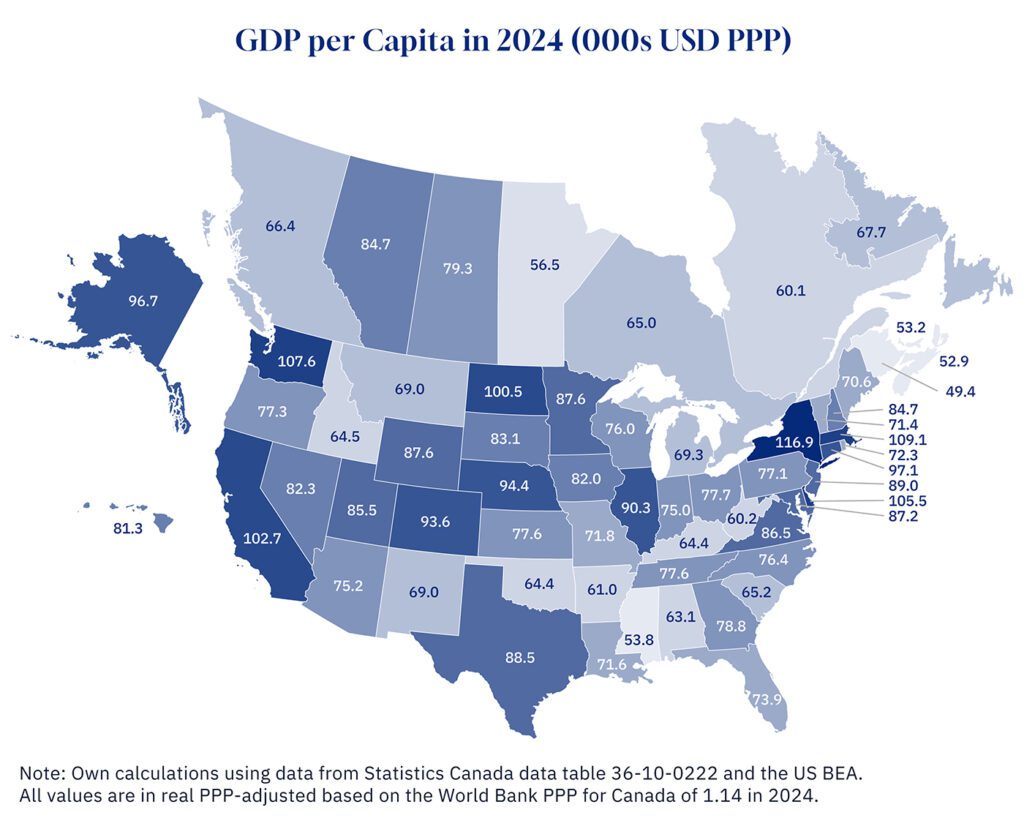
This diagnosis was reinforced just days later when Statistics Canada released detailed 2024 economic data across provinces. These once-per-year updates allow for a comprehensive comparison between Canadian provinces and U.S. states by adjusting for population, economic size, and price differences.

The results remain as striking today as the last time this comparison was done.
Graphic credit: Janice Nelson.

Many Canadian regions continue to lag behind every single U.S. state. New Brunswick now holds the unfortunate title of the lowest-income jurisdiction in North America, trailing even Mississippi, with Nova Scotia and Prince Edward Island close behind. Ontario has improved slightly—now above Alabama, rather than being tied with it not too long ago—but it still ranks closest to South Carolina and Idaho in terms of average economic strength. Only Alberta and Saskatchewan crack the upper ranks, largely thanks to their high-value oil and gas sectors.

Graphic credit: Janice Nelson.

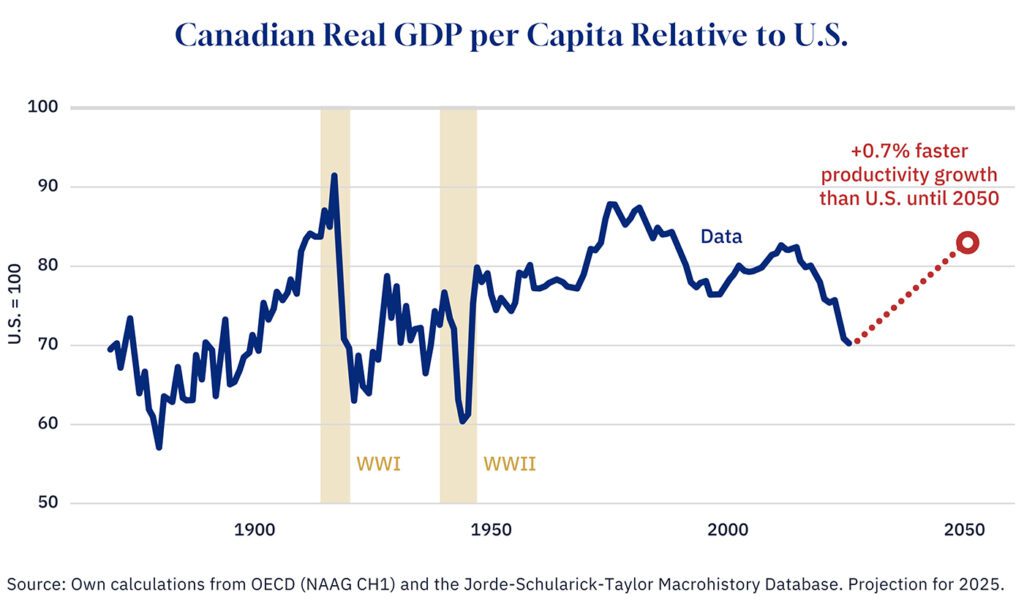
In aggregate, the gap between Canadian and U.S. living standards has not been wider since the Second World War.

Budget rhetoric versus reality

Budget 2025 aims to confront this. The finance minister rightly acknowledges that this is no time to tinker at the margins. Yet despite strong rhetoric, the budget’s actual measures fall short of the transformational ambition it claims.

The government also missed opportunities in this budget, it must be said, including a comprehensive tax review (which was promised in the Liberal platform earlier this year) and bolder regulatory reforms to encourage private investment.

In fairness, no single federal budget could likely dramatically alter the trajectory of a $3.2 trillion economy like Canada’s. But gradual and persistent adjustments, nudging each year at the margin, could accumulate to real gains.

And the budget did have some positive steps that are worth noting. There are tax changes to encourage new investment through accelerated depreciation allowances—a move first implemented years ago under the previous prime minister, and extended late last fall. The budget also projects significant growth in capital investment, although much of this appears to have already been in motion before the budget came down.

The long road ahead

But whether or not many of the budget’s measures are truly new, could they move the needle on Canada’s growth?

The government doesn’t provide detailed modelling, but early in the budget, they suggest that if Canada could unlock an additional $500 billion in private investment over the next five years—a big “if,” but let’s give the government’s stretch goal the benefit of the doubt—real GDP would be about 3.5 percent higher by 2030. That would close roughly one-fifth of the productivity gap accumulated over the past decade.

Put differently, this could raise average annual growth by 0.7 percentage points—a significant boost. I am skeptical this could occur, and the budget’s actual growth projections also seem to discount the possibility.

But even if that were achieved, and even if Canada were to outpace U.S. productivity growth by that margin every year going forward, we wouldn’t return to our pre-2015 relative position until 2050. And to actually become the “strongest economy in the G7”? We’d have to maintain that 0.7 percentage point boost relative to the U.S. for more than another quarter century again after that!
Graphic credit: Janice Nelson.

To put that challenge in historical context: even during Canada’s stronger periods—such as the late 1990s and early 2000s—our productivity only slightly outpaced that of the U.S. To find a period of sustained convergence like the one we now need, you’d have to go back over a century, to the years before the First World War.

This should not be read as a critique of Budget 2025. If it indeed represents the first of many more steps to come (much like Budget 1994 laid the groundwork for the landmark 1995 budget that dramatically improved Canada’s fiscal trajectory), then this could mark the beginning of a course correction toward stronger investment, higher productivity, and greater prosperity.

Beyond one budget, or one government

It will require follow-through across successive governments of different parties. It will also require provinces, since many of the drags on Canadian productivity are provincial in nature. Liberalizing internal trade, which the budget credibly notes could massively boost productivity, requires provinces to mutually recognize each other’s rules and regulations, especially in services and professional credentials.

Concerted action by all is the best-case scenario. Even then, results will not come quickly.

While digging ourselves into this hole didn’t take long, climbing out of it will take time—and more than just one budget.


Trevor Tombe is a professor of economics at the University of Calgary, the Director of Fiscal and Economic Policy at The School of Public Policy, a Senior Fellow at the Macdonald-Laurier Institute, and a Fellow at the Public Policy Forum.


Source: The Hub

Related Posts

CNAPS promotes “Grand Bargain” between Canada and United States at USMCA review hearing in Washington, D.C.
North America

CNAPS promotes “Grand Bargain” between Canada and United States at USMCA review hearing in Washington, D.C.

December 8, 2025
Canada’s global ambitions must begin with domestic protection: Andrew Kirsch in the Hamilton Spectator
National Security

Canada’s global ambitions must begin with domestic protection: Andrew Kirsch in the Hamilton Spectator

December 8, 2025
Oaths, trust and Canadian democracy: Stephen Van Dine and Karl Salgo for Inside Policy
Political Tradition

Coalition conservatism requires comfort with contradiction and debate: Shawn Whatley in The Hub

December 8, 2025
Next Post
Urban Violent Crime Report, Volume 2: Comparing crime across Canadian cities

Urban violence on the rise in Canada

Newsletter Signup

  Thank you for Signing Up
  Please correct the marked field(s) below.
Email Address  *
1,true,6,Contact Email,2
First Name *
1,true,1,First Name,2
Last Name *
1,true,1,Last Name,2
*
*Required Fields

Follow us on

Macdonald-Laurier Institute

323 Chapel Street, Suite #300
Ottawa, Ontario, K1N 7Z2 Canada

613.482.8327

info@macdonaldlaurier.ca
MLI directory

Support Us

Support the Macdonald-Laurier Institute to help ensure that Canada is one of the best governed countries in the world. Click below to learn more or become a sponsor.

Support Us

  • Inside Policy Magazine
  • Annual Reports
  • Jobs
  • Privacy Policy

© 2023 Macdonald-Laurier Institute. All Rights reserved.

No Result
View All Result
  • Home
  • About
    • Who We Are
    • Who Makes MLI Work
    • Fifteenth Anniversary
  • Experts
    • Experts Directory
    • In Memoriam
  • Issues
    • Domestic Policy
      • Economic Policy
      • Justice
      • Rights and Freedoms
      • Assisted Suicide (MAID)
      • Health Care
      • COVID-19
      • Gender Identity
      • Canada’s Political Tradition
      • AI, Technology and Innovation
      • Media and Telecoms
      • Housing
      • Immigration
      • Agriculture and Agri-Food
      • Competition Policy
    • Energy Policy
      • Energy
      • Environment
    • Foreign Policy
      • Israel-Hamas War
      • Ukraine
      • Taiwan
      • China
      • Europe and Russia
      • Indo-Pacific
      • Middle East and North Africa
      • North America
      • Foreign Interference
      • National Defence
      • National Security
      • Foreign Affairs
    • Indigenous Affairs
  • Projects
    • CNAPS (Center for North American Prosperity and Security)
    • The Promised Land
    • Voices that Inspire: The Macdonald-Laurier Vancouver Speaker Series
    • Dragon at the door
    • Canada on top of the world
    • Letter to a minister
    • Justice Report Card
    • The Great Energy Crisis
    • DisInfoWatch.org
    • Managing Indigenous Prosperity
    • Judicial Foundations
    • Landmark Cases Council
    • Defending The Marketplace of Ideas
    • Reforming the University
    • Past Projects
      • Digital Policy & Connectivity
      • Double Trouble
      • Canada and the Indo-Pacific Initiative
      • The Transatlantic Program
      • COVID Misery Index
      • Speak for Ourselves
      • The Eavesdropping Dragon: Huawei
      • Talkin’ in the Free World with Mariam Memarsadeghi
      • An Intellectual Property Strategy for Canada
      • Munk Senior Fellows
      • A Mandate for Canada
      • Confederation Series
      • Fiscal Reform
      • The Canadian Century project
      • Fixing Canadian health care
      • Internal trade
      • From a mandate for change
      • Size of government in Canada
      • Straight Talk
      • Labour Market Report
      • Leading Economic Indicator
      • Centre for Advancing Canada’s Interests Abroad
      • Indigenous Prosperity at a Crossroads
  • Events
    • Upcoming Events
    • Past Events
      • MLI Dinners
      • Great Canadian Debates
  • Latest News
  • Libraries
    • Columns
    • Commentary
    • Papers
    • Books
    • Video
  • Donate

© 2023 Macdonald-Laurier Institute. All Rights reserved.