This article originally appeared in The Hub.
By Trevor Tombe, March 4, 2026
Alberta is, by a wide margin, Canada’s richest province. Yet last week’s provincial budget projects a $9.4-billion deficit for the coming year. That is not a trivial shortfall. Relative to the province’s roughly $490-billion economy, it amounts to 1.9 percent of GDP, roughly the same share as Ottawa’s projected $65-billion deficit over that same period.
Debt is set to rise alongside it. Alberta anticipates its net debt will grow from less than 8 percent of GDP to nearly 13 percent. That remains far lower than in any other province, to be clear, and well below federal levels. But the speed of the increase is notable. It is roughly half the rise the federal government experienced during COVID-19 and its aftermath (with federal net debt today about 10 percentage points above its 2019 level).
So what’s behind Alberta’s fiscal troubles?
It turns out that policy choices, not external factors, are largely to blame.
The official explanation
The government points primarily to falling oil prices and rapid population growth.
Deflecting blame in difficult circumstances is common in politics, and there’s usually a kernel of truth behind such efforts. Indeed, oil prices have declined through much of 2025 amid global uncertainty and weaker economic growth. The province expects prices to barely exceed $60 per barrel in the coming fiscal year, down from $74 in 2024–25. And when every $1 change in the price of oil shifts revenues by nearly three-quarters of a billion dollars annually, price declines pose a serious challenge.
And yet, while oil prices matter, they are not the whole story.
Spending choices, not just external forces
The government plans to increase operating expenses to more than $70 billion this year, up not only from previous years but also from the government’s original plans for this year. Some (especially those outside Alberta) may find that surprising for a province typically viewed as fiscally conservative. But former premier Jason Kenney was unusual among recent premiers in recent decades in actually seeking to restrain the size of government and reduce per-person spending.
By contrast, the current government aims to keep spending growth in line with population plus inflation, an approach similar to most past premiers across all parties, from Ed Stelmach to Rachel Notley.
But a closer look at the numbers reveals that spending has actually grown well beyond population and inflation recently, effectively reversing the reductions under Kenney. Indeed, Budget 2026 projects a return to real per capita total spending levels that (slightly) exceed the highest year under former NDP Premier Notley.
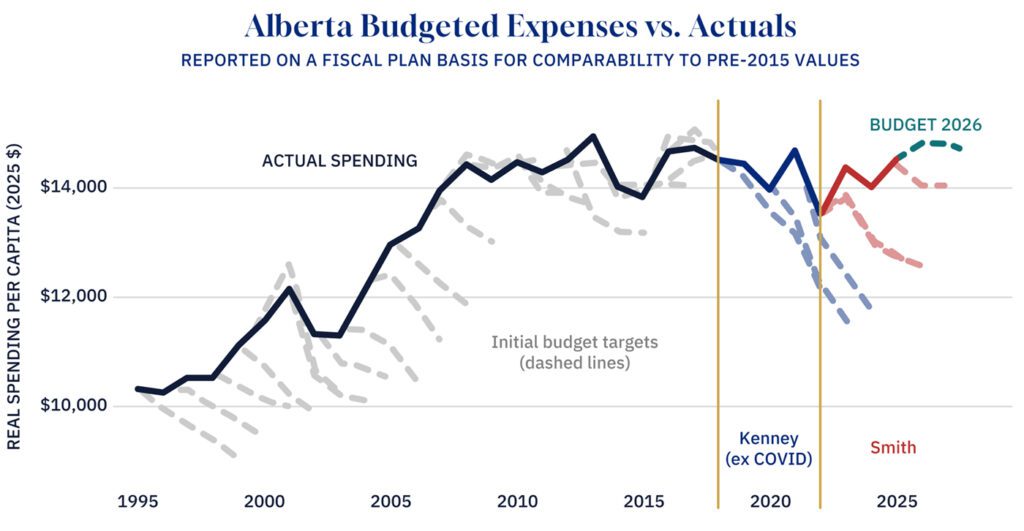
So what’s going on? Consider what the government itself planned just one year ago.
In Budget 2025, the government projected operating spending of $64.8 billion for 2026–27. Now, for that same fiscal year, it anticipates spending $70.4 billion, an increase of more than $5.5 billion.
Did inflation surge unexpectedly? Did population growth dramatically exceed forecasts? No.
Last year, the government projected population growth of 2.5 percent in 2025, followed by 1.4 percent in 2026. And today, in its latest budget, it assumes the same 2025 population growth and an even lower 1.1 percent in 2026. Inflation has also come in below earlier expectations, averaging about 2 percent last year and 2.1 percent this year, down from the 2.6 and 2.4 percent, respectively, that it previously thought.
None of the additional $5.5 billion can therefore be attributed to unexpected population or inflation pressures.
The spending cap that wasn’t
Moreover, spending growth in excess of population plus inflation is a pattern over many years, despite a recent law enacted to try to prevent that very thing.
Alberta’s main fiscal anchor, introduced in 2023, set a ceiling on operating spending that rises with population and inflation. By its own calculation, this year’s spending remains about $100 million below that ceiling. So no problem, right?
The trouble is, when the ceiling was first set, it incorporated roughly $1.9 billion in temporary COVID-related spending, effectively baking an unusually high starting point into the formula.
The ceiling is also adjusted each year using the previous year’s population and inflation rather than current figures. That also baked in higher adjustments, since inflation peaked in 2022 and declined thereafter. While the mathematical details behind why this matters may seem technical, the combined effect is substantial, as I illustrate below.
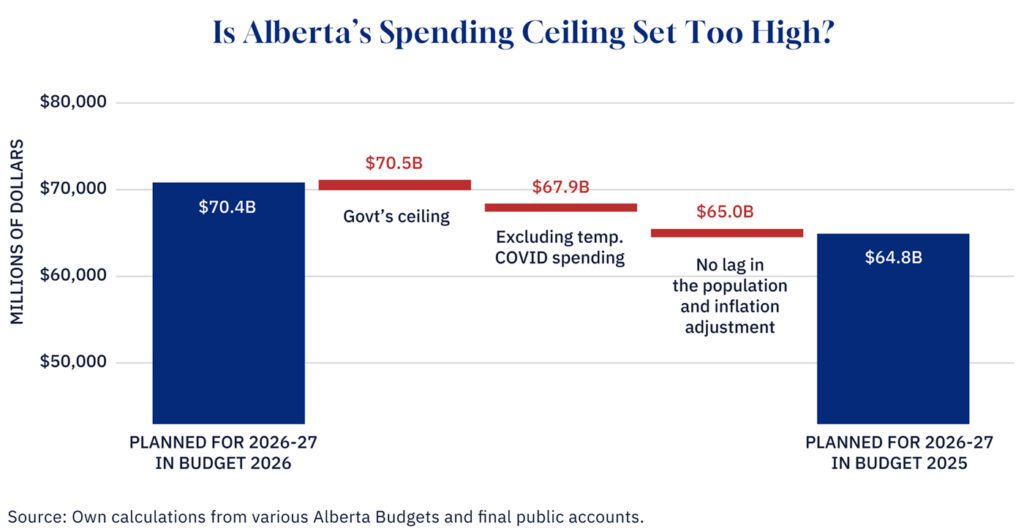
Absent those features, the ceiling this year, I estimate, would be roughly $5.5 billion lower and the deficit consequently less than half as large. And none of this even adjusts for the fact that several billion in provincial spending are excluded from the ceiling entirely.
Abandoning its fiscal anchor
While rapid spending growth may only violate the spirit of the Alberta budget law, there are more explicit violations at play, too.
First, running a deficit required freezing spending at the previous year’s level. That would have implied a much smaller shortfall (though obviously would also require difficult trade-offs and shelving new initiatives).
And second, the province was limited to no more than three consecutive deficits. Yet last week’s budget projects red ink throughout the forecast horizon, exceeding that limit.
So, as the federal government did in its budget from last November, Alberta has now abandoned its main fiscal anchor that was originally meant to “ensure spending growth is sustainable in the long run.”
The resource revenue rollercoaster
While these choices absolutely increased the scale of Alberta’s deficit in 2026, there’s a deeper reason why today’s deficit is largely of the province’s own making: the province’s very reliance on volatile oil prices is itself a policy choice.
Premier Prentice was the last one to seriously attempt to reduce the province’s reliance on resource revenues. Today, oil price swings have a larger impact on the bottom line than they did a decade ago. Delaying efforts to save more resource revenue, introduce alternative revenue sources, or exercise additional spending restraint has left Alberta more exposed to the volatility of its royalty roller-coaster than ever.
In fact, due largely to recent spending increases, Alberta’s reliance on resource revenues is higher today than under any premier since Don Getty (excluding COVID-19). Things might work out if oil prices rise, as they have sharply done following last week’s attacks on Iran, but who knows how things unfold from here.
Hope is not a strategy
None of this means Alberta is in fiscal crisis, nor does it suggest the province is incapable of managing its affairs. It remains the richest province in the country, with debt levels far below (and fiscal capacity far above) those elsewhere.
But the deficit now projected is not simply the product of bad luck or global events. It reflects choices: to increase spending beyond population and inflation, to loosen or abandon fiscal constraints, and to deepen reliance on volatile resource revenues. Those choices may be defensible. But they are choices nonetheless. And they’ve come with consequences.
Trevor Tombe is a professor of economics at the University of Calgary, the Director of Fiscal and Economic Policy at The School of Public Policy, a Senior Fellow at the Macdonald-Laurier Institute, and a Fellow at the Public Policy Forum.