By Nino Melikidze and Steven J. Paolasini
March 25, 2026
Canada launched the Start-Up Visa program in 2013 with a bold promise: welcome the world’s brightest entrepreneurial talent, give them a foothold, and let them build companies that would drive economic growth.
Thirteen years later, that promise is on hold. By January 1, 2026, Immigration, Refugees and Citizenship Canada (IRCC) had officially paused the program, leaving tens of thousands of hopeful founders in limbo. What happened to this once-promising experiment? The answer lies in systemic mismanagement, an overreliance on private partners, and a government slow to correct course.
The collapse of the Start-Up Visa came as no shock to many in the immigration space – the program had developed a tumultuous history marked by systemic government neglect and corrective efforts that arrived too late and proved largely ineffective.
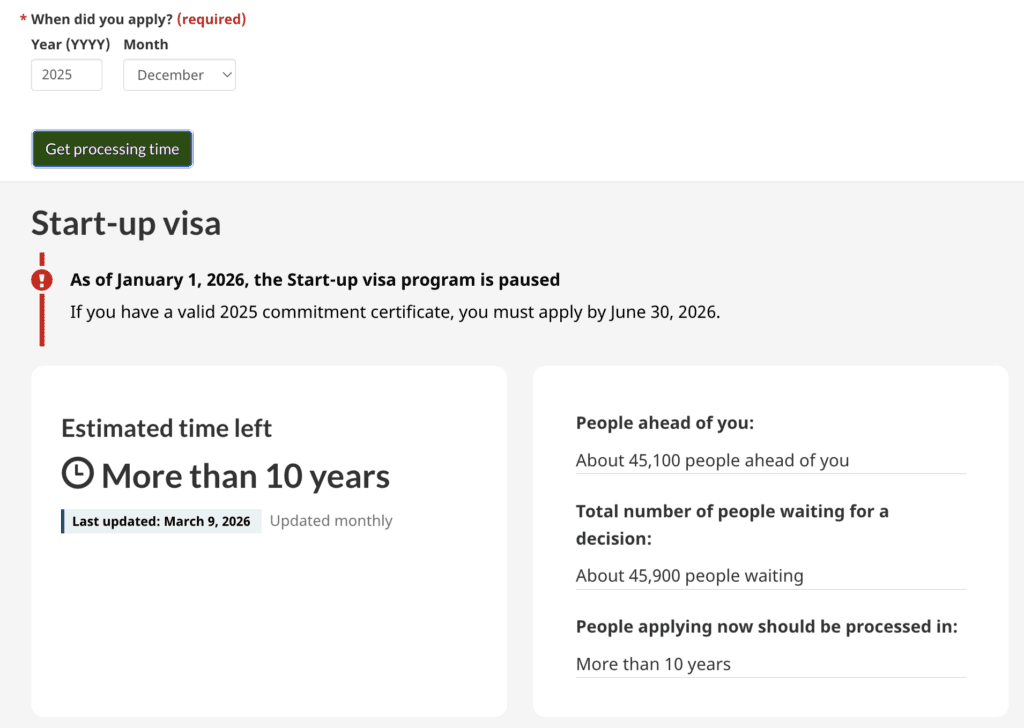
When the federal government released its new Immigration Levels Plan in November 2025, IRCC found itself in a difficult position. How could the department reconcile just 500 annual spots allocated to business immigration applicants with average processing times stretching to nearly a century of inventory and a backlog exceeding 45,000 applications? The math alone suggested that the program, in its existing form, was no longer sustainable.
To understand what ultimately led IRCC to pause, and essentially cancel, Canada’s only federal entrepreneur immigration program, we have to look backward. Ottawa did not conceive the Start-Up Visa as a flawed initiative. It launched the program with strong economic intentions and a clear policy rationale. However, even well-intentioned systems can deteriorate when a severe lack of government management and accountability allows structural weaknesses to simply fester and grow unchecked.
The birth of the Start-Up Visa pilot
When Canada launched the Start-Up Visa (SUV) in 2013, it did so as an experiment. It was the first economic immigration program introduced under section 14.1 of the Immigration and Refugee Protection Act, which allows temporary pilot programs to run for up to five years. That time limit gave the government the flexibility to test a new approach to entrepreneur immigration without immediately committing to a permanent stream.
Ottawa had a straightforward objective: to attract innovative founders who would build companies in Canada and contribute to the country’s long-term economic growth. IRCC’s own evaluation describes the pilot as a way to bring in entrepreneurs who would actively pursue business ventures in Canada and strengthen the national innovation ecosystem.
At the time, the federal government was phasing out the previous Immigration Entrepreneur (EN) Program after concerns that it no longer aligned with Canada’s evolving economic priorities. Established in the late 1970s, the EN program relied heavily on minimum net worth requirements and post-landing business commitments. In 2011, the government paused the EN stream, and in 2013, it introduced the Start-Up Visa pilot as a complete reset.
What distinguished the pilot was its selection mechanism. Instead of immigration officers attempting to assess the viability of business plans, applicants were required to secure support from a designated Canadian venture capital fund, angel investor group, or business incubator before applying for permanent residence.

Source: Twitter/@smeurrens
From the beginning, the program was explicitly conditional. It had to demonstrate results during its five-year trial in order to become permanent. And if it failed to show value, it would expire.
Essentially, the federal government designed the Start-Up Visa pilot to be a test: an attempt to select founders based not merely on capital, but on innovation potential and market validation.
Transition to a permanent economic immigration stream
By 2018, the federal government faced a decision: allow the Start-Up Visa pilot to expire or formalize it as a part of Canada’s economic immigration system. Ottawa presented the decision to make it permanent as a continuation based on early results and careful evaluation. In the Regulatory Impact Analysis Statement establishing the permanent Start-Up Business Class, the government cited positive pilot outcomes, recommendations from the program evaluation, and strong support from the Canadian private sector as justification for moving forward.
The evaluation focused on several measurable indicators. Between April 2013 and April 2016, the program received 113 applications. During that same period, IRCC highlighted that the model relied on designated venture capital funds, angel investor groups, and incubators to screen applicants, which reduced the administrative burden on government. The department estimated operating costs at roughly $1.3 million over two fiscal years – significantly lower than the former Entrepreneur Program. At the same time, pilot applicants had secured more than $3.7 million in investment capital from designated entities, reinforcing the idea that private-sector validation was working.
By January 1, 2018, 170 entrepreneurs had been approved for permanent residence and had launched more than 100 companies in Canada. The evaluation also emphasized that Start-Up Visa applicants demonstrated stronger human capital traits (including education, age, and official-language proficiency) than those admitted under previous business streams. While overall applicant volumes remained modest, their profiles were presented as economically promising.
The government believed the pilot had achieved what it set out to test. It was attracting innovation-driven founders, showing that investors were willing to back them with real capital, and doing so at a comparatively lower administrative cost. With the older federal entrepreneur stream already discontinued, making the program permanent felt like a natural next step to preserve a more modern, market-driven pathway for entrepreneur immigration.
The oversight gap that enabled program collapse
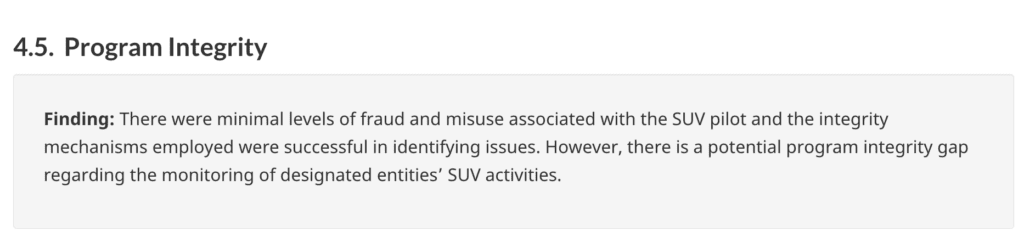
In the early years of the Start-Up Visa, the government largely believed the program’s integrity was holding up well. IRCC’s evaluation of the pilot phase (April 2013 to April 2016) concluded that there were “minimal levels of fraud and misuse.” At the same time, the evaluation hinted at an important weakness (outlined in Figure 2). Once IRCC approved organizations as designated investors or incubators, the department had limited visibility into their ongoing activities, meaning the program relied heavily on those private organizations to maintain its integrity.
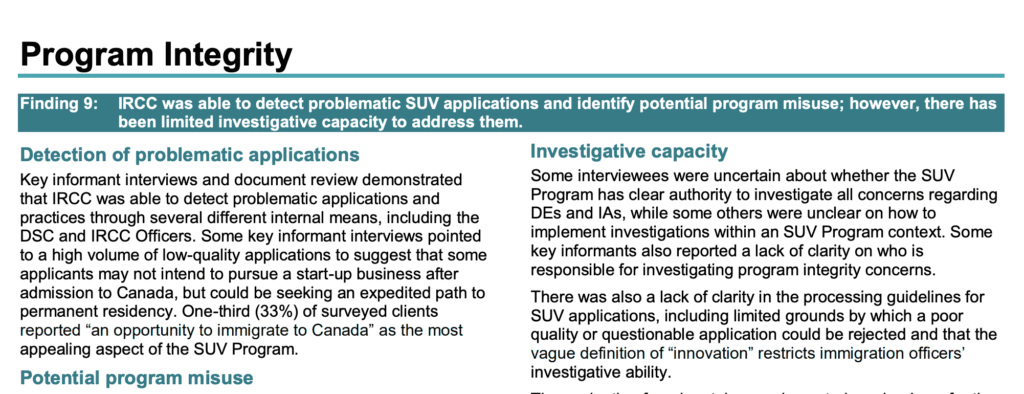
By the time Ottawa re-evaluated the program several years later, the tone had changed. IRCC’s December 2023 evaluation of the permanent program (covering 2016 to 2021) acknowledged that officials had detected a growing number of “problematic” applications (referenced in Figure 3).
The report pointed to several concerning patterns: “Many key informant interviews and internal integrity exercises have observed some instances of potential misuse of the SUV Program by some DEs, including charging applicants for assessing the business, submitting documents to IRCC, and accessing IRCC services; submitting fraudulent applications; falsifying or reusing documents and business plans; subcontracting due diligence responsibilities to external stakeholders; and conflicts of interest in business ownership and investment. In addition, some key informant interviews and internal integrity exercises observed program misuse by immigration lawyers and consultants, such as selling SUV business plans and submitting fraudulent documents.”
Source: IRCC Evaluation of the Start-Up Visa Program, December 2023
Government awareness and mismanagement of growing crisis
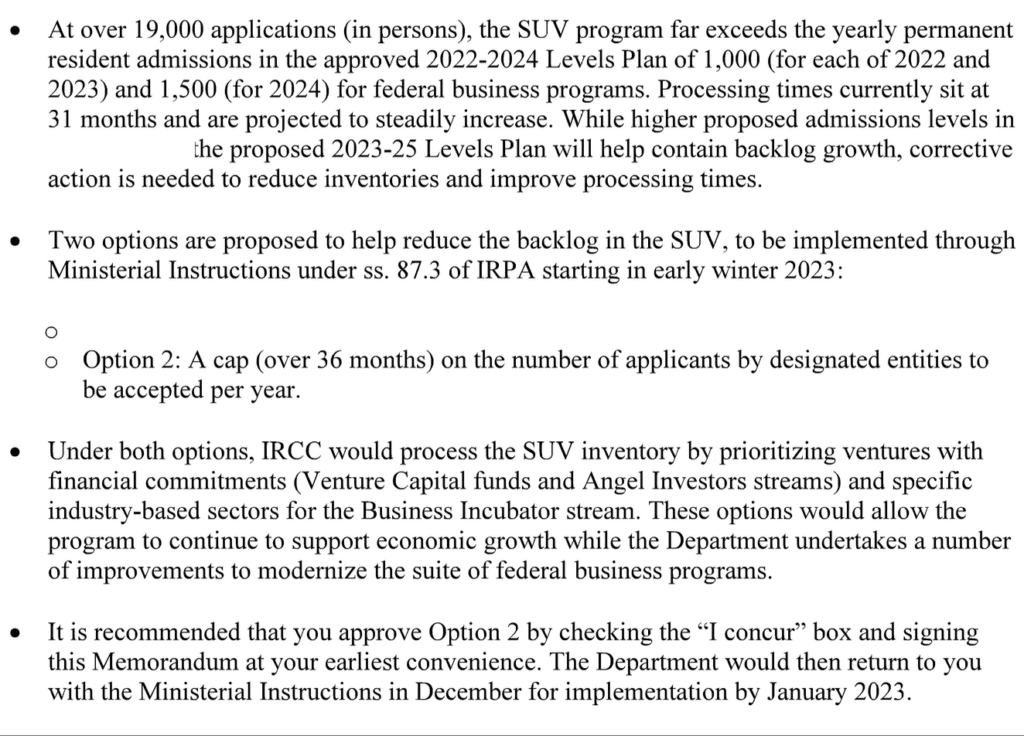
In 2022, the government began acknowledging the strain being put on the program. An internal memorandum (ATIP A-2024-69816) sent to Immigration Minister Sean Fraser on November 14, 2022, reported an inventory of more than 19,000 Start-Up Visa applicants. Despite the higher projected annual admission targets at the time (5,000–6,000 spots), processing times had reached 31 months and were expected to keep rising. Deputy Minister Christiane Fox warned that Canada was struggling to compete with peer countries. Comparable programs in the United Kingdom processed applications in about 8 weeks, while Australia typically took 6 to 8 months.
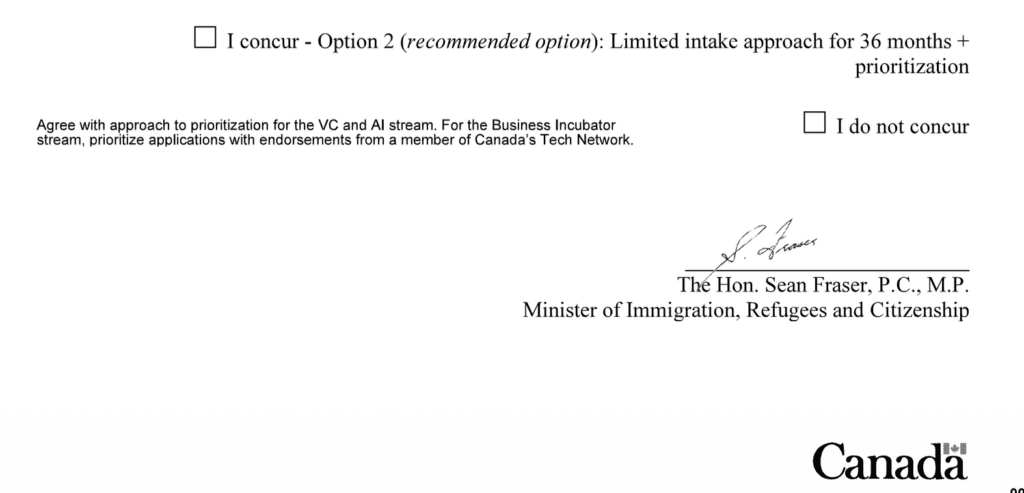
To prevent the situation from worsening, Fox recommended that the minister adopt “Option 2” (outlined in Figure 4): an immediate cap on the number of applications each designated organization could submit, targeted for implementation by January 2023. In the key points summarizing the expected impact of this recommendation, the memorandum stated that only 10 designated organizations comprised nearly 75 per cent of the intake of SUV applications.
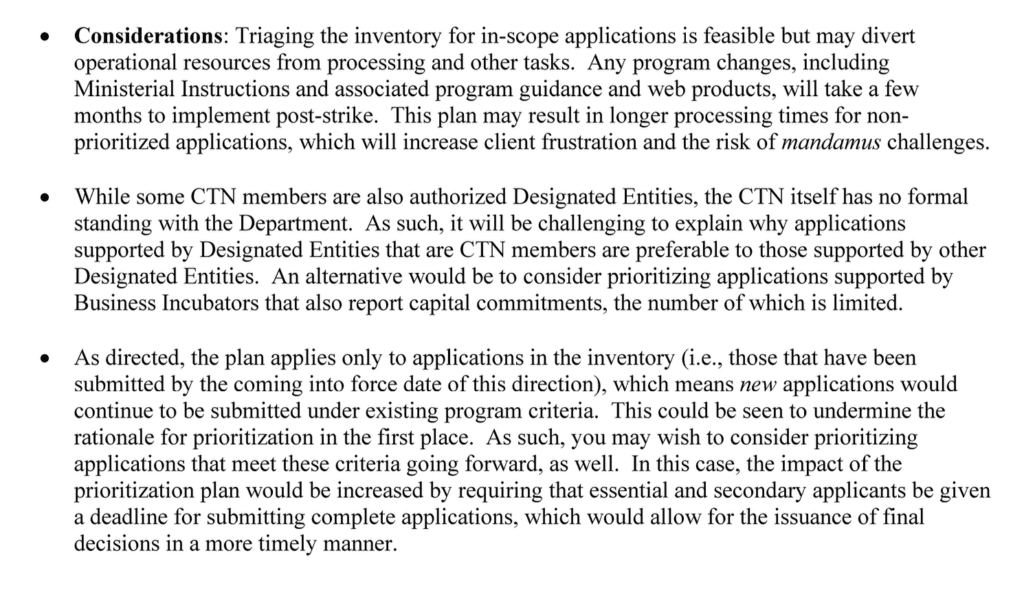
However, Minister Fraser did not heed this advice. He bypassed the recommendation and the government introduced a priority processing mandate tied to Canada’s Tech Network (CTN), a closed group of organizations whose applications would move ahead of others regardless of the underlying business merits (see Figure 5). At that same time, Fraser announced the introduction of a three-year open work permit, making the program even more attractive.
Source: Authors files/ ATIP file request
The introduction of “priority processing” in June 2023 effectively created a two-tier system. Applications connected to CTN vaulted to the front of the line, moving ahead regardless of their actual investment, job creation potential, or business progress. Internal memos reveal Deputy Minister Fox cautioned against this, proposing that IRCC not prioritize applicants based on membership in an external network the department did not control (see Figure 6). Because this advice was ignored, a founder who raised substantial capital could still face extreme delays simply because their incubator was outside the government-favored network.
For many startups, the system increasingly felt unpredictable and less aligned with the program’s original goal: letting the market determine which startups truly had potential.
Public record examples: Court decisions and a suspension case
Starting in 2019, Federal Court decisions involving certain Start-Up Visa applications supported by Empowered Startups (a designated organization under the Start-Up Visa program), began to appear in the public record.
One example is Kwan v. Canada (Citizenship and Immigration), 2019 FC 92. Immigration officials became concerned after learning that the applicant had agreed to pay roughly $300,000 for one year of incubation services. A peer review by the Canadian Association of Business Incubation (CABI) described the fee as “not normal for an incubator in Canada.” The review also raised concerns about the applicant’s level of involvement in developing the proposed business. Based on these issues, the officer concluded the arrangement may have been structured primarily to obtain immigration status rather than to build a genuine start-up. The Federal Court upheld the refusal, emphasizing that the good-faith obligation under the Start-Up Visa program continues beyond the initial application.
Another example is Nguyen v. Canada (Citizenship and Immigration), 2020 FC 1126. The applicant proposed building a mobile software platform for parents and childcare providers in member states of the Association of Southeast Asian Nations (ASEAN) and received a Commitment Certificate from the incubator supporting her Start-Up Visa application. However, immigration officials discovered she had agreed to pay the organization about $300,000 for incubation services, a fee the officer described as “not normal course of business in Canada.” Officials were also concerned that the applicant had made very little progress on the business, even while holding a work permit intended to develop the venture. The Court ultimately upheld the refusal, agreeing it was reasonable for the officer to conclude that the arrangement appeared aimed more at obtaining immigration status than building a real start-up.
A notable, non-immigration case involving this designated organization and CABI, referenced in the first decision, is Empowered Startups Ltd. v. Canadian Association of Business Incubation, 2020 BCSC 1904. The organization alleged that a CABI director had “used his position … to advance his own personal interests in a manner that conflicted with the interests of CABI and its members” in connection with Techstars’ designation. The Court’s reasons state that the director brought the application forward, voted in favour, and “did not disclose” his own interest in a leadership role with Techstars. However, the Court ultimately rejected the claim, concluding that the statutory requirement of good faith had not been satisfied. It concluded that “Empowered’s “primary purpose” in seeking leave to commence the proposed action is not to benefit CABI itself, but rather to advance its own interests” and evidence suggested that “… Empowered’s primary purpose is not to benefit CABI, but rather to punish Mr. Sharma and cause grief to a competitor.”
Three Federal Court cases involving applications supported by this designated organization were referenced in a Start-Up-Visa article by the Financial Post earlier this year.
Another designated organization emerged as a major contributor to application volumes. Biomedical Commercialization Canada Inc. (which participated in the Start-Up Visa program under multiple operating names, including Manitoba Technology Accelerator (MTA) and later, Manitoba Innovates), had its designation suspended by IRCC on December 19, 2025, preventing it from supporting new applications for nine months.

Between January 2023 and October 2024, the entity was linked to approximately 1,100 Start-Up Visa applications submitted:
- 760 under Biomedical Commercialization Canada Inc.
- 340 under Manitoba Technology Accelerator.
In several months during this period, applications appeared under both names simultaneously, although the organizations are presented as effectively the same entity. Their designation was suspended over a year later: only a couple of weeks before Ottawa paused the entire Start-Up Visa program.
The radical overcorrection
By October 2024, the Start-Up Visa program had reached a point where the system could no longer keep up with its own demand. At the time, IRCC was reporting 36,572 applications sitting in inventory, with processing times stretching to more than four years (38 to 48 months). Meanwhile, applications continued to surge and the backlog grew exponentially. The planned annual business immigration targets versus the number of applications received made the problem clear. Canada’s immigration strategy is governed by a rolling three-year Immigration Levels Plan, which, by law, must be tabled in Parliament on or before November 1 of each year. The targets within this plan are not arbitrary; they are developed through extensive consultations with provincial governments to assess regional capacity, as well as through annual public consultations on the Immigration Levels Plan. These numbers dictate exactly how many applications the government can process and approve in any given year.
The 2023 Immigration Levels Plan projected about 6,000 business immigration admissions for 2026. A year later, the 2024 plan lowered that same target to roughly 1,000. By the 2025 plan, it dropped again to just 500 admissions. In only two years, the projected capacity for the program shrank by a factor of 12.
According to IRCC’s own estimates, by 2026 the backlog surpassed 45,000 applications while projected processing timelines began stretching beyond 10 years. This contrasts sharply with Start-Up Visa applications that took roughly 12 to 16 months to process before the pandemic. A widening gap between the number of entrepreneurs waiting in line and the number of permanent residence spots actually available began to emerge.
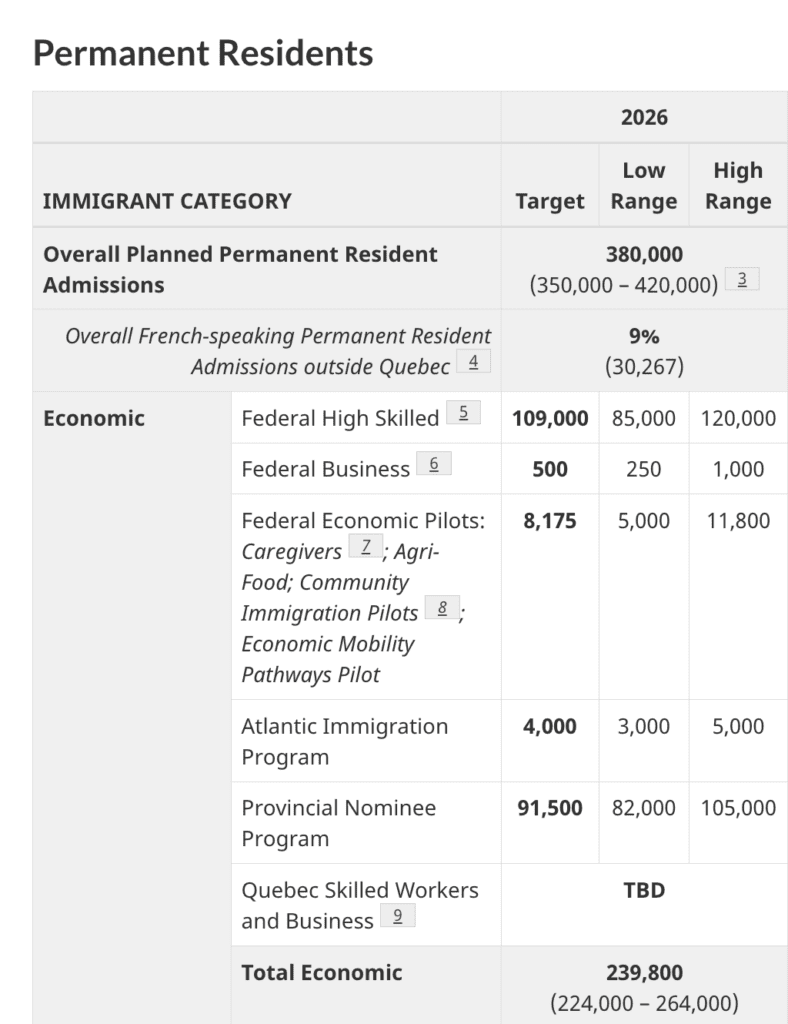
Source: IRCC 2026-2028 Immigration Levels Plan, November 2025
The major structural problem was the government’s immigration planning no longer matching the number of applications entering the system. Canada’s Immigration Levels Plans, which outline targets on a rolling three-year basis, are meant to provide stability and predictability. But for the Start-Up Visa program, those targets kept changing dramatically and in the opposite direction of the increased program demand.
In order to get the program back on track, the government’s first response was to slow the influx of new applications. Minister Marc Miller ultimately listened to Fox, his deputy minister, and in April 2024, IRCC introduced ministerial instructions limiting each designated organization to supporting no more than ten new start-ups per year. The goal was straightforward: reduce how quickly new applications entered the system while officers worked through the growing queue.
But the tightening did not stop there. In December 2025, IRCC closed the Start-Up Visa open work permit (see Figure 10) to new applicants, allowing only extensions for entrepreneurs already waiting for permanent residence decisions.
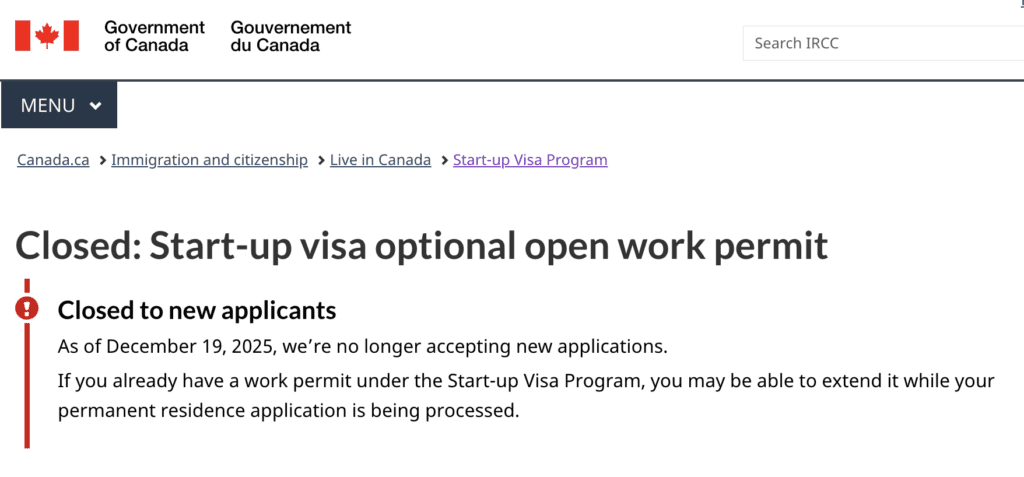
Source: IRCC Start-Up Visa Work Permit page, March 2026
Then, just a few weeks later, the government took its most decisive step. As of January 2026, it paused the Start-Up Visa program entirely (see Figure 11), with no new commitment certificates accepted after December 31, 2025.
When taken together, these moves represent a dramatic policy reversal. In three years, the program went from a generous target of 6,000 PR admissions per year to a complete shutdown. With a 90-year inventory at current targets, applicants are left without answers: a far cry from the fast-moving entrepreneurial pathway Ottawa originally envisioned the program to be.
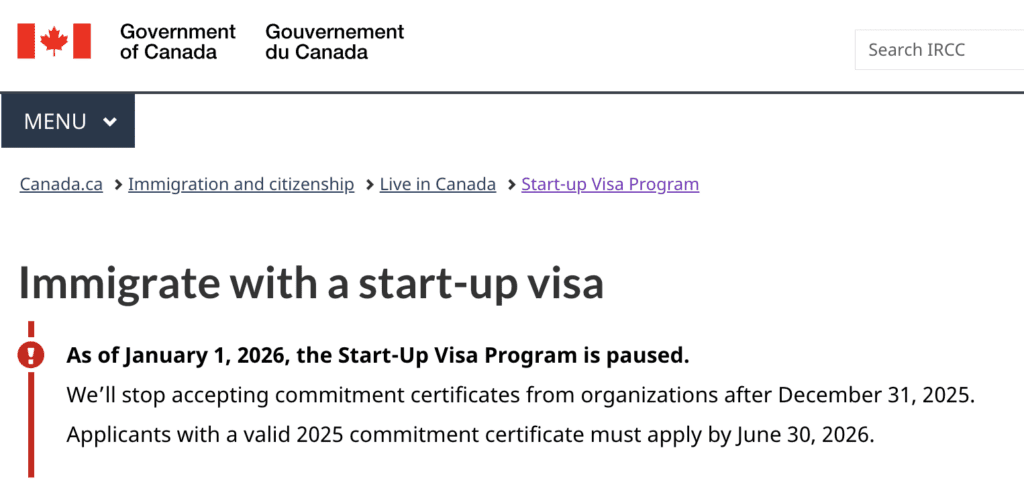
Source: IRCC Start-Up Visa Program page, March 2026
In parallel, a broader immigration policy conversation began to emerge. Proposed legislation, Bill C-12, would give the federal government new authority to suspend or cancel immigration applications when deemed in the public interest. While the bill would not automatically cancel existing Start-Up Visa applications, it would introduce a powerful mechanism that could be used to address large immigration backlogs.
In practice, these powers extend across the entire immigration system, allowing the government to pause intake, cancel applications, or shift processing priorities at a large scale. While this could be used to reduce the Start-Up Visa backlog, doing so risks penalizing the relatively small group of entrepreneurial applicants who are actively building real businesses in Canada and contributing to the economy. Many of these founders entered the program in good faith under its original design.
A more balanced approach would be to apply these powers in parts of the system with much larger volumes and less direct economic impact. That way, the government can address backlogs without undermining one of the few pathways designed to attract high-skilled, innovation-driven entrepreneurs to Canada.
Rebuilding Canadian business immigration from scratch
If Canada intends to remain competitive in attracting global entrepreneurial talent, the Start-Up Visa program cannot simply remain paused indefinitely, and applicants in queue deserve action instead of lifelong uncertainty. The collapse of the program exposed structural weaknesses that must be addressed before any relaunch is considered. Rebuilding Canada’s business immigration system will require three things: accountability for past failures, a clear, disciplined framework for how a new system should operate, and an immediate, “damage control” strategy to clear the backlog while being fair.
Here are three key steps recommended to move forward:
Conduct a full investigation into program history
One of the most troubling aspects of the Start-Up Visa program is how long mismanagement was allowed without meaningful consequences. Over time, credible allegations surfaced that some designated organizations facilitated questionable investment arrangements, sold incubator placements, or approved start-up commitments with little genuine validation. Yet rarely, if ever, were organizations removed from the designated list or suspended until it was far too late to prevent the program’s collapse.
To restore credibility to Canada’s entrepreneur immigration system, the government must conduct a full investigation into the financial transactions and agreements executed under the SUV framework. The investigation should focus on the 10 designated organizations that were responsible for the majority of total program intake.
The goal of the audit would be to understand how the government permitted a small fraction of the organizations to monopolize such a massive share of the national inventory. Where mismanagement occurred, it should not simply be treated as a policy failure.
Relaunch a modern Start-Up Visa with two clear pathways
Despite its collapse, the core idea behind the Start-Up Visa program remains sound. Canada benefits when capable entrepreneurs build companies, create jobs, and strengthen the innovation economy. The challenge is designing a system that attracts credible founders while preventing the abuses that undermined the original program.
A redesigned program could operate through two pathways:
- An Expansion Stream for founders who are willing to commit substantial personal capital to their Canadian venture. A minimum investment threshold of potentially C$750,000 would ensure applicants have both the resources and commitment needed to build their companies in Canada.
- A High Human Capital Stream focused on exceptional entrepreneurial talent and high-growth business potential. To qualify for this pathway, founders would need to secure a minimum C$500,000 investment from verified Canadian investors (e.g., Venture Capital Funds) for their business.
To maintain quality and manage inventory in line with processing standards, the program should introduce an Expression of Interest (EOI) system, similar to Express Entry. Candidates would enter a selection pool and be prioritized based on measurable criteria such as founder experience, language ability, investment secured, and start-up potential. A minimum language requirement (e.g. CLB 7) would help ensure founders can operate effectively in Canada’s business environment.
Selected founders could receive a three-year open work permit to build their companies in Canada. Permanent residence decisions would then depend on measurable outcomes such as revenue generation, founder income, or job creation during a predetermined time period.
Resolve the existing backlog using clear economic criteria
The tens of thousands of applications currently sitting in the Start-Up Visa backlog present a difficult but unavoidable policy challenge. Leaving applicants waiting indefinitely is neither fair nor sustainable, and it inflicts ongoing damage to Canada’s reputation as a global innovation hub. At the same time, processing every file under a broken framework is no longer realistic.
A pragmatic solution is to triage applicants who are already building businesses in Canada. Individuals who have submitted a PR application and currently hold work authorization in Canada should receive an Additional Document Request (ADR) demanding updated documentation within a strict timeframe (e.g., 30 days). To remain in the processing queue, these applicants must be given the opportunity to demonstrate that their companies are actively operational through verifiable metrics such as payroll records, corporate bank statements, and proof of domestic employment or revenue, and that they continue to meet the program requirements for PR.
Conversely, PR applications from individuals who cannot demonstrate meaningful, local economic activity should be returned and refunded. By prioritizing founders with a proven track record of actual contribution to the Canadian economy, the government can decisively clear the backlog and pave the way for a relaunched program without unfairly penalizing the genuine innovators who are already building here.
A chance to reset
The collapse of the Start-Up Visa program is more than a bureaucratic failure: it is a warning about what happens when growth outpaces oversight. Programs designed with good intentions can deteriorate quickly when incentives become distorted and accountability disappears.
But this moment also presents an opportunity. If Canada learns from the mistakes of the past decade, it can rebuild a business immigration system that attracts serious entrepreneurs, protects the integrity of the process, and strengthens the country’s innovation economy.
Canada’s long-term growth depends on its ability to attract people who build companies, create jobs, and bring new ideas into the economy. That is why high-skilled economic immigration isn’t just one part of the system, it’s one of the main drivers of future prosperity.
For that reason, relaunching a redesigned Start-Up Visa program should be a priority. Executed correctly, it can once again create a clear and credible pathway for founders who are building real businesses and contributing to Canada’s future.
The question is no longer whether Canada should welcome entrepreneurial talent, but whether it is willing to build a system that can select it effectively.
About the authors
Nino Melikidze and Steven Paolasini are leading immigration policy reform advocates involved in the Build Canada network. Melikidze is a Toronto-based immigration tech start-up founder, TEDx speaker, and immigration policy reform advocate. A prominent voice in the Canadian immigration space since 2021, Melikidze runs Immitracker, an immigration application tracking and analysis platform for Canada and Australia, and is the former host of the My Immigrant Story podcast. Paolasini is a licensed immigration consultant who works with hundreds of cases through his consultancy and regularly investigates Canadian immigration policy decisions.