This article originally appeared in the Japan Times.
By Stephen Nagy, January 23, 2026
During the final stages of China’s Warring States Period, leading up to 221 B.C., the Kingdom of Qin faced a daunting obstacle: six rival states that, if united, could have overwhelmed its armies. Strategists like Fan Ju devised an elegant solution. Rather than confronting this coalition directly, the kingdom pursued a policy of lianheng — vertical alliances that drew individual states into bilateral arrangements with Qin itself, fracturing the hezong, or horizontal alliances, that bound the six together. One by one, states succumbed to Qin’s inducements, each calculating that accommodation offered safer passage than collective resistance. Each was eventually consumed.
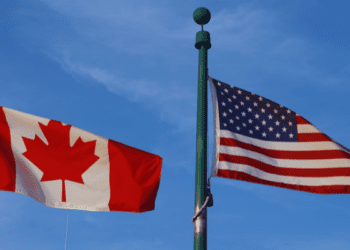
Nearly 23 centuries later, when Canadian Prime Minister Mark Carney touched down in Beijing this month, he carried with him the hopes of Canadian farmers crushed under Chinese tariffs and the frustrations of a nation battered by U.S. President Donald Trump’s economic nationalism. The visit, hailed as the “Carney Doctrine” and praised as nuanced diplomacy, offered immediate relief.
China signaled flexibility on agricultural restrictions. Trade delegations exchanged pleasantries. For a country bruised by its southern neighbor’s “51st-state” rhetoric and territorial ambitions toward Greenland, the embrace felt validating. It was also, in the cold calculus of geopolitics, precisely what Beijing wanted — a modern iteration of Fan Ju’s ancient strategy and a cautionary tale for Japan and other middle powers navigating great power competition.
Ottawa fixated on immediate Chinese accommodation rather than engaging in the harder work of building alternative coalitions. Beijing understands this dynamic intimately. As the Atlantic Council has documented, China’s economic inducements are strategically designed to align with the specific needs of recipient countries and their leaders, cultivating political and sectoral interests to incentivize alignment. Western Canadian farmers desperate for canola market access represent precisely the targeted constituency China has learned to exploit. This is lianheng in modern dress — bilateral arrangements that draw middle powers into orbit while fracturing potential horizontal resistance.
The immediate appeal is understandable. Trump’s tariffs have compounded Chinese restrictions, creating genuine economic pain. Voices within Canada argue persuasively for diversification. Canadian Sen. Yuen Pau Woo advocates deeper engagement with Beijing, while analysts like Wenran Jiang suggest fundamental reconsideration of the Indo-Pacific Strategy in favor of pragmatic accommodation. These positions find echoes across the Pacific. In Japan, former Prime Minister Hatoyama Yukio has long championed closer ties with China, envisioning an East Asian community reducing dependence on the U.S. alliance. Other scholars emphasize economic imperatives of accommodation and cultural affinities between Asian neighbors.
What unites these perspectives is a tendency to minimize clear evidence of nefarious behavior. China’s track record demands acknowledgment regardless of preferred policy orientation. The Australian Strategic Policy Institute (ASPI) documented 152 cases of Chinese coercive diplomacy between 2010 and 2020, with sharp escalation after 2018. Lithuania, for example, watched imports collapse by nearly 90% after opening a Taiwanese representative office. Norway endured years of diplomatic freeze after awarding Liu Xiaobo the Nobel Peace Prize. South Korea suffered an estimated $15 billion in tourism losses over deployment of the U.S. anti-missile system known as THAAD. In all cases, China never officially implemented sanctions; instead, unrelated reasons were provided or no reason given at all. Advocates for engagement must grapple honestly with this record rather than treating each incident as an isolated misunderstanding.
China’s courtship of Canada serves objectives extending beyond bilateral trade. Beijing seeks to weaken American alliances and convince leaders that bilateral arrangements offer viable paths to prosperity. Beijing has long employed a strategic mix of carrots and sticks calibrated to each country’s political climate, designed to pull middle powers into its economic orbit while preventing collective responses to Chinese assertiveness. Canada, in its rush toward relief, risks entanglement — accepting the carrot today without recognizing the stick that follows tomorrow. Fan Ju would recognize the pattern immediately.
Yet acknowledging Beijing’s strategic clarity requires equal honesty about Washington’s contribution to this dynamic. The Trump administration’s approach to allies has proven unproductive, highly alienating and actively harmful to postwar relationships, institutions and strategic assets. Transactional demands, territorial rhetoric about allied nations and contemptuous treatment of security partners have created precisely the conditions Beijing exploits. When the American president describes Canada as a potential “51st state,” when he demands tribute-like burden sharing from Japan and South Korea, he undermines the horizontal alliances representing the most effective counter to Chinese coercion. Middle powers seeking alternatives respond rationally to U.S. behavior. The tragedy is that their rational short-term responses serve Beijing’s long-term strategy of coalition fracture.
This recognition must be balanced against enduring realities. The U.S., despite its current administration’s approach, remains Japan’s and other middle powers’ most important ally. Shared national interests in maintaining open maritime commons, preserving rules-based international order and deterring territorial revision by force do not disappear because of temporary political dysfunction. Institutional bonds — from intelligence sharing to military interoperability developed over decades — represent investments not easily replicated. Shared commitment to rule of law, democratic governance and human rights creates alignment on fundamental values for which no amount of Chinese economic inducement can substitute. Administrations change; geographic realities and institutional architectures endure.

Former Japanese Ambassador to Australia Shingo Yamagami warns of “China magic” — the tendency of Japan and Australia to become obsessed with not displeasing Beijing. He cautions that if they are not careful, Beijing will exploit this excessive enthusiasm as it has before. In the early 1990s, following the Tiananmen Square massacre, then-Chinese Foreign Minister Qian Qichen boasted that China used Japan to weaken international sanctions, admitting that Beijing took full advantage of the Japanese emperor’s 1992 visit to lure back investment. Advocates for engagement, from Hatoyama to accommodating academics, must explain how their approach avoids repeating this exploitation.
For Tokyo, the Canadian experience offers critical lessons. Immediate relief carries long-term costs. Canada’s pivot may ease agricultural pain temporarily, but creates the asymmetric dependence China exploits when strategic interests diverge. Coalition building, while requiring patience, offers superior outcomes. Japan should pursue resilient economic security built on partnerships with democracies sharing interests and values — a comprehensive framework with the European Union, South Korea, Australia, Taiwan and Southeast Asian partners. Such agreements require patient diplomacy but prove infinitely more durable — and they represent the hezong that Fan Ju’s strategy was designed to prevent.
The ASPI research mentioned earlier concludes that countries have failed to band together against Chinese coercion even when manifestly in their interests. This failure of collective action represents a core strategic error. Japan must embrace the harder work Canada bypassed: deepening “Quad” cooperation, expanding the still crucial Comprehensive and Progressive Agreement for Trans-Pacific Partnership, strengthening bilateral ties and maintaining U.S.-alliance bonds despite temporary friction.
The costs of the Carney Doctrine will materialize later — when Chinese leverage becomes a tool for securing compliance, when Ottawa discovers that dependence constrains autonomy, when the coalition of democracies moves forward without full Canadian participation. The question is whether Tokyo and other middle powers can learn from this error before horizontal alliances fragment beyond repair and before Fan Ju’s ancient strategy claims new victims who mistook bilateral accommodation for security.
Stephen R. Nagy is professor of politics and international studies at the International Christian University. Concurrently, he holds appointments as a senior fellow and China project lead at the Macdonald-Laurier Institute and a visiting fellow at the Japan Institute for International Affairs. The title of his forthcoming book is “Japan as a Middle Power State: Navigating Ideological and Systemic Divides.”