This article originally appeared in The Hub.
By Heather Exner-Pirot, August 31, 2026
Canada is in the middle of a trade war with the United States, and it is preoccupying our thoughts. I understand that—lots of people and businesses are being harmed on both sides of the border, and the attack, for some, feels existential.
I confess that as someone who closely follows Canada’s energy and resources sectors, it is hard to feel the same level of dread. Canada is a commodity-exporting country, and right now commodities are ripping. Almost everything Canada is a top exporter of has seen strong double-digit gains this year, and Trump’s policies and incursions are largely to thank. Canada is very likely to enjoy a decade-long boom.
I think we have missed this story because most Canadians are either overly pessimistic about the U.S. trade war or overly pessimistic about Canada’s ability to build and develop our resources. This article is about correcting that pessimism.
Canada is trading more
Canada enjoyed its fourth consecutive trade surplus in June, despite American tariffs, and its first current account surplus in four years. Gold and oil, which together comprise about a quarter of Canadian merchandise exports, are obviously doing a lot of the heavy lifting.
No prizes for guessing why oil is up, and what happened four months ago. In January, WTI was averaging about $64 USD/barrel. Since April, it has averaged $88/barrel. That’s $24 more dollars for each of the 4.1 million barrels we export every day. Canada has received a windfall in the tens of billions of dollars, and prices are likely to stay high in the coming months and years. Alberta in particular, the premier is happy to tout, has turned a projected deficit into a surplus for the year.
The crisis has also provoked countries around the world into seeking to reduce dependence on Middle Eastern oil and gas. Canada is a top beneficiary of this, as evidenced by LNG offtake deals with Germany and negotiations on oil, natural gas and propane with Japan, South Korea, India, and others. There is a ready market for however many hydrocarbons Canada is able to produce.
Energy crises aside, gold has been the main beneficiary of the geopolitical chaos the world has experienced since Trump came into office, rising over 65 percent due to safe-haven asset demand. Canada is the world’s fourth-largest gold miner, and our production has doubled in the past decade. Gold dominates mining stocks on the TSX, and the TSX dominates mining stocks in the world. Gold has rocketed to become Canada’s second-largest export overall and has been carrying extra weight in our trade balance even before oil joined the party.
Canada is producing more
Trade balances matter, but the rubber hits the ground with investment, jobs, production, and exports. Those are the numbers to watch, because they indicate not just movement in global prices but confidence in Canada as a place to invest.
I have been highly critical of federal Liberal—and many provincial—government policies that saw resource extraction as a sin and an embarrassment for the past decade. I understand why people are skeptical that leopards can change their spots.
But the facts are that policies have improved, public opinion has become more supportive, and prices are higher in the past year and a half. This has led inexorably to more energy and resource projects.
Canada is far from a perfect jurisdiction, but it has great rocks in the ground, a skilled workforce, and a world-class financial and services ecosystem to draw on. It is clear that we will be producing more minerals and energy and growing global market share in the coming years. The shovels are already in the ground.
Potash
For potash, the world’s biggest mining company is putting its biggest ever investment into the Jansen mine in Saskatchewan, which will begin production next year. BHP is building a new potash port in Vancouver, and Nutrien is building one in Washington state.
Uranium
For uranium, two new mines were approved in the winter and have already started construction: NexGen’s Rook I and Denison’s Wheeler River. Cameco operates the world’s two largest uranium mines in Saskatchewan, has available brownfield (i.e. previously developed site), and is already the world’s largest and most valuable publicly traded uranium company.
Gold
Gold comprised all but one of the new mines opened in Canada in the past decade. Our production has increased over 100 percent since 2010. Leading jurisdictions in Ontario, Quebec, Nunavut, and B.C. are all growing production, and Canada’s biggest mining company, Agnico Eagle, is investing $14 billion in northern Ontario alone between now and 2030.
Copper and nickel
Copper hit all-time highs this week, as it is an essential metal in electricity, and demand is surging. Canada does not have the reserves of world leaders like Chile, Peru, and the Democratic Republic of Congo, but it is a solid player. Canadian production will finally see meaningful growth with the addition of Canada’s first new base metals mine in a decade, El Dorado’s Foran mine in northern Saskatchewan, which hit first production in June.
This is rounded out by a series of expansions including Highland Valley, Copper Valley and Red Chris in British Columbia and across the Sudbury Basin in Ontario. The latter also will see us produce more nickel, including from the Glencore Onaping Depth expansion which just hit first access to nickel ore this week.
Oil
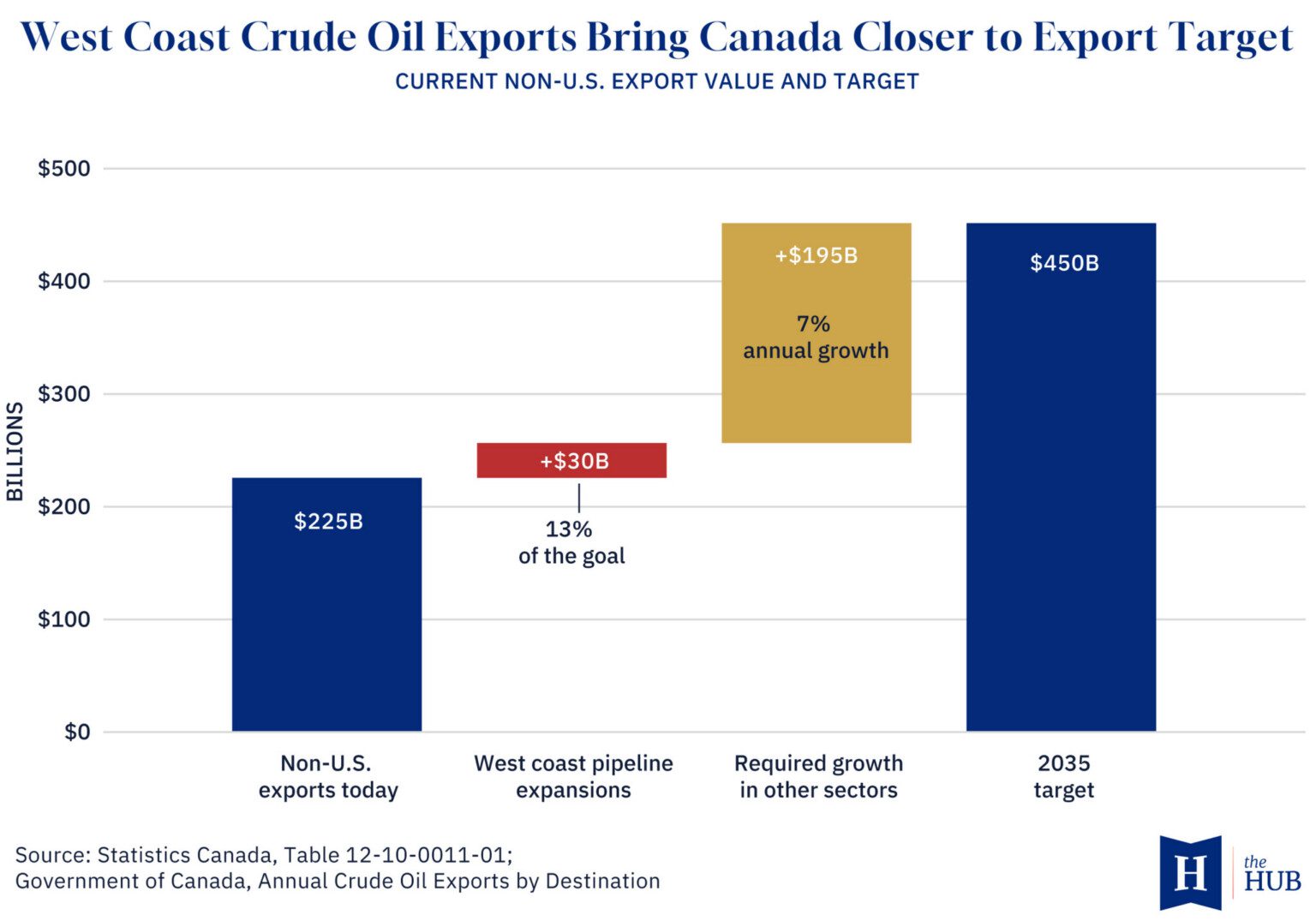
For oil, a series of pipelines and pipeline optimizations have been announced totalling about 2.3 million barrels, including the Enbridge Mainline Optimization, the Transmountain Optimization, the South Bow-Bridger pipeline and the West Coast Oil Pipeline. Some more regulatory and tax improvements are needed to fill all of that, such as capital cost allowances and royalty incentives for new production. Regardless, the Canadian oil patch is moving towards another supercycle, with Alberta issuing the most drilling licenses in the first half of a year since 2014, and will continue to hit new annual production records, as it has every year for the past 16 years (except during the pandemic in 2020). An 8 million barrel target—energy superpower levels—is well within our sights for the 2030s.
Natural gas
Finally, natural gas is continuing its steady growth. Building on the start-up of LNG Canada last year, Woodfibre and Cedar LNG are already under construction, and LNG Canada Phase 2 and Ksi Lisims LNG are at advanced stages and should see final investment decisions in the coming months. Enbridge is building its Sunrise pipeline expansion in B.C., and ATCO is building its Yellowhead pipeline in Alberta. Pembina is building a new 932 MW gas generation plant for the Meta AI data centre outside Edmonton, and many more gas plants and data centres are in the queue. Relatedly, Alta Gas is moving ahead with a new propane export terminal, REEF, in Prince Rupert.
I could go on about iron ore or aluminium or metallurgical coal or gallium, about more midstream projects and upstream investments. The point is, money is being spent, construction is underway, production is growing, and our trade balance will increasingly reflect not only higher prices from the commodity cycle but also higher volumes.
Lots of room for improvement
With a country as endowed as Canada, every commodity cycle upswing produces a windfall. We start running from third base, and it is easy to score.
Donald Trump has not gifted Canada with the hastening of the commodity upswing with his global misadventures and chaos; he’s also done us the service of shaking us out of our complacency. I have no doubt we will work a little harder to build more mines, pipelines, ports, railroads, and transmission lines this time around, and court a few more trading partners.
We aren’t just a junior partner anymore; I think we can use this commodity cycle to come into our own in the world.
A big part of our task is fixing the regulations, policies, and attitudes that have held our resource sectors back since 2015. Many first steps have been completed, but the federal government put forward a discussion paper in June that outlines many important further reforms for moving major projects ahead faster and dealing with long-standing labour issues for federally regulated transportation in ports, rail, and airlines.
Industry is broadly supportive of these reforms. But the usual catastrophizing—from the same groups that pushed Canada into our decade-long decline—quickly ensued.
We cannot let the loud minority block our opportunity this time around. It must be the priority of the Carney government to move ahead with legislation for these regulatory reforms as their first order of business in the fall parliamentary session, and they cannot be watered down. The stakes are high, and the prize is great.