Friday, August 21, 2026
No Result
View All Result
  • Media
Macdonald-Laurier Institute
  • Home
  • About
    • Who We Are
    • Who Makes MLI Work
    • Fifteenth Anniversary
  • Experts
    • Experts Directory
    • In Memoriam
  • Issues
    • Domestic Policy
      • Economic Policy
      • Justice
      • Rights and Freedoms
      • Assisted Suicide (MAID)
      • Health Care
      • COVID-19
      • Gender Identity
      • Canada’s Political Tradition
      • AI, Technology and Innovation
      • Media and Telecoms
      • Housing
      • Immigration
      • Agriculture and Agri-Food
      • Competition Policy
    • Energy Policy
      • Energy
      • Environment
    • Foreign Policy
      • Israel-Hamas War
      • Ukraine
      • Taiwan
      • China
      • Europe and Russia
      • Indo-Pacific
      • Middle East and North Africa
      • North America
      • Foreign Interference
      • National Defence
      • National Security
      • Foreign Affairs
    • Indigenous Affairs
  • Projects
    • CNAPS (Center for North American Prosperity and Security)
    • The Promised Land
    • Dragon at the door
    • Justice Report Card
    • DisInfoWatch.org
    • Managing Indigenous Prosperity
    • Judicial Foundations
    • Landmark Cases Council
    • Closing Canada’s Border, Policing, and Legal Gaps
    • Reforming the University
    • Digital Policy & Connectivity
    • Defending The Marketplace of Ideas
    • Letter to a minister
    • Past Projects
      • The Great Energy Crisis
      • Canada on top of the world
      • Double Trouble
      • Canada and the Indo-Pacific Initiative
      • The Transatlantic Program
      • COVID Misery Index
        • Provincial COVID Misery Index
        • Beyond Lockdown
        • COVID and after: A mandate for recovery
      • Speak for Ourselves
      • The Eavesdropping Dragon: Huawei
      • Talkin’ in the Free World with Mariam Memarsadeghi
      • An Intellectual Property Strategy for Canada
      • Munk Senior Fellows
      • A Mandate for Canada
      • Confederation Series
      • Fiscal Reform
      • The Canadian Century project
      • Fixing Canadian health care
      • Internal trade
      • From a mandate for change
      • Size of government in Canada
      • Straight Talk
      • Labour Market Report
      • Leading Economic Indicator
      • Centre for Advancing Canada’s Interests Abroad
      • Indigenous Prosperity at a Crossroads
        • Aboriginal Canada and Natural Resources
  • Events
    • Voices that Inspire: The Macdonald-Laurier Vancouver Speaker Series
    • Upcoming Events
    • Past Events
      • MLI Dinners
      • Great Canadian Debates
  • Latest News
  • Libraries
    • Columns
    • Commentary
    • Papers
    • Books
    • Video
  • Donate
  • Home
  • About
    • Who We Are
    • Who Makes MLI Work
    • Fifteenth Anniversary
  • Experts
    • Experts Directory
    • In Memoriam
  • Issues
    • Domestic Policy
      • Economic Policy
      • Justice
      • Rights and Freedoms
      • Assisted Suicide (MAID)
      • Health Care
      • COVID-19
      • Gender Identity
      • Canada’s Political Tradition
      • AI, Technology and Innovation
      • Media and Telecoms
      • Housing
      • Immigration
      • Agriculture and Agri-Food
      • Competition Policy
    • Energy Policy
      • Energy
      • Environment
    • Foreign Policy
      • Israel-Hamas War
      • Ukraine
      • Taiwan
      • China
      • Europe and Russia
      • Indo-Pacific
      • Middle East and North Africa
      • North America
      • Foreign Interference
      • National Defence
      • National Security
      • Foreign Affairs
    • Indigenous Affairs
  • Projects
    • CNAPS (Center for North American Prosperity and Security)
    • The Promised Land
    • Dragon at the door
    • Justice Report Card
    • DisInfoWatch.org
    • Managing Indigenous Prosperity
    • Judicial Foundations
    • Landmark Cases Council
    • Closing Canada’s Border, Policing, and Legal Gaps
    • Reforming the University
    • Digital Policy & Connectivity
    • Defending The Marketplace of Ideas
    • Letter to a minister
    • Past Projects
      • The Great Energy Crisis
      • Canada on top of the world
      • Double Trouble
      • Canada and the Indo-Pacific Initiative
      • The Transatlantic Program
      • COVID Misery Index
        • Provincial COVID Misery Index
        • Beyond Lockdown
        • COVID and after: A mandate for recovery
      • Speak for Ourselves
      • The Eavesdropping Dragon: Huawei
      • Talkin’ in the Free World with Mariam Memarsadeghi
      • An Intellectual Property Strategy for Canada
      • Munk Senior Fellows
      • A Mandate for Canada
      • Confederation Series
      • Fiscal Reform
      • The Canadian Century project
      • Fixing Canadian health care
      • Internal trade
      • From a mandate for change
      • Size of government in Canada
      • Straight Talk
      • Labour Market Report
      • Leading Economic Indicator
      • Centre for Advancing Canada’s Interests Abroad
      • Indigenous Prosperity at a Crossroads
        • Aboriginal Canada and Natural Resources
  • Events
    • Voices that Inspire: The Macdonald-Laurier Vancouver Speaker Series
    • Upcoming Events
    • Past Events
      • MLI Dinners
      • Great Canadian Debates
  • Latest News
  • Libraries
    • Columns
    • Commentary
    • Papers
    • Books
    • Video
  • Donate
No Result
View All Result
Macdonald-Laurier Institute

What’s at stake in the Canada-U.S. trade deal? How looming tariffs could cost Canada 90,000 jobs: Trevor Tombe in The Hub

The looming 50 percent tariffs on selected Canadian exports could lead to nearly 90,000 job losses across Canada, despite the overall economic impact being relatively small.

August 21, 2026
in Domestic Policy, Latest News, Columns, In the Media, Economic Policy, North America, Trevor Tombe
Reading Time: 4 mins read
A A
What’s at stake in the Canada-U.S. trade deal? How looming tariffs could cost Canada 90,000 jobs: Trevor Tombe in The Hub

Image via Canva.

This article originally appeared in The Hub.

By Trevor Tombe, August 21, 2026

At the very last minute on August 19, President Trump paused the new 50 percent tariffs on selected Canadian exports. Following ongoing negotiations between the two countries, they are now set to take effect at 12:01 am this Saturday if no final arrangement is reached.

While the situation is fast-moving and there are various reports that some sort of agreement will be reached, with a measure of tariff relief for at least some sectors, it’s worth considering the implications of what happens if the 50 percent tariffs are enacted.

There has been plenty of analysis of what Canada should or shouldn’t do in response, and what it should or shouldn’t agree to at the negotiating table. There has been much less analysis done on what these new tariffs might mean for jobs across the country.

At the macro level, solid estimates suggest the broader economic implications may be relatively small, including from recent work by Joseph Steinberg, a University of Toronto economist, covered in The Hub. I completely agree. My own estimates also suggest that since the new tariffs apply to a relatively small share of what we sell to the United States, the average tariff rate hitting Canadian exports rises by only about 2.5 percent.

The aggregate numbers, though, hide a great deal. If these tariffs take effect and remain in place, I estimate that nearly 90,000 jobs across Canada could be lost. And those losses go beyond where the tariffs directly land. Alberta is a good example: its exports are barely affected by the new tariffs, yet I estimate roughly 9,000 jobs there are at risk.

To see where these estimates come from, let’s start with how tariffs affect different sectors.

Exposure is uneven

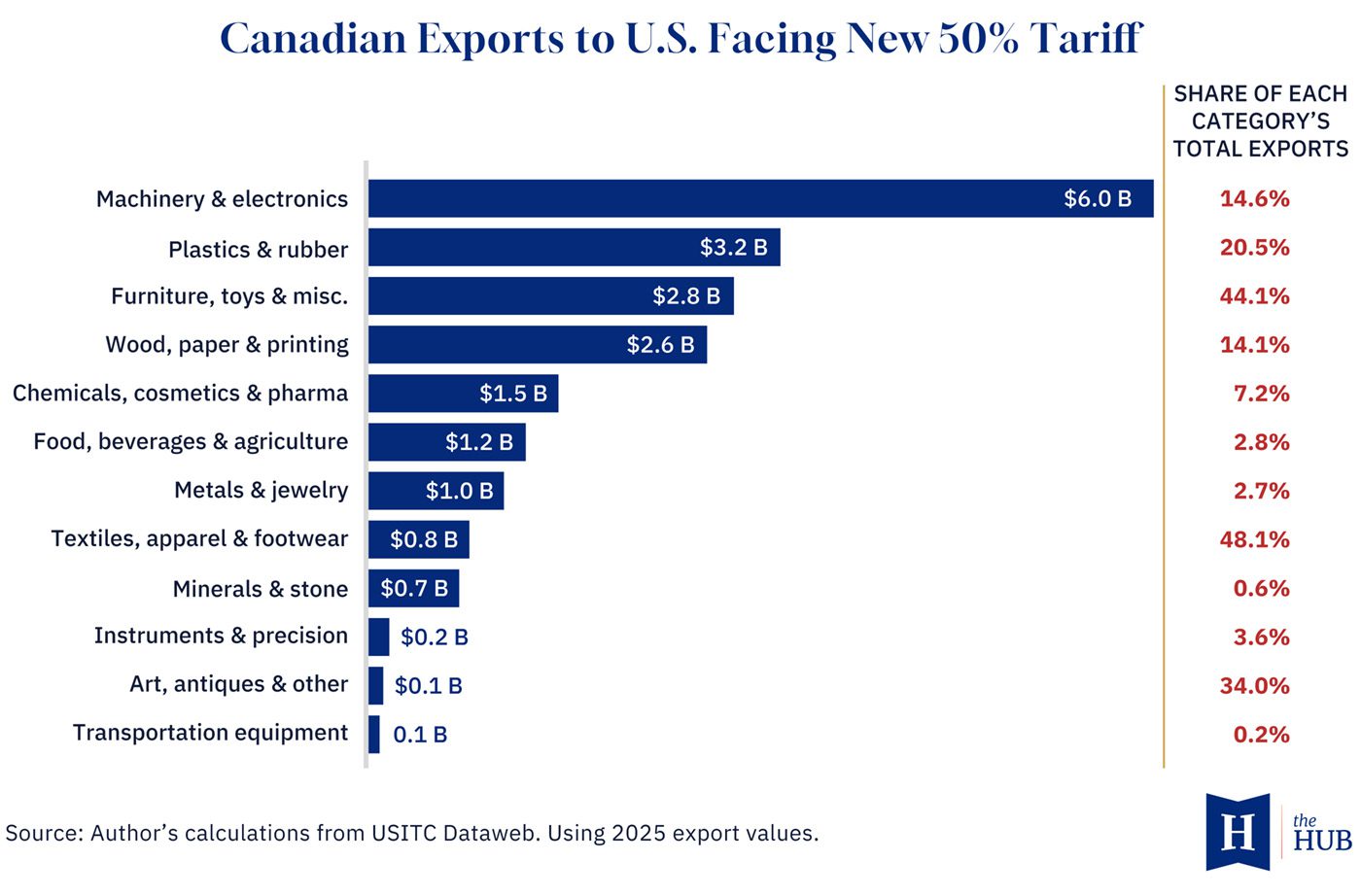
Using the full list of items subject to U.S. tariffs, I estimate that the most exposed sectors are machinery and electronics, plastics and rubber, furniture, toys, wood products, chemicals, food products, and clothing. Roughly half of textile exports to the United States would be affected, and nearly as high a share of furniture exports. I illustrate this below.
Graphic credit: Janice Nelson

And because sectors are exposed differently, so too are provinces.

I estimate the new tariffs would raise the average effective tariff rate facing Ontario and Quebec exporters by about 5 percentage points (double the national average), and British Columbia exporters by about 7 percent.

Much of Atlantic Canada, along with Alberta and Saskatchewan, appears largely spared. For Alberta, I estimate the increase is about 0.5 percentage points (one-fifth of the national average).

That uneven pattern has drawn attention for reasons beyond economics. With Ontario, Quebec, and British Columbia bearing most of the direct exposure while Alberta, Saskatchewan, and much of Atlantic Canada are largely spared, some see in these tariffs an attempt to set one part of the country against another.

But where a tariff lands is not the same as where its costs are felt, and the employment numbers make that clear.

What this might mean for jobs

So how many jobs might be disrupted?

Precise numbers are difficult, since much depends on how businesses respond. Given the uncertainty surrounding U.S. trade policy, many firms may not view these tariffs as permanent. So they may absorb a temporary hit without changing their employment decisions at all. And to the extent that the burden of U.S. tariffs lands on consumers in that country, it may also take time for their behaviour to change (and by how much is hard to know).

But suppose the tariffs remain in place for some time. And suppose sales of affected goods to the United States fall in proportion to the tariff itself, so that a 50 percent tariff means a 50 percent drop in sales. While overly simplistic, it allows us to get a ballpark figure.

On those assumptions, I estimate that over 52,000 jobs in Canada are directly at risk of loss. Adding jobs at suppliers and service providers to those exporters brings another 35,000 into play, for a total of a little over 87,000 across the country. Against a current unemployment rate of 6.4 percent, losses on that scale would push the rate up by roughly 0.4 points, to 6.8 percent.

Where the job losses show up

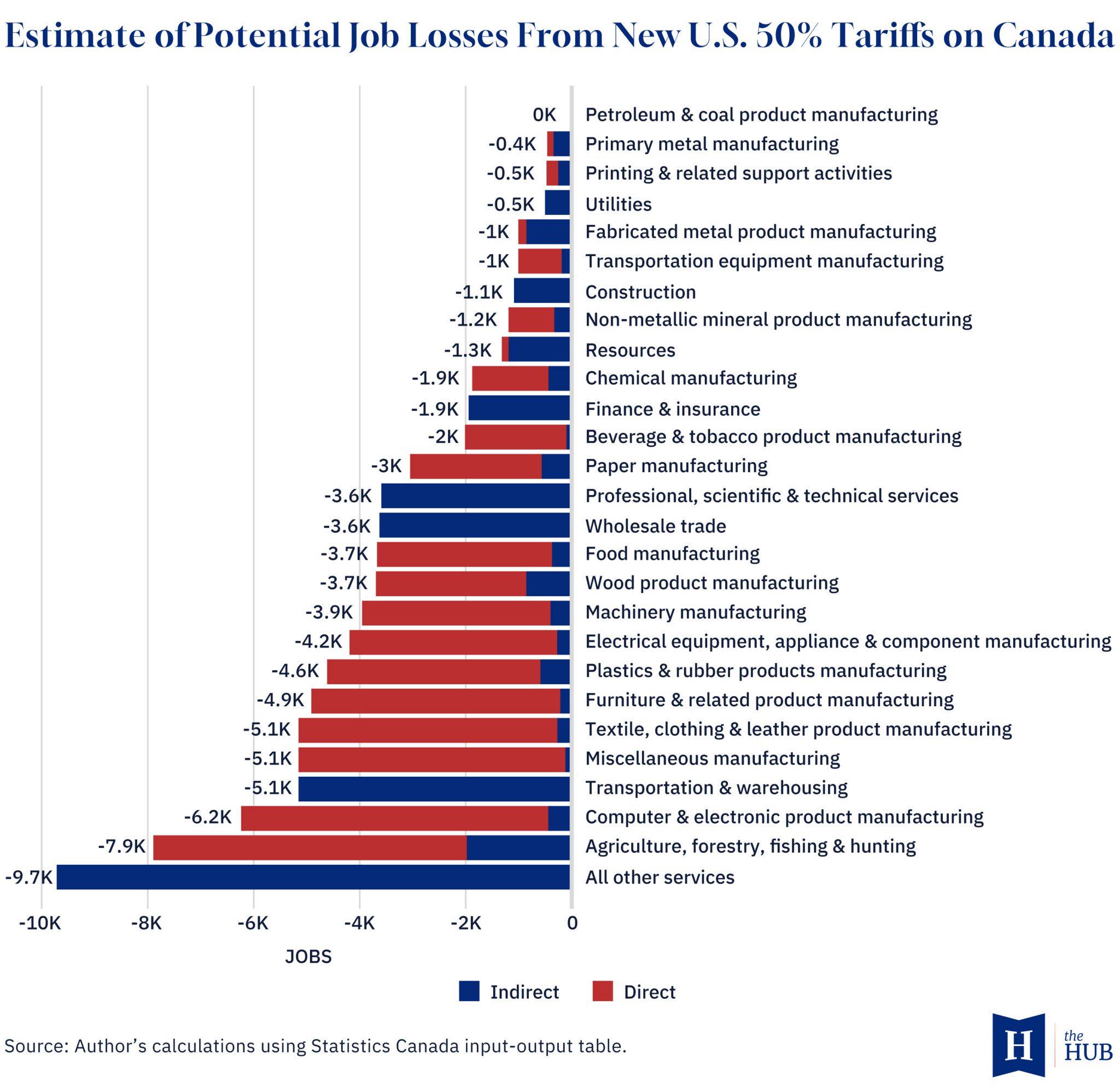
I illustrate estimated losses by sector below, including both direct and indirect effects.
Graphic credit: Janice Nelson

Direct losses are considerable in agriculture, electronic product manufacturing, textiles, furniture, plastic products, and electrical equipment. Add the indirect effects, and the largest disruptions show up in transportation and warehousing. Truck transportation is a big source here, as lower trade volumes mean fewer drivers are needed. Wholesale trade and professional, scientific, and technical services also see losses, since demand for their services falls when exporters contract.

Consider what this means. A large share of the losses occur in sectors that are not directly exposed to the tariffs at all. The economic consequences may therefore look quite different from the provincial pattern of effective tariff rates described above. Every province has considerable service-sector employment, and many have service firms supplying exporters located elsewhere in the country.

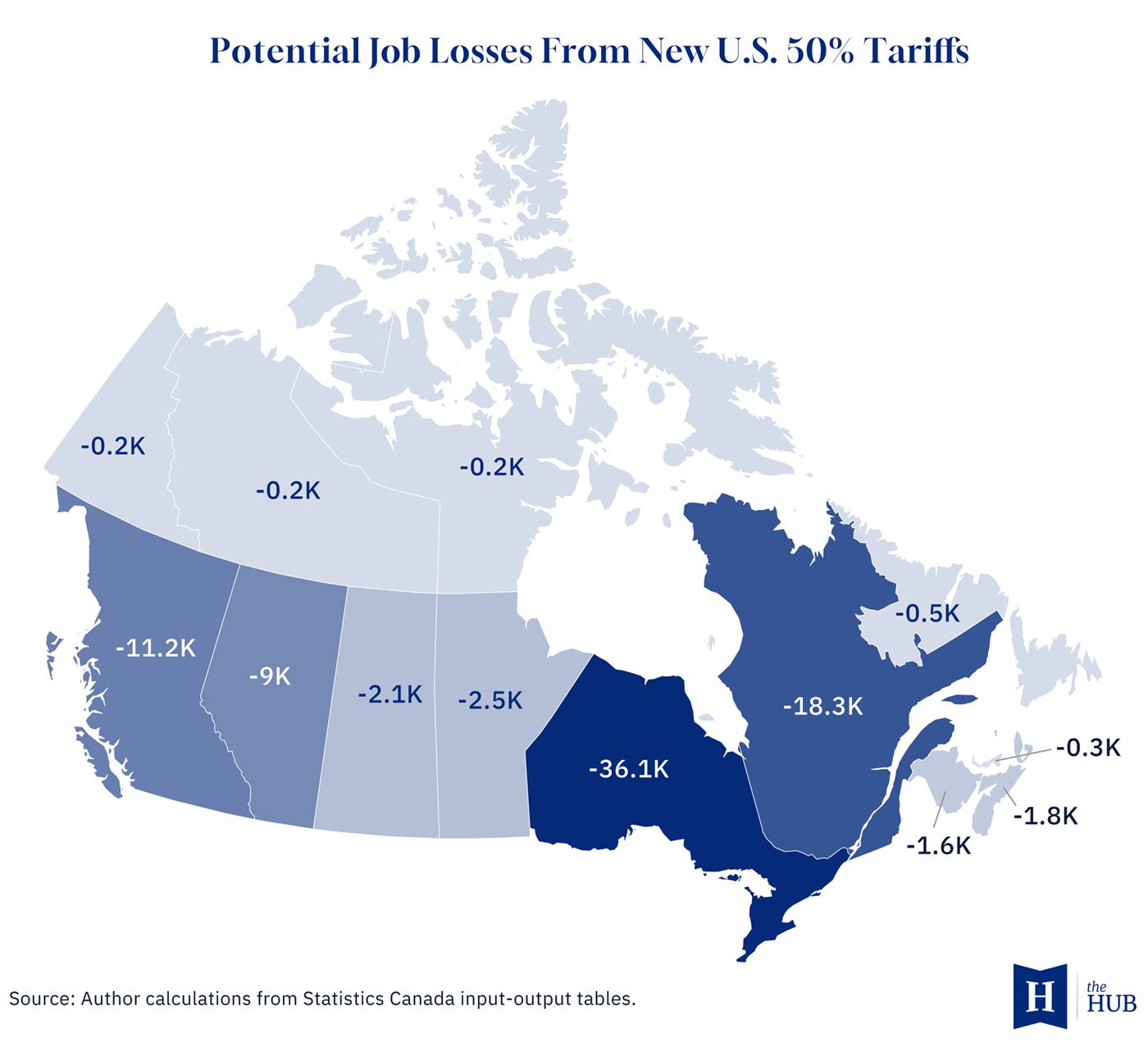
Spreading the sectoral job losses across provinces in proportion to how many jobs in each province are embodied in that sector’s exports to the United States, I estimate losses of roughly 36,000 in Ontario, 18,000 in Quebec, 11,000 in British Columbia, and 9,000 in Alberta.
Graphic credit: Janice Nelson

Alberta stands out. Its own exports are barely touched by these tariffs, yet the province still faces meaningful job losses, because service activity supporting exporters elsewhere would not be spared the disruption.

What’s at stake

The macroeconomic effects of this round may be fairly muted—I reckon a couple of tenths of a percentage point off of GDP growth. But the labour market effects are larger, and they reach well past the provinces the tariffs were aimed at.

Whether or not a deal is reached this weekend, that is worth remembering. Trade disruption unfortunately looks likely to be a recurring challenge for Canada’s economy. And each round will have effects felt right across the country.


Trevor Tombe is a professor of economics at the University of Calgary, the Director of Fiscal and Economic Policy at The School of Public Policy, a Senior Fellow at the Macdonald-Laurier Institute, and a Fellow at the Public Policy Forum.


Source: The Hub

Related Posts

China is fuelling Canada’s fentanyl crisis. Is it hybrid warfare?: Nirvan Bose for Inside Policy
Foreign Interference

China is fuelling Canada’s fentanyl crisis. Is it hybrid warfare?: Nirvan Bose for Inside Policy

August 21, 2026
Judicializing Everything?: Mark Harding on Runnymede Radio
Justice

Judicializing Everything?: Mark Harding on Runnymede Radio

August 19, 2026
The UNHCR is goading the U.S. into pulling its funding – and putting itself in existential risk: Michael Barutciski in The Globe and Mail
Immigration

The UNHCR is goading the U.S. into pulling its funding – and putting itself in existential risk: Michael Barutciski in The Globe and Mail

August 19, 2026
Next Post
China is fuelling Canada’s fentanyl crisis. Is it hybrid warfare?: Nirvan Bose for Inside Policy

China is fuelling Canada’s fentanyl crisis. Is it hybrid warfare?: Nirvan Bose for Inside Policy

Newsletter Signup

  Thank you for Signing Up
  Please correct the marked field(s) below.
Email Address  *
1,true,6,Contact Email,2
First Name *
1,true,1,First Name,2
Last Name *
1,true,1,Last Name,2
*
*Required Fields

Follow us on

Macdonald-Laurier Institute

323 Chapel Street, Suite #300
Ottawa, Ontario, K1N 7Z2 Canada

613.482.8327

info@macdonaldlaurier.ca
MLI directory

Support Us

Support the Macdonald-Laurier Institute to help ensure that Canada is one of the best governed countries in the world. Click below to learn more or become a sponsor.

Support Us

  • Inside Policy Magazine
  • Annual Reports
  • Jobs
  • Privacy Policy

© 2023 Macdonald-Laurier Institute. All Rights reserved.

No Result
View All Result
  • Home
  • About
    • Who We Are
    • Who Makes MLI Work
    • Fifteenth Anniversary
  • Experts
    • Experts Directory
    • In Memoriam
  • Issues
    • Domestic Policy
      • Economic Policy
      • Justice
      • Rights and Freedoms
      • Assisted Suicide (MAID)
      • Health Care
      • COVID-19
      • Gender Identity
      • Canada’s Political Tradition
      • AI, Technology and Innovation
      • Media and Telecoms
      • Housing
      • Immigration
      • Agriculture and Agri-Food
      • Competition Policy
    • Energy Policy
      • Energy
      • Environment
    • Foreign Policy
      • Israel-Hamas War
      • Ukraine
      • Taiwan
      • China
      • Europe and Russia
      • Indo-Pacific
      • Middle East and North Africa
      • North America
      • Foreign Interference
      • National Defence
      • National Security
      • Foreign Affairs
    • Indigenous Affairs
  • Projects
    • CNAPS (Center for North American Prosperity and Security)
    • The Promised Land
    • Dragon at the door
    • Justice Report Card
    • DisInfoWatch.org
    • Managing Indigenous Prosperity
    • Judicial Foundations
    • Landmark Cases Council
    • Closing Canada’s Border, Policing, and Legal Gaps
    • Reforming the University
    • Digital Policy & Connectivity
    • Defending The Marketplace of Ideas
    • Letter to a minister
    • Past Projects
      • The Great Energy Crisis
      • Canada on top of the world
      • Double Trouble
      • Canada and the Indo-Pacific Initiative
      • The Transatlantic Program
      • COVID Misery Index
      • Speak for Ourselves
      • The Eavesdropping Dragon: Huawei
      • Talkin’ in the Free World with Mariam Memarsadeghi
      • An Intellectual Property Strategy for Canada
      • Munk Senior Fellows
      • A Mandate for Canada
      • Confederation Series
      • Fiscal Reform
      • The Canadian Century project
      • Fixing Canadian health care
      • Internal trade
      • From a mandate for change
      • Size of government in Canada
      • Straight Talk
      • Labour Market Report
      • Leading Economic Indicator
      • Centre for Advancing Canada’s Interests Abroad
      • Indigenous Prosperity at a Crossroads
  • Events
    • Voices that Inspire: The Macdonald-Laurier Vancouver Speaker Series
    • Upcoming Events
    • Past Events
      • MLI Dinners
      • Great Canadian Debates
  • Latest News
  • Libraries
    • Columns
    • Commentary
    • Papers
    • Books
    • Video
  • Donate

© 2023 Macdonald-Laurier Institute. All Rights reserved.