Thursday, July 30, 2026
No Result
View All Result
  • Media
Macdonald-Laurier Institute
  • Home
  • About
    • Who We Are
    • Who Makes MLI Work
    • Fifteenth Anniversary
  • Experts
    • Experts Directory
    • In Memoriam
  • Issues
    • Domestic Policy
      • Economic Policy
      • Justice
      • Rights and Freedoms
      • Assisted Suicide (MAID)
      • Health Care
      • COVID-19
      • Gender Identity
      • Canada’s Political Tradition
      • AI, Technology and Innovation
      • Media and Telecoms
      • Housing
      • Immigration
      • Agriculture and Agri-Food
      • Competition Policy
    • Energy Policy
      • Energy
      • Environment
    • Foreign Policy
      • Israel-Hamas War
      • Ukraine
      • Taiwan
      • China
      • Europe and Russia
      • Indo-Pacific
      • Middle East and North Africa
      • North America
      • Foreign Interference
      • National Defence
      • National Security
      • Foreign Affairs
    • Indigenous Affairs
  • Projects
    • CNAPS (Center for North American Prosperity and Security)
    • The Promised Land
    • Dragon at the door
    • Justice Report Card
    • DisInfoWatch.org
    • Managing Indigenous Prosperity
    • Judicial Foundations
    • Landmark Cases Council
    • Closing Canada’s Border, Policing, and Legal Gaps
    • Reforming the University
    • Digital Policy & Connectivity
    • Defending The Marketplace of Ideas
    • Letter to a minister
    • Past Projects
      • The Great Energy Crisis
      • Canada on top of the world
      • Double Trouble
      • Canada and the Indo-Pacific Initiative
      • The Transatlantic Program
      • COVID Misery Index
        • Provincial COVID Misery Index
        • Beyond Lockdown
        • COVID and after: A mandate for recovery
      • Speak for Ourselves
      • The Eavesdropping Dragon: Huawei
      • Talkin’ in the Free World with Mariam Memarsadeghi
      • An Intellectual Property Strategy for Canada
      • Munk Senior Fellows
      • A Mandate for Canada
      • Confederation Series
      • Fiscal Reform
      • The Canadian Century project
      • Fixing Canadian health care
      • Internal trade
      • From a mandate for change
      • Size of government in Canada
      • Straight Talk
      • Labour Market Report
      • Leading Economic Indicator
      • Centre for Advancing Canada’s Interests Abroad
      • Indigenous Prosperity at a Crossroads
        • Aboriginal Canada and Natural Resources
  • Events
    • Voices that Inspire: The Macdonald-Laurier Vancouver Speaker Series
    • Upcoming Events
    • Past Events
      • MLI Dinners
      • Great Canadian Debates
  • Latest News
  • Libraries
    • Columns
    • Commentary
    • Papers
    • Books
    • Video
  • Donate
  • Home
  • About
    • Who We Are
    • Who Makes MLI Work
    • Fifteenth Anniversary
  • Experts
    • Experts Directory
    • In Memoriam
  • Issues
    • Domestic Policy
      • Economic Policy
      • Justice
      • Rights and Freedoms
      • Assisted Suicide (MAID)
      • Health Care
      • COVID-19
      • Gender Identity
      • Canada’s Political Tradition
      • AI, Technology and Innovation
      • Media and Telecoms
      • Housing
      • Immigration
      • Agriculture and Agri-Food
      • Competition Policy
    • Energy Policy
      • Energy
      • Environment
    • Foreign Policy
      • Israel-Hamas War
      • Ukraine
      • Taiwan
      • China
      • Europe and Russia
      • Indo-Pacific
      • Middle East and North Africa
      • North America
      • Foreign Interference
      • National Defence
      • National Security
      • Foreign Affairs
    • Indigenous Affairs
  • Projects
    • CNAPS (Center for North American Prosperity and Security)
    • The Promised Land
    • Dragon at the door
    • Justice Report Card
    • DisInfoWatch.org
    • Managing Indigenous Prosperity
    • Judicial Foundations
    • Landmark Cases Council
    • Closing Canada’s Border, Policing, and Legal Gaps
    • Reforming the University
    • Digital Policy & Connectivity
    • Defending The Marketplace of Ideas
    • Letter to a minister
    • Past Projects
      • The Great Energy Crisis
      • Canada on top of the world
      • Double Trouble
      • Canada and the Indo-Pacific Initiative
      • The Transatlantic Program
      • COVID Misery Index
        • Provincial COVID Misery Index
        • Beyond Lockdown
        • COVID and after: A mandate for recovery
      • Speak for Ourselves
      • The Eavesdropping Dragon: Huawei
      • Talkin’ in the Free World with Mariam Memarsadeghi
      • An Intellectual Property Strategy for Canada
      • Munk Senior Fellows
      • A Mandate for Canada
      • Confederation Series
      • Fiscal Reform
      • The Canadian Century project
      • Fixing Canadian health care
      • Internal trade
      • From a mandate for change
      • Size of government in Canada
      • Straight Talk
      • Labour Market Report
      • Leading Economic Indicator
      • Centre for Advancing Canada’s Interests Abroad
      • Indigenous Prosperity at a Crossroads
        • Aboriginal Canada and Natural Resources
  • Events
    • Voices that Inspire: The Macdonald-Laurier Vancouver Speaker Series
    • Upcoming Events
    • Past Events
      • MLI Dinners
      • Great Canadian Debates
  • Latest News
  • Libraries
    • Columns
    • Commentary
    • Papers
    • Books
    • Video
  • Donate
No Result
View All Result
Macdonald-Laurier Institute

Doug Ford is wrong – Why doing nothing at all is Canada’s best response to Trump’s tariffs: Trevor Tombe in The Hub

Canada’s best response to U.S. tariffs is to refrain from retaliation, focusing instead on domestic economic improvements.

July 30, 2026
in Domestic Policy, Columns, Latest News, In the Media, Economic Policy, North America, Trevor Tombe
Reading Time: 5 mins read
A A
Doug Ford is wrong – Why doing nothing at all is Canada’s best response to Trump’s tariffs: Trevor Tombe in The Hub

Official White House Photo by Joyce Boghosian via Flickr.

This article originally appeared in The Hub.

By Trevor Tombe, July 30, 2026

Canada’s best response to the latest round of U.S. tariffs may be to do nothing at all.

Not literally nothing. Governments will naturally help workers and communities facing serious disruption. And we should make our economy more productive, competitive, and resilient.

But when it comes to retaliation, doing nothing may be the wisest course.

That will strike many Canadians as wrong. Early in the trade war, roughly three in four said Ottawa should retaliate with tariffs of its own. A similar share supported restricting exports of electricity, wood, and oil.

Premiers have echoed that. Ontario’s Doug Ford has been the most forceful last week, calling on Ottawa to go after energy, potash, minerals, and electricity. They “need to feel the pain rather than us constantly feeling the pain,” he said last week, adding quite strongly that Canada could “dismantle the U.S. if we wanted to.” He framed retaliation as not merely an option, but an obligation: “I feel some days that I’m standing alone protecting Canada and I need everyone else to get onside.”

The prime minister, for his part, has been more cautious, but still says “everything is on the table.”

So what should Canada do?

Retaliation has one job

A useful answer comes from Adam Smith, whom my colleague Professor Kent Fellows has regularly (and wisely) cited on this point.

Writing in The Wealth of Nations 250 years ago, Smith argued that retaliation may be justified “when there is a probability that they will procure the repeal of the high duties or prohibitions complained of.”

When there is no such probability, “it seems a bad method of compensating the injury done to certain classes of our people, to do another injury ourselves.”

That is the test we should all have in mind.

The purpose of retaliation should be to change the other country’s behaviour. It should not be to express anger, satisfy a desire for revenge, or create the appearance of action.

I have no particular expertise on the president’s motivations, and I am happy to defer to those who do (although really, does anybody?). But the record is not encouraging. And there is little reason to think Canadian retaliation would change U.S. policy. Canada is far too small for retaliatory tariffs to do much damage to the U.S. economy.

The tariffs we imposed last year were, in practice, taxes on Canadian consumers and Canadian businesses. And even if we were large enough, it seems a stretch to suppose that a president who prizes “winning” over all else would respond by backing down.

Perhaps this isn’t actually a trade war

There’s another way to think about all of this. One that doesn’t consider it a trade war at all.

The United States is a sovereign country. It can adopt whatever policies it likes, including ones that damage its own economy. Tariffs are taxes on Americans, not on Canadians.

It feels like we are being targeted. Mostly, we are not. The data make that clear. Consider the distribution of tariffs that the United States now applies across a wide variety of products and countries. Below, I plot roughly 51,000 tariff lines in total (for the trade geeks, this is all country-HS4 combinations).
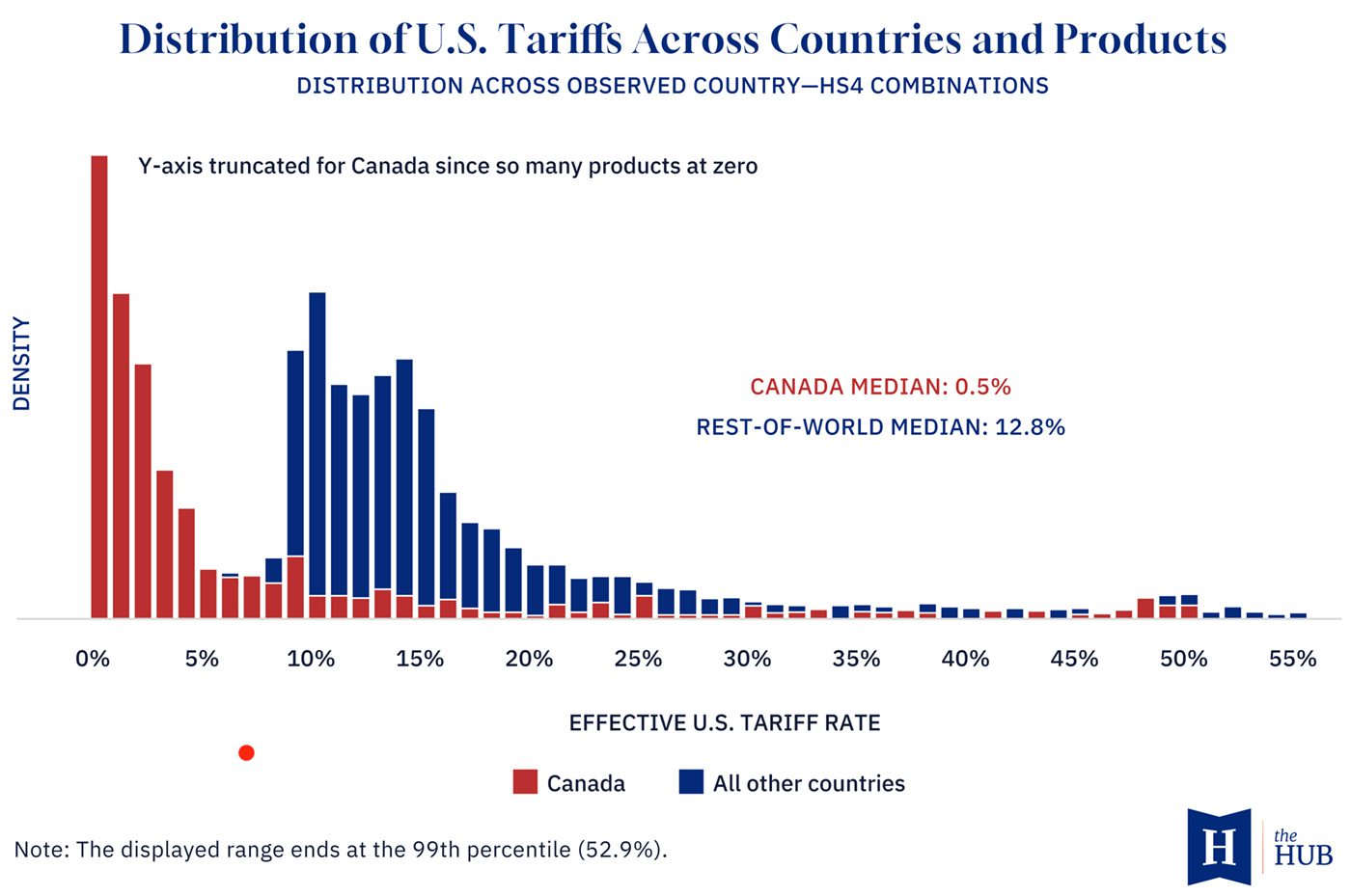
Graphic Credit: Janice Nelson.

Plenty of individual Canadian products face high rates. Many steel and aluminum items already face 50 percent rates, for example, and many more will on August 19. But on the whole, Canada is not singled out. If anything, it’s the reverse.

The same holds at the country level, where U.S. tariffs are landing on nearly every country on earth.
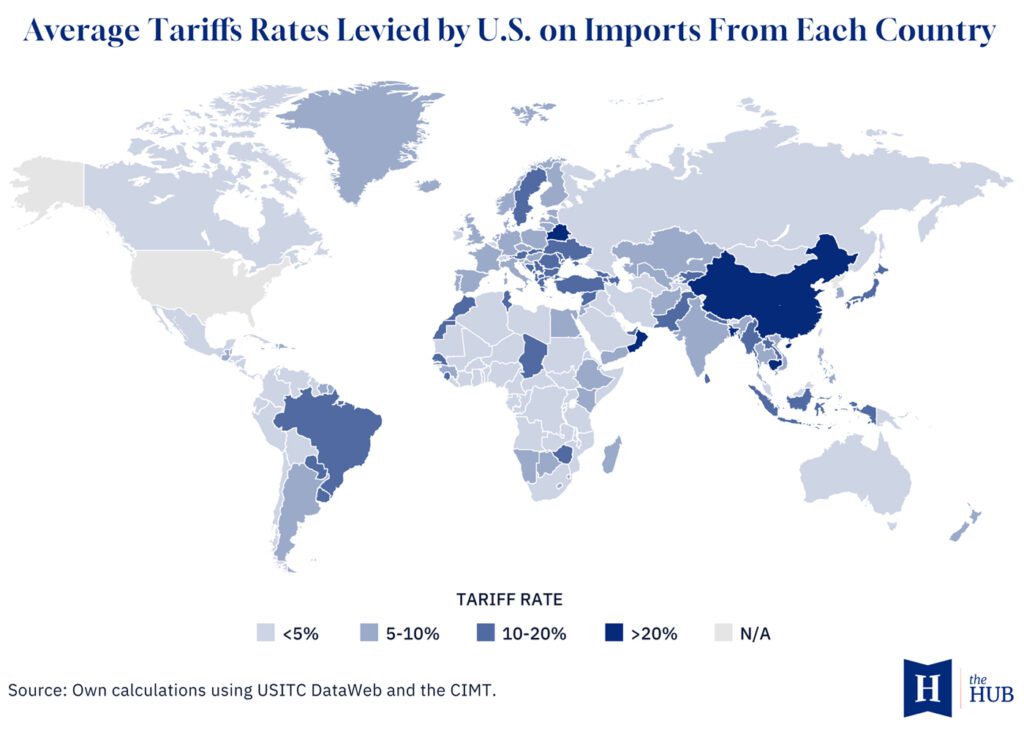
Graphic Credit: Janice Nelson.

This is a fundamental change in American economic policy, not a policy aimed at us.

Of course, within Canada, the effects are uneven.

Once the 50 percent tariffs take effect on August 19, some provinces will face a considerable drag. But even those provinces do not stand out by international standards. My own calculations on this are illustrated below, with Quebec topping the chart at over 13 percent.
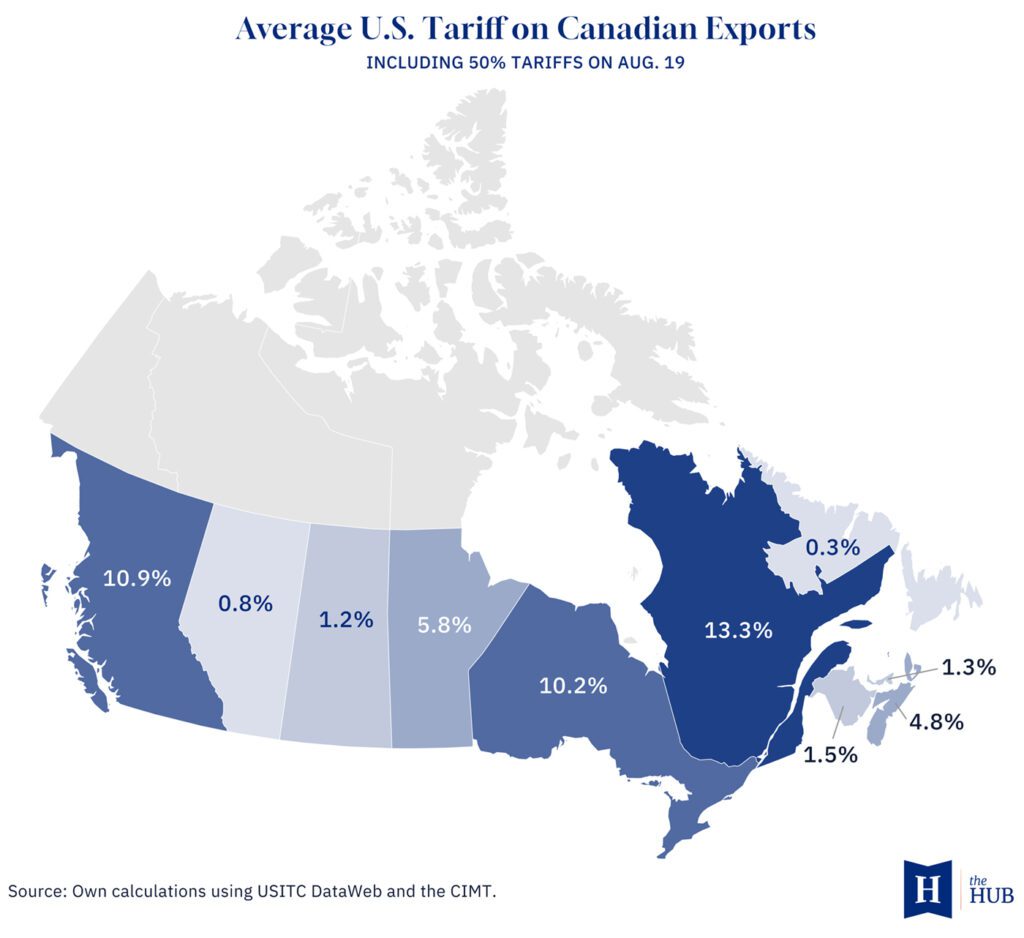
Graphic Credit: Janice Nelson.

This does not make the tariffs harmless, but it does put them in perspective.

Bad American tax policy

A better way to think about all this is as bad American tax policy. Suppose Washington doubled its corporate income tax, or raised top marginal rates on personal income to 80 or 90 percent. Growth south of the border would slow. Canadian firms would feel it. The United States is both a major buyer of what we produce and a major supplier of the inputs we use.

Bad American tax policy would hurt us.

But it would not cross anyone’s mind to retaliate. We would recognize it as an unfortunate choice the Americans made, and then get on with our own business.

Tariffs (at least as we’re seeing them now) deserve the same treatment. Our best response is the same one we would choose if the United States had adopted sensible policies instead: focus on what is under our control.

Anger is not a strategy

The rhetorical attacks coming from the president make that difficult. They have increased Canadian anger toward his administration and its policies. But while threats against our very sovereignty, or incoherent threats of tariffing wildfire smoke, may make it feel like we’re a unique target, the actual tariff schedules say something else.

There is also a great deal of incoherence in U.S. policymaking. Announcements can be abrupt, agreements temporary, and policies regularly change with little warning. Canada cannot control that uncertainty. But we can control much of what happens here.

From recognizing professional credentials across the country, to improving competition, to making it easier to build infrastructure and major projects, to reforming taxes that discourage investment. We can also improve Canada’s ability to sell goods and services to markets beyond the United States by (as the EU has) reaching agreements and deals with major economies from Argentina and Brazil to India.

We can also lower artificial costs on Canadian consumers. There is surprisingly little public pressure, for example, to improve and free markets for dairy, poultry, and other products.

The more energy we spend debating how to elbow the United States, the less attention we give to the policy choices that are actually ours to make.

Perhaps another analogy may also be helpful; think of U.S. policy like we do a hurricane, and respond similarly. We support the people harmed. We help them rebuild. We invest in resilience so the next one does less damage. We don’t shake our fists at the sky and demand the storms stop coming. We certainly don’t “retaliate” by imposing taxes on ourselves.

Do nothing, then. Not nothing at home, where there is a great deal to do. But nothing aimed at Washington.

Whether the United States finds its footing again soon does not depend much on us.

Whether Canada does is entirely up to us.

Trump’s tariffs are not an attack on Canada’s economy. They’re an attack on America’s. We should respond accordingly.


Trevor Tombe is a professor of economics at the University of Calgary, the Director of Fiscal and Economic Policy at The School of Public Policy, a Senior Fellow at the Macdonald-Laurier Institute, and a Fellow at the Public Policy Forum.
Source: The Hub

Related Posts

Canada’s golden opportunity – ours to lose?: Heather Exner-Pirot on This Is Mining with Amber Mac
Energy

Canada’s golden opportunity – ours to lose?: Heather Exner-Pirot on This Is Mining with Amber Mac

July 29, 2026
Canada must confront Russia’s Arctic aspirations: Alexander Dalziel and Sergey Sukhankin in the National Post
Arctic

Canada must confront Russia’s Arctic aspirations: Alexander Dalziel and Sergey Sukhankin in the National Post

July 29, 2026
Jews are leaving Canada in droves: Casey Babb in The Free Press
The Promised Land

Jews are leaving Canada in droves: Casey Babb in The Free Press

July 28, 2026

Newsletter Signup

  Thank you for Signing Up
  Please correct the marked field(s) below.
Email Address  *
1,true,6,Contact Email,2
First Name *
1,true,1,First Name,2
Last Name *
1,true,1,Last Name,2
*
*Required Fields

Follow us on

Macdonald-Laurier Institute

323 Chapel Street, Suite #300
Ottawa, Ontario, K1N 7Z2 Canada

613.482.8327

info@macdonaldlaurier.ca
MLI directory

Support Us

Support the Macdonald-Laurier Institute to help ensure that Canada is one of the best governed countries in the world. Click below to learn more or become a sponsor.

Support Us

  • Inside Policy Magazine
  • Annual Reports
  • Jobs
  • Privacy Policy

© 2023 Macdonald-Laurier Institute. All Rights reserved.

No Result
View All Result
  • Home
  • About
    • Who We Are
    • Who Makes MLI Work
    • Fifteenth Anniversary
  • Experts
    • Experts Directory
    • In Memoriam
  • Issues
    • Domestic Policy
      • Economic Policy
      • Justice
      • Rights and Freedoms
      • Assisted Suicide (MAID)
      • Health Care
      • COVID-19
      • Gender Identity
      • Canada’s Political Tradition
      • AI, Technology and Innovation
      • Media and Telecoms
      • Housing
      • Immigration
      • Agriculture and Agri-Food
      • Competition Policy
    • Energy Policy
      • Energy
      • Environment
    • Foreign Policy
      • Israel-Hamas War
      • Ukraine
      • Taiwan
      • China
      • Europe and Russia
      • Indo-Pacific
      • Middle East and North Africa
      • North America
      • Foreign Interference
      • National Defence
      • National Security
      • Foreign Affairs
    • Indigenous Affairs
  • Projects
    • CNAPS (Center for North American Prosperity and Security)
    • The Promised Land
    • Dragon at the door
    • Justice Report Card
    • DisInfoWatch.org
    • Managing Indigenous Prosperity
    • Judicial Foundations
    • Landmark Cases Council
    • Closing Canada’s Border, Policing, and Legal Gaps
    • Reforming the University
    • Digital Policy & Connectivity
    • Defending The Marketplace of Ideas
    • Letter to a minister
    • Past Projects
      • The Great Energy Crisis
      • Canada on top of the world
      • Double Trouble
      • Canada and the Indo-Pacific Initiative
      • The Transatlantic Program
      • COVID Misery Index
      • Speak for Ourselves
      • The Eavesdropping Dragon: Huawei
      • Talkin’ in the Free World with Mariam Memarsadeghi
      • An Intellectual Property Strategy for Canada
      • Munk Senior Fellows
      • A Mandate for Canada
      • Confederation Series
      • Fiscal Reform
      • The Canadian Century project
      • Fixing Canadian health care
      • Internal trade
      • From a mandate for change
      • Size of government in Canada
      • Straight Talk
      • Labour Market Report
      • Leading Economic Indicator
      • Centre for Advancing Canada’s Interests Abroad
      • Indigenous Prosperity at a Crossroads
  • Events
    • Voices that Inspire: The Macdonald-Laurier Vancouver Speaker Series
    • Upcoming Events
    • Past Events
      • MLI Dinners
      • Great Canadian Debates
  • Latest News
  • Libraries
    • Columns
    • Commentary
    • Papers
    • Books
    • Video
  • Donate

© 2023 Macdonald-Laurier Institute. All Rights reserved.