Tuesday, July 28, 2026
No Result
View All Result
  • Media
Macdonald-Laurier Institute
  • Home
  • About
    • Who We Are
    • Who Makes MLI Work
    • Fifteenth Anniversary
  • Experts
    • Experts Directory
    • In Memoriam
  • Issues
    • Domestic Policy
      • Economic Policy
      • Justice
      • Rights and Freedoms
      • Assisted Suicide (MAID)
      • Health Care
      • COVID-19
      • Gender Identity
      • Canada’s Political Tradition
      • AI, Technology and Innovation
      • Media and Telecoms
      • Housing
      • Immigration
      • Agriculture and Agri-Food
      • Competition Policy
    • Energy Policy
      • Energy
      • Environment
    • Foreign Policy
      • Israel-Hamas War
      • Ukraine
      • Taiwan
      • China
      • Europe and Russia
      • Indo-Pacific
      • Middle East and North Africa
      • North America
      • Foreign Interference
      • National Defence
      • National Security
      • Foreign Affairs
    • Indigenous Affairs
  • Projects
    • CNAPS (Center for North American Prosperity and Security)
    • The Promised Land
    • Dragon at the door
    • Justice Report Card
    • DisInfoWatch.org
    • Managing Indigenous Prosperity
    • Judicial Foundations
    • Landmark Cases Council
    • Closing Canada’s Border, Policing, and Legal Gaps
    • Reforming the University
    • Digital Policy & Connectivity
    • Defending The Marketplace of Ideas
    • Letter to a minister
    • Past Projects
      • The Great Energy Crisis
      • Canada on top of the world
      • Double Trouble
      • Canada and the Indo-Pacific Initiative
      • The Transatlantic Program
      • COVID Misery Index
        • Provincial COVID Misery Index
        • Beyond Lockdown
        • COVID and after: A mandate for recovery
      • Speak for Ourselves
      • The Eavesdropping Dragon: Huawei
      • Talkin’ in the Free World with Mariam Memarsadeghi
      • An Intellectual Property Strategy for Canada
      • Munk Senior Fellows
      • A Mandate for Canada
      • Confederation Series
      • Fiscal Reform
      • The Canadian Century project
      • Fixing Canadian health care
      • Internal trade
      • From a mandate for change
      • Size of government in Canada
      • Straight Talk
      • Labour Market Report
      • Leading Economic Indicator
      • Centre for Advancing Canada’s Interests Abroad
      • Indigenous Prosperity at a Crossroads
        • Aboriginal Canada and Natural Resources
  • Events
    • Voices that Inspire: The Macdonald-Laurier Vancouver Speaker Series
    • Upcoming Events
    • Past Events
      • MLI Dinners
      • Great Canadian Debates
  • Latest News
  • Libraries
    • Columns
    • Commentary
    • Papers
    • Books
    • Video
  • Donate
  • Home
  • About
    • Who We Are
    • Who Makes MLI Work
    • Fifteenth Anniversary
  • Experts
    • Experts Directory
    • In Memoriam
  • Issues
    • Domestic Policy
      • Economic Policy
      • Justice
      • Rights and Freedoms
      • Assisted Suicide (MAID)
      • Health Care
      • COVID-19
      • Gender Identity
      • Canada’s Political Tradition
      • AI, Technology and Innovation
      • Media and Telecoms
      • Housing
      • Immigration
      • Agriculture and Agri-Food
      • Competition Policy
    • Energy Policy
      • Energy
      • Environment
    • Foreign Policy
      • Israel-Hamas War
      • Ukraine
      • Taiwan
      • China
      • Europe and Russia
      • Indo-Pacific
      • Middle East and North Africa
      • North America
      • Foreign Interference
      • National Defence
      • National Security
      • Foreign Affairs
    • Indigenous Affairs
  • Projects
    • CNAPS (Center for North American Prosperity and Security)
    • The Promised Land
    • Dragon at the door
    • Justice Report Card
    • DisInfoWatch.org
    • Managing Indigenous Prosperity
    • Judicial Foundations
    • Landmark Cases Council
    • Closing Canada’s Border, Policing, and Legal Gaps
    • Reforming the University
    • Digital Policy & Connectivity
    • Defending The Marketplace of Ideas
    • Letter to a minister
    • Past Projects
      • The Great Energy Crisis
      • Canada on top of the world
      • Double Trouble
      • Canada and the Indo-Pacific Initiative
      • The Transatlantic Program
      • COVID Misery Index
        • Provincial COVID Misery Index
        • Beyond Lockdown
        • COVID and after: A mandate for recovery
      • Speak for Ourselves
      • The Eavesdropping Dragon: Huawei
      • Talkin’ in the Free World with Mariam Memarsadeghi
      • An Intellectual Property Strategy for Canada
      • Munk Senior Fellows
      • A Mandate for Canada
      • Confederation Series
      • Fiscal Reform
      • The Canadian Century project
      • Fixing Canadian health care
      • Internal trade
      • From a mandate for change
      • Size of government in Canada
      • Straight Talk
      • Labour Market Report
      • Leading Economic Indicator
      • Centre for Advancing Canada’s Interests Abroad
      • Indigenous Prosperity at a Crossroads
        • Aboriginal Canada and Natural Resources
  • Events
    • Voices that Inspire: The Macdonald-Laurier Vancouver Speaker Series
    • Upcoming Events
    • Past Events
      • MLI Dinners
      • Great Canadian Debates
  • Latest News
  • Libraries
    • Columns
    • Commentary
    • Papers
    • Books
    • Video
  • Donate
No Result
View All Result
Macdonald-Laurier Institute

Fishing for trouble: The fishery and Russia’s quest for Arctic maritime power

Russia's Arctic ambitions are at the heart of the growing struggle for security, influence, and power in northern waters.

July 28, 2026
in Foreign Policy, Latest News, Europe and Russia, Alexander Dalziel, Papers, Arctic
Reading Time: 6 mins read
A A
Fishing for trouble: The fishery and Russia’s quest for Arctic maritime power

By Alexander Dalziel
July 28, 2026

PDF of paper

Executive Summary | Sommaire (le français suit)

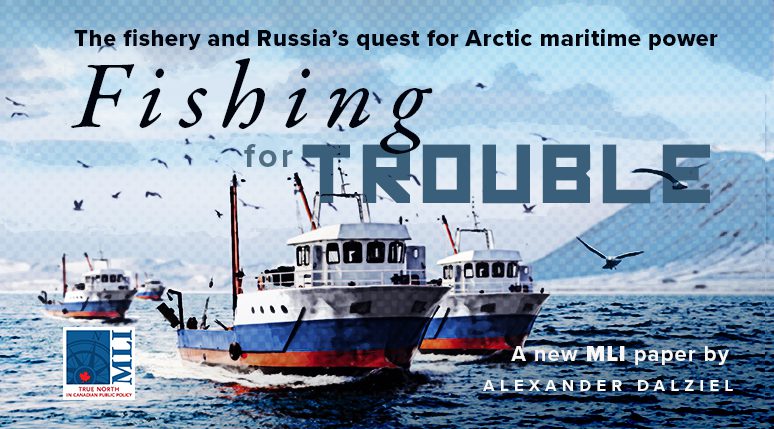
Russia wants to be a great power at sea. It is bringing all its fleets online to achieve that aim – and fishing vessels are not exception. Indeed, the fish they catch feed geopolitics, too.

President Vladimir Putin and Russia’s leadership consider fishing fleets and their catches part of the geopolitical tool kit. We know this because recent Russian strategic documents indicate that the integration of civilian fleets into military and state planning and operations in peace and war is underway.

Fishing fleets have become one more layer in Russia’s strategy to shore up its control of Arctic waters alongside dual-use infrastructure ashore, and hybrid warfare techniques – covert activities that it can deny – to intimidate, influence, and spy on neighbouring states.

Russia’s reputation as a reliable food supplier to the global market has taken a beating because of its attempts to block Ukrainian grain shipments across the Black Sea to low-income markets worldwide. To address this, Russia is trying to use fish exports and its knowledge in the sector to cultivate countries in the “Global South.” And, having gained important market share in China and the EU, Russia is trying to bolster its relations with the former and its influence in the latter. It is clear, especially in the case of Europe, that geopolitics are part of Russia’s export strategy.

Not all is well, of course. Russia thinks it exports too much raw fish and that other countries get the credit for processing it. Moreover, the Kremlin needs to convince regular Russians, whose access to fish has decreased since 2014, that feeding them is the state’s priority. So, President Putin and his government dedicate efforts to say that serving the domestic market is now their main objective – a claim that sits uncomfortably with the desire to tap the lucrative export market. In this context, Russia emphasizes social stability through food security – goals that also align with the language found in its national security and maritime strategy documents.

Russia’s strategy will undoubtedly have global impacts. For instance, will Russia’s fishing fleets – and Putin’s broader maritime ambitions in the region – harm the little-understood and ecologically sensitive fisheries in the Central Arctic Ocean? Russia is a signatory to the international agreement that has put a moratorium on such fishing. With the agreement set to expire in 2036, Canada, the United States, and the other Arctic coastal states will need to closely monitor how Russia integrates Arctic fisheries into its broader geopolitical strategy in anticipation of potentially difficult negotiations.

Moreover, the areas where Russia conducts its two most important fisheries – the Barents Sea and the North Pacific – are highly relevant to other Arctic nations. Russian fishing fleets are one more part of the “grey zone” in spaces that are also vital to Canada, the United States, and their allies and partners in northern Europe and northeast Asia.

Russia’s Arctic ambitions are at the heart of the growing struggle for security, influence, and power in northern waters. Canada, the US, and their allies must urgently strengthen maritime security strategies to counter Russia’s diversified toolkit. Sustained surveillance and early detection will be essential to prevent emerging threats. Coast guards, fisheries enforcement agencies, Western diplomats, and Arctic coastal communities, which greatly depend on fisheries for their livelihoods, must be prepared for the reality that, under Putin, fishing is not just about fish – it’s about leverage cast far beyond the nets.


La Russie aspire à devenir une grande puissance maritime. Elle mobilise l’ensemble de ses flottes dans ce but – y compris ses bateaux de pêche. Ses prises constituent également un levier d’influence.

La Russie mise sur son statut d’exportateur mondial dominant pour accroître son influence en Asie, en Europe et au-delà. Pour Vladimir Poutine et les dirigeants russes, les flottes de pêche et leurs prises font partie de l’arsenal géopolitique. Ce fait est connu, car certains textes de stratégie russes récents soulignent l’intégration en cours de la marine civile à la planification et aux opérations militaires et étatiques, en temps de paix comme en temps de guerre.

Les chercheurs relèvent certains éléments probants le corroborant. Les flottes de pêche représentent désormais un élément additionnel de la stratégie russe visant à renforcer la présence maritime et le contrôle sur les eaux arctiques, au moyen des infrastructures à double usage sur les côtes, des bateaux de pêche en mer, ainsi que des techniques de guerre hybride – activités secrètes pouvant être démenties – pour intimider, influencer et espionner les États voisins.

La Russie a terni sa réputation de fournisseur alimentaire fiable en bloquant les expéditions de céréales ukrainiennes à travers la mer Noire vers les marchés à faibles revenus. Pour y remédier, elle tente d’utiliser ses exportations de poisson et son expertise dans ce secteur pour se rapprocher des pays du Sud. Et, ayant conquis d’importantes parts de marché en Chine et dans l’UE, elle cherche à renforcer ses relations avec la première et son influence au sein de la seconde. Pour l’Europe en particulier, la géopolitique est essentielle pour la stratégie d’exportation de la Russie.

Bien évidemment, tout ne va pas pour le mieux. La Russie estime que les pays qui transforment ses trop abondantes exportations s’en attribuent le crédit. De plus, le Kremlin doit persuader la population russe de l’importance accordée par l’État à leur approvisionnement alimentaire, en dépit de la baisse de l’offre en poisson depuis 2014. Le président Poutine et son gouvernement s’emploient donc à affirmer que l’approvisionnement du marché intérieur est désormais leur objectif principal – ce qui coïncide mal avec la volonté d’exploiter le lucratif marché d’exportation. Dans ce contexte, l’accent est mis sur la stabilité sociale par le biais de la sécurité alimentaire – et s’aligne sur le discours tenu dans les textes de stratégie en matière de sécurité nationale et maritime.

La stratégie de la Russie aura inévitablement des répercussions mondiales. Par exemple, il convient de s’interroger sur la possibilité que les flottes de pêche russes – ainsi que les ambitions maritimes considérables de Poutine – portent préjudice aux pêcheries généralement méconnues et écologiquement sensibles de l›océan Arctique central. La Russie a signé le moratoire international sur ce type de pêche. Comme l’accord doit prendre fin en 2036, le Canada, les États‑Unis et d’autres États côtiers devront surveiller de près comment la Russie intègre les pêches arctiques dans sa stratégie géopolitique étendue, en prévision de négociations potentiellement difficiles.

Enfin, les régions où la Russie pratique ses deux formes de pêche les plus actives, la mer de Barents et le Pacifique Nord, sont particulièrement importantes pour l’Arctique. Les flottes de pêche russes consolident la « zone grise » dans des espaces également cruciaux pour le Canada, les États‑Unis ainsi que leurs alliés et partenaires en Europe du Nord et en Asie du Nord-Est.

Les aspirations arctiques de Poutine poussent l’Occident à s’engager dans une compétition accrue pour la sécurité, l’influence et le pouvoir dans les eaux boréales. Le Canada, les États‑Unis et leurs alliés doivent d’urgence renforcer leur sécurité maritime pour repousser l’expansionnisme russe. Une surveillance constante et une détection précoce seront cruciales pour parer aux menaces émergentes. Les gardecôtes, les organismes responsables de l’application des lois sur la pêche, les diplomates occidentaux et les communautés côtières de l’Arctique, qui dépendent largement de la pêche, doivent se préparer à une réalité inéluctable  : sous Poutine, la pêche ne concerne jamais seulement que les poissons – elle est un levier d’une portée bien plus grande que celle des filets.

Pour le Canada, les États-Unis, la Finlande, leurs alliés au sein de l’OTAN et leurs partenaires indopacifiques, la stratégie adoptée face aux ambitions de la Russie dans l’Arctique, manifestée par l’accroissement de sa flotte de brise-glaces nucléaires, repose sur le maintien de la stabilité et la poursuite assidue de leurs initiatives. Il est crucial que le Canada, les États-Unis et leurs alliés développent leurs capacités en matière de brise-glaces afin de répondre adéquatement aux besoins économiques, de souveraineté, d’approvisionnement pour les collectivités et de sécurité maritime. Dans de multiples situations, la croissance économique de l’Arctique requiert l’investissement et l’appui des gouvernements. Cependant, le développement ne saurait émaner exclusivement du centre et des grandes entreprises. Afin de contrecarrer efficacement les perceptions erronées de la Russie quant à sa suprématie en Arctique, nous devons intensifier nos propres efforts en resserrant la coopération et l’interopérabilité entre nations démocratiques arctiques et populations du Nord.

 

Related Posts

Arresting Netanyahu in America would be illegal: Brian L. Cox & John Spencer in Real Clear World
The Promised Land

Arresting Netanyahu in America would be illegal: Brian L. Cox & John Spencer in Real Clear World

July 28, 2026
Degrees of decline – Credential creep, lost trust, and the reckoning facing Canada’s universities: David Polansky for Inside Policy
Education

Degrees of decline – Credential creep, lost trust, and the reckoning facing Canada’s universities: David Polansky for Inside Policy

July 27, 2026
Aboriginal title vs private property – can Canada reconcile both?: Karen Restoule on Nuanced with Aaron Pete
Latest News

Aboriginal title vs private property – can Canada reconcile both?: Karen Restoule on Nuanced with Aaron Pete

July 27, 2026
Next Post
Arresting Netanyahu in America would be illegal: Brian L. Cox & John Spencer in Real Clear World

Arresting Netanyahu in America would be illegal: Brian L. Cox & John Spencer in Real Clear World

Newsletter Signup

  Thank you for Signing Up
  Please correct the marked field(s) below.
Email Address  *
1,true,6,Contact Email,2
First Name *
1,true,1,First Name,2
Last Name *
1,true,1,Last Name,2
*
*Required Fields

Follow us on

Macdonald-Laurier Institute

323 Chapel Street, Suite #300
Ottawa, Ontario, K1N 7Z2 Canada

613.482.8327

info@macdonaldlaurier.ca
MLI directory

Support Us

Support the Macdonald-Laurier Institute to help ensure that Canada is one of the best governed countries in the world. Click below to learn more or become a sponsor.

Support Us

  • Inside Policy Magazine
  • Annual Reports
  • Jobs
  • Privacy Policy

© 2023 Macdonald-Laurier Institute. All Rights reserved.

This site uses cookies. By continuing to browse the site you are agreeing to our use of cookies.

Privacy Preference Center

Consent Management

Necessary

Advertising

Analytics

Other

No Result
View All Result
  • Home
  • About
    • Who We Are
    • Who Makes MLI Work
    • Fifteenth Anniversary
  • Experts
    • Experts Directory
    • In Memoriam
  • Issues
    • Domestic Policy
      • Economic Policy
      • Justice
      • Rights and Freedoms
      • Assisted Suicide (MAID)
      • Health Care
      • COVID-19
      • Gender Identity
      • Canada’s Political Tradition
      • AI, Technology and Innovation
      • Media and Telecoms
      • Housing
      • Immigration
      • Agriculture and Agri-Food
      • Competition Policy
    • Energy Policy
      • Energy
      • Environment
    • Foreign Policy
      • Israel-Hamas War
      • Ukraine
      • Taiwan
      • China
      • Europe and Russia
      • Indo-Pacific
      • Middle East and North Africa
      • North America
      • Foreign Interference
      • National Defence
      • National Security
      • Foreign Affairs
    • Indigenous Affairs
  • Projects
    • CNAPS (Center for North American Prosperity and Security)
    • The Promised Land
    • Dragon at the door
    • Justice Report Card
    • DisInfoWatch.org
    • Managing Indigenous Prosperity
    • Judicial Foundations
    • Landmark Cases Council
    • Closing Canada’s Border, Policing, and Legal Gaps
    • Reforming the University
    • Digital Policy & Connectivity
    • Defending The Marketplace of Ideas
    • Letter to a minister
    • Past Projects
      • The Great Energy Crisis
      • Canada on top of the world
      • Double Trouble
      • Canada and the Indo-Pacific Initiative
      • The Transatlantic Program
      • COVID Misery Index
      • Speak for Ourselves
      • The Eavesdropping Dragon: Huawei
      • Talkin’ in the Free World with Mariam Memarsadeghi
      • An Intellectual Property Strategy for Canada
      • Munk Senior Fellows
      • A Mandate for Canada
      • Confederation Series
      • Fiscal Reform
      • The Canadian Century project
      • Fixing Canadian health care
      • Internal trade
      • From a mandate for change
      • Size of government in Canada
      • Straight Talk
      • Labour Market Report
      • Leading Economic Indicator
      • Centre for Advancing Canada’s Interests Abroad
      • Indigenous Prosperity at a Crossroads
  • Events
    • Voices that Inspire: The Macdonald-Laurier Vancouver Speaker Series
    • Upcoming Events
    • Past Events
      • MLI Dinners
      • Great Canadian Debates
  • Latest News
  • Libraries
    • Columns
    • Commentary
    • Papers
    • Books
    • Video
  • Donate

© 2023 Macdonald-Laurier Institute. All Rights reserved.