
This article originally appeared in The Hub.
By Dave Snow, June 30, 2026
In April, Alberta prosecutors announced that sexual assault charges against a prominent spiritual leader and his wife would be stayed due to a combination of trial delays and prosecutorial misconduct. After years of waiting, one complainant told The Globe and Mail that those who had come forward felt “betrayed,” that there was “no accountability,” and that they had become “victims of the system.”
Cases such as these are far from unique, as trial delays and rising numbers of stayed and withdrawn charges have become a source of public concern. Many observers trace the problem to the Supreme Court of Canada’s landmark 2016 Jordan decision, which imposed strict ceilings on the length of criminal trials and which the court reaffirmed in May.
This DeepDive completes a three-part examination of Canada’s criminal justice system by turning to the performance of the courts themselves. My previous analyses showed rising levels of violent crime and declining police clearance rates. But the criminal justice process does not end when police solve a case. Justice also requires that the courts resolve cases in a timely manner. Using nearly two decades of Statistics Canada data, this article examines how well Canada’s criminal courts are performing that task and what these trends mean for the Supreme Court’s approach to trial delay.
The results are sobering. Criminal trials are taking longer than ever, and more than half of all cases are stayed, withdrawn, dismissed, or otherwise terminated before guilt can be determined. While there is some provincial variation, the trendlines show that Canada’s criminal courts have become slower, less efficient, and increasingly incapable of delivering timely justice.
Justice delayed has become justice denied.
Trial delay: Criminal cases are taking longer
The analysis below draws from Statistics Canada’s annual Integrated Criminal Court Survey (ICCS), the most comprehensive source of criminal court data available in Canada. Although the dataset excludes data from some provincial superior courts and from Quebec municipal courts, these omissions likely result in a modest understatement of trial delay and sentence severity. To smooth annual fluctuations, I use three-year rolling averages (for example, the value for “2023/2024” is the average of the values for 2021/22, 2022/23, and 2023/24). All figures below begin in 2005/06, the first year for which data are available for every province and territory. The most recent available data are from 2023/24.
Readers should note that this data comes with a Quebec-shaped asterisk. Quebec has not reported any ICCS data since 2020/21, and even before then, its data excluded municipal courts, which account for approximately 14 percent of its criminal cases. Quebec also consistently records higher rates of guilty findings, lower rates of stayed and withdrawn charges, and higher acquittal rates than other provinces. For that reason, many of the figures below present national trends both with and without Quebec.
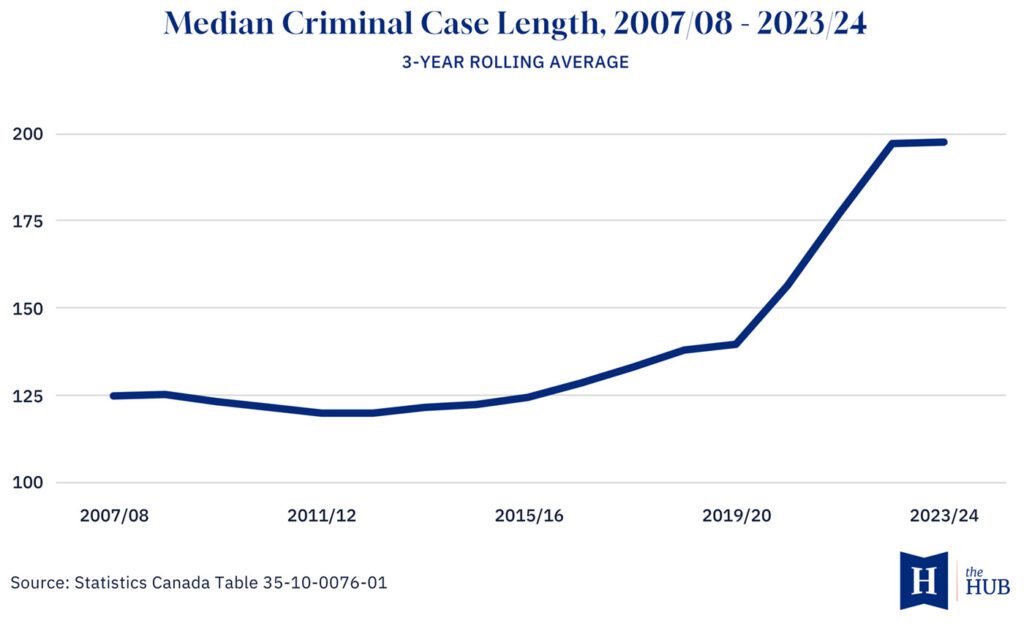
With those caveats in mind, the first trend to examine is trial delay. Statistics Canada measures the median number of days it takes to “complete a case, from first appearance to final decision.” The first chart shows the national trend between 2007/08 and 2023/24, using three-year rolling averages.
After remaining stable between 121 and 124 days between 2007/08 and 2015/16, median criminal case lengths have skyrocketed to 198 days, a 60 percent increase in just eight years. Most of this growth has occurred in the post-COVID years, with (rolling) median criminal case length rising by 41 percent in a three-year period.
Because Statistics Canada reports median case lengths, Quebec cannot simply be excluded from the national figures after its reporting ceased in 2020/21. However, because Quebec consistently exceeded the national median in the years prior, its absence is unlikely to meaningfully change the broader trend. Provincial and territorial data, displayed in the heat map below, confirm this.
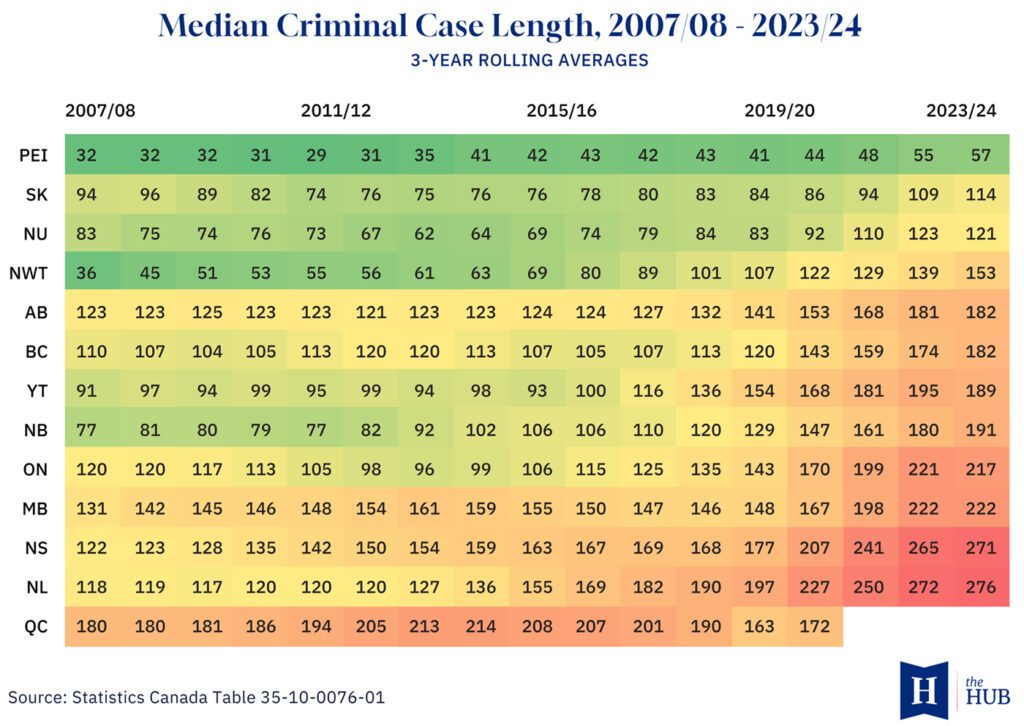
Three patterns from the heat map stand out. First, trial delay has worsened in every jurisdiction except Quebec (where case lengths had declined slightly before the province’s reporting ceased after 2020/21). Even Prince Edward Island, which has by far the shortest trials in Canada, saw median case lengths increase by 78 percent during this period, from 32 to 57 days.
Second, some areas have experienced particularly dramatic increases. Median case length has doubled in Yukon, Nova Scotia, Newfoundland and Labrador, and New Brunswick, and quadrupled in the Northwest Territories. Much of this deterioration has occurred since the pandemic, with delays increasing by more than 20 percent in 10 of 12 jurisdictions during the four-year period since 2019/20.
Finally, unlike violent crime rates—which are much higher in the Prairies and Territories—trial delay does not exhibit a strong regional pattern. Although the Atlantic Canadian provinces of Nova Scotia and Newfoundland and Labrador have the longest cases, PEI has by far the shortest. The increase in delay has been widespread.
More cases are being stayed or withdrawn
The above data show that trial length is going up. But what about cases that never even reach a determination of guilt or innocence? To capture these cases, Statistics Canada groups together stays (where criminal proceedings are halted), withdrawals, dismissals, discharges at preliminary inquiry, and referrals to alternative or restorative justice programs. Following Statistics Canada, I refer to these outcomes collectively as “stayed or withdrawn.”
The chart below shows the proportion of criminal cases that are stayed or withdrawn, again using three-year rolling averages between 2007/08 and 2023/24. Because Quebec consistently recorded lower stay/withdrawal rates than the rest of Canada, and because the province stopped reporting after 2020/21, the chart includes separate lines for Canada with and without Quebec.
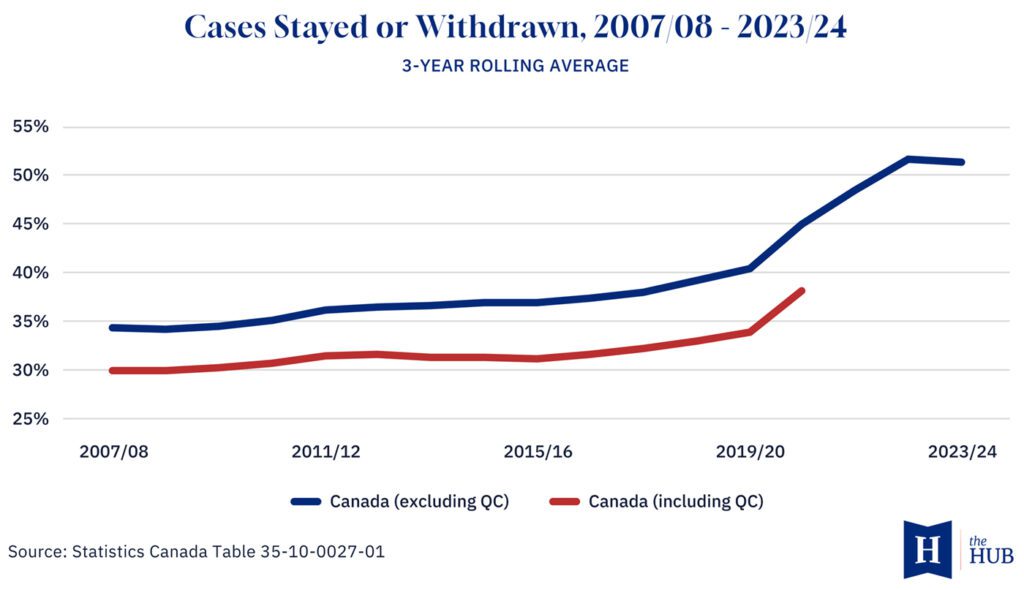
The trend is striking regardless of whether Quebec is included. Focusing on Canada outside Quebec, the proportion of criminal cases that were stayed or withdrawn increased from just under 35 percent in 2007/08 to 40 percent by 2019/20. The increase accelerated sharply after the pandemic, to the extent that more than 50 percent of criminal cases outside Quebec now end without a determination of guilt or innocence.
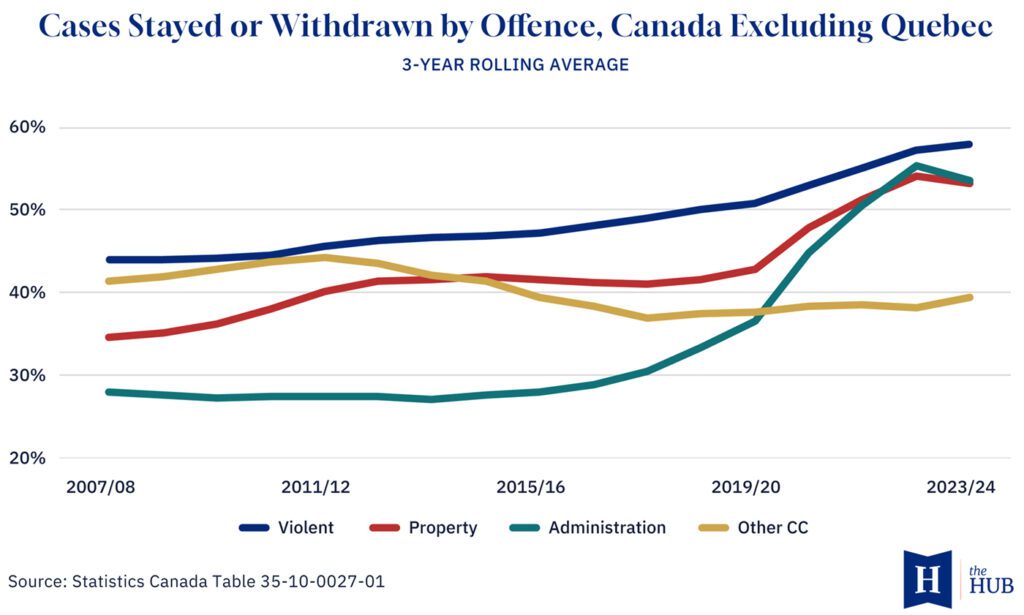
The problem is particularly acute for violent crime. The chart above shows the trends for stays/withdrawals for four broad categories of non-traffic Criminal Code offences: violent crime (technically “crimes against the person”), property crime, administration of justice offences (such as breaching court orders or missing court dates), and “other” (non-violent weapon, prostitution, distributing the peace, and residual offences). As the chart shows, stay and withdrawal rates for violent offences have risen steadily to 58 percent, the highest rate of all four categories. We have now reached a point where nearly three in five cases involving violent crimes are stayed or withdrawn. The upward trend shows no sign of slowing down.
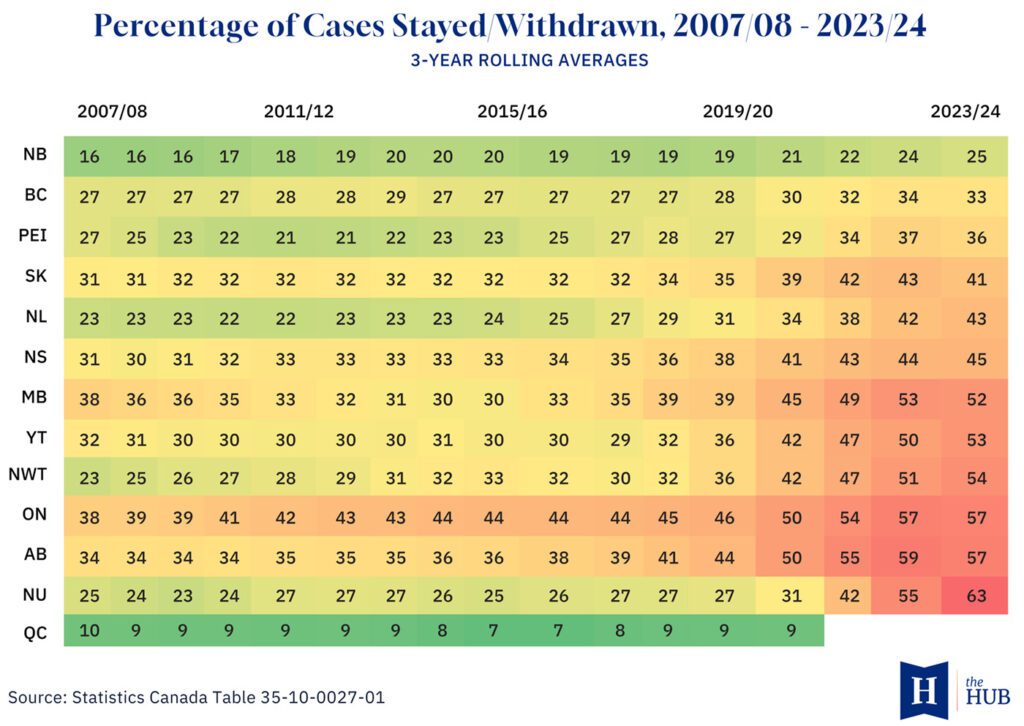
Looking at the heat map of provincial and territorial data, three patterns again stand out. First, outside Quebec, the rise in stayed and withdrawn cases is universal. Every other province and territory experienced substantial increases, to the extent that stayed and withdrawn cases now account for more than half of all criminal cases in three provinces and all three territories.
Second, as the Supreme Court itself recently noted, the COVID-19 pandemic clearly had an effect. There have been sharp increases after 2019/20 in provinces large and small, with Ontario’s rate rising from 46 to 57 percent and Newfoundland and Labrador’s from 31 to 43 percent in just four years. The largest proportional increases occurred in the territories, with nearly two-thirds of cases in Nunavut now stayed or withdrawn.
Third, Quebec stands apart. Throughout the period for which data were available, the province’s stayed/withdrawn rate remained between 7 and 10 percent, roughly a quarter of that recorded in the rest of Canada. Given the exclusion of municipal court data and Quebec’s unusually high acquittal rates, this confirms that comparisons of Quebec’s case outcome data to other jurisdictions should be approached with considerable caution (as Statistics Canada itself recommends.)
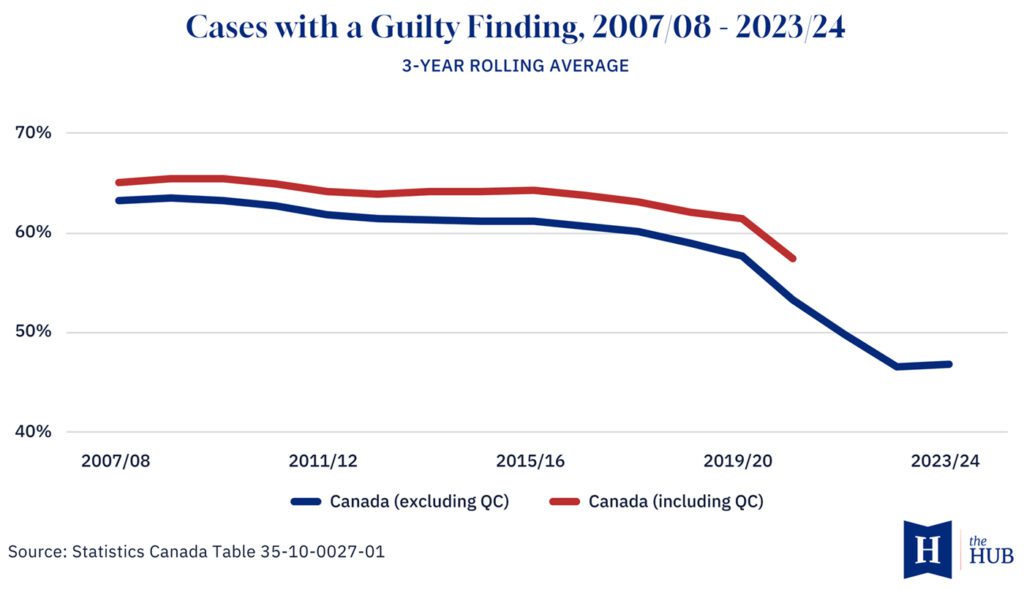
The increase in stayed or withdrawn cases has had a predictable knock-on effect: fewer of those accused of crimes are being found guilty. Statistics Canada uses a broad definition of cases with a “guilty” finding, which includes guilty pleas and cases in which the accused receives an absolute or conditional discharge. Even by this definition, the rolling proportion of criminal cases resulting in guilty findings outside Quebec fell from approximately 63 percent in 2007/08 to just 46 percent in 2023/24 (Quebec’s rate remained steady between 73 and 77 percent between 2007/08 and 2020/21).
Although substantial regional variation persists—from 34 percent in Nunavut to 71 percent in New Brunswick—the overall trend was remarkably consistent. And, as with stays and withdrawals, the problem is especially pronounced for violent crime: the rolling average of violent crime cases without a guilty finding dropped to 39 percent in 2023/24, the first time it fell below 40 percent.
In isolation, a decline in guilty findings is not inherently troubling. Yet the data suggest that this decline has been driven less by actual acquittals—which have consistently accounted for only 1 to 3 percent of completed cases outside Quebec—than by the growing number of cases that never reach a determination of guilt or innocence. Above all, one fact stands out: criminal cases are now more likely to end in a stay, withdrawal, dismissal, or diversion than in a determination of guilt or innocence.
Who is responsible? The Supreme Court and trial delay
Who—or what—is responsible for these trends? For many critics, the Supreme Court’s 2016 Jordan decision regarding the Charter right “to be tried within a reasonable time” is the main culprit. After decades of attempting to draw the line between acceptable and unacceptable delay, in 2016 a majority of the court established “presumptive ceilings” of 18 months for provincial court cases and 30 months for superior court cases.
Once these ceilings have been reached, proceedings must generally be stayed unless there are exceptional circumstances. Lamenting a “culture of complacency towards delay that has pervaded the criminal justice system,” the majority hoped its decision would spur governments and other actors within the criminal justice system to undertake “broader structural and procedural changes.”
In the years since, Jordan has become the focal point of debates over trial delay, with particular criticism that the one-size-fits-all approach does not account for growing court congestion and regional variation. These concerns resurfaced in the Supreme Court’s May 2026 decision in Vrbanic. Although all nine judges in Vrbanic agreed that the complex facts of the case justified an exception to the Jordan limits, eight of the court’s nine justices reaffirmed the broader Jordan framework while one called for greater flexibility.
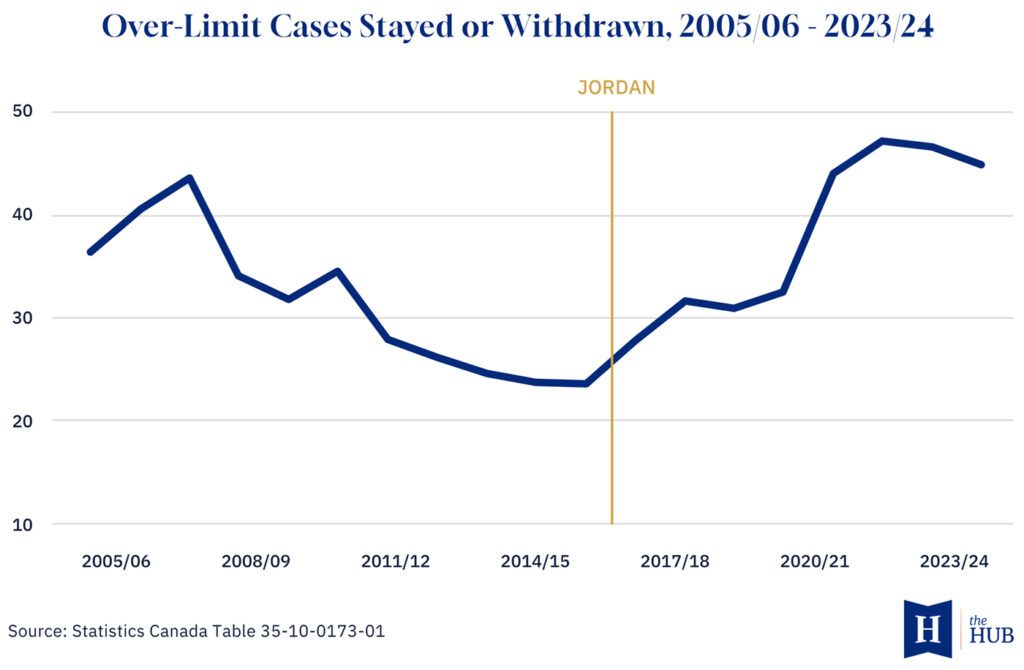
Interestingly, the judges in Vrbanic cited two Statistics Canada metrics that track indicators related to Jordan: the proportion of all adult criminal cases that exceed the Jordan ceilings and the proportion of those over-ceiling cases that end in stays or withdrawals. The charts below illustrate both trends dating back to 2005/06, a decade before Jordan. For consistency with the data cited by the Court in Vrbanic, these charts use annual figures rather than rolling averages (Quebec data are again unavailable for the three most recent years).
The charts clearly show that the pandemic contributed both to an increase in cases exceeding the Jordan ceilings and to an increase in stays and withdrawals among those cases. Yet they also show that the latter trend was already well underway before the pandemic.
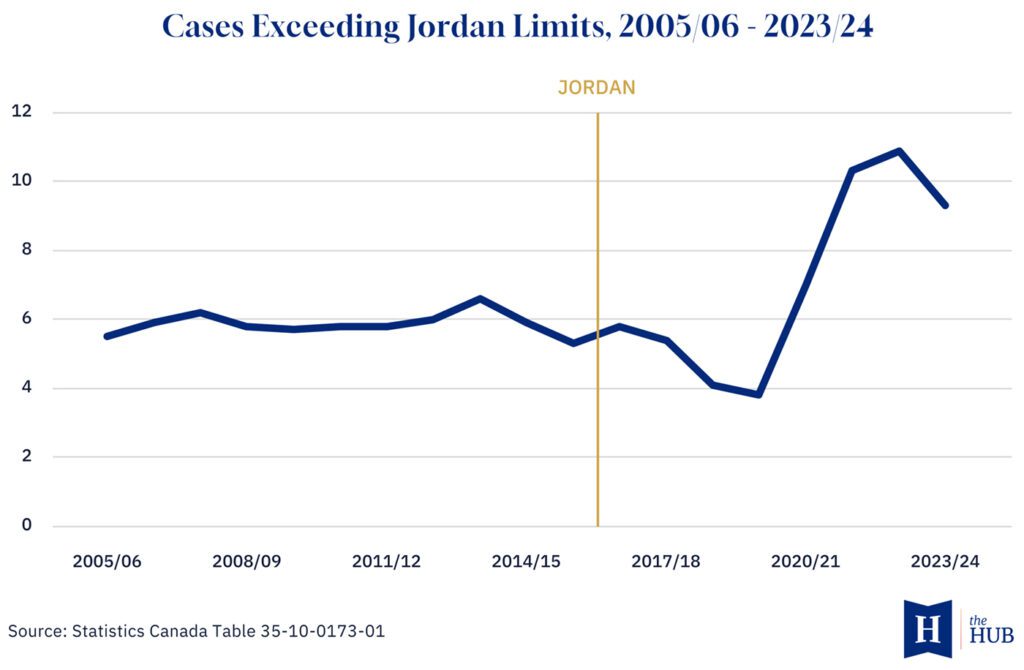
In Vrbanic, the judges cited this data, albeit in different ways. Chief Justice Richard Wagner, writing for eight of the court’s nine judges, recognized that more cases now exceeded the Jordan ceilings (the first figure). However, he rejected the Crown’s attempt to blame these trends on Jordan itself. The chief justice emphasized that the proportion of cases exceeding the ceilings “decreased in each full year of reporting after Jordan was released,” then “spiked to previously unseen levels during the height of the COVID-19 pandemic,” after which there was a (modest one-year) “decrease in the proportion of cases exceeding the ceilings.” For eight of the court’s nine judges, the post-pandemic rise in delay reflected broader pressures on the justice system, not a failure of Jordan itself.
Justice Malcolm Rowe, in a separate opinion, agreed with the majority on the case outcome but little else. Arguing that “Jordan has not kept up with the contemporary realities of criminal prosecutions,” he warned that “a significant proportion of serious charges are now being stayed.” Citing Statistics Canada data from both figures above, Justice Rowe held that “the pandemic may explain the increase in the proportion of cases that exceed the presumptive ceiling [the first chart], but it does not fully explain the increase in the proportion of stays [the second chart].” He argued that the court should modify its Jordan framework to permit judges “residual discretion” to avoid stays in serious cases where the circumstances justify doing so.
On balance, the data lend greater support to Justice Rowe’s concerns than to the majority’s reassurances. The pandemic undoubtedly placed enormous strain on criminal courts, but it cannot fully explain the growth of stays and withdrawals after Jordan, as the second chart shows.
In 2015/16, less than 24 percent of cases that exceeded what would become the Jordan ceilings ended in stays or withdrawals. That number had risen to 32 percent before the pandemic (including Quebec), and now stands at 45 percent (with Quebec data absent, likely resulting in a modest national overestimate).
Criminal cases are taking much longer today than when Jordan was decided, and an increasing proportion end in stays, withdrawals, or dismissals. These are not the hallmarks of a system that has undergone the “broader structural and procedural changes” envisioned by the court in 2016. Jordan was intended as a treatment for trial delay, but the evidence suggests it has allowed the disease to spread.
The price of delay
This DeepDive has documented another dimension of strain within Canada’s criminal justice system: criminal courts are struggling to perform their most basic function of delivering timely justice. Criminal cases now take much longer to resolve than they did five years ago, and the result is a growing number of cases that never reach a determination of guilt or innocence. We have arrived at the remarkable reality that criminal cases are now more likely to end in stays, withdrawals, dismissals, or diversions than in findings of guilt. The disparity is even more pronounced for violent crime, with 58 percent of cases resulting in a stay/withdrawal compared to 39 percent with a finding of guilt. That fact alone should give Canadians pause.
Numerous factors have contributed to this predicament. The COVID-19 pandemic, increasing case complexity, shifting prosecutorial practices, an underfunded justice system, and the Supreme Court’s own jurisprudence have all likely played a role. Reasonable people can disagree about the relative importance of these factors. But no one can deny that they point in a troubling direction.
Viewed alongside rising violent crime and declining police clearance rates, the data presented here once again point to a criminal justice system in crisis. More violence is occurring. Fewer crimes are being solved. And, increasingly, criminal cases are ending without findings of guilt or innocence, increasing the risk that crime—especially violent crime—is going unpunished.
Canadians rightly hold their courts in high regard. We expect judges to apply the law fairly, protect individual rights, and resolve disputes in a timely fashion. Yet even the most respected institutions cannot compensate for a broader justice system that is no longer operating as intended. Canadians have every right to expect a justice system that resolves criminal cases fairly, efficiently, and with finality. Increasingly, that is not the system they have.