By Heather Exner-Pirot
June 2, 2026
Commodity supercycles are often described as simple stories of supply and demand. In reality, they are much larger historical phenomena. They emerge when technological systems, geopolitical structures, and industrial organization change, reorganizing the world’s demand for physical resources faster than supply systems can adapt.
The world now appears to be entering a new cycle shaped by all three at once. While previous cycles have often been defined by globalization and expansion, this one is likely to be characterized by fragmentation, security concerns, and the rediscovery of physical constraints.
For a resource-rich country like Canada, that shift may prove unusually consequential. More than any cycle in the past century, Canada has an opportunity to generate not only wealth but influence in the coming decade. Few nations have that privilege; Canada should not waive it.
Commodity cycles in modern times
Commodities are the foundational physical resources – energy, minerals, and agricultural products – that industrial economies depend on for production, infrastructure, transportation, and security.
Commodity prices and availability ebb and wane across cycles that typically last about a generation each. Commodity cycles are longer than normal business cycles, which tend to last only 5–7 years, because they are driven by long-term structural changes rather than short-term inventory fluctuations. The relatively slow supply response for commodities owes to the need to explore for new deposits, attract substantial capital, obtain regulatory approvals, and build new mines, railroads, pipelines, and ports before sufficient supply can return to the market. Cycles are characterized by booms, or investment phases, with high prices, followed by busts, or exploitation phases, with low prices.
Since the beginning of the 20th century, there have been four commodity cycles, characterized respectively by: 1) industrialization and empire (1899–1933); 2) reconstruction and mass consumption (1933–1961); 3) energy scarcity and monetary disorder (1962–1995); and (4) hyper-globalization and the rise of China (1996–2014) (see Table 1).
We are now entering the fifth, defined not by expansion but by breakdown; not by abundance, but by scarcity. I call it the Rupture Cycle, in a nod to Canadian Prime Minister Mark Carney’s 2026 speech at the World Economic Forum in Davos, in which he declared a rupture in the world order.
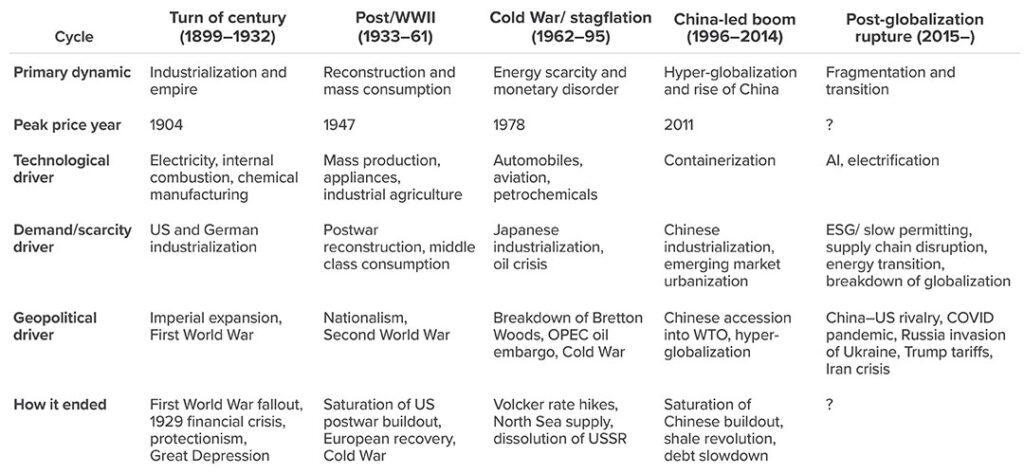
Past commodity cycles and their features
Industrialization and Empire (1899–1932)
The first modern commodity supercycle emerged in the last stages of the age of empire. While Great Britain had earlier hastened the Industrial Revolution, driven by coal, steel and the steam engine, the turn of the 20th century saw the phenomenon go global. Rising powers such as the United States and Germany industrialized rapidly, putting pressure on supply.
As electrification, railways, steel, internal combustion engines, and industrial chemistry transformed economies and gave rise to urbanization, commodities became instruments of national power. Industrial economies required vast quantities of coal, iron ore, copper, rubber, oil, and agricultural products. Competition for colonies, shipping routes, and resource access intensified, particularly among European powers. Industrialization and geopolitics fused together.
This cycle culminated in First World War, the first truly industrialized war. The conflict massively accelerated demand for steel, fuel, chemicals, and industrial production, but it also destabilized the global financial and imperial order. The cycle eventually collapsed under the weight of war debts, protectionism, and financial instability. The stock market crash of October 1929 triggered the Great Depression and demand for raw materials collapsed.
Reconstruction and mass consumption (1933–1961)
The next cycle emerged from the demands of the Second World War and its aftermath. With the buildup towards and outbreak of war, a massive industrial diversion to military production took place, followed by global shipping disruptions. Steel, iron, and tin were heavily prioritized for weapons, tires and gasoline were diverted to military use, and silk, nylon, wool, and cotton were diverted for parachutes, tents, and uniforms. Rationing of sugar, butter, coffee, meat, and processed foods was also commonplace.
Following allied victory, wartime industrial mobilization gave way to postwar reconstruction, prompting the expansion of the middle class, suburban housing, consumer appliances, personal automobiles, highways, and the mass production of goods.
The United States sat at the centre of the postwar order with unmatched industrial dominance; cheap oil and abundant domestic resources underpinned its growth. This was further supported by the Bretton Woods system, an international monetary regime created in July 1944 by 44 nations that pegged currencies to the US dollar, which in turn was backed by gold. It was explicitly designed to facilitate international trade, including raw materials and goods, by providing a stable and predictable financial environment and a framework of fixed exchange rates.
The cycle ended not through crisis but through maturation. By the early 1960s the US had largely industrialized and Europe and Japan had recovered economically; demand and supply became more closely balanced.
Energy scarcity and monetary disorder (1962–1995)
The third cycle was driven not by new industrialization, but by the maturation, and then exposure, of the hydrocarbon industrial economy.
By the 1960s and 1970s, advanced economies had become deeply dependent on automobiles, aviation, petrochemicals, mechanized agriculture, electricity, and cheap oil. At the same time, the Cold War had intensified and the United States was running massive deficits to fund the Vietnam War.
By 1971, US gold reserves were far lower than the foreign-held dollar supply. On August 15 of that year, President Richard Nixon announced a temporary suspension of the dollar’s convertibility into gold and introduced a 10 per cent tariff to stop the run on the US gold reserve. Eventually the US could not maintain the dollar’s fixed link to gold, and the Bretton Woods system collapsed.
This was an appetizer to the main course of the 1973 oil crisis, caused by an oil embargo launched by the Organization of Arab Petroleum Exporting Countries (OAPEC) against the United States and other nations that supported Israel during the Yom Kippur War. Oil prices quadrupled, pushing the global economy into a long period of stagflation bookended by a second oil shock triggered by the Iranian Revolution in 1979.
Unlike earlier cycles, this one was driven as much by scarcity and monetary instability as by demand growth. Commodities became inflation hedges and strategic geopolitical assets.
The cycle eventually ended through a combination of new oil supply from Alaska and the North Sea, and the “Volcker Shock,” an aggressive monetary policy shift led by Federal Reserve Chairman Paul Volcker starting in October 1979 that targeted the growth of the money supply rather than focusing solely on interest rates. It was successful in ending double digit inflation, but also triggered a severe recession in 1981–82.
This reduced demand; the end of the Cold War and dissolution of the Soviet Union unleashed significant new supply. That ushered an era of disinflation, financialization, and globalization.
Hyper-globalization and China (1996–2014)
The China-led supercycle was perhaps the largest commodity demand shock in modern history. Hyper-globalization underpinned its technological and organizational foundation: containerized trade, global supply chains, manufacturing integration, and massive emerging-market urbanization.
China’s accession to the WTO in 2001 transformed the world economy, acting as a catalyst for that nation’s transformation into a global economic powerhouse and a major disruptor of international trade.
Hundreds of millions of people urbanized while the country built highways, ports, airports, housing, steel mills, electricity systems, and industrial infrastructure at extraordinary speed. Demand for iron ore, coal, copper, natural gas, and oil surged. Commodity producers around the world expanded aggressively to meet Chinese demand. The cycle was briefly disrupted by the 2008–09 financial crisis, but soon regained its momentum.
The cycle ended when China’s infrastructure build-out matured and debt-fuelled investment became increasingly unsustainable. The prolonged period of high prices also led to an overinvestment in new supply, much of which came online just as Chinese growth slowed. Finally, the US shale revolution, combining new technologies of hydraulic fracturing and horizontal drilling, unleashed abundant and short cycle sources of hydrocarbons, driving down both global energy prices and inflation.
Key drivers of commodity cycles
Looking across these cycles, several patterns emerge.
First, major commodity cycles are rarely caused by normal economic growth alone. They are usually associated with a structural transformation in the world economy, either through industrialization, reconstruction, energy-system change, globalization, or technological reorganization (technological drivers).
Second, commodity cycles tend to emerge when physical infrastructure must expand rapidly, often owing to demographic or societal shifts. Railways, highways, suburbs, electrification, urbanization, and data infrastructure all require enormous quantities of steel, copper, cement, fuel, electricity, and construction materials (demand/supply drivers).
Third, geopolitics matters enormously. Wars, sanctions, trade disruptions, monetary disorder, and great-power rivalry repeatedly reshape commodity markets by changing the strategic value of energy and resources (geopolitical drivers).
Finally, supply systems tend to lag structural shifts. Commodity industries require long investment horizons, efficient permitting, infrastructure, skilled labour, and effective governance. When capital underinvests in physical systems during periods of technological or financial enthusiasm, shortages eventually emerge. Structural bull-and-bear markets cannot be resolved quickly.
The characteristics of the new “Rupture Cycle”
The emerging cycle differs from most previous ones because it is being driven not only by increased demand, but by fragmentation and constraint.
Expansion and demand
Like all commodity cycles, the Rupture Cycle involves a transformative new demand driver: AI (artificial intelligence), data centres and the electricity infrastructure that powers it.
Data centres are currently the biggest driver of investment in the world, having captured more than one-fifth of global greenfield investment (i.e., all new physical investment projects starting from scratch, across all economic sectors) in 2025. Unlike the tech boom of the late 1990s and early 2000s, which was largely digital and software-driven, the AI build-out is deeply dependent on physical infrastructure, energy, and raw materials.
The last decade, which was a commodity downswing phase, saw the rise of the “Magnificent Seven”: high-performing US tech companies Alphabet, Amazon, Apple, Meta, Microsoft, Nvidia, and Tesla, which have dominated market returns. These are the best capitalized companies in the world, and they have made commitments for capital expenditures of $680 billion in 2026 alone, mostly for AI infrastructure.
This is already causing electricity prices to rise at levels that are uncomfortable for consumers, utilities, and governments. But the electricity problem has far deeper challenges than powering data centres.
A huge build-out of the grid in North America and Europe occurred, first, in the postwar boom, driven by coal generation and hydroelectricity; and second, in the aftermath of the 1970s oil crises, driven by nuclear. Much of this infrastructure is now at the end of its lifespan and needs refurbishment or replacement.
Electricity consumption in the West plateaued after 2000, due to the offshoring of energy-intense heavy industry to China during the China-led boom; and efficiency gains in appliances, lighting, and industrial motors. There was limited incentive or pressure to develop more power, and in fact electricity generation per capita declined in many places as coal was phased out.
The AI boom is coming at the same time as existing infrastructure is aging, hotter temperatures are driving more use of air conditioning, and climate policy is driving electrification of transportation and heating. But now low-cost renewables, which have absorbed most of the recent increase in demand, have largely saturated the system.
In the early stages of the return of electricity demand growth (2021–22), adding renewables was relatively straightforward: grids already had abundant firm power from coal, gas, hydro, and nuclear; electricity demand growth was reasonable; and wind and solar could simply plug into existing systems and reduce fuel consumption.
But as renewable penetration rises, the challenge changes. The issue is no longer simply generating electricity, but maintaining reliability and stability in increasingly electrified economies.
In addition, the best wind and solar sites were developed first, meaning later projects are farther from demand centres, harder to connect, more transmission-intensive, and less economically attractive.
The next, more demanding, phase of electricity growth will require larger investments in firm power, storage, transmission, substations and grid modernization. These inherently have longer lead times, larger upfront capital costs, skilled labour needs, and more burdensome permitting requirements.
Most importantly, they are material intensive. We will need vastly more copper, aluminum, uranium, natural gas, steel, cement, transformers, and grid equipment to meet the coming surge in electricity demand. And because AI is not only important for the economy but for security, governments will be incentivized to financially stimulate electricity growth. In particular, the US cannot allow China to win the AI race, China cannot allow the US to win the AI race, and middle powers cannot allow AI capacity to be concentrated in the US and China. The AI build-out will not only resemble past technology-driven demand booms; it will resemble an arms race as well.
Fragmentation
While most commodity cycles are triggered by a black swan event, the Rupture Cycle has produced a flock of them: the COVID-19 pandemic; the Russian invasion of Ukraine; Trump’s widespread application of tariffs, and the closing of the Strait of Hormuz in Iran.
Each one of these events severely disrupted global trade; in combination they have ruptured it, creating a post-globalization era.
The policy consequence is that nations are now seeking to bolster and insulate their supply chains from future disruption. Following two decades in which the cheapest producer won out, this commodity cycle is seeing a security premium applied to raw materials. Governments are prioritizing the production of goods domestically, production by dependable allies and partners, and production nearer by.
Stunningly, there are now four regions/states with whom trade seems unreliable and/or coercive, and for which alternatives are being sought: China, Russia, the US and the Middle East.
This is an enormous portion of the global economy and of raw materials. As such, the upswing in this commodity cycle is not just about meeting growing demand, but about replacing current supply. Market share for raw materials is likely to shift meaningfully from the last cycle, with Canada, Australia, South America, and Africa looking more attractive for importers.
Constraint
Commodity cycles reflect the time it takes to balance supply and demand. There are reasons to believe meaningful growth in supply will be harder to achieve in this cycle than in previous ones.
The first is that the past two decades have seen a spectrum of policy restraints applied to resource extraction. Owing to both legitimate concerns about environmental and social impacts of resource development; and subjective distaste for mining, drilling, and farming from an increasingly white collar and urbanized population divorced from the production of goods; social acceptance of resource extraction declined and regulatory and permitting processes became far more onerous.
This was not restricted to political processes in the West, although it was concentrated there. Environmental-, social-, and governance-based lending (ESG), investment, and disclosure frameworks increasingly shaped capital allocation decisions globally, contributing to reduced investment in resource extraction and long-cycle commodity development. One reason why China was able to monopolize some mineral production and processing is that private Western capital barely flowed into the sector.
The consequence is that there has been structural underinvestment in oil and gas, mining, non-renewable electricity production, and infrastructure for over a decade, especially in the high-income, developed economies of the OECD – who ironically are now scrambling to secure more OECD sources of supply.
Compounding non-economic restrictions of capital is the fact that oil, gas and minerals are non-renewable and finite in the earth’s crust. After 200 years of industrialization, the cheapest and easiest deposits to exploit have been discovered and exploited. The China-led boom benefited from highly sophisticated geological, engineering, and financial expertise in the resource sector, and exhausted many of the last best discoveries. New ones tend to be lower grade, deeper, more remote, more politically complex, and more capital-intensive. That means they require higher prices to move into production.
To illustrate, major copper discoveries have declined dramatically since the 1990s and early 2000s, with recent annual discovery volumes often only a fraction – in some years roughly one-tenth – of peak levels. And while annual conventional oil discovered volumes averaged more than 20 billion barrels of oil equivalent (boe) per year in the early 2010s, between 2023–25 they averaged only 5.5 billion boe. Global oil discoveries are significantly lagging consumption.
Substitution with alternative materials and recycling of scrap will help close the gap. And it is likely some new technology will emerge that unleashes significant and affordable new mineral and energy supplies. In many ways, it was the US shale revolution – the combination of the innovations of hydraulic fracturing and horizontal drilling – that ended the China-led cycle after oil supply rose and prices fell dramatically by summer 2014.
But that story has an epilogue. The shale revolution was partly responsible for the prolonged downswing phase of the current commodity cycle by introducing large volumes of relatively flexible new oil supply and easing fears of long-term energy scarcity. However, the era of rapid US shale production growth now appears to be ending, with many analysts expecting production to plateau compared to the explosive expansion of the 2010s. Some forecasts, including projections from the US Energy Information Administration itself, suggest US oil production may have reached a near-term peak or plateau, as the most productive shale acreage has been depleted. Other major OECD producers are also facing mature basin dynamics, with Mexico’s oil production in long-term decline and Norway nearing the limits of sustained production growth from its legacy fields.
The world does not just need more oil in this cycle to meet expected population and demand growth to 2050 and beyond; it must also replace production losses from legacy contributors, especially those in the West, when energy security is a high priority.
Oil, copper, and other minerals are increasingly short in availability and high in need, not only as a result of geopolitical disruption, but from structural demand growth for electricity and structural supply tightness from regulatory burdens and resource depletion. Prices must therefore rise. We are entering a period that will be inflationary and destabilizing.
Canada’s opportunity
As in any commodity cycle upswing phase, countries with abundant energy and mineral resources are regaining leverage. There are dozens of nations with resources in the ground, but few as endowed as Canada. It literally has more than a century’s worth of oil in the Alberta oilsands, natural gas in the Western Canadian sedimentary basin, uranium in the Athabasca basin, potash fertilizer in Saskatchewan, and critical minerals in the Labrador Trough, Sudbury Basin, the Golden Triangle, and across the Canadian Shield. Finally, it has access to global markets through three oceans.
What makes this cycle unique is that the Canadian virtues of political stability and reliability, adherence to the rule of law, and status as a trusted trading partner mean Canadian resources may command a strategic premium.
The Rupture Cycle will reward not simply resource abundance, but the ability to translate it into infrastructure, production, and geopolitical influence. Countries capable of doing so will occupy a much stronger position in the emerging global order than they did during the peak globalization era, when manufacturing scale and low-cost labour mattered the most.
In chaos comes opportunity, but opportunity alone is insufficient. The defining question is still whether Canada can actually build. Permitting delays, infrastructure bottlenecks, regulatory uncertainty, interprovincial fragmentation, and declining productivity remain serious obstacles. To quote the president of the International Energy Agency, Fatih Birol, Canada has a “golden opportunity” but not the “luxury of being slow”: “the cost of missing this train will be incredible.”
In whatever paradigm replaces the current order, Canada is uniquely positioned to enhance its standing. While Canada has a competitive advantage, there will still be competition. Our great geographic and geological fortune has often made us complacent; a geopolitical and economic rupture is no time for Canada to sit back.
This commodity cycle is a chance for our nation to increase its wealth and power. We should not leave it only to undemocratic and coercive actors to accumulate such things.
About the author
Heather Exner-Pirot is a senior fellow and director of Energy, Natural Resources, and Environment at the Macdonald-Laurier Institute. She has twenty years of experience in Indigenous, Arctic, and resource development and governance. She has published on Indigenous economic development, resource politics and policy, energy security, Arctic human security, regional Arctic governance and the Arctic Council, Arctic innovation, First Nations equity, and own source revenues, and more. She obtained a PhD in Political Science from the University of Calgary.
Exner-Pirot sits on the boards of the Saskatchewan Indigenous Economic Development Network and the Canadian Rural Revitalization Foundation, and is a research advisor to the Indigenous Resource Network. She is a network coordinator at the North American and Arctic Defense and Security Network and managing editor of the Arctic Yearbook (an international, peer-reviewed annual volume). She has published over 45 peer-reviewed journal articles, book chapters, and edited volumes, and presented at over 100 conferences and events nationally and internationally, in addition to authoring dozens of op-eds in Canada’s top publications.