Monday, June 1, 2026
No Result
View All Result
  • Media
Macdonald-Laurier Institute
  • Home
  • About
    • Who We Are
    • Who Makes MLI Work
    • Fifteenth Anniversary
  • Experts
    • Experts Directory
    • In Memoriam
  • Issues
    • Domestic Policy
      • Economic Policy
      • Justice
      • Rights and Freedoms
      • Assisted Suicide (MAID)
      • Health Care
      • COVID-19
      • Gender Identity
      • Canada’s Political Tradition
      • AI, Technology and Innovation
      • Media and Telecoms
      • Housing
      • Immigration
      • Agriculture and Agri-Food
      • Competition Policy
    • Energy Policy
      • Energy
      • Environment
    • Foreign Policy
      • Israel-Hamas War
      • Ukraine
      • Taiwan
      • China
      • Europe and Russia
      • Indo-Pacific
      • Middle East and North Africa
      • North America
      • Foreign Interference
      • National Defence
      • National Security
      • Foreign Affairs
    • Indigenous Affairs
  • Projects
    • CNAPS (Center for North American Prosperity and Security)
    • Justice Report Card
    • The Promised Land
    • Voices that Inspire: The Macdonald-Laurier Vancouver Speaker Series
    • Dragon at the door
    • Canada on top of the world
    • Letter to a minister
    • The Great Energy Crisis
    • DisInfoWatch.org
    • Managing Indigenous Prosperity
    • Judicial Foundations
    • Landmark Cases Council
    • Defending The Marketplace of Ideas
    • Reforming the University
    • Digital Policy & Connectivity
    • Past Projects
      • Double Trouble
      • Canada and the Indo-Pacific Initiative
      • The Transatlantic Program
      • COVID Misery Index
        • Provincial COVID Misery Index
        • Beyond Lockdown
        • COVID and after: A mandate for recovery
      • Speak for Ourselves
      • The Eavesdropping Dragon: Huawei
      • Talkin’ in the Free World with Mariam Memarsadeghi
      • An Intellectual Property Strategy for Canada
      • Munk Senior Fellows
      • A Mandate for Canada
      • Confederation Series
      • Fiscal Reform
      • The Canadian Century project
      • Fixing Canadian health care
      • Internal trade
      • From a mandate for change
      • Size of government in Canada
      • Straight Talk
      • Labour Market Report
      • Leading Economic Indicator
      • Centre for Advancing Canada’s Interests Abroad
      • Indigenous Prosperity at a Crossroads
        • Aboriginal Canada and Natural Resources
  • Events
    • Upcoming Events
    • Past Events
      • MLI Dinners
      • Great Canadian Debates
  • Latest News
  • Libraries
    • Columns
    • Commentary
    • Papers
    • Books
    • Video
  • Donate
  • Home
  • About
    • Who We Are
    • Who Makes MLI Work
    • Fifteenth Anniversary
  • Experts
    • Experts Directory
    • In Memoriam
  • Issues
    • Domestic Policy
      • Economic Policy
      • Justice
      • Rights and Freedoms
      • Assisted Suicide (MAID)
      • Health Care
      • COVID-19
      • Gender Identity
      • Canada’s Political Tradition
      • AI, Technology and Innovation
      • Media and Telecoms
      • Housing
      • Immigration
      • Agriculture and Agri-Food
      • Competition Policy
    • Energy Policy
      • Energy
      • Environment
    • Foreign Policy
      • Israel-Hamas War
      • Ukraine
      • Taiwan
      • China
      • Europe and Russia
      • Indo-Pacific
      • Middle East and North Africa
      • North America
      • Foreign Interference
      • National Defence
      • National Security
      • Foreign Affairs
    • Indigenous Affairs
  • Projects
    • CNAPS (Center for North American Prosperity and Security)
    • Justice Report Card
    • The Promised Land
    • Voices that Inspire: The Macdonald-Laurier Vancouver Speaker Series
    • Dragon at the door
    • Canada on top of the world
    • Letter to a minister
    • The Great Energy Crisis
    • DisInfoWatch.org
    • Managing Indigenous Prosperity
    • Judicial Foundations
    • Landmark Cases Council
    • Defending The Marketplace of Ideas
    • Reforming the University
    • Digital Policy & Connectivity
    • Past Projects
      • Double Trouble
      • Canada and the Indo-Pacific Initiative
      • The Transatlantic Program
      • COVID Misery Index
        • Provincial COVID Misery Index
        • Beyond Lockdown
        • COVID and after: A mandate for recovery
      • Speak for Ourselves
      • The Eavesdropping Dragon: Huawei
      • Talkin’ in the Free World with Mariam Memarsadeghi
      • An Intellectual Property Strategy for Canada
      • Munk Senior Fellows
      • A Mandate for Canada
      • Confederation Series
      • Fiscal Reform
      • The Canadian Century project
      • Fixing Canadian health care
      • Internal trade
      • From a mandate for change
      • Size of government in Canada
      • Straight Talk
      • Labour Market Report
      • Leading Economic Indicator
      • Centre for Advancing Canada’s Interests Abroad
      • Indigenous Prosperity at a Crossroads
        • Aboriginal Canada and Natural Resources
  • Events
    • Upcoming Events
    • Past Events
      • MLI Dinners
      • Great Canadian Debates
  • Latest News
  • Libraries
    • Columns
    • Commentary
    • Papers
    • Books
    • Video
  • Donate
No Result
View All Result
Macdonald-Laurier Institute

The Carney government just made a costly mistake purchasing Swedish aircraft: Richard Shimooka in The Hub

The move will sour relations with the Americans even further.

June 1, 2026
in Columns, Foreign Policy, Latest News, National Defence, In the Media, Richard Shimooka
Reading Time: 5 mins read
A A
The Carney government just made a costly mistake purchasing Swedish aircraft: Richard Shimooka in The Hub

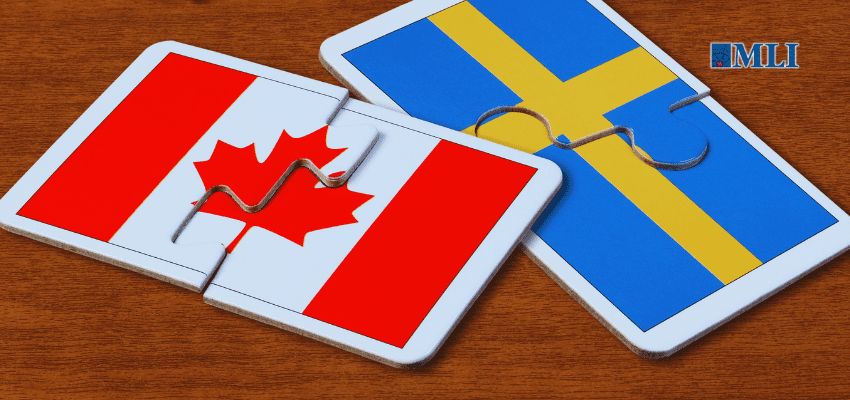
Image via Canva.

This article originally appeared in The Hub.

By Richard Shimooka, June 1, 2026

The prime minister’s surprise announcement that Canada will enter into negotiations to procure Sweden’s GlobalEye airborne early warning (AEW) aircraft from Saab and Bombardier seems like good politics. The move is consistent with his favoured lines that Canada needs to wean itself off American systems and provide a more independent defence of the country. Yet doing so is much more difficult than it appears at first glance, and would leave the country much weaker as a result. Overall, this purchase is sure to increase tensions with the United States.

To fully appreciate how short-sighted this move is, it’s first important to understand how continental defence operates, specifically NORAD. NORAD’s mission is to “Deter, Detect, Deny, Defeat” any threat to North American aero- and airspace, and requires “domain awareness”—being able to detect, track, assess, and anticipate activities that could affect security or military operations.

While much of the focus has been on the visible enablers—the fighter-interceptors and anti-ballistic missiles—required to carry out this mission, command and control has been the central feature of NORAD’s existence. Back in the 1950s, the U.S. developed the Semi-Automatic Ground Environment (SAGE), a groundbreaking project that linked together radars, air defence sites, and fighters on a single network—effectively the first such system ever developed. SAGE helped set the stage for our modern internet and is the core element for how Canada and the U.S. collaborate on continental defence.

The secret sauce is how those systems integrate a vast amount of data from sensors and other data sources. This includes highly sensitive intelligence data that is collected and operationalized by the United States’ vast intelligence-gathering apparatus.

Given the unprecedented increase in strategic nuclear systems being developed and fielded by the People’s Republic of China and the Russian Federation, investment in these defensive systems is absolutely necessary to provide security for North America.

The signals intelligence component of the U.S. military’s budget alone likely exceeds Canada’s entire defence budget, to speak nothing of the command and control networks, sensors, fighters, missile defence systems, or missiles that are essential parts of continental defence today.

In this context, the suggestion that Canada can “do it alone” in its Arctic defence is just utterly preposterous, given the scale of the threats facing the continent and the lack of resources Ottawa can bring to bear.

Canada’s ability to access U.S. data is unique. In practical terms, it means selected RCAF systems that operate in NORAD obtain cutting-edge U.S. data that can allow them to detect targets farther, or more accurately, as well as improve the precision of missiles and other defences. Due to its sensitivity, integration of systems is highly controlled, even within the U.S.

Within NORAD, AEW aircraft have played an important role. They are employed to extend vision beyond static terrestrial sensor sites, fill in gaps, and provide capabilities within Canadian territory. They also provide “air battle management,” which is localized command and control for aircraft.

In the late 2010s, it became increasingly apparent to the U.S. that the threat environment was worsening, and Canada, which had stalled its own military modernization efforts, was too reliant on U.S. NORAD capabilities. This was problematic as AEW aircraft are a scarce resource, and would be needed for other contingencies, like a major conflict in the Western Pacific or Eastern Europe. The Pentagon pushed Canada to acquire more of its own capabilities for NORAD to provide a more equitable burden: not just airborne early warning but ground radars and aerial refuelling aircraft.

Given the need for close integration with the U.S., it was assumed that the E-7 Wedgetail, a Boeing-Northrop Grumman system being procured by the USAF, and already in use with Australia and the U.K., would have the inside track to fill this capabilities gap. Failing that, a competing system developed by American contractor L3 Harris and Bombardier, picked by South Korea for their own AEW requirements, was seen as another plausible alternative.

Which brings us back to this week’s announcement, in which Canada chose neither of these options. GlobalEye was always seen as an unlikely candidate because it was never designed to be integrated into NORAD systems and lacks the security features that all other systems possess. Furthermore, it has significant capability deficiencies, like the lack of a 360-degree radar aperture, which is fairly critical for the RCAF operating in the north. It will also cost hundreds of millions in development costs, before even buying the aircraft.

All of this was tacitly acknowledged by Stephen Fuhr, Canada’s secretary of state for defence procurement, disclosing that Saab would need to develop a new radar and other mission systems to bring it up to a baseline level of capability.

However, more critically, without American clearance to provide specific communications gear, as well as ongoing cryptological support, GlobalEye will be unable to connect to NORAD command and control networks, making it essentially worthless in its stated role for northern defence.

This may lead to a significant impasse, especially given that the U.S. has asked Ottawa to provide a credible plan to quickly modernize NORAD, and its failure to do so yet was a reason recently cited by Elbridge Colby, the U.S. under secretary of war for policy, to suspend the Permanent Joint Board of Defence.

Another issue: the development of an entirely new radar capability for the GlobalEye aircraft, one that can be integrated into NORAD, will likely take at least a decade, if it happens at all.

Developing this system will only happen at a significant cost as well, which, given the wide range required, could pull much-needed resources away from other priorities. Part of the justification offered by the government is that the system would have great export opportunities.

However, the integration of sensitive American systems would render the GlobalEye subject to a set of U.S. regulations called International Traffic in Arms Regulations, which allows the U.S. a veto on their export. Given that the system would directly compete with the E-7, it’s quite likely that its potential market opportunities are limited, as the U.S. would limit its export options.

Perhaps the government believes it can use the promise to continue F-35 purchases as leverage to obtain U.S. support for the GlobalEye purchase. This would be a deeply foolish assumption—at no point is the Department of War likely to compromise on their own operational security, nor support a policy that would deliver less capability at a later date than their own program.

The GlobalEye decision was clearly made to cater to the particular political moment Canada is in, and facing an acrimonious relationship with the Trump administration. Yet Ottawa can ill afford, both politically and fiscally, to make decisions like this based on weak policy foundations. This decision has the potential to further sour bilateral relations, all while squandering precious fiscal resources for the much-needed modernization of the Canadian Armed Forces.


Richard Shimooka is a Hub contributing writer and a senior fellow at the Macdonald-Laurier Institute who writes on defence policy.
Source: The Hub

Related Posts

B.C. Aboriginal title chaos the predictable result of NDP virtue-signalling: Karen Restoule in the National Post
Indigenous Affairs

B.C. Aboriginal title chaos the predictable result of NDP virtue-signalling: Karen Restoule in the National Post

June 1, 2026
Pratas Island is Beijing’s next pressure point and Washington’s next test: Joe Varner in the National Review
Taiwan

Pratas Island is Beijing’s next pressure point and Washington’s next test: Joe Varner in the National Review

June 1, 2026
Rising government debt will hit Canada, too: Jack Mintz in the Financial Post
Economic Policy

Rising government debt will hit Canada, too: Jack Mintz in the Financial Post

May 29, 2026

Newsletter Signup

  Thank you for Signing Up
  Please correct the marked field(s) below.
Email Address  *
1,true,6,Contact Email,2
First Name *
1,true,1,First Name,2
Last Name *
1,true,1,Last Name,2
*
*Required Fields

Follow us on

Macdonald-Laurier Institute

323 Chapel Street, Suite #300
Ottawa, Ontario, K1N 7Z2 Canada

613.482.8327

info@macdonaldlaurier.ca
MLI directory

Support Us

Support the Macdonald-Laurier Institute to help ensure that Canada is one of the best governed countries in the world. Click below to learn more or become a sponsor.

Support Us

  • Inside Policy Magazine
  • Annual Reports
  • Jobs
  • Privacy Policy

© 2023 Macdonald-Laurier Institute. All Rights reserved.

No Result
View All Result
  • Home
  • About
    • Who We Are
    • Who Makes MLI Work
    • Fifteenth Anniversary
  • Experts
    • Experts Directory
    • In Memoriam
  • Issues
    • Domestic Policy
      • Economic Policy
      • Justice
      • Rights and Freedoms
      • Assisted Suicide (MAID)
      • Health Care
      • COVID-19
      • Gender Identity
      • Canada’s Political Tradition
      • AI, Technology and Innovation
      • Media and Telecoms
      • Housing
      • Immigration
      • Agriculture and Agri-Food
      • Competition Policy
    • Energy Policy
      • Energy
      • Environment
    • Foreign Policy
      • Israel-Hamas War
      • Ukraine
      • Taiwan
      • China
      • Europe and Russia
      • Indo-Pacific
      • Middle East and North Africa
      • North America
      • Foreign Interference
      • National Defence
      • National Security
      • Foreign Affairs
    • Indigenous Affairs
  • Projects
    • CNAPS (Center for North American Prosperity and Security)
    • Justice Report Card
    • The Promised Land
    • Voices that Inspire: The Macdonald-Laurier Vancouver Speaker Series
    • Dragon at the door
    • Canada on top of the world
    • Letter to a minister
    • The Great Energy Crisis
    • DisInfoWatch.org
    • Managing Indigenous Prosperity
    • Judicial Foundations
    • Landmark Cases Council
    • Defending The Marketplace of Ideas
    • Reforming the University
    • Digital Policy & Connectivity
    • Past Projects
      • Double Trouble
      • Canada and the Indo-Pacific Initiative
      • The Transatlantic Program
      • COVID Misery Index
      • Speak for Ourselves
      • The Eavesdropping Dragon: Huawei
      • Talkin’ in the Free World with Mariam Memarsadeghi
      • An Intellectual Property Strategy for Canada
      • Munk Senior Fellows
      • A Mandate for Canada
      • Confederation Series
      • Fiscal Reform
      • The Canadian Century project
      • Fixing Canadian health care
      • Internal trade
      • From a mandate for change
      • Size of government in Canada
      • Straight Talk
      • Labour Market Report
      • Leading Economic Indicator
      • Centre for Advancing Canada’s Interests Abroad
      • Indigenous Prosperity at a Crossroads
  • Events
    • Upcoming Events
    • Past Events
      • MLI Dinners
      • Great Canadian Debates
  • Latest News
  • Libraries
    • Columns
    • Commentary
    • Papers
    • Books
    • Video
  • Donate

© 2023 Macdonald-Laurier Institute. All Rights reserved.