
By Dave Snow
May 26, 2026
Section 7 of the Canadian Charter of Rights and Freedoms began as something modest: a procedural protection meant to ensure that when the state interferes with “life, liberty, and security of the person,” it does so in accordance with the “principles of fundamental justice.” It was not, at least on paper, designed to place courts at the centre of sweeping policy disputes.
That understanding has not survived intact. Over the past four decades, the Supreme Court of Canada has steadily transformed section 7 into one of the Charter’s most powerful engines of constitutional change. It has been used to strike down or reshape major areas of public policy, including abortion, prostitution, assisted dying, and supervised drug consumption (R. v. Morgentaler 1988; PHS Community Services 2011; Canada v. Bedford 2013; Carter v. Canada 2015).
More recently, lower courts have extended section 7 even further, issuing rulings that prevented governments from closing encampments, banning public drug use, and removing bike lanes (Harm Reduction Nurses Association v. British Columbia 2023; The Regional Municipality of Waterloo v. Persons Unknown and to be Ascertained 2023; Cycle Toronto v. Attorney General of Ontario 2025).
Section 7 has unquestionably become the most important right in the Charter.
Although there is growing scholarly and media attention to the expanding reach of section 7 (Fehr 2018; Stewart 2019; Hopper 2025; The Globe and Mail 2025), there has not yet been a data-driven analysis of how the Supreme Court has actually interpreted and applied the provision over time. This commentary fills the gap. It draws on an original dataset covering every Supreme Court decision between 1984 and 2025, offering a quantitative analysis of section 7 jurisprudence and its evolution over four decades.
The findings point to three clear conclusions. First, since the Court’s early shift toward a substantive interpretation of section 7 in Re B.C. Motor Vehicle Act (1985), the concept of the “principles of fundamental justice” has become increasingly amorphous. Rather than coalescing around a stable test, the Court has developed a sprawling set of more than 20 principles. The result is a doctrinal framework that is difficult to predict and even harder to define with precision. The data confirm former Supreme Court Justice Russell Brown’s description of section 7 jurisprudence as “the product of 40 years of accumulated judicial ad hoc-ery” (R. v. J.J. 2022, para. 213).
Second, the data confirm that the Charter’s familiar two-step framework – first identifying a rights infringement, then asking whether it can be justified as a “reasonable limit” – does little real work in section 7 cases. In practice, section 1 is often bypassed entirely or applied superficially. When the Court does engage with reasonable limits on the right to life, liberty, and security of the person, the outcome is predetermined by the Court’s analysis of the principles of fundamental justice.
Third, this combination of doctrinal fluidity and the collapse of section 1 has substantially expanded the scope of judicial intervention. By defining “fundamental justice” in broad and flexible terms, the Court has enabled section 7 to reach an ever-widening range of policy domains. The result is an expanded judicial role in constitutionalizing and resolving disputes that are intensely political and policy-laden.
The implications are difficult to ignore: the most important right in the Charter operates without clear limits. This creates uncertainty for legislatures and litigants, expands the role of courts in major policy questions, and increases the temptation for judges to substitute their policy preferences under the guise of legal reasoning.
What section 7 was meant to do – and what it became
Section 7 guarantees that “Everyone has the right to life, liberty, and security of the person and the right not to be deprived thereof except in accordance with the principles of fundamental justice.” Beyond those words, there are no subsections and no detailed definitions.
Like all rights in the Charter, section 7 is subject to section 1, which allows governments to impose “reasonable limits” that “can be demonstrably justified in a free and democratic society.” This structure has led scholars such as Knopff and Morton (1992) to describe Charter adjudication as the “Charter two-step”: first, a court must determine whether a right has been infringed (or “breached”); second, if it finds an infringement, the court must determine if it is a reasonable limit – normally by using the “Oakes test” (R. v. Oakes 1986).
However, for many rights in the Charter, the “two-step” is not so simple, because the rights themselves contain internal qualifications (see Kennedy and Sigalet 2026). Section 8 does not merely protect against search and seizure; it protects against “unreasonable search and seizure.” Section 12 does not prevent treatment or punishment; it protects against “cruel and unusual treatment or punishment.” Of these internally qualified rights, section 7 is arguably the most complicated: it protects the rights to “life, liberty, and security of the person,” but permits the state to deprive claimants of those rights provided it is done “in accordance with the principles of fundamental justice.”
Thus, in a case involving the alleged violation of a section 7 right to life, liberty, and security of the person, the Charter two-step effectively becomes a “Charter three-step”:
-
Does the law engage the claimant’s life, liberty, and/or security of the person?
-
If so: does the state deprivation of life, liberty, and/or security of the person accord with the principles of fundamental justice? (If no, section 7 is “infringed” or “breached.”)
-
If section 7 has been infringed: Is the infringement a reasonable limit under s. 1 of the Charter?
Because it is not difficult for a law to engage the rights to life, liberty, and security of the person, the definition of the “principles of fundamental justice” becomes crucial. Yet these principles are not defined in the text of the Constitution, and when the Charter was passed, there was no substantive body of case law regarding them. Although section 2(e) of the statutory 1960 Bill of Rights stated that a law may not deprive “a person of the right to a fair hearing in accordance with the principles of fundamental justice for the determination of his rights and obligations,” this section was narrowly tailored to the right to a fair hearing. Moreover, the Supreme Court’s generally restrained approach to the Bill of Rights gave minimal doctrinal guidance for what would constitute a “principle of fundamental justice” in the Charter era (Hovius 1982).
Yet it was clear from the parliamentary debates at the Special Joint Committee on the Constitution of Canada from 1980–81 why the drafters of the Charter used the term “principles of fundamental justice”: to avoid the kind of judicial adventurism associated with the United States Supreme Court’s interpretation of “due process.” At its core, this debate turned on whether section 7 would be understood in “procedural” or “substantive” terms. A procedural approach focuses on whether the state has followed fair processes – such as providing an impartial decision-maker and an opportunity to be heard – when depriving an individual of rights. A substantive approach, by contrast, allows courts to assess the content of legislation itself, including whether laws meet broader standards of fairness or reasonableness (Petter 2010, 52–58).
By using the term “principles of fundamental justice” rather than “due process,” the Charter’s drafters sought to limit section 7 to procedural protections. In the words of then-Assistant Deputy Justice Minister Barry Strayer, the term “principles of fundamental justice” was adopted to prevent a “narrowing” of “the range of discretion of Parliament in matters of policy by possibly opening the door to the courts second guessing laws of Parliament on the basis of the policy involved rather than the question of procedural fairness.” Likewise, then-Justice Minister Jean Chrétien said the government avoided the term “due process of law” to prevent courts from “limit[ing] the scope of the power of legislation by the Parliament” (quoted in Dodek 2018, 198–99). In the words of constitutional scholar Andrew Petter, “the decision to limit review in section 7 solely to procedural values reflects the reluctance of the framers of the Charter to abandon entirely Anglo-Canadian traditions of parliamentary sovereignty” (2010, 53).
However, the Supreme Court rejected this approach almost immediately. In Re B.C. Motor Vehicle Act (1985), the Court spoke to the “unreliability of such statements and speeches” as those made by Strayer and Chrétien. Writing for the majority, Justice Lamer noted that “the Charter is not the product of a few individual public servants, however distinguished” and ultimately decided to give such statements “minimal weight” (paras. 51–52). With one fell swoop, the Court freed the Charter from any fidelity to framers’ intent, turning section 7 into a far more freestanding substantive right that has become “the single most fertile source for the discovery of new rights and the de facto constitutionalization of political and social issues” (Joyal 2024, 594). In the four decades since, the Court has invalidated countless high-profile policies for violating section 7 on the basis of their substantive content, including those related to abortion, prostitution, supervised drug consumption, medical assistance in dying, foreign policy, and corrections (R. v. Morgentaler 1988; Canada v. Bedford 2013; PHS Community Services 2011; Carter v. Canada 2015; Charkaoui v. Canada 2007; John Howard Society of Saskatchewan v. Saskatchewan 2025).
Even after embracing a substantive interpretation, the Court was initially divided over its scope. In its early jurisprudence, the Court disagreed on whether section 7 applied only in cases involving the “administration of justice” or whether it created a broader, free-standing right to liberty, as suggested by Justice Bertha Wilson in Morgentaler (1988). This debate was largely resolved in New Brunswick v. G. (J.) (1999), where a majority of the Court agreed that section 7 is engaged only where rights deprivations occur “as a result of an individual’s interaction with the justice system and its administration.” However, the Court defined “justice system” broadly, noting that it is “not limited solely to purely criminal or penal matters” (para. 65). In subsequent jurisprudence, this requirement – what Justice Bradley Miller of the Ontario Court of Appeal has described as the “administration of justice threshold” – has been applied to claims arising in a wide range of adjudicative contexts, including child welfare, human rights, and state-imposed medical treatment (Drover v. Canada 2025, paras. 21, 32; see also Plaxton 2025).
The result is a framework in which section 7 operates as a broad, substantive right, but one theoretically limited to certain types of state action. In this context, the process for defining the “principles of fundamental justice” plays the central role in determining the scope of section 7. The Court has summarized its jurisprudence for discovering a principle of fundamental justice as follows:
- It must be a legal principle.
- There must be sufficient consensus that the principle is “vital or fundamental to our societal notion of justice.”
- The principle “must be capable of being identified with precision and applied to situations in a manner that yields predictable results” (Canadian Foundation for Children, Youth and the Law 2004, para. 8; see also Re B.C. Motor Vehicle Act 1985, 503; Rodriguez v. British Columbia 1993, p. 521; Canada v. Bedford 2013, paras. 94-96; R. v. Malmo-Levine; R. v. Caine 2003, para. 113).
The Court’s jurisprudence for discovering and applying principles of fundamental justice has been criticized, including from within the Court itself. Most controversial has been the Court’s expansive use of its three most “substantive” principles of fundamental justice – norms against arbitrariness, overbreadth, and gross disproportionality, collectively referred to as the “principles of instrumental rationality” (see Stewart 2019). These principles have been criticized for mirroring the components of the Oakes test used to assess a reasonable limit under section 1 of the Charter (Fehr 2018, 55–6; see also Stewart 2019, 150–51). In a recent case (R. v. J.J. 2022), Justice Malcolm Rowe claimed the Court had “been unclear on how to identify and define the principles of fundamental justice,” producing “idiosyncratic applications of an unsettled definition” (paras. 356, 369). Justice Russell Brown went even further, describing the Court’s section 7 jurisprudence as “doctrinally obscure and methodologically incoherent, being the product of 40 years of accumulated judicial ad hoc-ery” (para. 213).
Thus, much ink has been spilled about the supposed malleability and unpredictability of the Court’s section 7 analysis. But what do the data say? To answer this question, this commentary draws from an original dataset of all Supreme Court of Canada Charter rights decisions from 1984 to 2025 (n = 646). While other studies have quantitatively explored the Supreme Court’s invalidation of statutes (Sigalet and Snow 2025; Clarke 2026), this dataset goes further, examining every Charter rights case that adjudicates any state action for a Charter rights infringement. After excluding very brief (mostly oral) decisions and cases in which a majority of the Court did not actually rule on a rights infringement, there are 513 Charter rights cases overall, of which more than one-third, 176, involve the adjudication of a section 7 rights claim. The analysis below focuses primarily on those 176 cases.
Section 7 dominates the Charter docket
The first thing to note is the sheer volume of Supreme Court jurisprudence taken up by section 7. Table 1 shows the ten most frequently adjudicated rights in the Supreme Court’s post-Charter history. The right to life, liberty, and security of the person has been adjudicated in 176 cases, more than double any other right apart from the right to be secure against unreasonable search and seizure in section 8.
Table 1
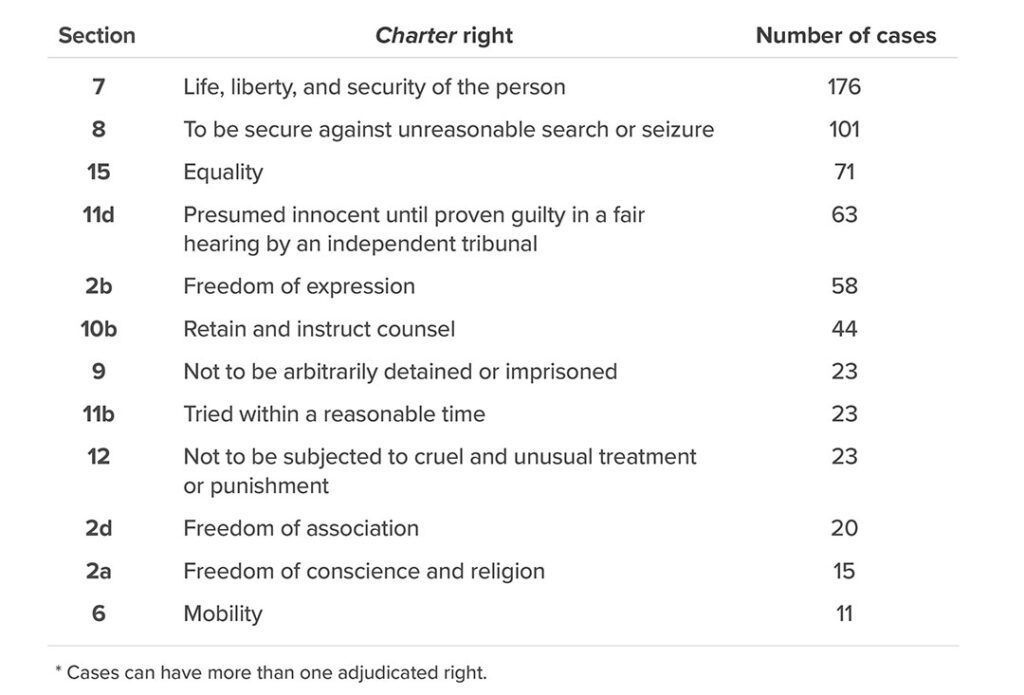
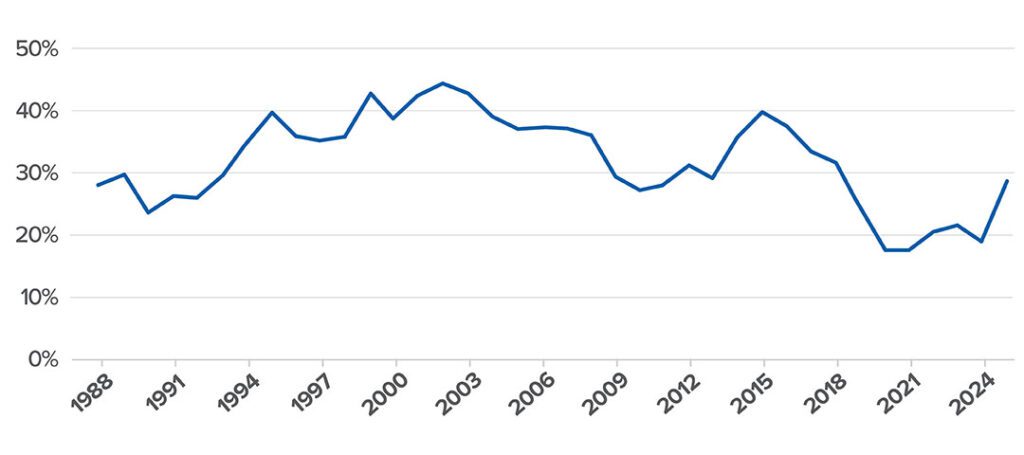
Figure 1 then tracks the five-year moving average of section 7 rights cases as a proportion of all Supreme Court Charter rights cases. It shows that section 7 has consistently occupied a substantial share of the Court’s Charter docket, although the proportion is down slightly in recent years. Between 2016 and 2025, more than one-quarter of Charter rights decisions involved the adjudication of a section 7 claim (18 of 69). Although its share has diminished slightly, section 7 remains central to the Court’s Charter work.
Because legal rights in section 7–14 of the Charter were intended to apply primarily to the criminal justice context, I sought to determine the extent to which the Court has strayed from that context in its section 7 jurisprudence. Table 2 shows the extent to which legal rights – including section 7 – were used to challenge a non-criminal statute (thus excluding laws such as the Criminal Code, Youth Criminal Justice Act, Controlled Drugs and Substances Act).
Table 2
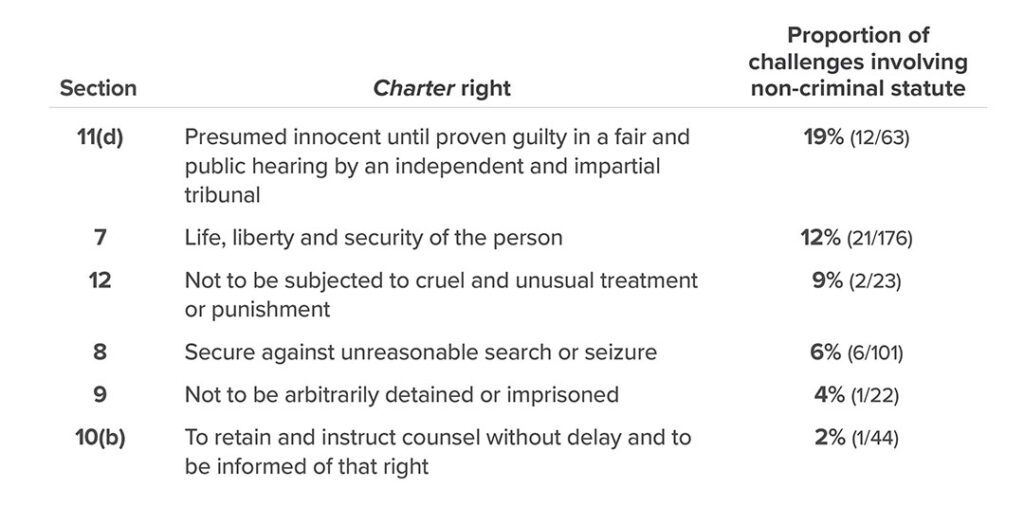
As shown in Table 2, of the 18 discrete legal rights listed in sections 7–14 of the Charter, only six have been used to challenge a non-criminal statute at the Supreme Court. The highest proportion (19 per cent) was actually in section 11(d) cases involving the right to be presumed innocent until proven guilty by an independent and impartial tribunal. Most of these cases involved challenges to statutes governing courts and judicial proceedings (Mackin v. New Brunswick 2002; Reference re Remuneration of Judges of the Prov. Court of P.E.I 1997; R. v. Edwards 2024).
By contrast, section 7 cases had the second-highest proportion (12 per cent) of non-criminal statutes challenged among legal rights, and the highest absolute number (21 cases). However, unlike section 11(d) cases, these section 7 cases spanned a wide range of policies, from immigration and refugee determinations (Singh v. Minister of Employment and Immigration 1985; Canadian Council for Refugees v. Canada 2023) to family and child welfare (B. (R.) v. Children’s Aid Society of Metropolitan Toronto 1995; A.C. v. Manitoba 2009; Winnipeg Child and Family Services v. K.L.W. 2000) to health care (Auton v. British Columbia 2004; Chaoulli v. Quebec 2005). Although these non-criminal section 7 challenges were only successful 19 per cent of the time, they nevertheless represent evidence that section 7 has been used to adjudicate and invalidate legislation well beyond the criminal justice realm. This shows that the “administration of justice threshold” has been stretched well beyond the core of the justice system.
Principles of fundamental justice: Too many principles, too little structure
Above, I noted that the first step of section 7 analysis – whether the rights to life, liberty, and/or security of the person are “engaged” – is easy to pass. Of the 176 cases in which the majority adjudicated a section 7 claim, 151 cases (86 per cent) engaged these rights, requiring the Court to then determine whether the state deprivation accorded with the principles of fundamental justice.
Table 3
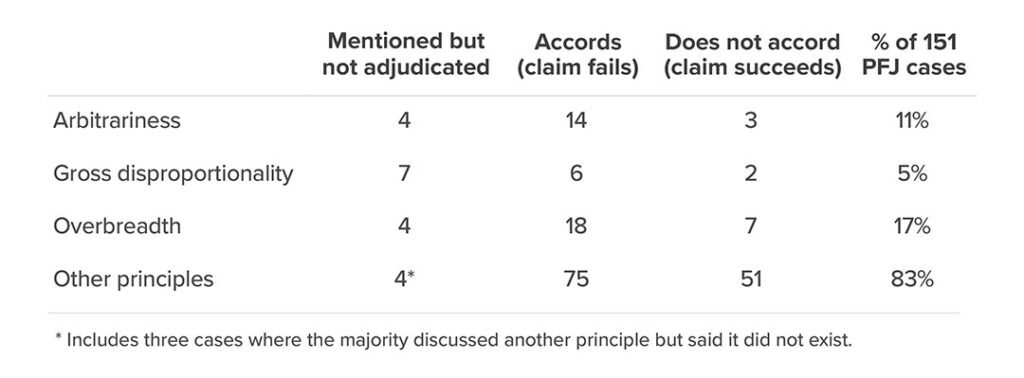
First, I measured the extent to which the three most substantive principles of fundamental justice that have received attention in recent years – the norms against arbitrariness, overbreadth, and gross disproportionality, the three “principles of instrumental rationality” – have taken up space in the Supreme Court’s section 7 analysis. These principles have been used to invalidate government policies in arguably the three most high-profile Supreme Court section 7 cases this century, which concerned drug consumption sites, prostitution, and medical assistance in dying (PHS Community Services 2011, Bedford 2013; Carter 2015). Yet their effect has been more qualitative than quantitative: as Table 3 shows, these three principles have only been mentioned by the majority of the Supreme Court in 21 (arbitrariness), 15 (gross disproportionality), and 29 (overbreadth) cases, and have been adjudicated in even fewer.
In most section 7 cases, the Supreme Court has drawn from a much wider array of principles. Table 4 shows that the Court has identified 21 different principles of fundamental justice, with considerable variation in the frequency with which they are invoked. For example, overbreadth and the right to make a full answer and defence were adjudicated in 17 per cent of all cases in which the rights to life, liberty, and security of the person were engaged (25/151), while several others have only been adjudicated in one or two such cases. This is not an exhaustive list of every time the Supreme Court mentions these principles; it only includes those cases in which a Charter rights claim based on these principles is adjudicated by the majority.
Table 4
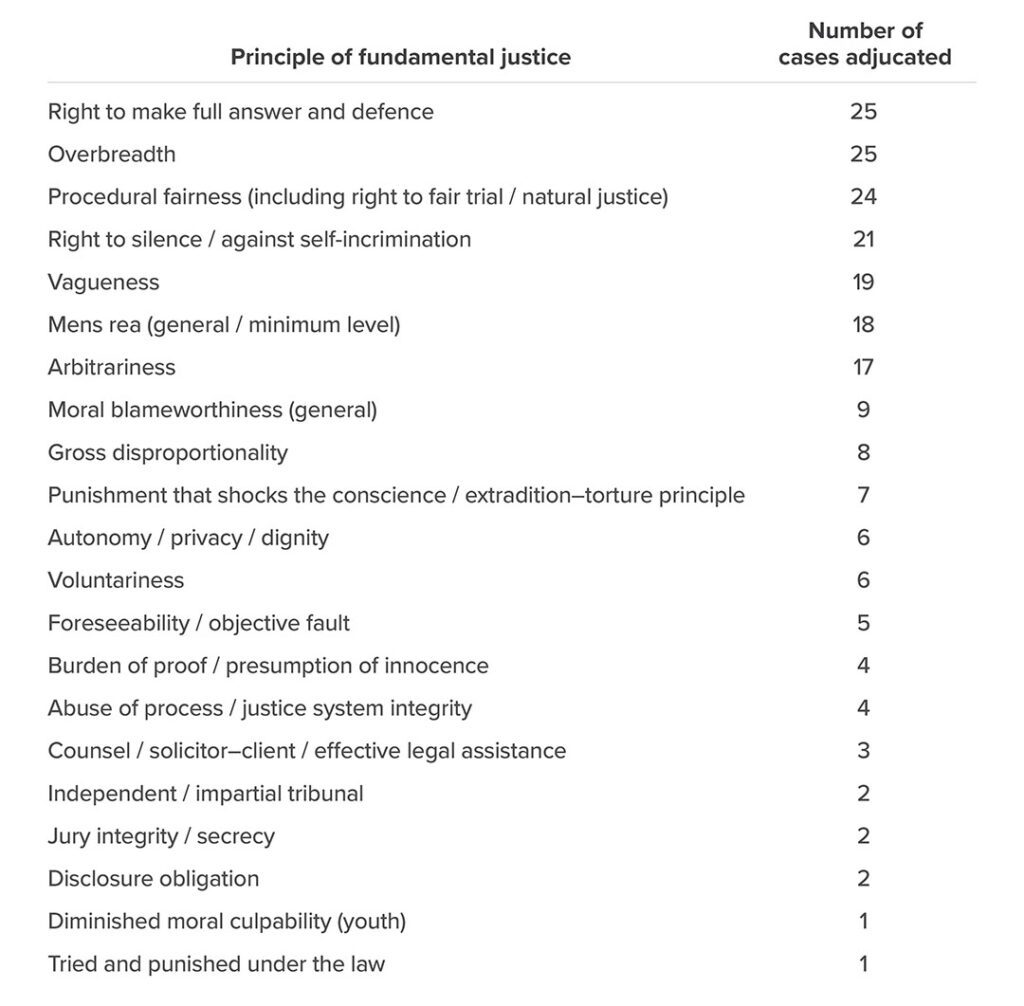
As the table shows, the Court is not always consistent with its terminology from case to case when invoking these principles. Moreover, these principles are often not invoked alone: in 30 per cent of cases involving an analysis of principles of fundamental justice (45/151), the Court invoked more than one principle.
The erosion of reasonable limits in section 7 analysis
I also examined the extent to which section 7 rights claims are ultimately successful at the Supreme Court. The rate of section 7 violations was consistent with other rights: on the 176 occasions in which a majority of the Supreme Court adjudicated a section 7 claim, the claimant was successful 34 per cent of the time (60/176) – nearly identical to the success rate for non-section 7 rights claims (35 per cent, or 178/514).
More interesting is how the Court has gone about determining a violation of the right to life, liberty, and security of the person. As noted above, for section 7, the normal “Charter two-step” for determining reasonable limits on rights becomes a “Charter three-step,” where courts ask: 1) Is the section 7 right engaged? 2) If so, is the deprivation of the right in accordance with the principles of fundamental justice? 3) If not, is it a reasonable limit?
The data confirm that the Court’s analysis of principles of fundamental justice in step 2 effectively renders its reasonable limits analysis in step 3 redundant. For each right that was infringed, the dataset categorizes whether the Court did a full Oakes test, a “perfunctory” Oakes test where it did not fully go through the steps, or whether it skipped the Oakes test altogether (see Table 5). Of the 61 breaches of section 7, two cases preceded R. v. Oakes (1986) decision; for the remaining 59 post-Oakes cases, the Court did a full Oakes test less than half the time (29), did a perfunctory test five times, and skipped the Oakes test 25 times. This confirms that the Oakes test is inconsistently applied in section 7 cases.
Table 5
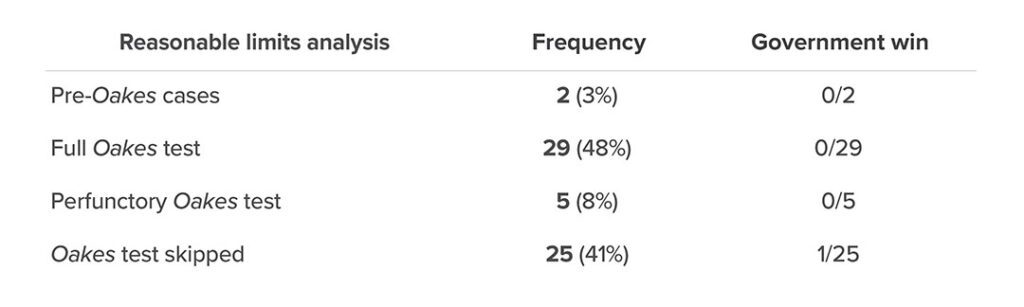
While the Court is inconsistent in the way it conducts reasonable limits analysis for section 7 rights, it is remarkably consistent in terms of outcome: of the 61 cases in which a majority of the Supreme Court found a state action engaged section 7 and did not accord with the principles of fundamental justice, the Supreme Court ultimately permitted the rights infringement only once, in Canada v. Harkat (2014). Harkat was a complex case in which the majority found one breach of section 7 after rejecting several other section 7 claims, but permitted the use of evidence derived from that breach without engaging in reasonable limits analysis. On the 34 occasions the Court did some form of the Oakes test, the government failed to pass it, with the Court often devoting minimal attention to the test itself. Overall, the data confirm that section 1 has become largely irrelevant in section 7 cases, despite the Court’s repeated assertions to the contrary (see Bedford 2013, paras. 124–129; Carter 2015, para. 95; see also Clarke 2026).
Finally, I examined unanimity with respect to section 7 cases. Section 7 cases actually had a slightly higher unanimity rate (40 per cent) than non-section 7 cases (33 per cent), and the same pattern held for cases in which the right was infringed (43 per cent unanimous for section 7, 38 per cent for non-section 7). However, the unanimity rate was slightly lower for cases involving multiple principles of fundamental justice (36 per cent) than for those where only one principle was adjudicated (41 per cent), suggesting the presence of multiple principles can complicate the court’s ability to speak with one voice.
An expansive right without limits
The data point to several conclusions about the Supreme Court’s approach to section 7 of the Charter. First, the Court’s decision to move forward with a substantive approach to section 7 has led to the absence of a consistent doctrinal framework. Although the Court presents its section 7 analysis as structured, there is an inherent subjectivity in determining what constitutes a principle of fundamental justice. The Supreme Court has identified no fewer than 21 distinct principles of fundamental justice across its 151 cases involving such principles, an average of one new principle every seven cases. The fact that some of these principles appear very similar to rights found elsewhere in the Charter – such as the right to a fair trial and the presumption of innocence – can only lead to legal uncertainty.
Indeed, a glance at the list of 21 principles in Table 4 – many of which have been collapsed into larger categories – reflects the Court’s lack of clarity and consistency in defining them. If this subjectivity is problematic for social scientists and legal scholars, it is a far more pressing issue for litigants who come before Canada’s courts looking for certainty. Returning to the Supreme Court’s three requirements for determining a principle, one might agree that all 21 are “legal principles” and that they are vital to our notion of justice (requirements one and two). However, the Supreme Court has been unable to ensure these principles meet the third requirement – that they are “identified with precision and applied to situations in a manner that yields predictable results” (Canadian Foundation for Children, Youth, and the Law 2004, para. 8).
Second, in the Court’s section 7 analysis, there has been no meaningful role for reasonable limits analysis under section 1 of the Charter. When the Court engages with section 1, it is a foregone conclusion, with the government never passing the Oakes test if a section 7 right has been infringed. The Supreme Court has been at pains to try to explain why its analysis of the principles of fundamental justice was fundamentally different from the Oakes test, describing its section 7 analysis as “not quantitative … but qualitative” and “narrower” than section 1 (Bedford 2013, paras. 125–27). The argument was never convincing, and the data show it has never been true in practice. Instead, reasonable limits analysis is largely symbolic in section 7 cases, as the “Charter two-step” collapses into what has largely become a single stage of analysis of the principles of fundamental justice.
This collapsing of section 1 into section 7 is especially problematic for legal predictability. On the one hand, the Oakes test has itself been subject to criticism, and for good reason. In particular, Kennedy and Sigalet (2026) have persuasively shown how the Oakes test has become unpredictable and utilitarian, thrusting the court into an increased policymaking role. Their recommendations for “renovating” Oakes, by curbing the Court’s increasingly free-form proportionality analysis, should be adopted. On the other hand, even an unrenovated Oakes test is preferable to the unstructured and deteriorating architecture of the principles of fundamental justice framework. At the very least, the Oakes test provides a series of linear, sequential steps that have been consistently defined (if not consistently applied) through decades of case law. By contrast, the Court’s jurisprudence on the principles of fundamental justice resembles an open-ended “choose your own adventure” whereby judges can evaluate laws against any number of vague principles, providing ample opportunity for the intrusion of judicial preferences dressed up as legal reasoning.
Third, the Court’s approach to fundamental justice considerably expands the reach of judicial intervention. While section 7 cases do not quantitatively produce a higher rate of Charter violations than other rights, the broad nature of the right itself increases the scope of judicial involvement in public life. By defining principles of fundamental justice as constituting “the basic values underpinning our constitutional order” (Canada v. Bedford 2013, para. 96), the Court has left the door wide open for these values to mean just about anything. Lower courts have taken note: some of the more audacious instances of lower-court activism in recent years – preventing governments from closing down homeless encampments, preventing public drug use, and tearing up bike lanes – have all involved section 7 of the Charter and the principles of fundamental justice.
If the Supreme Court is to restore coherence to section 7, it will need to reintroduce meaningful doctrinal constraints into its analysis. At a minimum, this would require a more disciplined approach to identifying new principles of fundamental justice, a clear distinction between such principles and other Charter rights, and a renewed commitment to the distinct role of section 1 as the primary site of justificatory analysis.
More specifically, the Supreme Court should cease using its four most substantive and expansive principles of fundamental justice – the three “principles of instrumental rationality” of arbitrariness, overbreadth, and gross disproportionality, as well as the principle of “vagueness.” Ironically, the principles have themselves become vague, overbroad, and capable of arbitrary application. As Justice Bradley Miller has observed about overbreadth, “all legislation is overbroad to some extent. That is the nature of laws of general application. A finding of overbreadth is virtually always open to a court” (Drover v. Canada 2025, para. 110). The same can be said of arbitrariness, gross disproportionality, and vagueness. In practice, these principles duplicate the work of the Oakes test, but in a less structured manner. They are too easily applied beyond the “administration of justice threshold,” and their continued use risks further expanding section 7 beyond any meaningful limits.
In the end, section 7 has emerged as the most important but least-structured right in the Charter. It has been defined in such a way that grants courts a wide and largely unconstrained role in resolving complex public policy questions. Unmoored from the intent of the framers, the right to “life, liberty, and security of the person” has become an open-ended invitation for Canadian judges to reshape public policy under the banner of constitutional interpretation.
About the author
Dave Snow is an associate professor in the Department of Political Science and the graduate coordinator of the Criminal Justice and Public Policy program at the University of Guelph. He is the author of Assisted Reproduction Policy in Canada: Framing, Federalism, and Failure, and the co-editor (with F.L. Morton) of Law, Politics, and the Judicial Process in Canada, 5th Edition.
Acknowledgements
I would like to thank Emily Bray, Brendan Dell, Dylan Clarke, and especially Andrew Mattan for their research assistance in creating the dataset. This research assistance was funded by a Social Science and Humanities Research Council (SSHRC) Insight Grant.
References
Clarke, Dylan R. 2026. Judicial Activism in Canadian Criminal Law – The Lasting Legacy of Irwin Toy. Macdonald-Laurier Institute. Available at https://macdonaldlaurier.ca/judicial-activism-in-canadian-criminal-law-the-lasting-legacy-of-irwin-toy-dylan-r-clarke/.
Dodek, Adam M. (ed). 2018. The Charter Debates: The Special Joint Committee on the Constitution, 1980–81, and the Making of the Canadian Charter of Rights and Freedoms. Toronto: University of Toronto Press.
Fehr, Colton. 2018. “The ‘Individualistic’ Approach to Arbitrariness, Overbreadth, and Gross Disproportionality.” UBC Law Review 51(1): 55–74.
Hopper, Tristan. 2025. “The wacky Charter rights Canadian courts keep finding (like a right to bike lanes).” National Post, September 1. Available at https://nationalpost.com/opinion/he-wacky-charter-rights-canadian-courts-keep-finding-like-a-right-to-bike-lanes.
Hovius, Berend. 1982. “The Legacy of the Supreme Court of Canada’s Approach to the Canadian Bill of Rights: Prospects for the Charter.” McGill Law Journal 28: 31–58.
Joyal, Glenn. 2024 [2017]. “The Charter and Canada’s New Political Culture: Are We All Ambassadors Now?” In F.L. Morton and Dave Snow (eds.), Law, Politics, and the Judicial Process in Canada (5th edition), 584-599. Calgary: University of Calgary Press. Originally delivered at the Canadian Constitution Foundation’s Law and Freedom Conference, January 6, 2017.
Kennedy, Gerard, and Geoffrey Sigalet. 2026. Renovating Oakes: Section 1 Justifies Limits on Charter Rights—Not Infringements. Macdonald-Laurier Institute. Available at https://macdonaldlaurier.ca/renovating-oakes-section-1-justifies-limits-on-charter-rights-not-infringements-gerard-kennedy-and-geoffrey-sigalet/
Knopff, Rainer, and F.L. Morton. 1992. Charter Politics. Scarborough: Nelson Canada.
Petter, Andrew. 2010. “Charter Legitimacy on Trial: The Resistible Rise of Substantive Due Process.” In Andrew Petter (ed.), The Politics of the Charter: The Illusive Promise of Constitutional Rights, 50–76. Toronto: University of Toronto Press.
Plaxton, Michael. 2025. “Drover and ‘Liberty’.” Substack, November 22. Available at https://michaelplaxton.substack.com/p/drover-and-liberty.
Sigalet, Geoffrey, and Dave Snow. 2025. “Notwithstanding Centralism: The Resurgence of the Notwithstanding Clause and the Conservative Provincial Rights Movement.” Canadian Journal of Political Science 58(3): 516–537.
Stewart, Hamish. 2019. Fundamental Justice : Section 7 of the Canadian Charter of Rights and Freedoms. Second edition. Irwin Law.
The Globe and Mail. 2025. “Judges should stay in their own lane.” The Globe and Mail, Unsigned editorial. August 18. Available at https://www.theglobeandmail.com/opinion/editorials/article-toronto-bike-lanes-judge-schabas/.
Cases Cited
A.C. v. Manitoba (Director of Child and Family Services), 2009 SCC 30, [2009] 2 S.C.R. 181.
Auton (Guardian ad litem of) v. British Columbia (Attorney General), [2004] 3 S.C.R. 657, 2004 SCC 78.
B. (R.) v. Children’s Aid Society of Metropolitan Toronto, [1995] 1 S.C.R. 315.
Canada (Attorney General) v. Bedford, 2013 SCC 72, [2013] 3 S.C.R. 1101.
Canada (Citizenship and Immigration) v. Harkat, 2014 SCC 37, [2014] 2 S.C.R. 33.
Canada (Attorney General) v. PHS Community Services Society, 2011 SCC 44, [2011] 3 S.C.R. 134.
Canadian Foundation for Children, Youth and the Law v. Canada (Attorney General), 2004 SCC 4, [2004] 1 S.C.R. 76.
Carter v. Canada (Attorney General), 2015 SCC 5, [2015] 1 S.C.R. 331.
Chaoulli v. Quebec (Attorney General), 2005 SCC 35, [2005] 1 S.C.R. 791.
Charkaoui v. Canada (Citizenship and Immigration), 2007 SCC 9, [2007] 1 S.C.R. 350.
Cycle Toronto et al. v. Attorney General of Ontario et al., 2025 ONSC 4397.
Drover v. Canada (Attorney General), 2025 ONCA 468.
Harm Reduction Nurses Association v. British Columbia (Attorney General), 2023 BCSC 2290.
John Howard Society of Saskatchewan v. Saskatchewan (Attorney General), 2025 SCC 6.
Mackin v. New Brunswick (Minister of Finance), 2002 SCC 13, [2002] 1 S.C.R. 405.
New Brunswick (Minister of Health and Community Services) v. G. (J.), [1999] 3 S.C.R. 46.
R. v. Edwards, 2024 SCC 15.
R. v. J.J., 2022 SCC 28, [2022] 2 S.C.R. 3.
R. v. Malmo-Levine; R. v. Caine, 2003 SCC 74, [2003] 3 S.C.R. 571.
R. v. Morgentaler, [1988] 1 S.C.R. 30.
R. v. Oakes, [1986] 1 S.C.R. 103.
Reference re Remuneration of Judges of the Prov. Court of P.E.I, [1997] 3 S.C.R. 3.
Re B.C. Motor Vehicle Act, [1985] 2 S.C.R. 486.
Rodriguez v. British Columbia (Attorney General), [1993] 3 S.C.R. 519.
Singh v. Minister of Employment and Immigration, [1985] 1 S.C.R. 177.
The Regional Municipality of Waterloo v. Persons Unknown and to be Ascertained, 2023 ONSC 670.
Winnipeg Child and Family Services v. K.L.W., [2000] 2 S.C.R. 519.