By Mehdi Moradi
May 28, 2026
Over a century ago, Max Weber observed in Politics as a Vocation that “one can say that three pre-eminent qualities are decisive for the politician: passion, a feeling of responsibility, and a sense of proportion.” Once detached from responsibility and objective judgment, passion becomes a mere sentiment staged as action, a gesture absorbed in itself and blind to the consequences it sets loose. Canada’s recognition of a Palestinian state, in many ways, moves within the contours of this condition.
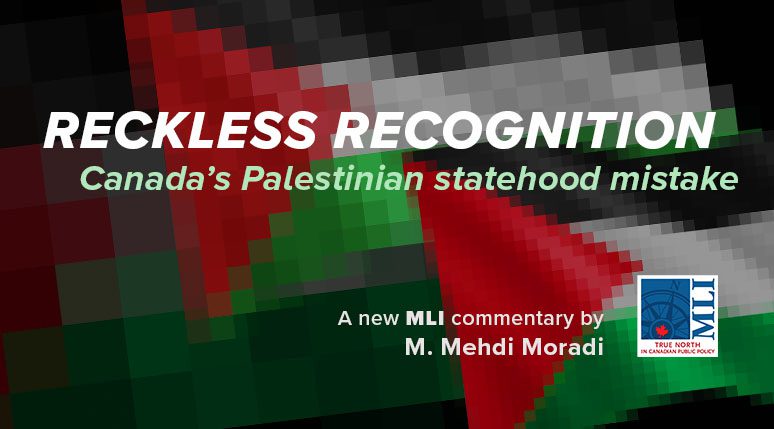
The Liberal government’s decision in September 2025, made in the same month as similar announcements by the United Kingdom and France, to recognize a Palestinian state entered the political atmosphere with the speed of a slogan and the weight of a symbol. Presented in Ottawa as a long-awaited moral correction, the move instead exposed something far more troubling. Across the country, the reaction made evident the absence of any serious political theory behind it and the deepening chaos already unleashed in Canadian streets after the Hamas massacre of October 7.
Canada’s recognition of a Palestinian state is neither pragmatism nor a solution nor principle. Rather, it is mostly symbolic messaging. It’s certainly not an attempt to engage with political reality.
Prime Minister Mark Carney’s official statement betrays the lack of political reasoning behind the move. It speaks of a “context” for recognition, as if the term itself could stand in for strategic direction. In place of statecraft, we are offered a loose listing of regional grievances: Israel’s rejection of a future Palestinian state, the expansion of settlements, and the civilian devastation in Gaza. These are grave realities – but they don’t, by themselves, explain the justification behind recognizing a Palestinian state.
In turn, the misguided recognition is received as political validation of the Palestinian cause, and that perception emboldens the ongoing pro-Palestinian protests that are causing chaos on our streets.
The poverty of theory
Ottawa’s recognition of a Palestinian state reveals its first fracture in the domain where politics demands its greatest discipline: theory.
Borrowing from E.P. Thompson’s The Poverty of Theory, the phrase “poverty of theory” describes a mode of thinking that substitutes abstraction for analysis, presenting weak reasoning in the guise of intellectual seriousness.
A decision of this magnitude – recognition of a Palestinian state – requires a multi-fold understanding of what constitutes a state, who its actors are, and whether its institutions exist beyond rhetoric. Carney’s announcement, however, rests largely on abstractions, misconceptions, and imagined partners, offering a gesture in place of political substance. It is here that the poverty of theory is laid bare.
The first problem begins with what Canada claims to be recognizing. A state is an entity, a political order constituted by definable parameters. It presupposes, among other things, legitimate institutions, effective mechanisms of governance, fair elections, a recognized monopoly on force, and, above all, a coherent spatial framework capable of supporting a population’s sociopolitical life. These requirements align with the Weberian tradition which predicates statehood on the functional reality of institutions and a demonstrated monopoly on power.
None of these conditions, observed with any seriousness, exist in the fractured geography now described as Palestine. What exists instead is a fragmented territory split between the West Bank and Gaza – a terrain of terrorism, tragedy, and debris, governed by irreconcilable factions, with no unified political or even semi-political structure within its own narrow boundaries. Recognition, in that light, becomes a ceremonial gesture toward a political vacuum. At best it is flawed in its basic parametric tenets, and at worst it reveals how replete the Liberal government’s thinking is with unmoored concepts that give way when confronted with material conditions of geopolitics.
In this climate of semi-statehood, or say meta-statehood, the entity being recognized lacks the minimal institutional coherence required for sovereignty. The Canadian government claims that recognizing a Palestinian state led by the Palestinian Authority, which is, in substance, Fatah under Mahmoud Abbas, empowers those who present themselves as seekers of peaceful coexistence and an end to Hamas. The real question, however, is who these actors are in the actual political landscape in terms of effective authority on the ground.
Indeed, how much does Canada grasp about the ideological architecture of the Muslim Brotherhood, or the battle for real authority that has given rise to and sustained Hamas’s theology of violence within the Palestinian landscape? And how much does Canada truly apprehend of the Fatah leadership controlling the West Bank – its long history of violence and machination, the rise of Fatah-affiliated militants who replicated Hamas’s methods, and the extent to which Hamas’s ideology seeped into its own structure? This same Fatah, only as an example, spent the years 2024 and 2025 disbursing millions of dollars to terrorists and their families without the slightest trace of accountability. One wonders who remains to answer for such decisions within this so-called Authority that claims to govern.
This uncertainty grows more acute when one looks more closely at the Abbas-led faction – the only body Canada has trusted in its recognition statement. Canada’s reasoning leans on the name alone, as if the fleeting emphasis placed on this Authority could somehow summon the capacity for rule that the institution has consistently failed to realize. But it is precisely here that the fault line lies. Years of corruption, weakness, and internal decay have hollowed the current Fatah leadership to a point where its legitimacy survives largely in formal title. It is not unfair to say that it has, for many years, denied its own population – Muslims, Christians, secular Palestinians, and other minorities alike – the space to speak or even to articulate dissent.
What precise knowledge exists, for instance, of what Arab Generation Z in Ramallah understands as a prosperous society, or how the Christian communities of Bethlehem conceive the future of a Palestinian state? Finding any genuine articulation of their ideas, when no real space has ever been granted for it, is like finding a needle in a haystack. That silence is structurally reinforced by the absence of inner free presses capable of carrying public inquiry and overtly criticizing years of tragic, hollow inner-political competitions. The extent to which any external, independent press is allowed to witness, record, or report from within is equally uncertain. Canada’s recognition of a Palestinian state will do nothing to loosen Hamas’s authoritarian grip on Gaza. Indeed, it’s preposterous for politicians in Canada and the West to use the language of human rights to justify recognition, when at the very same time, ignoring Hamas’s efforts to silence ordinary Palestinian voices.
In a juncture like this, how odd that insight belongs not to bombastic diplomacy but to the moral intelligence of those who have incurred the full cost of speaking freely. Take Salman Rushdie, a voice shaped by decades of uncompromising dissent in his writings, who stood behind the formation of a Palestinian state since the 1980s yet now hesitates when confronted with the conditions of the present. He has warned after the October 7 Hamas terror attacks that any Palestinian state formed today would be a Taliban-like structure run by Hamas and imprinted by Iran. He describes a political formation that would serve as a client of Tehran, an authority built on the same forces that have asphyxiated public life in Gaza. He even asks whether this is what the progressive movements of the Western left wish to construct beside Israel, another Taliban-like or Ayatollah-like order soaked in the language of liberation. Rushdie meets the present as it stands, while those who cling to a past built on their preferred fictions insist on remaining untouched by the hard and often tragic gravity of experienced reality.
Nowhere is this clearer than in Canada’s final justification, which exposes the grounding void even more plainly. The statement claims that the Palestinian Authority has promised “direct commitments” to major reforms, from governance overhaul to 2026 elections without Hamas, extending even to a demilitarized state. On this basis, Canada pledges support for measures such as institutional overhaul, peace plans, and humanitarian delivery. But a promise is not a logical premise. A premise is a reasoned foundation, while a promise is just something that someone says. And given the history of broken oaths, promises aren’t very reliable as a basis for recognition.
For nearly two decades under the Ramallah-based authority, the so-called reform, coupled with fair “elections,” has been announced, postponed, revived, deferred, and ultimately absorbed into a political culture where postponement has become a governing method and unelected rule a multi-generational privilege. A political class whose mandates expired long ago continues to rule without contest or accountability, propped up by a cycle of promised ballots that never reach the light of the judgment day. It cannot be incidental that the perpetually trusted leader of this democracy-oriented authority was recently exposed for allegedly celebrating the October 7 mayhem as “the greatest day in Palestinian history.” Despite this, the Carney government continues to support Mahmoud Abbas as the future steward of statehood.
What emerges from all this, as sketched above, is a poverty of theory held together by three fractures that shape the entire argument. One lies in the very object Canada claims to recognize. Another lies in the actors it chooses to elevate. And the third lies in the letters of promised reforms it treats as political substance. These breaks converge to show how recognition has drifted away from grounded reasoning and rested instead on a red flag placed over a chaotic sociopolitical space it had already mistaken for order.
The practice of chaos
The deterioration of Canadian public life didn’t start with Ottawa’s recognition of a Palestinian state, but that move accelerated trends that emerged in the wake of the atrocities of October 7. In the months that followed, pro-Palestinian protests and public discourse metastasized into ideological fervour, and in many cases, open hostility toward Israel and Jewish communities in Canada. In this environment, Canada’s recognition of a Palestinian state served as a catalyst, lending institutional cover to a disorder that continues to spread without meaningful response.
Praise for Hamas continues to appear openly on Canadian streets. From faces covered with Hamas insignia headbands and identities withheld, to wearing their attire while roaming Jewish neighbourhoods and causing fear, to publicly shouting threats and slurs at anyone who condemns the terror group, to grotesque chants such as “I love Hamas” being voiced with ease, the protestors display open admiration for a barbaric organization. What is framed as a political cause devolves into a screen onto which extremists and activists project their fantasies about Palestine, sidelining Palestinians themselves and stripping the struggle of meaning through the embrace of violence and violent ideological ambitions. This environment is especially corrosive in a country like Canada, itself entangled with roughly 450 individuals connected to Hamas in assorted roles. In this climate, any declarations of support for Palestinian statehood are quickly contaminated.
Such postures, it bears saying, represent a profound betrayal of Palestinians, whose lives have been wrecked under the rule and violence of Hamas. What many would rather forget is that Palestinians themselves, despite sustained censorship, intimidation, and systematic media biases, seized every narrow opening available to express resentment toward Hamas well before October 7, most clearly through the “Bidna Na’ish” (We Want to Live) movement in 2019. That moment was suppressed by the very terrorists whom naive or history-blind crowds in Canada now elevate. In a tragic inversion, how easily their suffering is turned into moral currency and gambled at safe Canadian crossroads in the service of terror glorification, a confusion so complete that even Hamas finds reason to hail Mark Carney for recognizing a Palestinian state.
This dynamic took concrete form in the encampment phenomenon, where glorification of violence and terror dominated Canadian university campuses. These semi-permanent university protest camps, erected on central campus lawns or quads, became instruments for pressing divestment demands against Israel, introducing a narrative of genocide, and ultimately overwriting the rhythms of university life altogether. A substantial body of evidence suggests the encampments did not arise organically. Rather, they were coordinated and funded by foreign actors, including Iran, with recurring signs of Qatari involvement, as well as Samidoun, a non-profit whose terrorist designation I was among the few in Canada to publicly and in detail argue for before it was listed. At the height of the 2024 encampments, Samidoun’s international coordinator travelled to Tehran to be honoured by a brutal regime widely alleged to have enabled Hamas’s October 7 atrocities, even as it styled itself as a guardian of Palestinian statehood.
Nonetheless, despite Canada’s recognition of a Palestinian state, the encampments did not subside. Instead, they mutated, shedding static permanence for hit-and-run coercion. What followed were smoke bombs and the burning of Israeli flags, building takeovers, classroom intrusions, and blocking access, calculated to outpace security and exhaust institutional response, a resurrection that clarifies the principles driving the movement. Seen in this light, statehood recognition is poorly positioned to smooth over a misdirected and proxy-driven movement that was never oriented toward that end, whether in present claims of solidarity or in any future political reality. The slogans continuing to be heard on campuses themselves evidence a call for the total negation of the other, probably condensed most clearly through the eliminationist chant “from the river to the sea.”
Beyond the locational boundaries of the encampments, something far more unruly entered the bloodstream of Canadian communal life. What began as general sociopolitical activism gradually calcified into what I would call a permanent “street ritual.” In the past three years, almost every week, if not every day, public spaces were surrendered to a cycle of disruption in which crowds freely and constantly applauded traditions of intimidation and zeal, coupled with scenes where figures like Qasem Soleimani and Hassan Nasrallah were no longer recognized as terrorists, but honored instead as “martyrs.” Streets were blocked, prayers were interrupted, shops were encircled, and even Christmas markets turned into odd scenes of Palestinian flag-waving, with crowds screaming and ranting through megaphones, something Canadian journalist Terry Newman labelled “a war on Christmas.” The objective shifted from democratic, political, civic, or even simply empathetic persuasion toward burdening daily life in every possible way. In such a climate, few could doubt the surreality of bureaucratic formulations, so detached from the ritualized frenzy consuming the streets.
This transformation took a grimmer turn as the rhetoric of the so-called “globalizing the intifada” became a centerpiece of the ritual. This language effectively erased the historical reality of the First and Second Intifadas, which claimed over 1,200 civilian lives, as well as the thousands killed globally in the name of similar goals. For instance, these violent legacies – when resurrected on posters calling Torontonians to weekly demonstrations for the “only one solution” of “intifada revolution” – suggest that history itself has become a performative act by social justice activists who embrace a cult-like posture. Out of this, we see a complex of concepts and desires and feelings and hatred and drama and tragedy poured into a single soup where we no longer understand what kind of revolutionary appetite it is meant to satisfy. One wonders what the sun and soil of Toronto or Montreal could possibly contribute to the ignition of this borderless uprising against Israelis, Jews, and pro-Israel establishments, defined by masked crowds and flag bearers. Whatever the label, it appears less and less like grounded social activism, or even standard radicalism per se, leaving gestures toward Palestinian statehood and the broader political response to this performative extremism to resemble a script without an audience.
Ultimately, it is the rise of antisemitism that defines the limits of this fevered air. What initially appeared as scattered incidents now carries the feeling of permanence. Stories that once would have sounded unimaginable in Canada now arrive almost routinely. Pedestrians being shouted at with “Go back to the slums of Europe,” constant campaigns of menace outside Jewish community centres, including facilities caring for seniors with dementia, attacks and gunfire directed at synagogues, and even abhorrent reports of men allegedly hunting Jewish women on Toronto streets. It is therefore not surprising that many now see this as one of the darkest moments in recent Canadian memory, with some even warning that “a pogrom is brewing in Canada.” For me, what hangs over all this is a deeper exhaustion in the public atmosphere itself, where the language of solidarity, or simple indifference, increasingly functions as protection for impulses that, sadly, previous Canadian generations already knew too well. It is precisely this capacity for adaptation that Hannah Arendt warned of over six decades ago, where hatred, instead of arriving in familiar uniforms, reshapes itself through the moral language of its age.
What now lingers past all this is that Canada’s political leadership seems content to turn a blind eye, offering only platitudes and grudging acknowledgment of the harassment and violence suffered daily by Jewish Canadians. I do not wish to be pessimistic, but chaos, once settled, invites further extensions, and in that moment, tragedies like those we have seen recently in Sydney no longer feel far from the parks and pavements of Canada.
Toward reality, away from illusion
The failure of political “hyperbole,” a word I used months ago when the winds of official Palestinian state recognition first began to gather, has already shown its limits and its consequences. I argued then that exaggeration could not serve the Palestinian people, and the long passage since October 7, followed now by recognition itself, has turned that warning into history. Serious decision-making demands resolve, especially as the political temperature rises. Carney’s hasty decision to recognize a Palestinian state was undoubtedly influenced by the constant pressure of mass pro-Palestinian protests and diaspora politics. As I noted previously, and not alone, the Carney government should have calibrated the contours of its posture vis-à-vis Washington, the only international actor with real sway over events on the ground. That path, sadly, found no listeners.
Indeed, the United States can take much credit for the ceasefire in Gaza and the return of hostages to Israel. It also backed the creation of the Gaza Humanitarian Foundation (GHF) aid initiative in the early months of 2025. Despite Hamas threatening Palestinians who accepted food from it, the GHF delivered 187 million free meals to Gaza by last November without falling into terrorist hands. This significantly crushed Hamas’s ability to turn humanitarian aid into a currency of power, and also reduced the role of UNRWA, whose Hamas infiltration is no longer a matter of speculation. Meanwhile, the UN Security Council began formally considering demilitarization following a US proposal, with removing Hamas from control of Gaza as the only serious option on the table. This is what happens when politics governed by proportion meets capacity. It is a world that has no use for slogan-therapy or theatrical staging, a lesson Canada still struggles with on multiple fronts.
Canada must realize that the future of a Palestinian state will be shaped by the decisive actors of the region. It will emerge from the political work of those, and only those, who carry the weight of security, reconstruction, demilitarization, and regional order. The Carney government’s premature recognition of a Palestinian state contributed nothing positive or impactful on the ground.
Ironically, Carney’s own statement ends by cautioning that recognition is no panacea. By definition, a “panacea” is a remedy for all diseases or difficulties. In this case, it’s a poison pill – one that simply can’t be swallowed by those who value and desire a truly lasting peace in the region.
In the end, the Liberal government acted passionately, but not responsibly or in the proportion Max Weber believed politics demands. And in so doing, Canada has sidelined its credibility and ensured its irrelevance in shaping the future of the region.
About the author
Mehdi Moradi is an Iranian-Canadian journalist and justice advocate who writes about Canada’s national security risks, including Iranian regime infiltration networks and terrorist-affiliated entities such as the IRGC and Samidoun.