Thursday, May 14, 2026
No Result
View All Result
  • Media
Macdonald-Laurier Institute
  • Home
  • About
    • Who We Are
    • Who Makes MLI Work
    • Fifteenth Anniversary
  • Experts
    • Experts Directory
    • In Memoriam
  • Issues
    • Domestic Policy
      • Economic Policy
      • Justice
      • Rights and Freedoms
      • Assisted Suicide (MAID)
      • Health Care
      • COVID-19
      • Gender Identity
      • Canada’s Political Tradition
      • AI, Technology and Innovation
      • Media and Telecoms
      • Housing
      • Immigration
      • Agriculture and Agri-Food
      • Competition Policy
    • Energy Policy
      • Energy
      • Environment
    • Foreign Policy
      • Israel-Hamas War
      • Ukraine
      • Taiwan
      • China
      • Europe and Russia
      • Indo-Pacific
      • Middle East and North Africa
      • North America
      • Foreign Interference
      • National Defence
      • National Security
      • Foreign Affairs
    • Indigenous Affairs
  • Projects
    • CNAPS (Center for North American Prosperity and Security)
    • Justice Report Card
    • The Promised Land
    • Voices that Inspire: The Macdonald-Laurier Vancouver Speaker Series
    • Dragon at the door
    • Canada on top of the world
    • Letter to a minister
    • The Great Energy Crisis
    • DisInfoWatch.org
    • Managing Indigenous Prosperity
    • Judicial Foundations
    • Landmark Cases Council
    • Defending The Marketplace of Ideas
    • Reforming the University
    • Past Projects
      • Digital Policy & Connectivity
      • Double Trouble
      • Canada and the Indo-Pacific Initiative
      • The Transatlantic Program
      • COVID Misery Index
        • Provincial COVID Misery Index
        • Beyond Lockdown
        • COVID and after: A mandate for recovery
      • Speak for Ourselves
      • The Eavesdropping Dragon: Huawei
      • Talkin’ in the Free World with Mariam Memarsadeghi
      • An Intellectual Property Strategy for Canada
      • Munk Senior Fellows
      • A Mandate for Canada
      • Confederation Series
      • Fiscal Reform
      • The Canadian Century project
      • Fixing Canadian health care
      • Internal trade
      • From a mandate for change
      • Size of government in Canada
      • Straight Talk
      • Labour Market Report
      • Leading Economic Indicator
      • Centre for Advancing Canada’s Interests Abroad
      • Indigenous Prosperity at a Crossroads
        • Aboriginal Canada and Natural Resources
  • Events
    • Upcoming Events
    • Past Events
      • MLI Dinners
      • Great Canadian Debates
  • Latest News
  • Libraries
    • Columns
    • Commentary
    • Papers
    • Books
    • Video
  • Donate
  • Home
  • About
    • Who We Are
    • Who Makes MLI Work
    • Fifteenth Anniversary
  • Experts
    • Experts Directory
    • In Memoriam
  • Issues
    • Domestic Policy
      • Economic Policy
      • Justice
      • Rights and Freedoms
      • Assisted Suicide (MAID)
      • Health Care
      • COVID-19
      • Gender Identity
      • Canada’s Political Tradition
      • AI, Technology and Innovation
      • Media and Telecoms
      • Housing
      • Immigration
      • Agriculture and Agri-Food
      • Competition Policy
    • Energy Policy
      • Energy
      • Environment
    • Foreign Policy
      • Israel-Hamas War
      • Ukraine
      • Taiwan
      • China
      • Europe and Russia
      • Indo-Pacific
      • Middle East and North Africa
      • North America
      • Foreign Interference
      • National Defence
      • National Security
      • Foreign Affairs
    • Indigenous Affairs
  • Projects
    • CNAPS (Center for North American Prosperity and Security)
    • Justice Report Card
    • The Promised Land
    • Voices that Inspire: The Macdonald-Laurier Vancouver Speaker Series
    • Dragon at the door
    • Canada on top of the world
    • Letter to a minister
    • The Great Energy Crisis
    • DisInfoWatch.org
    • Managing Indigenous Prosperity
    • Judicial Foundations
    • Landmark Cases Council
    • Defending The Marketplace of Ideas
    • Reforming the University
    • Past Projects
      • Digital Policy & Connectivity
      • Double Trouble
      • Canada and the Indo-Pacific Initiative
      • The Transatlantic Program
      • COVID Misery Index
        • Provincial COVID Misery Index
        • Beyond Lockdown
        • COVID and after: A mandate for recovery
      • Speak for Ourselves
      • The Eavesdropping Dragon: Huawei
      • Talkin’ in the Free World with Mariam Memarsadeghi
      • An Intellectual Property Strategy for Canada
      • Munk Senior Fellows
      • A Mandate for Canada
      • Confederation Series
      • Fiscal Reform
      • The Canadian Century project
      • Fixing Canadian health care
      • Internal trade
      • From a mandate for change
      • Size of government in Canada
      • Straight Talk
      • Labour Market Report
      • Leading Economic Indicator
      • Centre for Advancing Canada’s Interests Abroad
      • Indigenous Prosperity at a Crossroads
        • Aboriginal Canada and Natural Resources
  • Events
    • Upcoming Events
    • Past Events
      • MLI Dinners
      • Great Canadian Debates
  • Latest News
  • Libraries
    • Columns
    • Commentary
    • Papers
    • Books
    • Video
  • Donate
No Result
View All Result
Macdonald-Laurier Institute

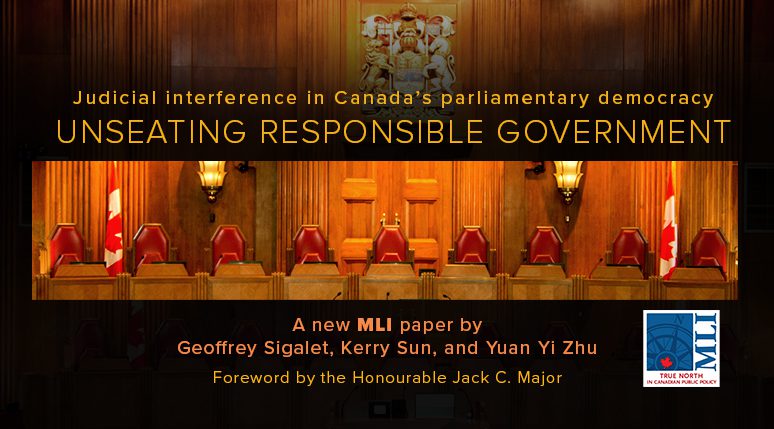
Unseating responsible government: Judicial interference in Canada’s parliamentary democracy

Canada’s constitutional order depends on a careful balance between political and judicial authority.

May 12, 2026
in Domestic Policy, Latest News, Papers, Justice, Geoffrey Sigalet
Reading Time: 6 mins read
A A
Unseating responsible government: Judicial interference in Canada’s parliamentary democracy

By Geoffrey Sigalet, Kerry Sun, and Yuan Yi Zhu
May 12, 2026

PDF of paper

Executive Summary | Sommaire (le français suit)

When the Canadian Charter of Rights and Freedoms came into force in 1982, many warned that it would undermine the foundations of Canada’s system of parliamentary democracy and usher in a new age of judicial supremacy. For a time, those concerns appeared overstated. Canadian courts exercised a degree of restraint, and the basic contours of Westminster parliamentary governance remained intact. More than 40 years later, that early judicial restraint has largely given way.

Canadian courts now play a far more assertive and expansive role in shaping the country’s political and legal order. What was once a system grounded firmly in parliamentary supremacy has been steadily reworked through constitutional interpretation. This shift has not occurred through formal amendment or explicit redesign. Instead, it has emerged gradually through judicial decisions that have redefined both the meaning of rights and the proper role of courts in public life.

The cumulative effect is an erosion of Parliament’s traditional authority. Legislatures continue to pass laws, but they do so in an environment where the boundaries of acceptable policy are increasingly determined through litigation. Over time, this has altered the balance between political and judicial authority at the heart of Canada’s constitutional system.

This troubling transformation has unfolded through several distinct but reinforcing developments:

• The invention of the “living tree” as an autonomous approach to constitutional interpretation, enabling courts to expand constitutional meaning over time and move beyond earlier constraints.

• The relativization of Charter rights under section 1, where rights are routinely subordinated to broad and ad hoc judicial balancing.

• The expansive, substantive reading given to section 7’s guarantee of “life, liberty, and security of the person,” transforming it into a wide-ranging basis for reviewing legislation.

• The elevation of “reasonable hypotheticals” as a basis for finding legislation non-compliant with the Charter, particularly in the application of section 12’s provision against cruel and unusual punishment to mandatory minimum sentences.

• The inflation of equality rights under section 15 through an interpretation that extends judicial oversight into complex areas of social policy.

• An increasing tendency to countenance judicial supervision of the parliamentary process, marking a departure from traditional boundaries between courts and legislatures.

Taken together, they represent a significant shift away from the traditional foundations of parliamentary democracy in Canada. Through the accretion of undisciplined judicial interpretations, courts are, in important respects, reshaping the scope of legislative authority.

Restoring constitutional balance will involve making use of the mechanisms in our constitution that are designed to preserve the role of political authority alongside the courts. Governments should act deliberately and consistently in defence of their institutional role, including by:

• Reasserting legislative freedom by invoking section 33 of the Charter, also known as the notwithstanding clause or parliamentary sovereignty clause, where warranted.

• Instructing Crown counsel to advocate for revisiting problematic judicial precedents in defending against lawfare – litigation intended to subvert public policymaking.

• Preventing courts from questioning parliamentary proceedings by amending legislation governing the admission of evidence.

• Curtailing lawfare by tightening procedural thresholds for Crown liability.

• Correcting the Supreme Court’s misinterpretation of section 24 of the Charter, by amending it to limit the remedies that courts may grant in relation to legislative conduct or proceedings.

Canada’s constitutional order depends on a careful balance between political and judicial authority. That balance has shifted – gradually, but decisively. Reasserting it is essential to preserving a system in which elected representatives, not courts, remain at the centre of public decision-making.


Lorsque la Charte canadienne des droits et libertés a été mise en vigueur en 1982, de nombreuses voix ont signalé son potentiel à compromettre les bases de la démocratie parlementaire et à inaugurer une ère de suprématie judiciaire au Canada. Pendant un moment, ces craintes ont paru exagérées, les tribunaux ayant fait preuve de retenue, et la gouvernance parlementaire de type Westminster étant restée intacte. Plus de 40 ans après, cette retenue judiciaire initiale a largement disparu.

Les tribunaux jouent désormais un rôle bien plus important pour l’ordre politique et juridique du pays. L’interprétation constitutionnelle a graduellement transformé un système autrefois fondé sur la primauté du Parlement. Ce changement n’est pas le fruit d’un amendement ou d’une refonte explicite, mais des décisions judiciaires qui ont progressivement redéfini à la fois les droits et le rôle des tribunaux dans la vie publique.

L’effet cumulatif s’est traduit par l’érosion progressive du pouvoir traditionnel du Parlement. Désormais, les législatures adoptent les lois dans un contexte où l’acceptabilité est de plus en plus définie devant un tribunal, ce qui modifie l’équilibre entre les pouvoirs politique et judiciaire au cœur du système constitutionnel canadien.

Cette mutation s’est opérée à travers plusieurs évolutions distinctes se renforçant réciproquement :

• L’adoption de l’approche qualifiée d’« évolutive », qui confère intrinsèquement aux tribunaux la faculté, au fil du temps, d’étendre la portée constitutionnelle au-delà de ses limites historiques.

• La relativisation des droits assurés par la Charte conformément à l’article 1, les droits devenant systématiquement subordonnés à un rééquilibrage judiciaire étendu et ad hoc.

• L’interprétation extensive et approfondie de la garantie relative à la « vie, la liberté et la sécurité de la personne » énoncée à l’article 7, la transformant en une base extrêmement large pour l’examen d’une loi.

• L’élévation des « hypothèses raisonnables » au rang de fondement pour conclure à la non-conformité d’une loi avec la Charte, en particulier la disposition de l’article 12 contre les peines cruelles et inusitées, en vertu de laquelle une peine minimale obligatoire peut être jugée inopérante.

• La flambée des droits à l’égalité prévus à l’article 15, résultant d’une interprétation qui étend la compétence des tribunaux à des secteurs complexes de la politique sociale.

• Une propension accrue à admettre la surveillance judiciaire du déroulement parlementaire, ce qui modifie la démarcation classique entre les tribunaux et les organes législatifs.

Considérés globalement, ces éléments constituent un éloignement important des fondements traditionnels de la démocratie parlementaire au Canada. Par l’agrégation d’interprétations judiciaires non conformes aux normes établies, les tribunaux redéfinissent, à d’importants égards, l’étendue de la compétence législative.

La restauration de l’équilibre constitutionnel s’appuiera sur les dispositifs prévus par notre Constitution, destinés à préserver le rôle de l’autorité politique aux côtés des tribunaux. Les gouvernements se doivent d’intervenir de façon intentionnelle et cohérente pour préserver leur rôle institutionnel, notamment à travers les mesures suivantes :

• En réaffirmant la liberté législative au moyen de l’article 33 de la Charte, également connu sous le nom de « clause dérogatoire » ou « nonobstant », lorsqu’elle se justifie.

• En chargeant les procureurs de la Couronne de plaider en faveur d’une révision des précédents judiciaires contestables, l’objectif étant de contrer les « guerres juridiques », c’est-à-dire les débats visant à perturber l’élaboration des politiques publiques.

• En interdisant aux tribunaux de contester les travaux parlementaires par la modification de la législation encadrant l’admissibilité des preuves.

• En limitant les « guerres juridiques » par le renforcement du seuil de compétence pécuniaire.

• En corrigeant l’interprétation inexacte de l’article 24 de la Charte par la Cour suprême, au moyen d’un amendement destiné à restreindre les réparations ordonnées par les tribunaux en lien avec les lois ou les procédures.

L’ordre constitutionnel du Canada s’appuie sur un équilibre subtil entre les autorités politique et judiciaire. Cet équilibre a été modifié de façon progressive, mais déterminante. Il est fondamental de le restaurer afin de garantir un système dans lequel les représentants élus, et non pas les tribunaux, occupent le rôle central dans la prise de décision publique.


 

Tags: Kerry SunYuan Yi Zhu

Related Posts

Canada backs the Philippines against Chinese coercion: Kevin Vuong and Christopher Coates for Inside Policy
Indo-Pacific

Canada backs the Philippines against Chinese coercion: Kevin Vuong and Christopher Coates for Inside Policy

May 13, 2026
Nearly 50% of all violent offences go unpunished in Canada—why police are solving fewer crimes: Dave Snow in The Hub
National Security

Canada released an ISIS recruiter. Here’s why—and how to prevent it from happening again: Ches W. Parsons and Sheryl Saperia in The Hub

May 13, 2026
First Nations are ready to stand with Canada against Trump’s tariff threat: Stephen Buffalo in the Calgary Herald
Indigenous Affairs

DRIPA’s problem is not its goal. It is its design: Jerome Gessaroli for Inside Policy

May 12, 2026
Next Post
First Nations are ready to stand with Canada against Trump’s tariff threat: Stephen Buffalo in the Calgary Herald

DRIPA's problem is not its goal. It is its design: Jerome Gessaroli for Inside Policy

Newsletter Signup

  Thank you for Signing Up
  Please correct the marked field(s) below.
Email Address  *
1,true,6,Contact Email,2
First Name *
1,true,1,First Name,2
Last Name *
1,true,1,Last Name,2
*
*Required Fields

Follow us on

Macdonald-Laurier Institute

323 Chapel Street, Suite #300
Ottawa, Ontario, K1N 7Z2 Canada

613.482.8327

info@macdonaldlaurier.ca
MLI directory

Support Us

Support the Macdonald-Laurier Institute to help ensure that Canada is one of the best governed countries in the world. Click below to learn more or become a sponsor.

Support Us

  • Inside Policy Magazine
  • Annual Reports
  • Jobs
  • Privacy Policy

© 2023 Macdonald-Laurier Institute. All Rights reserved.

No Result
View All Result
  • Home
  • About
    • Who We Are
    • Who Makes MLI Work
    • Fifteenth Anniversary
  • Experts
    • Experts Directory
    • In Memoriam
  • Issues
    • Domestic Policy
      • Economic Policy
      • Justice
      • Rights and Freedoms
      • Assisted Suicide (MAID)
      • Health Care
      • COVID-19
      • Gender Identity
      • Canada’s Political Tradition
      • AI, Technology and Innovation
      • Media and Telecoms
      • Housing
      • Immigration
      • Agriculture and Agri-Food
      • Competition Policy
    • Energy Policy
      • Energy
      • Environment
    • Foreign Policy
      • Israel-Hamas War
      • Ukraine
      • Taiwan
      • China
      • Europe and Russia
      • Indo-Pacific
      • Middle East and North Africa
      • North America
      • Foreign Interference
      • National Defence
      • National Security
      • Foreign Affairs
    • Indigenous Affairs
  • Projects
    • CNAPS (Center for North American Prosperity and Security)
    • Justice Report Card
    • The Promised Land
    • Voices that Inspire: The Macdonald-Laurier Vancouver Speaker Series
    • Dragon at the door
    • Canada on top of the world
    • Letter to a minister
    • The Great Energy Crisis
    • DisInfoWatch.org
    • Managing Indigenous Prosperity
    • Judicial Foundations
    • Landmark Cases Council
    • Defending The Marketplace of Ideas
    • Reforming the University
    • Past Projects
      • Digital Policy & Connectivity
      • Double Trouble
      • Canada and the Indo-Pacific Initiative
      • The Transatlantic Program
      • COVID Misery Index
      • Speak for Ourselves
      • The Eavesdropping Dragon: Huawei
      • Talkin’ in the Free World with Mariam Memarsadeghi
      • An Intellectual Property Strategy for Canada
      • Munk Senior Fellows
      • A Mandate for Canada
      • Confederation Series
      • Fiscal Reform
      • The Canadian Century project
      • Fixing Canadian health care
      • Internal trade
      • From a mandate for change
      • Size of government in Canada
      • Straight Talk
      • Labour Market Report
      • Leading Economic Indicator
      • Centre for Advancing Canada’s Interests Abroad
      • Indigenous Prosperity at a Crossroads
  • Events
    • Upcoming Events
    • Past Events
      • MLI Dinners
      • Great Canadian Debates
  • Latest News
  • Libraries
    • Columns
    • Commentary
    • Papers
    • Books
    • Video
  • Donate

© 2023 Macdonald-Laurier Institute. All Rights reserved.