Friday, April 3, 2026
No Result
View All Result
  • Media
Macdonald-Laurier Institute
  • Home
  • About
    • Who We Are
    • Who Makes MLI Work
    • Fifteenth Anniversary
  • Experts
    • Experts Directory
    • In Memoriam
  • Issues
    • Domestic Policy
      • Economic Policy
      • Justice
      • Rights and Freedoms
      • Assisted Suicide (MAID)
      • Health Care
      • COVID-19
      • Gender Identity
      • Canada’s Political Tradition
      • AI, Technology and Innovation
      • Media and Telecoms
      • Housing
      • Immigration
      • Agriculture and Agri-Food
      • Competition Policy
    • Energy Policy
      • Energy
      • Environment
    • Foreign Policy
      • Israel-Hamas War
      • Ukraine
      • Taiwan
      • China
      • Europe and Russia
      • Indo-Pacific
      • Middle East and North Africa
      • North America
      • Foreign Interference
      • National Defence
      • National Security
      • Foreign Affairs
    • Indigenous Affairs
  • Projects
    • CNAPS (Center for North American Prosperity and Security)
    • Justice Report Card
    • The Promised Land
    • Voices that Inspire: The Macdonald-Laurier Vancouver Speaker Series
    • Dragon at the door
    • Canada on top of the world
    • Letter to a minister
    • The Great Energy Crisis
    • DisInfoWatch.org
    • Managing Indigenous Prosperity
    • Judicial Foundations
    • Landmark Cases Council
    • Defending The Marketplace of Ideas
    • Reforming the University
    • Past Projects
      • Digital Policy & Connectivity
      • Double Trouble
      • Canada and the Indo-Pacific Initiative
      • The Transatlantic Program
      • COVID Misery Index
        • Provincial COVID Misery Index
        • Beyond Lockdown
        • COVID and after: A mandate for recovery
      • Speak for Ourselves
      • The Eavesdropping Dragon: Huawei
      • Talkin’ in the Free World with Mariam Memarsadeghi
      • An Intellectual Property Strategy for Canada
      • Munk Senior Fellows
      • A Mandate for Canada
      • Confederation Series
      • Fiscal Reform
      • The Canadian Century project
      • Fixing Canadian health care
      • Internal trade
      • From a mandate for change
      • Size of government in Canada
      • Straight Talk
      • Labour Market Report
      • Leading Economic Indicator
      • Centre for Advancing Canada’s Interests Abroad
      • Indigenous Prosperity at a Crossroads
        • Aboriginal Canada and Natural Resources
  • Events
    • Upcoming Events
    • Past Events
      • MLI Dinners
      • Great Canadian Debates
  • Latest News
  • Libraries
    • Columns
    • Commentary
    • Papers
    • Books
    • Video
  • Donate
  • Home
  • About
    • Who We Are
    • Who Makes MLI Work
    • Fifteenth Anniversary
  • Experts
    • Experts Directory
    • In Memoriam
  • Issues
    • Domestic Policy
      • Economic Policy
      • Justice
      • Rights and Freedoms
      • Assisted Suicide (MAID)
      • Health Care
      • COVID-19
      • Gender Identity
      • Canada’s Political Tradition
      • AI, Technology and Innovation
      • Media and Telecoms
      • Housing
      • Immigration
      • Agriculture and Agri-Food
      • Competition Policy
    • Energy Policy
      • Energy
      • Environment
    • Foreign Policy
      • Israel-Hamas War
      • Ukraine
      • Taiwan
      • China
      • Europe and Russia
      • Indo-Pacific
      • Middle East and North Africa
      • North America
      • Foreign Interference
      • National Defence
      • National Security
      • Foreign Affairs
    • Indigenous Affairs
  • Projects
    • CNAPS (Center for North American Prosperity and Security)
    • Justice Report Card
    • The Promised Land
    • Voices that Inspire: The Macdonald-Laurier Vancouver Speaker Series
    • Dragon at the door
    • Canada on top of the world
    • Letter to a minister
    • The Great Energy Crisis
    • DisInfoWatch.org
    • Managing Indigenous Prosperity
    • Judicial Foundations
    • Landmark Cases Council
    • Defending The Marketplace of Ideas
    • Reforming the University
    • Past Projects
      • Digital Policy & Connectivity
      • Double Trouble
      • Canada and the Indo-Pacific Initiative
      • The Transatlantic Program
      • COVID Misery Index
        • Provincial COVID Misery Index
        • Beyond Lockdown
        • COVID and after: A mandate for recovery
      • Speak for Ourselves
      • The Eavesdropping Dragon: Huawei
      • Talkin’ in the Free World with Mariam Memarsadeghi
      • An Intellectual Property Strategy for Canada
      • Munk Senior Fellows
      • A Mandate for Canada
      • Confederation Series
      • Fiscal Reform
      • The Canadian Century project
      • Fixing Canadian health care
      • Internal trade
      • From a mandate for change
      • Size of government in Canada
      • Straight Talk
      • Labour Market Report
      • Leading Economic Indicator
      • Centre for Advancing Canada’s Interests Abroad
      • Indigenous Prosperity at a Crossroads
        • Aboriginal Canada and Natural Resources
  • Events
    • Upcoming Events
    • Past Events
      • MLI Dinners
      • Great Canadian Debates
  • Latest News
  • Libraries
    • Columns
    • Commentary
    • Papers
    • Books
    • Video
  • Donate
No Result
View All Result
Macdonald-Laurier Institute

Fire any Supreme Court judge that tries to put limits on Section 33: Yuan Yi Zhu in the National Post

The constitution must not be changed without democratic consent.

April 1, 2026
in Domestic Policy, Latest News, Columns, In the Media, Justice, Judicial Foundations
Reading Time: 4 mins read
A A
Objections notwithstanding, the constitutional clause is OK: Philip Cross in the Financial Post

Image via Canva.

This article originally appeared in the National Post.

By Yuan Yi Zhu, April 1, 2026

In a normal country, ideas about the ideal arrangements for society’s well-functioning are debated by the public and voted upon by either elected legislators or, in some cases, through direct democracy. But Canada isn’t a normal country.

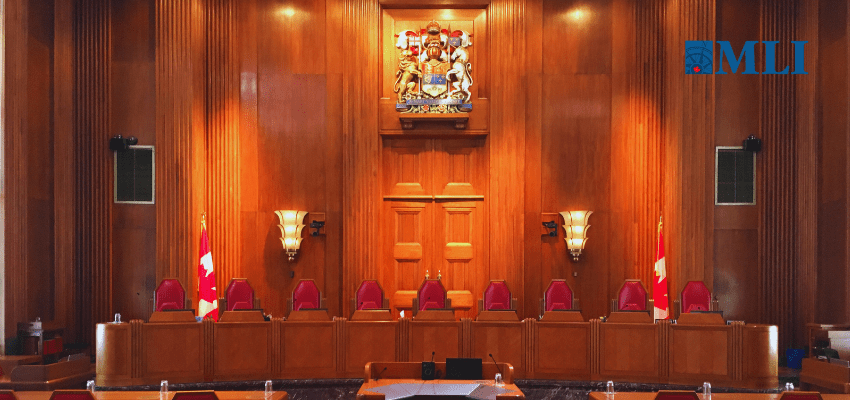
Last week, the Supreme Court heard oral arguments on the challenge against Quebec’s secularism law, which imposes all manners of restrictions on the public practice of religion in the name of secularism. For good measure, the legislature insulated it from constitutional challenge by invoking the notwithstanding clause.

Both the bill’s substance (with a few small exceptions) as well as Quebec’s invocation of Section 33 were upheld in the Quebec Court of Appeal. But critics of the law, supported by the federal government and numerous NGOs, have taken the case to the Supreme Court. They hope not only to strike down the law, but to introduce limits on the invocation of Section 33, a longstanding goal of a segment of the Laurentian elite (think Andrew Coyne).

It is impossible to exaggerate how dangerous such an outcome would be for the future of the country. The law enjoys broad popular support in Quebec, and the notwithstanding clause has long been viewed as a necessary override for a bill of rights many in la belle province consider to be illegitimate. Any move against by the Supreme Court could lead to the beginning of the country’s breakup.

Yet there is little evidence that such concerns have percolated to the court or the advocates of finishing the country’s transformation into a judicial dictatorship, and possibly a rump state. Trump was of course invoked. Guy Pratte, the lawyer for the attorney general of Canada, claimed that if Section 33 were left alone, legislators could introduce slavery, a suggestion which did not find a ready audience even among their lordships. In any case, a legislature which is capable of introducing slavery is unlikely to feel bound by a scrap of paper.

But you could see why Pratte tried to use a hypothetical to challenge the constitutionality of a real law: the Supreme Court has held, for example, that a one-year mandatory minimum sentence for possession of child pornography is unconstitutional because the court can imagine scenarios in which possession of child pornography might not be that bad.

What about that old Roman tag, let justice be done, though the heavens fall? The problem is that nothing in the text of the Canadian Charter of Rights and Freedoms says that there are limits to the invocation of Section 33 beyond the fact that the legislature has to invoke it. Then the law is safe from the Charter for five years unless the notwithstanding clause is renewed. There are no other requirements, as the Supreme Court found in Ford v. Quebec (Attorney General) in 1988.

The text of the notwithstanding clause hasn’t changed since then: what the Canadian government is asking the Supreme Court of Canada to do is to amend the constitution without democratic consent. It is an attempt to relitigate the battle which Pierre Trudeau — who thought that a Canada without a constitutionalized bill of rights did not deserve to continue to exist as a state — lost in 1982 against the premiers, who insisted on safeguarding the prerogatives of the legislators and of the broader public through an override clause.
Now, some readers may not like the idea of those who are religiously observant being barred from certain public sector jobs because they wear religious headgear. I share their dislike for Quebec’s law. But we live in a democracy, and democracies are free to pass laws that are stupid. Elected politicians do not have the monopoly on stupidity just as judges do not have the sole guardianship of wisdom, as some of the Supreme Court’s justices believe.

In the end, you can vote out the former, but you’re stuck with the latter. And the latter have been racking up decisions that are not only outrageous to large segments of the public, but have done so in spite of the text, history and original public meaning of the law: declaring bike lanes protected by the Charter, mandatory minimums for child pornographers in violation of it, and drug use, prostitution and assisted suicide guaranteed by it. The court is drifting from the letter and spirit of the law with alarming regularity, which is why legislatures are responding in turn, by invoking the clause with greater frequency.

If the Supreme Court continues on its trajectory and decides to throw Canada’s future into the unknown by inventing limits on the notwithstanding clause, Parliament should use its powers under Section 9 of the Supreme Court Act, to remove from office any judge who voted for such restrictions. Judges hold office “during good behaviour” and trying to eviscerate the Canadian constitution would definitely not be that.

Editor’s note: Parliament has authority to remove a Supreme Court justice under the Supreme Court Act. An earlier version of this column misstated, which provision could be used to remove a judge


Yuan Yi Zhu is an assistant professor in international relations and international law at Leiden University, The Netherlands, a member of the Macdonald-Laurier Institute’s Judicial Foundations Project, and a research associate at the University of British Columbia’s Research Group for Constitutional Law and Legal Studies.
Source: National Post
Tags: Yuan Yi Zhu

Related Posts

University of Austin exposes everything wrong with Canadian universities: Peter MacKinnon in the National Post
Education

University of Austin exposes everything wrong with Canadian universities: Peter MacKinnon in the National Post

April 2, 2026
Housing affordability requires increased construction productivity, not just more workers: Murtaza Haider and Peter Copeland in National Newswatch
Housing

Housing affordability requires increased construction productivity, not just more workers: Murtaza Haider and Peter Copeland in National Newswatch

April 2, 2026
Outsmarting the machine – Ensuring students learn to think in the AI age: Paul W. Bennett for Inside Policy
Education

Outsmarting the machine – Ensuring students learn to think in the AI age: Paul W. Bennett for Inside Policy

April 2, 2026
Next Post
Independent in name only – Lifting the veil on Canada’s broken judicial selection process: Collin May for Inside Policy

Independent in name only - Lifting the veil on Canada’s broken judicial selection process: Collin May for Inside Policy

Newsletter Signup

  Thank you for Signing Up
  Please correct the marked field(s) below.
Email Address  *
1,true,6,Contact Email,2
First Name *
1,true,1,First Name,2
Last Name *
1,true,1,Last Name,2
*
*Required Fields

Follow us on

Macdonald-Laurier Institute

323 Chapel Street, Suite #300
Ottawa, Ontario, K1N 7Z2 Canada

613.482.8327

info@macdonaldlaurier.ca
MLI directory

Support Us

Support the Macdonald-Laurier Institute to help ensure that Canada is one of the best governed countries in the world. Click below to learn more or become a sponsor.

Support Us

  • Inside Policy Magazine
  • Annual Reports
  • Jobs
  • Privacy Policy

© 2023 Macdonald-Laurier Institute. All Rights reserved.

No Result
View All Result
  • Home
  • About
    • Who We Are
    • Who Makes MLI Work
    • Fifteenth Anniversary
  • Experts
    • Experts Directory
    • In Memoriam
  • Issues
    • Domestic Policy
      • Economic Policy
      • Justice
      • Rights and Freedoms
      • Assisted Suicide (MAID)
      • Health Care
      • COVID-19
      • Gender Identity
      • Canada’s Political Tradition
      • AI, Technology and Innovation
      • Media and Telecoms
      • Housing
      • Immigration
      • Agriculture and Agri-Food
      • Competition Policy
    • Energy Policy
      • Energy
      • Environment
    • Foreign Policy
      • Israel-Hamas War
      • Ukraine
      • Taiwan
      • China
      • Europe and Russia
      • Indo-Pacific
      • Middle East and North Africa
      • North America
      • Foreign Interference
      • National Defence
      • National Security
      • Foreign Affairs
    • Indigenous Affairs
  • Projects
    • CNAPS (Center for North American Prosperity and Security)
    • Justice Report Card
    • The Promised Land
    • Voices that Inspire: The Macdonald-Laurier Vancouver Speaker Series
    • Dragon at the door
    • Canada on top of the world
    • Letter to a minister
    • The Great Energy Crisis
    • DisInfoWatch.org
    • Managing Indigenous Prosperity
    • Judicial Foundations
    • Landmark Cases Council
    • Defending The Marketplace of Ideas
    • Reforming the University
    • Past Projects
      • Digital Policy & Connectivity
      • Double Trouble
      • Canada and the Indo-Pacific Initiative
      • The Transatlantic Program
      • COVID Misery Index
      • Speak for Ourselves
      • The Eavesdropping Dragon: Huawei
      • Talkin’ in the Free World with Mariam Memarsadeghi
      • An Intellectual Property Strategy for Canada
      • Munk Senior Fellows
      • A Mandate for Canada
      • Confederation Series
      • Fiscal Reform
      • The Canadian Century project
      • Fixing Canadian health care
      • Internal trade
      • From a mandate for change
      • Size of government in Canada
      • Straight Talk
      • Labour Market Report
      • Leading Economic Indicator
      • Centre for Advancing Canada’s Interests Abroad
      • Indigenous Prosperity at a Crossroads
  • Events
    • Upcoming Events
    • Past Events
      • MLI Dinners
      • Great Canadian Debates
  • Latest News
  • Libraries
    • Columns
    • Commentary
    • Papers
    • Books
    • Video
  • Donate

© 2023 Macdonald-Laurier Institute. All Rights reserved.