Friday, April 3, 2026
No Result
View All Result
  • Media
Macdonald-Laurier Institute
  • Home
  • About
    • Who We Are
    • Who Makes MLI Work
    • Fifteenth Anniversary
  • Experts
    • Experts Directory
    • In Memoriam
  • Issues
    • Domestic Policy
      • Economic Policy
      • Justice
      • Rights and Freedoms
      • Assisted Suicide (MAID)
      • Health Care
      • COVID-19
      • Gender Identity
      • Canada’s Political Tradition
      • AI, Technology and Innovation
      • Media and Telecoms
      • Housing
      • Immigration
      • Agriculture and Agri-Food
      • Competition Policy
    • Energy Policy
      • Energy
      • Environment
    • Foreign Policy
      • Israel-Hamas War
      • Ukraine
      • Taiwan
      • China
      • Europe and Russia
      • Indo-Pacific
      • Middle East and North Africa
      • North America
      • Foreign Interference
      • National Defence
      • National Security
      • Foreign Affairs
    • Indigenous Affairs
  • Projects
    • CNAPS (Center for North American Prosperity and Security)
    • Justice Report Card
    • The Promised Land
    • Voices that Inspire: The Macdonald-Laurier Vancouver Speaker Series
    • Dragon at the door
    • Canada on top of the world
    • Letter to a minister
    • The Great Energy Crisis
    • DisInfoWatch.org
    • Managing Indigenous Prosperity
    • Judicial Foundations
    • Landmark Cases Council
    • Defending The Marketplace of Ideas
    • Reforming the University
    • Past Projects
      • Digital Policy & Connectivity
      • Double Trouble
      • Canada and the Indo-Pacific Initiative
      • The Transatlantic Program
      • COVID Misery Index
        • Provincial COVID Misery Index
        • Beyond Lockdown
        • COVID and after: A mandate for recovery
      • Speak for Ourselves
      • The Eavesdropping Dragon: Huawei
      • Talkin’ in the Free World with Mariam Memarsadeghi
      • An Intellectual Property Strategy for Canada
      • Munk Senior Fellows
      • A Mandate for Canada
      • Confederation Series
      • Fiscal Reform
      • The Canadian Century project
      • Fixing Canadian health care
      • Internal trade
      • From a mandate for change
      • Size of government in Canada
      • Straight Talk
      • Labour Market Report
      • Leading Economic Indicator
      • Centre for Advancing Canada’s Interests Abroad
      • Indigenous Prosperity at a Crossroads
        • Aboriginal Canada and Natural Resources
  • Events
    • Upcoming Events
    • Past Events
      • MLI Dinners
      • Great Canadian Debates
  • Latest News
  • Libraries
    • Columns
    • Commentary
    • Papers
    • Books
    • Video
  • Donate
  • Home
  • About
    • Who We Are
    • Who Makes MLI Work
    • Fifteenth Anniversary
  • Experts
    • Experts Directory
    • In Memoriam
  • Issues
    • Domestic Policy
      • Economic Policy
      • Justice
      • Rights and Freedoms
      • Assisted Suicide (MAID)
      • Health Care
      • COVID-19
      • Gender Identity
      • Canada’s Political Tradition
      • AI, Technology and Innovation
      • Media and Telecoms
      • Housing
      • Immigration
      • Agriculture and Agri-Food
      • Competition Policy
    • Energy Policy
      • Energy
      • Environment
    • Foreign Policy
      • Israel-Hamas War
      • Ukraine
      • Taiwan
      • China
      • Europe and Russia
      • Indo-Pacific
      • Middle East and North Africa
      • North America
      • Foreign Interference
      • National Defence
      • National Security
      • Foreign Affairs
    • Indigenous Affairs
  • Projects
    • CNAPS (Center for North American Prosperity and Security)
    • Justice Report Card
    • The Promised Land
    • Voices that Inspire: The Macdonald-Laurier Vancouver Speaker Series
    • Dragon at the door
    • Canada on top of the world
    • Letter to a minister
    • The Great Energy Crisis
    • DisInfoWatch.org
    • Managing Indigenous Prosperity
    • Judicial Foundations
    • Landmark Cases Council
    • Defending The Marketplace of Ideas
    • Reforming the University
    • Past Projects
      • Digital Policy & Connectivity
      • Double Trouble
      • Canada and the Indo-Pacific Initiative
      • The Transatlantic Program
      • COVID Misery Index
        • Provincial COVID Misery Index
        • Beyond Lockdown
        • COVID and after: A mandate for recovery
      • Speak for Ourselves
      • The Eavesdropping Dragon: Huawei
      • Talkin’ in the Free World with Mariam Memarsadeghi
      • An Intellectual Property Strategy for Canada
      • Munk Senior Fellows
      • A Mandate for Canada
      • Confederation Series
      • Fiscal Reform
      • The Canadian Century project
      • Fixing Canadian health care
      • Internal trade
      • From a mandate for change
      • Size of government in Canada
      • Straight Talk
      • Labour Market Report
      • Leading Economic Indicator
      • Centre for Advancing Canada’s Interests Abroad
      • Indigenous Prosperity at a Crossroads
        • Aboriginal Canada and Natural Resources
  • Events
    • Upcoming Events
    • Past Events
      • MLI Dinners
      • Great Canadian Debates
  • Latest News
  • Libraries
    • Columns
    • Commentary
    • Papers
    • Books
    • Video
  • Donate
No Result
View All Result
Macdonald-Laurier Institute

Canadian digital sovereignty depends on semiconductors: Erik Henningsmoen in National Newswatch

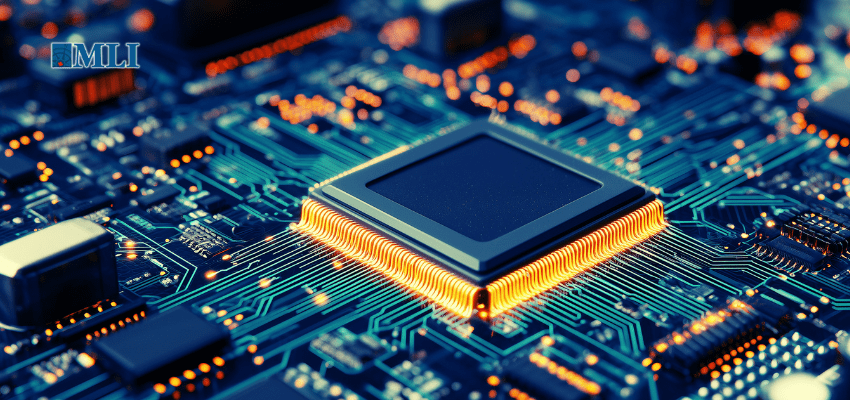
Canada is the only G7 country without a comprehensive national semiconductor strategy. Yet its digital sovereignty depends upon semiconductors, the small chips that provide information processing and memory to computers and other electronic devices.

March 30, 2026
in Domestic Policy, Latest News, Columns, AI, Technology and Innovation, In the Media
Reading Time: 4 mins read
A A
Canadian digital sovereignty depends on semiconductors: Erik Henningsmoen in National Newswatch

Image via Canva.

This article originally appeared in National Newswatch.

By Erik Henningsmoen, March 30, 2026

These chips are crucial to strategic Canadian industries—like aerospace and defence, health tech, automotive manufacturing, and telecommunications—which rely on secure semiconductor supply chains and innovative chip designs. Semiconductors are crucial in advanced computing applications, including artificial intelligence (AI) and quantum computing. Specialized AI chips provide the immense computing power needed in modern datacenters for tasks such as training and operating large language models. McKinsey & Company forecasts that the global semiconductor market will be valued at USD $1 trillion by 2030.

That’s why secure semiconductor supply chains are crucial to the continued development of Canada’s digital economy and advanced manufacturing. Yet semiconductor supply chain risks—like geopolitical tensions, foreign ownership, and natural disasters—could disrupt the flow and present a strategic threat. Presently, the industry is highly geographically concentrated among just five countries: the United States, South Korea, Japan, Taiwan, and China.

Today, Canada is home to a small but innovative semiconductor industry—a mix of domestic companies and multinational firms operating in Canada. They are located primarily in Ontario and Québec, with secondary industry clusters in British Columbia and Alberta. The industry is particularly strong in research and development and chip design. Economic analysis by Statistics Canada estimates that in 2020 Canada’s semiconductor industry created $28.8 billion in total economic output and accounted for nearly 10 per cent of total in-house R&D spending.

While Canada does not currently have a large‑scale fabricator capable of mass-producing advanced logic and memory chips—like those found in several of the top semiconductor producing countries—it does have some specialized semiconductor fabrication facilities, most notably the Canadian Photonics Fabrication Centre, which focuses on photonic and compound semiconductor devices.

Innovative Canadian firms are at the forefront of semiconductor technology and compete globally. Canada’s strengths include AI chip design, photonics, advanced packaging, and compound semiconductors, all of which have important applications for next-generation AI datacentres.

Yet all of this is being carried out without the backbone of a national semiconductor strategy. Canada’s small but innovative industry could benefit from a coherent plan to maximize our economic potential with a focus on digital sovereignty. Such a strategy would dovetail well with Canada’s 2024 sovereign AI compute national strategy and the federal government’s forthcoming renewed national AI strategy.

The strategy should include provisions to attract investments in domestic chip fabrication and advanced packaging capacity, promote industrial clusters around newly established fabrication facilities, and support targeted R&D investments to foster and protect Canadian IP in advanced chip technology.

With significant portions of Canada’s semiconductor workforce heading to retirement in the next five to ten years, the strategy should seek to attract Canadian STEM talent through education and workforce development.

Furthermore, it must foster international linkages and secure chip supply chains with allies. Canada’s wealth of critical mineral resources, required for chip production, could be an important asset in these relationships.

When it comes to semiconductors, sovereignty does not equate to autarky—developing full self-reliance would be astronomically expensive and divert resources away from other important national priorities. The semiconductor industry is hyper-globalized; no country has the capability to cover all the steps and inputs needed to produce the most advanced chips.

Instead, semiconductor sovereignty should be thought of as having deployable semiconductor technology that Canada’s trade partners and allies need, while also having enough self-sufficiency to be able to absorb a major chip supply chain disruption and still have its digital economy function. Sovereignty in this regard would buy the Canadian economy time to adapt to economic and geopolitical shocks.

Canada does not need to compete directly with leading semiconductor-producing countries, nor does it need to become fully self-sufficient in chip production to protect its digital sovereignty.

Rather, a Canadian semiconductor strategy needs to highlight the important role that semiconductors play in Canada’s modern digital economy, understand current risks and uncertainties in the global semiconductor supply chain, and further foster Canada’s already successful semiconductor industry. It needs to play towards the country’s existing technological strengths and mitigate supply chain risks, while developing the talent needed to drive the industry forward and create national resilience.


Erik Henningsmoen is a senior research and policy analyst with the Information and Communications Technology Council (ICTC) and a contributor to the Macdonald-Laurier Institute.

Source: National Newswatch
Tags: Erik Henningsmoen

Related Posts

University of Austin exposes everything wrong with Canadian universities: Peter MacKinnon in the National Post
Education

University of Austin exposes everything wrong with Canadian universities: Peter MacKinnon in the National Post

April 2, 2026
Housing affordability requires increased construction productivity, not just more workers: Murtaza Haider and Peter Copeland in National Newswatch
Housing

Housing affordability requires increased construction productivity, not just more workers: Murtaza Haider and Peter Copeland in National Newswatch

April 2, 2026
Outsmarting the machine – Ensuring students learn to think in the AI age: Paul W. Bennett for Inside Policy
Education

Outsmarting the machine – Ensuring students learn to think in the AI age: Paul W. Bennett for Inside Policy

April 2, 2026
Next Post
The Charter was a huge mistake: Geoffrey Sigalet on the Canada Did What? podcast

The Charter was a huge mistake: Geoffrey Sigalet on the Canada Did What? podcast

Newsletter Signup

  Thank you for Signing Up
  Please correct the marked field(s) below.
Email Address  *
1,true,6,Contact Email,2
First Name *
1,true,1,First Name,2
Last Name *
1,true,1,Last Name,2
*
*Required Fields

Follow us on

Macdonald-Laurier Institute

323 Chapel Street, Suite #300
Ottawa, Ontario, K1N 7Z2 Canada

613.482.8327

info@macdonaldlaurier.ca
MLI directory

Support Us

Support the Macdonald-Laurier Institute to help ensure that Canada is one of the best governed countries in the world. Click below to learn more or become a sponsor.

Support Us

  • Inside Policy Magazine
  • Annual Reports
  • Jobs
  • Privacy Policy

© 2023 Macdonald-Laurier Institute. All Rights reserved.

No Result
View All Result
  • Home
  • About
    • Who We Are
    • Who Makes MLI Work
    • Fifteenth Anniversary
  • Experts
    • Experts Directory
    • In Memoriam
  • Issues
    • Domestic Policy
      • Economic Policy
      • Justice
      • Rights and Freedoms
      • Assisted Suicide (MAID)
      • Health Care
      • COVID-19
      • Gender Identity
      • Canada’s Political Tradition
      • AI, Technology and Innovation
      • Media and Telecoms
      • Housing
      • Immigration
      • Agriculture and Agri-Food
      • Competition Policy
    • Energy Policy
      • Energy
      • Environment
    • Foreign Policy
      • Israel-Hamas War
      • Ukraine
      • Taiwan
      • China
      • Europe and Russia
      • Indo-Pacific
      • Middle East and North Africa
      • North America
      • Foreign Interference
      • National Defence
      • National Security
      • Foreign Affairs
    • Indigenous Affairs
  • Projects
    • CNAPS (Center for North American Prosperity and Security)
    • Justice Report Card
    • The Promised Land
    • Voices that Inspire: The Macdonald-Laurier Vancouver Speaker Series
    • Dragon at the door
    • Canada on top of the world
    • Letter to a minister
    • The Great Energy Crisis
    • DisInfoWatch.org
    • Managing Indigenous Prosperity
    • Judicial Foundations
    • Landmark Cases Council
    • Defending The Marketplace of Ideas
    • Reforming the University
    • Past Projects
      • Digital Policy & Connectivity
      • Double Trouble
      • Canada and the Indo-Pacific Initiative
      • The Transatlantic Program
      • COVID Misery Index
      • Speak for Ourselves
      • The Eavesdropping Dragon: Huawei
      • Talkin’ in the Free World with Mariam Memarsadeghi
      • An Intellectual Property Strategy for Canada
      • Munk Senior Fellows
      • A Mandate for Canada
      • Confederation Series
      • Fiscal Reform
      • The Canadian Century project
      • Fixing Canadian health care
      • Internal trade
      • From a mandate for change
      • Size of government in Canada
      • Straight Talk
      • Labour Market Report
      • Leading Economic Indicator
      • Centre for Advancing Canada’s Interests Abroad
      • Indigenous Prosperity at a Crossroads
  • Events
    • Upcoming Events
    • Past Events
      • MLI Dinners
      • Great Canadian Debates
  • Latest News
  • Libraries
    • Columns
    • Commentary
    • Papers
    • Books
    • Video
  • Donate

© 2023 Macdonald-Laurier Institute. All Rights reserved.