
By Milton Friesen, March 20, 2026
Canada’s housing crisis is usually framed as a shortage of homes. But the problem runs deeper: Canada has become steadily worse at building housing.
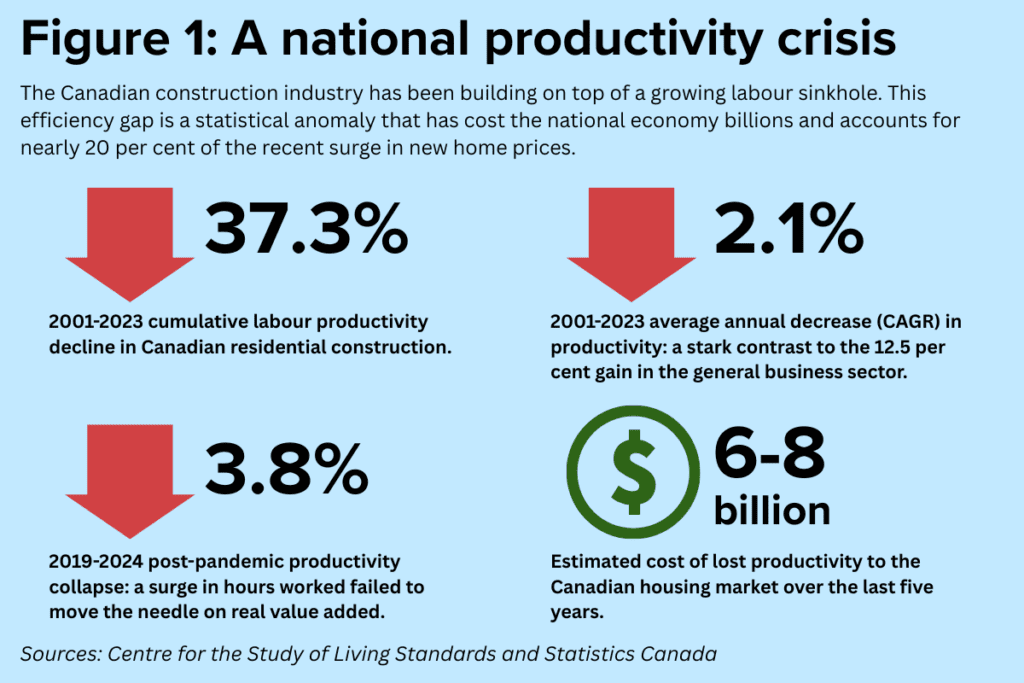
Over the past two decades, labour productivity in residential construction has fallen sharply. Builders are putting in more hours and employing more workers, yet producing less value per worker than they once did. Data from Statistics Canada shows that labour productivity in Canadian residential construction declined by more than a third between 2001 and 2023.
The consequences are profound. When productivity falls, housing becomes slower and more expensive to build – making it harder for supply to keep pace with demand.
This national trend is not driven by a single market or region. It reflects structural challenges across Canada’s housing industry: fragmented construction firms, growing regulatory complexity, and slow adoption of productivity-enhancing technologies.
To understand how these forces play out on the ground, this article uses Regina as a specific example of what is common across the country. The Saskatchewan capital may not face the extreme land constraints of Canada’s largest cities, but its construction sector illustrates many of the same productivity pressures shaping housing markets from coast to coast to coast.
By looking closely at Regina’s experience, including its challenges, constraints, and emerging solutions, we can see more clearly what Canada must do to build more homes, faster and more efficiently.
Regina’s housing productivity decline
The underlying cause of Regina’s building productivity stagnation is found in the structural features of the housing industry. The residential construction sector is very fragmented, dominated by small firms that can produce housing with traditional methods but lack the resources to improve overall productivity through innovation. Statistics Canada reveals that firms with fewer than 20 employees account for two-thirds of the industry’s total employment. In Regina, these small players are the backbone of the market, but the inability to innovate – to get more value out of an hour of work – means that as material and labour costs go up, productivity steadily ratchets down.
These challenges aren’t unique to Regina. The housing crisis is impacting communities large and small across the country. Solving the crisis is crucial for addressing larger issues of poverty and security, as well as improving Canada’s overall competitiveness on the world stage.
Labour productivity (the value produced by what a worker builds) is a potent indicator of economic vitality. Highly productive labour allows societies to build more with less, translating human effort into shelter without necessitating a straight, linear expansion of the workforce.
In Regina, the construction industry simply can’t keep pace with demand. The industry is deeply mired in tired approaches that lack innovation. This, in turn, acts as a drag on the local and provincial economies.
Sharpening our focus further, the smallest firms – those with fewer than five employees – experienced the most aggressive productivity erosion, at -2.3 per cent CAGR (Compound Annual Growth Rate). This fragmentation is particularly evident in Regina’s shifting urban landscape. As the city moves from simple greenfield sprawl to more complex projects, such as the “retrofitting of downtown buildings” or high-density infill, the limitations of small firms become apparent.
A five-person crew may be efficient at framing a single-family home in a new subdivision, but they lack the scale to manage the regulatory, logistical, and technical complexities of a multi-unit downtown retrofit. Without the scale to adopt Building Information Modelling (BIM) (a data-driven 3-D modelling tool) or advanced robotics, these firms are locked in a “technological trap” – better tools and processes exist but are not widely implemented. Incentives and programs need to make BIM adoption a competitive advantage for the large number of construction firms and builders with fewer than 20 employees.
Statistics Canada reports that the smallest firms face a 10 per cent productivity disadvantage compared to their larger counterparts. In a market like Regina, where micro-firms are the norm, this creates a structural “ceiling” on housing starts. Consolidation may appear to be the cure, but the data suggests larger firms are only slightly more productive – not enough to reverse the downward trend. This means the problem isn’t just size – it’s the absence of technological adoption across the entire spectrum of the industry. We are not changing how we build.
Regina’s housing productivity problem Isn’t unique
To the casual observer navigating Regina’s burgeoning subdivisions, the local residential construction sector appears as a portrait of industrious health. Farmland has grown hundreds of houses and nail guns join the meadowlark songs of summer. But this visible activity masks a sclerotic internal reality – an invisible “productivity collapse” that has been grinding away at our vitality for more than 30 years.
And it’s happening everywhere. According to the latest Statistics Canada data, the construction industry in Canada has been building on top of a growing sinkhole of labour: we are working harder, but getting less value. In the high-stakes theatre of Canadian real estate, this efficiency gap is not merely a statistical anomaly; it is a radiating structural stress that has cost the national economy billions in lost productivity since 2019 and accounts for nearly 20 per cent of the recent surge in new home prices (see Figure 1).
While the national outlook is grim, Saskatchewan’s performance suggests a “fragile bulwark” – a relative resilience compared to the rest of Canada that is currently being tested by the same gravitational forces of inefficiency.
The Saskatchewan hope: We aren’t as bad as some
In the narrative of Canadian housing, Saskatchewan has long occupied the role of the “economic outlier.” While productivity has been sliding in the overheated markets of the GTA and the Lower Mainland, the Saskatchewan market has managed a level of stability that appears to be a strategic triumph. This “Saskatchewan Hope” is verified by the Compound Annual Growth Rate (CAGR) of labour productivity: where the national average was nose-down at -2.1 per cent, Saskatchewan’s decline was a comparatively modest slide of -0.3 per cent (see Figure 2).
Of course, Saskatchewan residents should not feel too complacent. When it comes to productivity, Saskatchewan may not be sinking as fast as its provincial neighbours, but over the decades, it has sunk low enough for its residents to be worried.
Interrogation of the data reveals a problem. While the province enjoyed a 2.2 per cent annual growth in real output, this was cannibalized by a 2.5 per cent growth in jobs. The driver behind the math is simple: the province is hiring faster than it is building. Again, compared to Ontario, which suffered a catastrophic -3.0 per cent CAGR, Saskatchewan looks healthy, but it is effectively running faster just to stay in the same place. In other words, the water is coming in faster than we can bail it out.
Provincial averaging masks the specific pressures within Regina. To understand why construction capital is being eroded we need to shift our focus from provincial borders to the local city streetscape.
The Regina vs. Saskatoon dynamic: Metropolitan efficiency bleed
City by city analysis reflects that there is variation across the country. City-level analysis is the only way to identify where construction capital value is losing ground. Using Saskatoon as a reliable proxy for the Saskatchewan urban landscape, the worrying trend is that job growth in construction surged 4 per cent annually but real output struggled to keep pace at 3 per cent (CMHC).
In Regina, this 0.3 per cent to 1.0 per cent efficiency gap represents a slow-motion impact. When jobs grow faster than the value of what is produced, it generally signals a systemic failure to invest in capital equipment or managerial software that could generate more output for each hour worked.
As is the case across Canada, instead of using technology to bridge the gap, Regina’s builders are resorting to “brute force” construction – adding more bodies to the job site to compensate for stagnant processes. This is not a sign of a healthy job market; it is a sign of “labour hoarding” – keeping construction workers employed but not necessarily in housing production work. Housing is persistently hitting a technological ceiling – no significant innovations, just more effort invested in the same processes. While growth pressures create the demand, it is the microscopic structure of the firms themselves that determines whether affordable housing demand will be met.
How we build matters
Statistics Canada reports that the smallest firms face a 10 per cent productivity disadvantage compared to their larger counterparts. In a market like Regina, where micro-firms are the norm, this creates a structural “ceiling” on housing starts. Consolidation is often cited as the cure, but the data suggests a darker truth: even larger firms are seeing productivity slides, meaning the problem isn’t just size – it’s the absence of technological adoption across the entire spectrum of the industry. We are not changing how we build.
Macroeconomic headwinds and the “labour hoarding” trap
The strategic risk of economic volatility cannot be overstated. Regina’s builders are currently navigating a post-pandemic landscape defined by what Canadian economist Aled ab Iorwerth describes as a “productivity collapse.” The national -3.8 per cent decline from 2019 to 2024 reflects an industry that is doggedly resistant to innovation.
In Regina’s tight labour market, “labour hoarding” has become a strategic survival mechanism. Builders, terrified of losing skilled tradespeople during a downturn only to be left empty-handed during the next boom, keep workers on the payroll even when output drops. While this preserves skills, it destroys productivity metrics, as more “hours worked” produce fewer “units completed.” This survival instinct, though rational for an individual firm with five employees, is perversely killing the industry’s ability to adapt forward – the capacity of a seasonally driven crew doesn’t go into finding better ways to build.
This is exacerbated by a staggering regulatory burden. As noted by Beata Caranci and James Marple, construction is uniquely hit by overlapping federal, provincial, and municipal policies. In Regina, a builder might face municipal zoning delays, provincial building code shifts, and federal environmental mandates simultaneously. Each order of government makes demands that seem reasonable – even necessary – within their own context. The problem is that when everyone does this, the total burden crushes productivity – death by pebbles rather than a single large stone. Canada has been ranked near the very bottom of OECD countries in regulatory efficiency in housing.
When combined with soaring material costs and supply chain disruptions, regulatory smothering makes innovation impossible. Why gamble on a million-dollar modular construction facility when a single regulatory delay or interest rate hike could bankrupt the small firm trying to gear up using new approaches? This uncertainty locks Regina into a cycle of “tried-and-tested” manual methods that are as inefficient as they are familiar. Take away the new trucks, battery-powered nail guns, and laser levels, and you wouldn’t know if you were on a jobsite in 1980 or 2026.
A blueprint for change: Lessons from the global stage
Reversing this slide requires a cross-sector approach that moves beyond small adjustments. If Saskatchewan is to prevent a permanent loss of affordability and economic decline, the government must act as risk-reduction partner for industry innovation.
International best practices for the Saskatchewan market
Canada can learn from international players who are well ahead of us, but that needs to translate into city-level changes that reach the 66 per cent of small firms. The following examples offer potential solutions that can be adapted for our own domestic housing markets and have been highlighted as a way forward by CMHC.
Singapore’s PIP
The Productivity Innovation Project offers 70 per cent co-funding for on-site productivity and was already active more than 15 years ago. Regina and other Canadian cities could adapt this through provincial grants specifically targeted at small firms adopting digital project management.
UK’s BIM mandate
By requiring Building Information Modelling for all public and social housing, the United Kingdom has standardized digital data. Municipal governments in Canada could lead by mandating BIM for all high-density developments and new developments on greenfields.
Japan’s i-Construction
Japan addresses its labour shortage through robotics and autonomous haulage (the Shimizu Smart Site). While Regina and other cities may not be ready for autonomous welding, the principle of using automation to replace repetitive, high-turnover labour is the only long-term solution to the trades shortage.
At the federal level, the new agency Build Canada Homes aims to “supercharge” homebuilding by incentivizing offsite and modular construction. The burning question is: Will this federal effort do anything directly for small construction firms in Regina and other smaller cities? By moving construction from the unpredictable prairie weather into controlled factory environments, the industry could achieve the economies of scale that have been eroding over past decades. Systems that support the industry need to be much smarter than they are now.
The path to productivity
The arithmetic of the next decade is unforgiving. If Regina is to meet the national goal of doubling housing starts by 2035, it must confront the reality that its current productivity drag – the 0.3 per cent to 2.1 per cent annual efficiency loss – makes that target a mathematical impossibility. We cannot simply hire our way out of this crisis; the labour pool is too shallow and the costs are too high.
As Gita Bhatt of the International Monetary Fund notes, housing is a “unique economic asset” that is central to financial stability. Regina’s inability to solve its productivity paradox is not just a problem for aspiring homeowners; it is a threat to the city’s broader economic health. Without aggressive regulatory reform to reduce the burden on builders and a concerted effort to build industry confidence in new technologies, the gap between Regina’s current output and its 2035 requirements will only widen.
Across the country, countless other communities are facing the same challenges. And they all stand to benefit from finding effective and efficient solutions.
Improving housing productivity will reduce poverty, educational disparity, housing insecurity, and economic decline. The era of manual, fragmented construction is reaching its logical end. To bridge the gap, the construction industry must stop hoarding labour and start unleashing innovation. Anything less is merely managing a disturbing decline.
Milton Friesen is Vice President of Strategy & Growth at Campbell & Haliburton Group of Companies in Regina. He previously served as managing director of CitiIQ, a Canadian data company specializing in advanced city measurement, and as an elected municipal councillor in Warman, Saskatchewan. He also contributed to the Program Committee for the Computational Social Sciences Society of the Americas and serves on the board of the Certified Management Consultants of Saskatchewan.