Friday, March 20, 2026
No Result
View All Result
  • Media
Macdonald-Laurier Institute
  • Home
  • About
    • Who We Are
    • Who Makes MLI Work
    • Fifteenth Anniversary
  • Experts
    • Experts Directory
    • In Memoriam
  • Issues
    • Domestic Policy
      • Economic Policy
      • Justice
      • Rights and Freedoms
      • Assisted Suicide (MAID)
      • Health Care
      • COVID-19
      • Gender Identity
      • Canada’s Political Tradition
      • AI, Technology and Innovation
      • Media and Telecoms
      • Housing
      • Immigration
      • Agriculture and Agri-Food
      • Competition Policy
    • Energy Policy
      • Energy
      • Environment
    • Foreign Policy
      • Israel-Hamas War
      • Ukraine
      • Taiwan
      • China
      • Europe and Russia
      • Indo-Pacific
      • Middle East and North Africa
      • North America
      • Foreign Interference
      • National Defence
      • National Security
      • Foreign Affairs
    • Indigenous Affairs
  • Projects
    • CNAPS (Center for North American Prosperity and Security)
    • Justice Report Card
    • The Promised Land
    • Voices that Inspire: The Macdonald-Laurier Vancouver Speaker Series
    • Dragon at the door
    • Canada on top of the world
    • Letter to a minister
    • The Great Energy Crisis
    • DisInfoWatch.org
    • Managing Indigenous Prosperity
    • Judicial Foundations
    • Landmark Cases Council
    • Defending The Marketplace of Ideas
    • Reforming the University
    • Past Projects
      • Digital Policy & Connectivity
      • Double Trouble
      • Canada and the Indo-Pacific Initiative
      • The Transatlantic Program
      • COVID Misery Index
        • Provincial COVID Misery Index
        • Beyond Lockdown
        • COVID and after: A mandate for recovery
      • Speak for Ourselves
      • The Eavesdropping Dragon: Huawei
      • Talkin’ in the Free World with Mariam Memarsadeghi
      • An Intellectual Property Strategy for Canada
      • Munk Senior Fellows
      • A Mandate for Canada
      • Confederation Series
      • Fiscal Reform
      • The Canadian Century project
      • Fixing Canadian health care
      • Internal trade
      • From a mandate for change
      • Size of government in Canada
      • Straight Talk
      • Labour Market Report
      • Leading Economic Indicator
      • Centre for Advancing Canada’s Interests Abroad
      • Indigenous Prosperity at a Crossroads
        • Aboriginal Canada and Natural Resources
  • Events
    • Upcoming Events
    • Past Events
      • MLI Dinners
      • Great Canadian Debates
  • Latest News
  • Libraries
    • Columns
    • Commentary
    • Papers
    • Books
    • Video
  • Donate
  • Home
  • About
    • Who We Are
    • Who Makes MLI Work
    • Fifteenth Anniversary
  • Experts
    • Experts Directory
    • In Memoriam
  • Issues
    • Domestic Policy
      • Economic Policy
      • Justice
      • Rights and Freedoms
      • Assisted Suicide (MAID)
      • Health Care
      • COVID-19
      • Gender Identity
      • Canada’s Political Tradition
      • AI, Technology and Innovation
      • Media and Telecoms
      • Housing
      • Immigration
      • Agriculture and Agri-Food
      • Competition Policy
    • Energy Policy
      • Energy
      • Environment
    • Foreign Policy
      • Israel-Hamas War
      • Ukraine
      • Taiwan
      • China
      • Europe and Russia
      • Indo-Pacific
      • Middle East and North Africa
      • North America
      • Foreign Interference
      • National Defence
      • National Security
      • Foreign Affairs
    • Indigenous Affairs
  • Projects
    • CNAPS (Center for North American Prosperity and Security)
    • Justice Report Card
    • The Promised Land
    • Voices that Inspire: The Macdonald-Laurier Vancouver Speaker Series
    • Dragon at the door
    • Canada on top of the world
    • Letter to a minister
    • The Great Energy Crisis
    • DisInfoWatch.org
    • Managing Indigenous Prosperity
    • Judicial Foundations
    • Landmark Cases Council
    • Defending The Marketplace of Ideas
    • Reforming the University
    • Past Projects
      • Digital Policy & Connectivity
      • Double Trouble
      • Canada and the Indo-Pacific Initiative
      • The Transatlantic Program
      • COVID Misery Index
        • Provincial COVID Misery Index
        • Beyond Lockdown
        • COVID and after: A mandate for recovery
      • Speak for Ourselves
      • The Eavesdropping Dragon: Huawei
      • Talkin’ in the Free World with Mariam Memarsadeghi
      • An Intellectual Property Strategy for Canada
      • Munk Senior Fellows
      • A Mandate for Canada
      • Confederation Series
      • Fiscal Reform
      • The Canadian Century project
      • Fixing Canadian health care
      • Internal trade
      • From a mandate for change
      • Size of government in Canada
      • Straight Talk
      • Labour Market Report
      • Leading Economic Indicator
      • Centre for Advancing Canada’s Interests Abroad
      • Indigenous Prosperity at a Crossroads
        • Aboriginal Canada and Natural Resources
  • Events
    • Upcoming Events
    • Past Events
      • MLI Dinners
      • Great Canadian Debates
  • Latest News
  • Libraries
    • Columns
    • Commentary
    • Papers
    • Books
    • Video
  • Donate
No Result
View All Result
Macdonald-Laurier Institute

What rising oil prices mean for your bank account: Trevor Tombe in The Hub

The conflict in Iran has disrupted oil and gas supplies through the Strait of Hormuz, leading to a 50 percent increase in oil prices, impacting Canadian households.

March 20, 2026
in Energy, Energy Policy, Latest News, Columns, Resources, In the Media, Trevor Tombe
Reading Time: 4 mins read
A A
What rising oil prices mean for your bank account: Trevor Tombe in The Hub

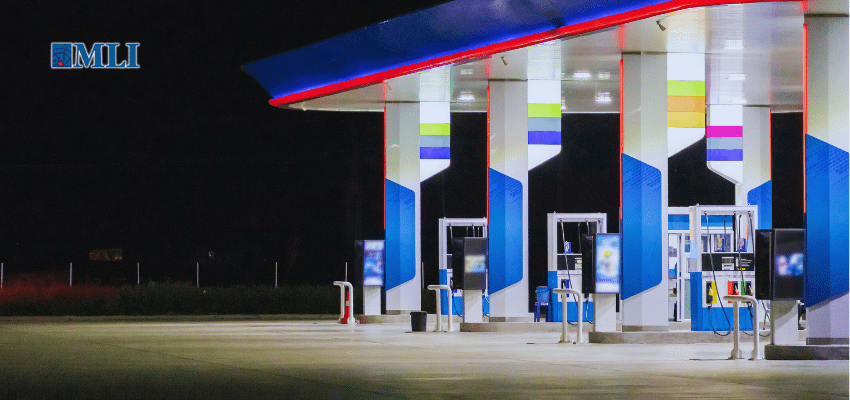
Image via Canva.

This article originally appeared in The Hub.

By Trevor Tombe, March 20, 2026

A widening conflict involving Iran, the United States, and Israel has led to a near-total halt of shipping through the Strait of Hormuz, a passage that handles a considerable share of global oil and gas supplies. If disruptions persist, this could represent one of the largest supply interruptions in recorded history.

We are already seeing the effects. Oil prices are up roughly 50 percent. Natural gas markets are also tightening, since liquefied natural gas exports move through the Strait as well, pushing prices higher, particularly in Europe. The region is also a major supplier of fertilizers, adding pressure to agricultural inputs. Meanwhile, shipping container costs are rising sharply in major ports around the world, as are insurance costs.

The potential implications for economies and households are obviously significant. But putting some numbers on the scale of the challenge may be valuable.

Canada is better positioned than in past shocks

Canada is somewhat better positioned to absorb an energy shock today than in the past. In the early 1970s, the amount of energy required to produce each dollar of GDP was roughly double what it is today. Our economy is simply far less energy-intensive than it once was.

Even so, oil and gas remain central to Canada’s economy, accounting for roughly two-thirds of total energy consumption. And gasoline alone still represents about 3 percent of household spending, right in the middle of the 2.5–4 percent range observed since at least the mid-1950s.

But the impact of higher oil prices extends far beyond what Canadians pay at the pump. Energy is embedded throughout the economy, affecting transportation, manufacturing, agriculture, and many other sectors.

To estimate those broader effects, I rely on a model of Canada’s economy that traces relationships across several hundred distinct product categories covering nearly the entire structure of production and consumer spending. This allows me to capture both the direct effects of higher fuel costs and the indirect effects that ripple through supply chains.

Total costs to consumers

If oil prices remain roughly 50 percent above last year’s levels, the direct effect on households would be immediate. Higher gasoline and fuel costs alone would raise consumer prices by about 0.6 percent. Within two weeks of the conflict starting, average gas prices rose nearly 35 cents a litre on average across the country. Over a year, that’s about a $500 for the average household in added costs.

And what about all the indirect supply chain implications? Transportation, manufacturing, and agriculture all rely heavily on fuel, meaning higher energy costs gradually push up the price of many goods and services.

Food is particularly exposed. Agriculture is among the most energy-intensive non-energy sectors of the economy, and higher fuel costs raise the cost of producing and transporting food. Over time, a sustained 50 percent increase in crude oil prices would raise grocery prices by roughly 1 percent, I estimate, adding about $75 per year for the typical household. Including the effect on restaurant prices brings the total food-related increase to roughly $100 annually.

Other sectors are affected as well. Air travel alone could add roughly $50 per year to the spending of the average household, with smaller but widespread increases appearing across many other goods and services.

Taken together, a sustained 50 percent rise in oil prices could push overall inflation a little more than one percentage point higher. And if fertilizer prices rise by a similar amount, as early indications suggest, the total effect on inflation could reach about 1.2 percentage points, meaning inflation would well exceed 3 percent overall.

In this scenario, Canadian food prices alone could increase by roughly 1.6 percent. That translates to about $120 more per year for groceries, which rises to roughly $150 once higher restaurant prices are included and to $175 with alcohol.

For the typical household, the overall cost increase would be nearly $1,000 per year.
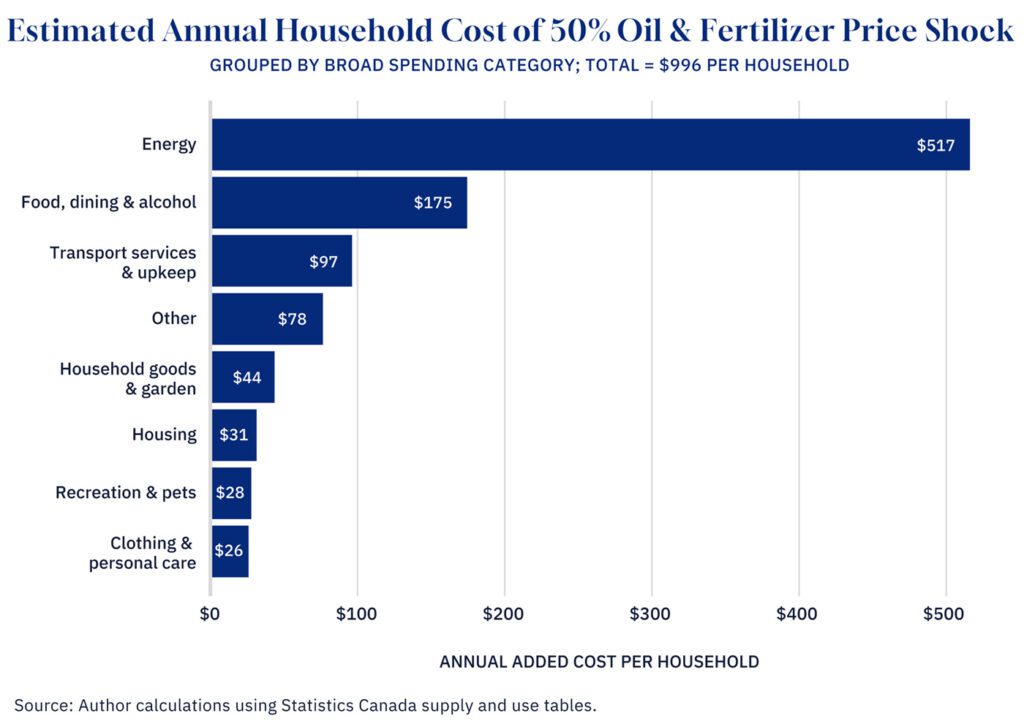
Graphic Credit: Janice Nelson.

Across the economy, the total effect amounts to roughly a $17-billion hit to Canadian consumers from this shock.

How large the impact ultimately becomes depends on how far oil prices rise and how long they remain elevated.

If crude prices were to climb to around $200 per barrel and stay there for a sustained period, the effects would be far larger. Inflation could exceed 6 percent, the typical household could face roughly $3,600 in additional annual costs, and the total hit to Canadian consumers could reach about $60 billion.

Higher oil prices also bring economic gains

But Canada is not only a consumer of oil. It is also a major producer. With over 1.9 billion barrels of annual production, higher prices generate enormous gains in income for producers, workers, investors, and governments. At prices near $200 per barrel, those gains would be roughly four to five times larger than the added costs faced by consumers.

That tension sits at the centre of every oil shock in Canada. Higher prices strain household budgets, but they also increase national income in a country that is one of the world’s largest energy producers.

What matters, then, is not whether higher oil prices are “good” or “bad” for Canada, but how their effects are distributed and over what time horizon. The same shock that raises national income can simultaneously erode purchasing power for millions of households.

The estimates here help anchor that distinction. They show that even in a country that benefits from higher energy prices overall, the first-order effect is an increase in the cost of living—one that is measurable, material, and, for many, difficult to avoid.


Trevor Tombe is a professor of economics at the University of Calgary, the Director of Fiscal and Economic Policy at The School of Public Policy, a Senior Fellow at the Macdonald-Laurier Institute, and a Fellow at the Public Policy Forum.

Source: The Hub

Related Posts

Middle power mirage
China: The dragon at the door

Carney’s middle-power mirage: Stephen Nagy in Canadian Affairs

March 20, 2026
Building slower, paying more – What Regina reveals about Canada’s housing crisis: Milton Friesen for Inside Policy
Housing

Building slower, paying more – What Regina reveals about Canada’s housing crisis: Milton Friesen for Inside Policy

March 20, 2026
Alberta bill restricting assisted suicide reaffirms that care comes first: Ramona Coelho in the National Post
Assisted Suicide (MAID)

Alberta bill restricting assisted suicide reaffirms that care comes first: Ramona Coelho in the National Post

March 20, 2026
Next Post
Building slower, paying more – What Regina reveals about Canada’s housing crisis: Milton Friesen for Inside Policy

Building slower, paying more - What Regina reveals about Canada’s housing crisis: Milton Friesen for Inside Policy

Newsletter Signup

  Thank you for Signing Up
  Please correct the marked field(s) below.
Email Address  *
1,true,6,Contact Email,2
First Name *
1,true,1,First Name,2
Last Name *
1,true,1,Last Name,2
*
*Required Fields

Follow us on

Macdonald-Laurier Institute

323 Chapel Street, Suite #300
Ottawa, Ontario, K1N 7Z2 Canada

613.482.8327

info@macdonaldlaurier.ca
MLI directory

Support Us

Support the Macdonald-Laurier Institute to help ensure that Canada is one of the best governed countries in the world. Click below to learn more or become a sponsor.

Support Us

  • Inside Policy Magazine
  • Annual Reports
  • Jobs
  • Privacy Policy

© 2023 Macdonald-Laurier Institute. All Rights reserved.

This site uses cookies. By continuing to browse the site you are agreeing to our use of cookies.

Privacy Preference Center

Consent Management

Necessary

Advertising

Analytics

Other

No Result
View All Result
  • Home
  • About
    • Who We Are
    • Who Makes MLI Work
    • Fifteenth Anniversary
  • Experts
    • Experts Directory
    • In Memoriam
  • Issues
    • Domestic Policy
      • Economic Policy
      • Justice
      • Rights and Freedoms
      • Assisted Suicide (MAID)
      • Health Care
      • COVID-19
      • Gender Identity
      • Canada’s Political Tradition
      • AI, Technology and Innovation
      • Media and Telecoms
      • Housing
      • Immigration
      • Agriculture and Agri-Food
      • Competition Policy
    • Energy Policy
      • Energy
      • Environment
    • Foreign Policy
      • Israel-Hamas War
      • Ukraine
      • Taiwan
      • China
      • Europe and Russia
      • Indo-Pacific
      • Middle East and North Africa
      • North America
      • Foreign Interference
      • National Defence
      • National Security
      • Foreign Affairs
    • Indigenous Affairs
  • Projects
    • CNAPS (Center for North American Prosperity and Security)
    • Justice Report Card
    • The Promised Land
    • Voices that Inspire: The Macdonald-Laurier Vancouver Speaker Series
    • Dragon at the door
    • Canada on top of the world
    • Letter to a minister
    • The Great Energy Crisis
    • DisInfoWatch.org
    • Managing Indigenous Prosperity
    • Judicial Foundations
    • Landmark Cases Council
    • Defending The Marketplace of Ideas
    • Reforming the University
    • Past Projects
      • Digital Policy & Connectivity
      • Double Trouble
      • Canada and the Indo-Pacific Initiative
      • The Transatlantic Program
      • COVID Misery Index
      • Speak for Ourselves
      • The Eavesdropping Dragon: Huawei
      • Talkin’ in the Free World with Mariam Memarsadeghi
      • An Intellectual Property Strategy for Canada
      • Munk Senior Fellows
      • A Mandate for Canada
      • Confederation Series
      • Fiscal Reform
      • The Canadian Century project
      • Fixing Canadian health care
      • Internal trade
      • From a mandate for change
      • Size of government in Canada
      • Straight Talk
      • Labour Market Report
      • Leading Economic Indicator
      • Centre for Advancing Canada’s Interests Abroad
      • Indigenous Prosperity at a Crossroads
  • Events
    • Upcoming Events
    • Past Events
      • MLI Dinners
      • Great Canadian Debates
  • Latest News
  • Libraries
    • Columns
    • Commentary
    • Papers
    • Books
    • Video
  • Donate

© 2023 Macdonald-Laurier Institute. All Rights reserved.