
By W.A. Rivera, March 19, 2026
The Hogue Commission’s initial report on foreign interference in Canadian federal electoral processes is the most significant public account of an ongoing national security challenge Canada has produced in a generation. Its findings are clear: Beijing’s efforts to influence Canadian politics are systematic, sustained, and structurally embedded in ways that extend well beyond individual incidents.
Bill C-70 and the Foreign Influence Transparency Registry take these findings seriously. The legislation addresses the visible nodes of Beijing’s influence architecture: individuals acting on behalf of foreign principals, organizations maintaining undisclosed foreign relationships, and activities that cross defined thresholds of political influence.
It does not address the architecture itself. That is the problem. China’s United Front strategy is not a collection of individual agents. It is a distributed network in which influence is generated through the interaction of many actors, each of whom may be individually legal, individually innocent, and individually insufficient to trigger a registry obligation.
Countering the United Front architecture requires a network model — one that maps structural relationships rather than evaluating individual actors in isolation. It also argues something more uncomfortable: that Canada currently lacks the legal instrument to act on what that model reveals. Administrative tools can compensate at the margins. They are not a substitute for a statute that targets network-level organizational capacity the way the United States’ Racketeer Influenced and Corrupt Organizations Act (RICO) and similar laws in other jurisdictions target criminal enterprises.
How the architecture works
Beijing’s foreign interference operations in Western democracies operate through the United Front Work Department, coordinating a network of overseas Chinese community organizations, business associations, academic and research institutions, and media ecosystem components — many of which have legitimate functions and genuine members unaware of their organization’s role in the broader architecture. Anne-Marie Brady’s foundational analysis of United Front operations documents this architecture in detail.
The framework we use is based on the structure of the network more than on any individuals. Influence is not generated by a small number of covert operatives acting as foreign agents in the traditional espionage sense. It is generated by the structure of relationships between a much larger number of actors, most of whom are operating within the law, many of whom are acting in good faith, out of love for Chinese culture for instance, and all of whom are components of an architecture that produces political effects at the systemic level.
This is precisely what makes it difficult to counter with a case-file model – one that identifies individual actors who have crossed defined thresholds of prohibited behaviour. This work changes the emphasis from individuals in a network to the structure of the network itself. We think of “influence capacity,” the ability of the Chinese government to influence Canadian politics, as a structural issue because removing an individual does not effectively dismantle the network or prevent it from recouping quickly from the loss of any single individual. The structure of the network is the bigger more enduring challenge.
What a network model reveals
A network model of foreign interference – one that maps structural relationships between actors rather than evaluating each actor in isolation – reveals three categories of vulnerability that a case-file model cannot detect.
The first is high-centrality structural nodes. High-centrality means that certain individuals and organizations function as bridges between the China-linked networks and Canadian institutions. They may not be doing anything illegal, performing any activity that would get them placed on the registry. What matters is their position – they sit in the middle and help ideas, relationships, or influence flow between the two sides. A network model identifies them by position; a case-file model cannot see them at all.
Figure 1. CSS-LUCAS Network Model — Cultural Risk Amplifiers.
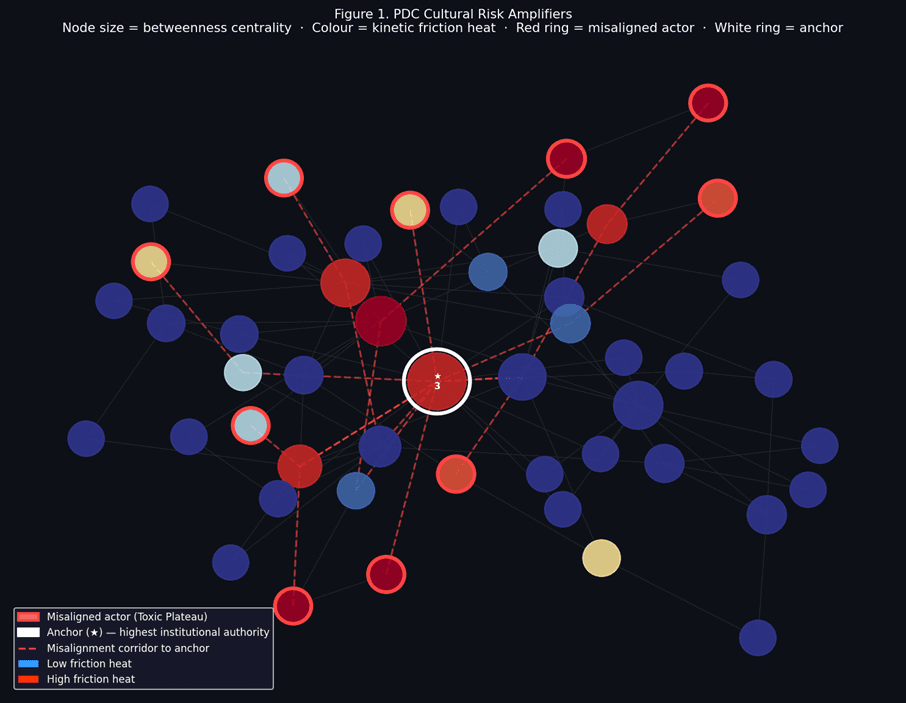
Note: Node size reflects betweenness centrality, which measures how often an individual node acts as a bridge between other nodes. Red-ringed nodes are misaligned actors; white-ringed node is the anchor (★). Dashed red lines trace misalignment corridors.
Figure 1 depicts a CSS-LUCAS Network Model highlighting “Cultural Risk Amplifiers.” In this simulation finding, CSS-LUCAS network modelling of a 50-node influence network identified Node 25 as the highest-betweenness misaligned actor – a structural bridge whose risk is positional, not behavioural. Nodes 30 and 45 sat at depth-1 from the anchor node – a single relational step from the centre of institutional authority. Neither would be flagged by a model examining individual conduct. Their risk is a property of network location.
The second is contagion corridors. Norms, narratives, and misinformation spread through social networks via pathways determined by network structure. A network model can identify the structural pathways through which PRC-aligned narratives – on Taiwan, on Uyghur policy, on electoral candidates – propagate from origin points into broader Canadian political conversation, regardless of whether any actor on the path has a relationship with a foreign principal.
Figure 2. CSS-LUCAS Network Model — Misalignment Corridor Map
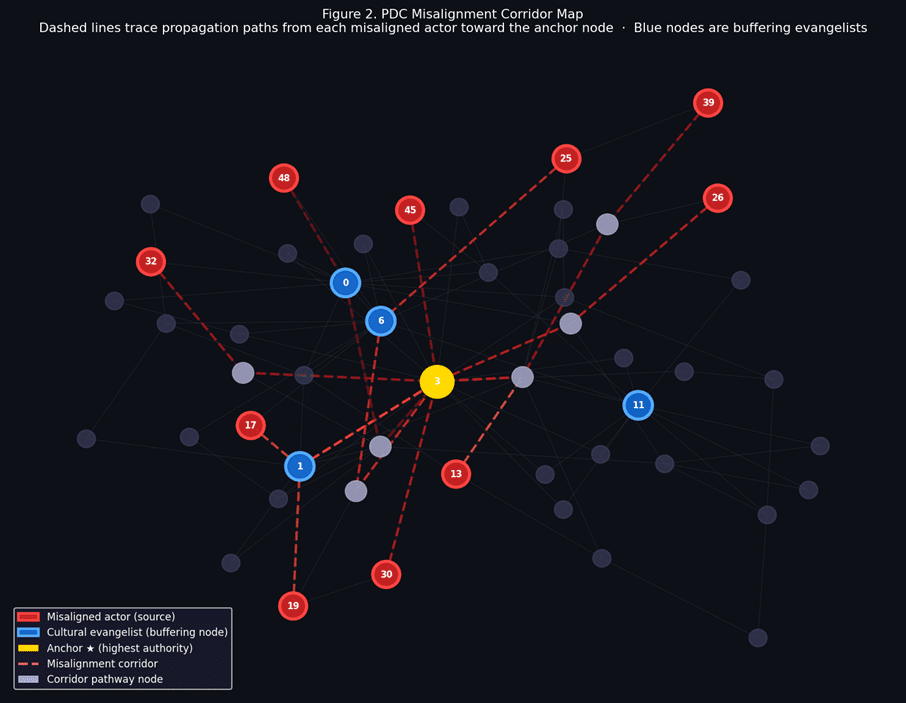
Note: Dashed lines trace propagation paths from misaligned actors (red ring) toward the anchor (★, gold). Blue nodes are cultural evangelists providing partial buffering.
Figure 2 shows how problems spread through the organization. We identified 10 different pathways where misalignment could travel toward leadership. In each pathway, there was at least one person helping to steady things and limit the damage. By strengthening those people, leaders can slow or even stop problems from spreading –without needing to change everyone individually.
The third factor is how close influence gets to decision-makers. As it moves closer to the centre, its impact grows rapidly – not gradually. Network models can track how this influence spreads over time, while traditional approaches only notice it once it becomes a visible problem at the individual level.
Figure 3. CSS-LUCAS Network Model — Evangelist Buffer Reach
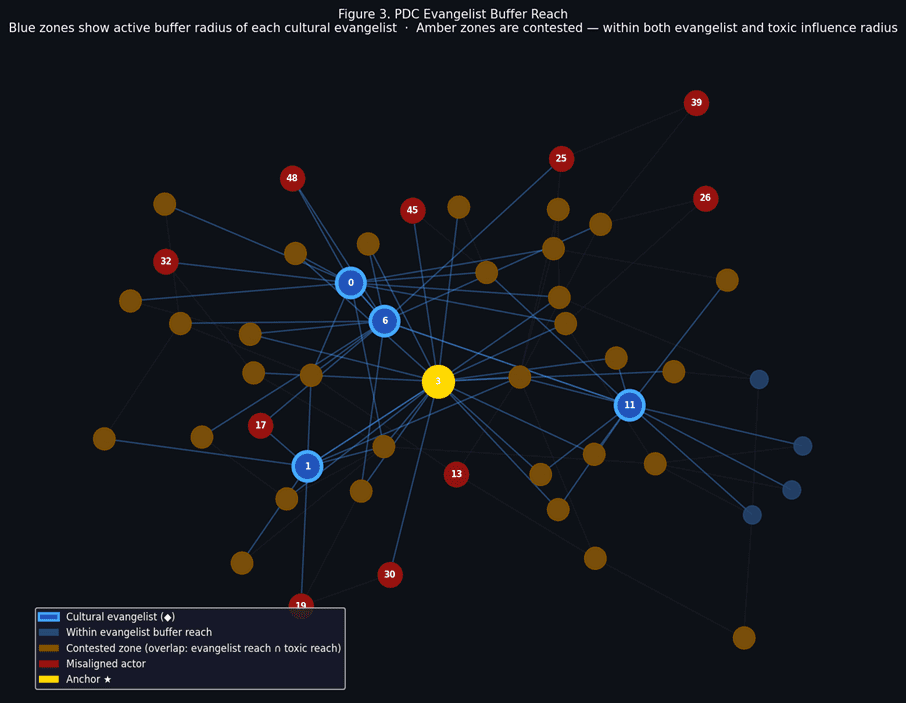
Note: Blue nodes are cultural evangelists; amber nodes are contested zones within both buffering and toxic influence reach.
Figure 3 shows how certain people in the organization help contain problems before they spread. The blue areas represent their “buffer” – their ability to stabilize those around them. The amber areas are contested, where positive and negative influences overlap. When these stabilizing individuals are strong and well-positioned, they can slow or block problems from reaching leadership.
For example, if a negative attitude starts spreading through a team, a respected team member can absorb and redirect that energy – preventing it from escalating or spreading further.
The limits of what Canada has done
Bill C-70 and the Foreign Influence Transparency Registry represent genuine progress, bringing Canada closer to frameworks adopted by the United Kingdom and Australia. But the Hogue Commission’s findings describe a different kind of problem – one that operates below the threshold of what the registry is designed to capture. The registry is built to identify clear, direct foreign influence. For example:
- A person being paid by a foreign government to lobby a Canadian official.
- An organization formally directed by a foreign state to shape public policy.
- Coordinated political activity conducted under the direction of a foreign principal.
These are visible, documentable, and legally actionable. What the Commission identified is more subtle.
In many cases:
- Community leaders promote narratives that align with foreign state interests without formal direction.
- Organizations create access points between candidates and specific voting blocs without explicit coordination.
- Individuals act as connectors – introducing people, shaping conversations, and influencing perception – without ever crossing a legal line.
None of these actions, on their own, trigger registration requirements. But together, they form a network that can shape political outcomes. This is the core limitation: The current framework is designed to identify individual actors who cross a legal threshold. But the influence described in the Commission emerges from patterns of relationships and repeated interactions. The architecture is not hidden – it is simply not visible through the tools we are using.
What Canada needs is a complementary approach: a network model of foreign interference. One that identifies structural vulnerabilities – who connects to whom, how influence travels, and where pressure accumulates – rather than waiting for individual violations to occur. Because in this case, the system is not failing to detect bad actors. It is failing to detect how influence actually works.
Network intelligence within the existing legal framework
If this type of influence operates below the legal thresholds set by Bill C-70, what can network analysis actually do? It helps in three ways.
First, at the strategic level:
Mapping the network shows how influence actually moves – who connects to whom, where pressure builds, and how narratives spread. That allows for targeted responses. Instead of broad messaging or reactive measures, efforts can focus on the people and points in the system where they will have the most impact.
For example, if influence tends to pass through a small number of well-connected individuals, strengthening or countering those positions can limit how far it spreads. Likewise, if certain pathways consistently carry narratives toward decision-makers, those pathways can be disrupted early – before the issue reaches leadership.
Second, at the administrative level: Canada already has tools that do not require criminal charges. The problem is not the absence of tools—it is how they are used.
Network analysis makes those tools more precise:
- Investigative targeting (CSIS)
CSIS is responsible for identifying threats, not prosecuting them. A network view helps prioritize where to focus attention. Instead of waiting for clear misconduct, it highlights which individuals or groups are most central to how influence moves through the system. - Financial monitoring (FINTRAC)
Canada already tracks financial networks to identify money laundering. The same logic applies here. Rather than looking only for direct foreign funding, authorities can examine patterns of financial relationships that support influence activity over time. - Immigration decisions
Existing law allows the government to deny entry on national security grounds, even without a criminal conviction. A clearer picture of how individuals are connected to known influence networks makes those decisions more defensible and more consistent.
These tools already exist. Network analysis simply makes them more effective.
Third, at the legal level: This is where the real gap appears. Canada’s legal system is designed to deal with individuals. It can prosecute someone for breaking the law. But it is not designed to deal with systems made up of many people, each acting within legal limits, but together producing harmful outcomes.
This is not a new problem. The United States faced something similar with organized crime. Individual actions were often legal or difficult to prosecute, but the pattern of activity was clearly harmful. Their response was to create laws that target participation in the broader system, not just individual acts. Canada does not currently have an equivalent tool for foreign interference.
That matters because the influence described here does not depend on a single illegal act. It depends on coordination, relationships, and repeated interactions – none of which, on their own, may cross a legal threshold.
Canada is not without tools. But it is using tools designed for individual cases to address a network-based problem. Network analysis helps close that gap at the strategic and administrative levels. But until the legal framework evolves to address coordinated activity as a system – not just isolated actions – the core problem will remain: The architecture is visible. But it is still largely beyond the reach of the law.
Four structural policy interventions
A network model of the United Front architecture in Canada does not merely provide a more accurate analytical picture – it points to a different class of policy interventions. Rather than identifying individual actors who have crossed thresholds, structural policy interventions target the network properties that generate influence capacity. Three of the four interventions below operate within the existing administrative framework. The fourth requires legislation.
The Hogue Commission’s recommended measures focus primarily on transparency and registration requirements – appropriate and necessary first steps that address the individual-level manifestation of the problem. The four structural interventions proposed here address the network-level architecture that transparency and registration requirements cannot reach:
- Academic and research partnership screening based on network position rather than stated purpose. Current partnership screening focuses on the stated purpose of proposed collaboration and the known affiliations of named partners. This misses the structural risk: a research partnership with a Chinese institution that has no known United Front affiliations but that sits at high network centrality in the United Front relationship graph poses higher structural risk than a partnership with an institution that has nominal United Front connections but low centrality. Screening protocols should incorporate network position analysis.
- Diaspora community organization funding rules based on financial network topology. The pattern identified in the Hogue Commission’s findings – in which PRC-affiliated financial flows moved through diaspora community organizations before reaching political targets – is a network topology signature, not an individual-level transaction signature. Funding rules that require disclosure of financial network relationships, not just direct foreign funding, would make this topology visible to regulators.
- Parliamentary staff and political office access protocols based on relationship-graph proximity to known United Front nodes. Current security screening for parliamentary and political staff focuses on individual affiliations and disclosed relationships. A network-aware protocol would add a measure of relationship-graph proximity: how many degrees of separation separate this individual from known United Front-affiliated network nodes? High proximity, even without direct affiliation, represents elevated structural risk that current screening cannot detect.
- A foreign interference network liability statute. The three administrative interventions above are constrained by a foundational legal gap: Canada has no instrument that creates liability for participation in a foreign interference network as such. The administrative tools reach around the gap; they do not close it. What is required is a statute modelled on the organizational liability logic of RICO — one that treats coordinated participation in a foreign interference architecture as a distinct legal wrong, actionable at the network level, without requiring proof that any individual participant crossed an existing criminal threshold. A foreign interference network liability act would give prosecutors the tool the architecture currently defeats: the ability to charge the pattern, not merely the act.
Recommendations
The following steps would begin to close the gap between Canada’s analytical capacity and its legal tools:
- Creating a foreign interference network analysis capability within CSIS – mandated to produce structural network assessments and feed outputs directly into CSIS threat assessments, FINTRAC financial monitoring referrals, and IRPA section 34 inadmissibility determinations. The model is FINTRAC’s existing network analysis function, adapted for influence network topology.
- Amending the FITR regulations to require network relationship disclosure – not just direct foreign principal relationships, but organizational network connections between registered entities. The registry currently produces a list; it needs to produce a graph.
- Commissioning of an unclassified baseline network topology assessment of the United Front architecture in Canada, drawing on open-source data from academic partnership databases, corporate registry filings, and election financing disclosures. An unclassified baseline gives policymakers a common analytical picture and establishes the evidentiary foundation for section 34 determinations and FINTRAC referrals that must withstand legal scrutiny.
- Launching a parliamentary study of foreign interference network liability legislation to examine whether Canada requires a statutory instrument analogous to RICO. This instrument would create liability for coordinated participation in a foreign interference architecture without requiring proof that any individual act crossed an existing criminal threshold. The administrative framework identified in this piece is a near-term workaround. The legislative question is the long-term requirement.
Canada already has tools it can use – and the Hogue Commission has made clear that it must start using them differently. Network analysis shows how to do that.
But this is only part of the answer. The deeper problem is legal. Canada’s system is built to respond to individuals. The threat we face operates as a network.
That gap has real consequences. It means influence can shape who gets access to decision-makers. It means narratives can be reinforced and spread without ever triggering a legal threshold. Over time, it risks distorting how decisions are made – not through overt control, but through accumulated pressure inside the system.
Left unaddressed, this does not produce a single crisis. It produces gradual erosion: of trust, of transparency, and of confidence that political outcomes are shaped only by Canadians. Until the law evolves, that system will continue to operate in plain sight – mapped, understood, and largely untouched.
We can see how it works. We are not yet equipped to stop it.
Dr. W.A. Rivera is the founder and principal researcher at the Center for Strategic Studies — Laboratory for Unconventional Conflict Analysis and Simulation (CSS-LUCAS). He is the lead architect of the PIL (Power and Ideology Lethality) geopolitical simulation platform, which incorporates the PILOT event ontology for modelling information operations, foreign interference, and gray zone statecraft. CSS-LUCAS conducts applied research at the intersection of computational social science, network analysis, and national security policy.