This article originally appeared in The Hub.
By Richard Shimooka, March 9, 2026
We are about a week removed from the onset of the U.S.-Israel attacks on Iran. With President Trump reluctant to commit to American troops on the ground, the war, to date, has been waged primarily in the air, with bombers, fighter jets, drones, and ballistic missiles as the all-important variables.
So what are the primary lessons we’ve learned so far?
1. The return of the great airpower debate
For much of its history, airpower has been defined by a central question: can it actually win a war without requiring soldiers on the ground? Early theorists, searching for alternatives that could avoid the carnage of the First World War, hoped it could. Similarly, in more recent interventions, such as in Kosovo and Libya, Allied airforces have sought to achieve their war aims while avoiding any casualties whatsoever. President Trump has likewise been searching for a way to quickly achieve the U.S.’s aims (a la Venezuela) without getting bogged down in the quagmire of yet another protracted war in the Middle East.
Unfortunately, airpower’s track record as the primary means of military force has been poor, and is unlikely to change as a result of this war. Historically, states under air strikes alone have rarely reacted to coercion by acceding to demands; it is even rarer to see a bombarded government collapse. Venezuela’s recent turn, (overlooking the short capture operation), might be argued to be one of the few examples. However that outcome bears few similarities to the situation in Iran.
Airpower is most effective at degrading and suppressing a state’s warmaking capacities temporarily, but not fundamentally undermine existing power structures within a state. Indeed, the president’s recent call for Kurdish militias to overthrow the regime, is a tacit acknowledgement that airpower on its own is insufficient to overthrow the Iranian regime.
2. A new paradigm of air warfare is emerging
Leaving aside the questions of political efficacy, it’s clear that airpower is going through a dramatic shift in platforms, force structures, and capabilities. We have been discussing this for a number of years, particularly in the context of the Ukraine War, but the past six months have seen three clear demonstrations of this new doctrine, variously named penetration dominance or multi-domain operations. The key idea is to break through an enemy’s tightly integrated air, land, sea, space, and cyber defences and overwhelm them quickly, disrupting the entire enemy system at once.
Iran’s air-defence capabilities are limited (having been degraded in Operation Midnight Hammer several months ago), and the U.S. and Israel demonstrated their ability to operate with relative impunity over the country. They’ve exhibited extremely high levels of coordination to deliver precision strikes against time-sensitive targets.
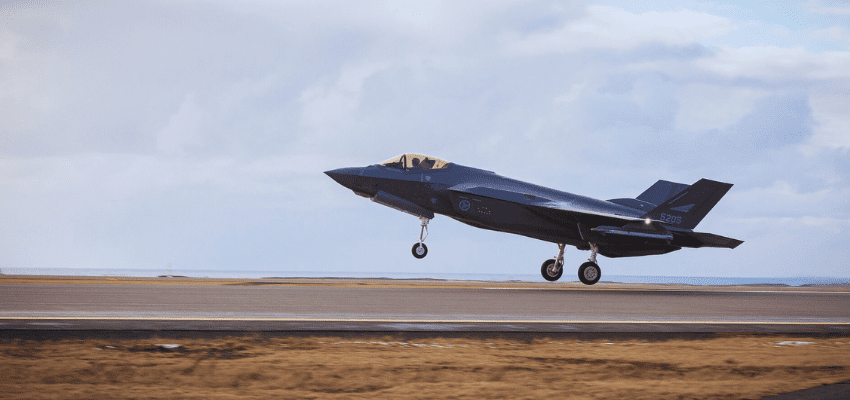
Firstly, any doubts about the capabilities of the fifth-generation fighter jets, particularly the F-35, should be ended. They are quite demonstrably peerless when it comes to airpower capabilities.
But while manned aircraft are central to this new doctrine, it also involves a whole range of capabilities. This includes large numbers of land-based long-range missiles and loitering one-way attack munitions such as LUCAS and Scorpions. The importance of these integrated systems will only continue, as the development of more effective non-kinetic capabilities will further unlock this doctrine. These include more advanced forms of artificial intelligence, cyber warfare, and space-based systems that will promote greater integration and rapid decision-making.
Canada is essentially a decade behind in absorbing these new doctrinal concepts. Fundamentally, it exposes just how misguided the current debate between the F-35 and the Gripen is: any future fighter capability must have high levels of integration within this emerging doctrine to be operationally relevant. If the choice is between a fighter that is operated by 15 of Canada’s allies and partners, or another that is used by only a single one, it isn’t really a choice.
Beyond just acquiring a tactical fighter, the RCAF will need to develop its own doctrine reflecting this new concept of operations, not to mention acquiring the ancillary capabilities that have enabled the U.S. dominance in Iran. It will be all the more essential considering the much more capable systems Canada’s adversaries can field in regions of clear national interest, namely North America’s approaches, Eastern Europe, or the Western Pacific.
The conflict has additional lessons for future planners. Iran’s retaliatory strikes show the imperative for integrated air and missile defence to safeguard targets. They, too, have launched a broad array of munitions, from long-range ballistic missiles to small, lightweight drones. While the allied response has reportedly been successful at intercepting most capabilities, it’s a clear indicator of the emergence of a multi-layered threat, which requires a comprehensive response from high-end multi-million dollar missile systems, to smaller, local interceptor drones.
This is yet another area that Canada has failed to invest in, though it could be a future area of cooperation within the NORAD framework—another reason to strengthen, not weaken, bilateral ties and defence cooperation between Ottawa and Washington.
3. Industrial production matters
A key aspect of determining the course of the conflict in the coming weeks will be the ability of both sides to maintain their operational tempo without exhausting their stockpile of munitions. Already, there are concerns that the U.S. may run out of certain munition types, which would then require the use of less capable systems that may put personnel and civilian populaces into harm’s way. This is particularly evident in air defence, as the number of Patriot surface-to-air missiles launched has been extremely high.
It should be noted that this has been a major area of concern for both the Biden and Trump administrations, and there has been a four-year effort to significantly increase the production of all critical munitions. Iran faces a similar dynamic, as attacks on depots and manufacturing centres, as well as blockades, will limit its ability to sustain the same level of retaliatory strikes it currently is attempting—indeed, the frequency of its missile launches has already slowed dramatically.
Canada, clearly, is even further behind in this area. It has not even begun to meaningfully address this serious limitation in its war-fighting effort. Dedicated attention to scaling munition production or acquisition to wartime production was conspicuously absent in the recent defence industrial strategy, and really should have been a major consideration for where future investments are made.
As may be illustrated in the coming days and weeks, the failure to have a constant supply of munitions may be more determinative of this particular conflict’s outcome than any other factor.