Wednesday, March 4, 2026
No Result
View All Result
  • Media
Macdonald-Laurier Institute
  • Home
  • About
    • Who We Are
    • Who Makes MLI Work
    • Fifteenth Anniversary
  • Experts
    • Experts Directory
    • In Memoriam
  • Issues
    • Domestic Policy
      • Economic Policy
      • Justice
      • Rights and Freedoms
      • Assisted Suicide (MAID)
      • Health Care
      • COVID-19
      • Gender Identity
      • Canada’s Political Tradition
      • AI, Technology and Innovation
      • Media and Telecoms
      • Housing
      • Immigration
      • Agriculture and Agri-Food
      • Competition Policy
    • Energy Policy
      • Energy
      • Environment
    • Foreign Policy
      • Israel-Hamas War
      • Ukraine
      • Taiwan
      • China
      • Europe and Russia
      • Indo-Pacific
      • Middle East and North Africa
      • North America
      • Foreign Interference
      • National Defence
      • National Security
      • Foreign Affairs
    • Indigenous Affairs
  • Projects
    • CNAPS (Center for North American Prosperity and Security)
    • The Promised Land
    • Voices that Inspire: The Macdonald-Laurier Vancouver Speaker Series
    • Dragon at the door
    • Canada on top of the world
    • Letter to a minister
    • Justice Report Card
    • The Great Energy Crisis
    • DisInfoWatch.org
    • Managing Indigenous Prosperity
    • Judicial Foundations
    • Landmark Cases Council
    • Defending The Marketplace of Ideas
    • Reforming the University
    • Past Projects
      • Digital Policy & Connectivity
      • Double Trouble
      • Canada and the Indo-Pacific Initiative
      • The Transatlantic Program
      • COVID Misery Index
        • Provincial COVID Misery Index
        • Beyond Lockdown
        • COVID and after: A mandate for recovery
      • Speak for Ourselves
      • The Eavesdropping Dragon: Huawei
      • Talkin’ in the Free World with Mariam Memarsadeghi
      • An Intellectual Property Strategy for Canada
      • Munk Senior Fellows
      • A Mandate for Canada
      • Confederation Series
      • Fiscal Reform
      • The Canadian Century project
      • Fixing Canadian health care
      • Internal trade
      • From a mandate for change
      • Size of government in Canada
      • Straight Talk
      • Labour Market Report
      • Leading Economic Indicator
      • Centre for Advancing Canada’s Interests Abroad
      • Indigenous Prosperity at a Crossroads
        • Aboriginal Canada and Natural Resources
  • Events
    • Upcoming Events
    • Past Events
      • MLI Dinners
      • Great Canadian Debates
  • Latest News
  • Libraries
    • Columns
    • Commentary
    • Papers
    • Books
    • Video
  • Donate
  • Home
  • About
    • Who We Are
    • Who Makes MLI Work
    • Fifteenth Anniversary
  • Experts
    • Experts Directory
    • In Memoriam
  • Issues
    • Domestic Policy
      • Economic Policy
      • Justice
      • Rights and Freedoms
      • Assisted Suicide (MAID)
      • Health Care
      • COVID-19
      • Gender Identity
      • Canada’s Political Tradition
      • AI, Technology and Innovation
      • Media and Telecoms
      • Housing
      • Immigration
      • Agriculture and Agri-Food
      • Competition Policy
    • Energy Policy
      • Energy
      • Environment
    • Foreign Policy
      • Israel-Hamas War
      • Ukraine
      • Taiwan
      • China
      • Europe and Russia
      • Indo-Pacific
      • Middle East and North Africa
      • North America
      • Foreign Interference
      • National Defence
      • National Security
      • Foreign Affairs
    • Indigenous Affairs
  • Projects
    • CNAPS (Center for North American Prosperity and Security)
    • The Promised Land
    • Voices that Inspire: The Macdonald-Laurier Vancouver Speaker Series
    • Dragon at the door
    • Canada on top of the world
    • Letter to a minister
    • Justice Report Card
    • The Great Energy Crisis
    • DisInfoWatch.org
    • Managing Indigenous Prosperity
    • Judicial Foundations
    • Landmark Cases Council
    • Defending The Marketplace of Ideas
    • Reforming the University
    • Past Projects
      • Digital Policy & Connectivity
      • Double Trouble
      • Canada and the Indo-Pacific Initiative
      • The Transatlantic Program
      • COVID Misery Index
        • Provincial COVID Misery Index
        • Beyond Lockdown
        • COVID and after: A mandate for recovery
      • Speak for Ourselves
      • The Eavesdropping Dragon: Huawei
      • Talkin’ in the Free World with Mariam Memarsadeghi
      • An Intellectual Property Strategy for Canada
      • Munk Senior Fellows
      • A Mandate for Canada
      • Confederation Series
      • Fiscal Reform
      • The Canadian Century project
      • Fixing Canadian health care
      • Internal trade
      • From a mandate for change
      • Size of government in Canada
      • Straight Talk
      • Labour Market Report
      • Leading Economic Indicator
      • Centre for Advancing Canada’s Interests Abroad
      • Indigenous Prosperity at a Crossroads
        • Aboriginal Canada and Natural Resources
  • Events
    • Upcoming Events
    • Past Events
      • MLI Dinners
      • Great Canadian Debates
  • Latest News
  • Libraries
    • Columns
    • Commentary
    • Papers
    • Books
    • Video
  • Donate
No Result
View All Result
Macdonald-Laurier Institute

Have Alberta’s finances gone off the rails?: Trevor Tombe in The Hub

Alberta’s projected $9.4 billion deficit is raising concerns, especially given the province’s historical fiscal conservatism.

March 4, 2026
in Domestic Policy, Latest News, Columns, In the Media, Intergovernmental Affairs, Economic Policy, Trevor Tombe
Reading Time: 5 mins read
A A
Have Alberta’s finances gone off the rails?: Trevor Tombe in The Hub

Image via Canva.

This article originally appeared in The Hub.

By Trevor Tombe, March 4, 2026

Alberta is, by a wide margin, Canada’s richest province. Yet last week’s provincial budget projects a $9.4-billion deficit for the coming year. That is not a trivial shortfall. Relative to the province’s roughly $490-billion economy, it amounts to 1.9 percent of GDP, roughly the same share as Ottawa’s projected $65-billion deficit over that same period.

Debt is set to rise alongside it. Alberta anticipates its net debt will grow from less than 8 percent of GDP to nearly 13 percent. That remains far lower than in any other province, to be clear, and well below federal levels. But the speed of the increase is notable. It is roughly half the rise the federal government experienced during COVID-19 and its aftermath (with federal net debt today about 10 percentage points above its 2019 level).

So what’s behind Alberta’s fiscal troubles?

It turns out that policy choices, not external factors, are largely to blame.

The official explanation

The government points primarily to falling oil prices and rapid population growth.

Deflecting blame in difficult circumstances is common in politics, and there’s usually a kernel of truth behind such efforts. Indeed, oil prices have declined through much of 2025 amid global uncertainty and weaker economic growth. The province expects prices to barely exceed $60 per barrel in the coming fiscal year, down from $74 in 2024–25. And when every $1 change in the price of oil shifts revenues by nearly three-quarters of a billion dollars annually, price declines pose a serious challenge.

And yet, while oil prices matter, they are not the whole story.

Spending choices, not just external forces

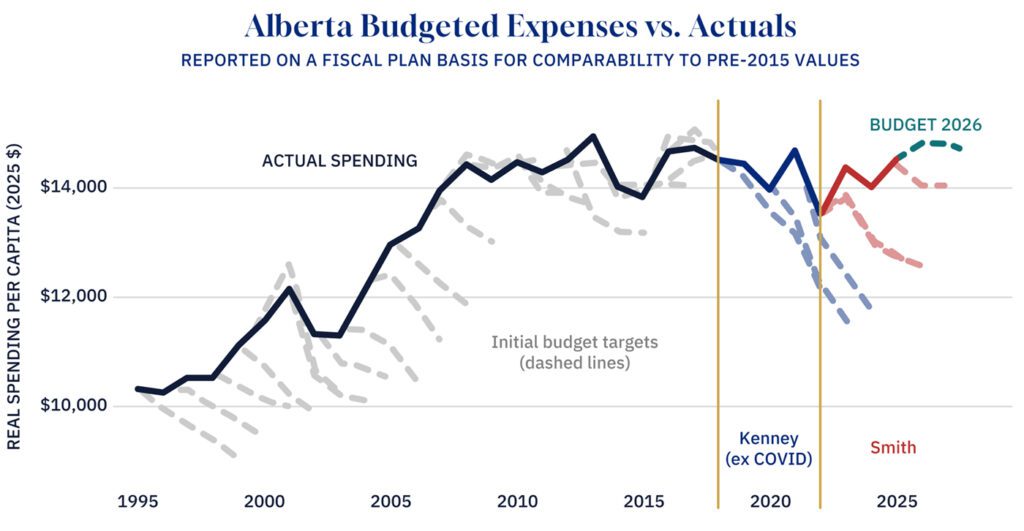
The government plans to increase operating expenses to more than $70 billion this year, up not only from previous years but also from the government’s original plans for this year. Some (especially those outside Alberta) may find that surprising for a province typically viewed as fiscally conservative. But former premier Jason Kenney was unusual among recent premiers in recent decades in actually seeking to restrain the size of government and reduce per-person spending.

By contrast, the current government aims to keep spending growth in line with population plus inflation, an approach similar to most past premiers across all parties, from Ed Stelmach to Rachel Notley.

But a closer look at the numbers reveals that spending has actually grown well beyond population and inflation recently, effectively reversing the reductions under Kenney. Indeed, Budget 2026 projects a return to real per capita total spending levels that (slightly) exceed the highest year under former NDP Premier Notley.
Graphic credit: Janice Nelson.

So what’s going on? Consider what the government itself planned just one year ago.

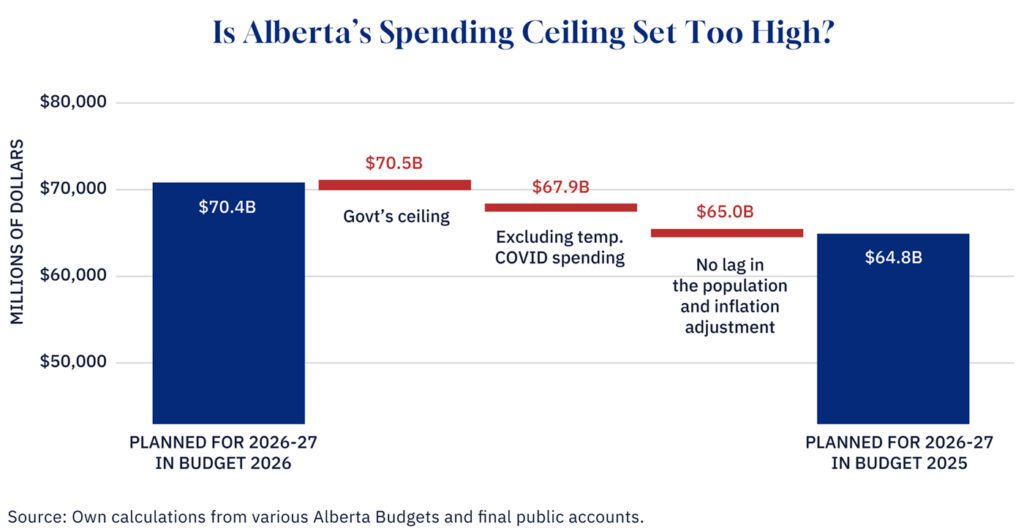
In Budget 2025, the government projected operating spending of $64.8 billion for 2026–27. Now, for that same fiscal year, it anticipates spending $70.4 billion, an increase of more than $5.5 billion.

Did inflation surge unexpectedly? Did population growth dramatically exceed forecasts? No.

Last year, the government projected population growth of 2.5 percent in 2025, followed by 1.4 percent in 2026. And today, in its latest budget, it assumes the same 2025 population growth and an even lower 1.1 percent in 2026. Inflation has also come in below earlier expectations, averaging about 2 percent last year and 2.1 percent this year, down from the 2.6 and 2.4 percent, respectively, that it previously thought.

None of the additional $5.5 billion can therefore be attributed to unexpected population or inflation pressures.

The spending cap that wasn’t

Moreover, spending growth in excess of population plus inflation is a pattern over many years, despite a recent law enacted to try to prevent that very thing.

Alberta’s main fiscal anchor, introduced in 2023, set a ceiling on operating spending that rises with population and inflation. By its own calculation, this year’s spending remains about $100 million below that ceiling. So no problem, right?

The trouble is, when the ceiling was first set, it incorporated roughly $1.9 billion in temporary COVID-related spending, effectively baking an unusually high starting point into the formula.

The ceiling is also adjusted each year using the previous year’s population and inflation rather than current figures. That also baked in higher adjustments, since inflation peaked in 2022 and declined thereafter. While the mathematical details behind why this matters may seem technical, the combined effect is substantial, as I illustrate below.
Graphic credit: Janice Nelson.

Absent those features, the ceiling this year, I estimate, would be roughly $5.5 billion lower and the deficit consequently less than half as large. And none of this even adjusts for the fact that several billion in provincial spending are excluded from the ceiling entirely.

Abandoning its fiscal anchor

While rapid spending growth may only violate the spirit of the Alberta budget law, there are more explicit violations at play, too.

First, running a deficit required freezing spending at the previous year’s level. That would have implied a much smaller shortfall (though obviously would also require difficult trade-offs and shelving new initiatives).

And second, the province was limited to no more than three consecutive deficits. Yet last week’s budget projects red ink throughout the forecast horizon, exceeding that limit.

So, as the federal government did in its budget from last November, Alberta has now abandoned its main fiscal anchor that was originally meant to “ensure spending growth is sustainable in the long run.”

The resource revenue rollercoaster

While these choices absolutely increased the scale of Alberta’s deficit in 2026, there’s a deeper reason why today’s deficit is largely of the province’s own making: the province’s very reliance on volatile oil prices is itself a policy choice.

Premier Prentice was the last one to seriously attempt to reduce the province’s reliance on resource revenues. Today, oil price swings have a larger impact on the bottom line than they did a decade ago. Delaying efforts to save more resource revenue, introduce alternative revenue sources, or exercise additional spending restraint has left Alberta more exposed to the volatility of its royalty roller-coaster than ever.

In fact, due largely to recent spending increases, Alberta’s reliance on resource revenues is higher today than under any premier since Don Getty (excluding COVID-19). Things might work out if oil prices rise, as they have sharply done following last week’s attacks on Iran, but who knows how things unfold from here.

Hope is not a strategy

None of this means Alberta is in fiscal crisis, nor does it suggest the province is incapable of managing its affairs. It remains the richest province in the country, with debt levels far below (and fiscal capacity far above) those elsewhere.

But the deficit now projected is not simply the product of bad luck or global events. It reflects choices: to increase spending beyond population and inflation, to loosen or abandon fiscal constraints, and to deepen reliance on volatile resource revenues. Those choices may be defensible. But they are choices nonetheless. And they’ve come with consequences.


Trevor Tombe is a professor of economics at the University of Calgary, the Director of Fiscal and Economic Policy at The School of Public Policy, a Senior Fellow at the Macdonald-Laurier Institute, and a Fellow at the Public Policy Forum.

Source: The Hub

Related Posts

Want to remain strong and free, Canada? Six steps to becoming an energy and resource superpower: Heather Exner-Pirot in The Hub
Resources

In a tariff war, Canada’s resources are our strategic advantage: Philip Cross in the Hill Times

March 4, 2026
Japan leg of Carney’s Indo-Pacific tour is Canada’s chance to course-correct: Jonathan Berkshire Miller for Inside Policy
Indo-Pacific

Japan leg of Carney’s Indo-Pacific tour is Canada’s chance to course-correct: Jonathan Berkshire Miller for Inside Policy

March 4, 2026
How Canada can prepare for high-pressure U.S. demands on sovereignty and trade: Jerome Gessaroli in Policy Options
Economic Policy

How Canada can prepare for high-pressure U.S. demands on sovereignty and trade: Jerome Gessaroli in Policy Options

March 3, 2026
Next Post
Want to remain strong and free, Canada? Six steps to becoming an energy and resource superpower: Heather Exner-Pirot in The Hub

In a tariff war, Canada’s resources are our strategic advantage: Philip Cross in the Hill Times

Newsletter Signup

  Thank you for Signing Up
  Please correct the marked field(s) below.
Email Address  *
1,true,6,Contact Email,2
First Name *
1,true,1,First Name,2
Last Name *
1,true,1,Last Name,2
*
*Required Fields

Follow us on

Macdonald-Laurier Institute

323 Chapel Street, Suite #300
Ottawa, Ontario, K1N 7Z2 Canada

613.482.8327

info@macdonaldlaurier.ca
MLI directory

Support Us

Support the Macdonald-Laurier Institute to help ensure that Canada is one of the best governed countries in the world. Click below to learn more or become a sponsor.

Support Us

  • Inside Policy Magazine
  • Annual Reports
  • Jobs
  • Privacy Policy

© 2023 Macdonald-Laurier Institute. All Rights reserved.

No Result
View All Result
  • Home
  • About
    • Who We Are
    • Who Makes MLI Work
    • Fifteenth Anniversary
  • Experts
    • Experts Directory
    • In Memoriam
  • Issues
    • Domestic Policy
      • Economic Policy
      • Justice
      • Rights and Freedoms
      • Assisted Suicide (MAID)
      • Health Care
      • COVID-19
      • Gender Identity
      • Canada’s Political Tradition
      • AI, Technology and Innovation
      • Media and Telecoms
      • Housing
      • Immigration
      • Agriculture and Agri-Food
      • Competition Policy
    • Energy Policy
      • Energy
      • Environment
    • Foreign Policy
      • Israel-Hamas War
      • Ukraine
      • Taiwan
      • China
      • Europe and Russia
      • Indo-Pacific
      • Middle East and North Africa
      • North America
      • Foreign Interference
      • National Defence
      • National Security
      • Foreign Affairs
    • Indigenous Affairs
  • Projects
    • CNAPS (Center for North American Prosperity and Security)
    • The Promised Land
    • Voices that Inspire: The Macdonald-Laurier Vancouver Speaker Series
    • Dragon at the door
    • Canada on top of the world
    • Letter to a minister
    • Justice Report Card
    • The Great Energy Crisis
    • DisInfoWatch.org
    • Managing Indigenous Prosperity
    • Judicial Foundations
    • Landmark Cases Council
    • Defending The Marketplace of Ideas
    • Reforming the University
    • Past Projects
      • Digital Policy & Connectivity
      • Double Trouble
      • Canada and the Indo-Pacific Initiative
      • The Transatlantic Program
      • COVID Misery Index
      • Speak for Ourselves
      • The Eavesdropping Dragon: Huawei
      • Talkin’ in the Free World with Mariam Memarsadeghi
      • An Intellectual Property Strategy for Canada
      • Munk Senior Fellows
      • A Mandate for Canada
      • Confederation Series
      • Fiscal Reform
      • The Canadian Century project
      • Fixing Canadian health care
      • Internal trade
      • From a mandate for change
      • Size of government in Canada
      • Straight Talk
      • Labour Market Report
      • Leading Economic Indicator
      • Centre for Advancing Canada’s Interests Abroad
      • Indigenous Prosperity at a Crossroads
  • Events
    • Upcoming Events
    • Past Events
      • MLI Dinners
      • Great Canadian Debates
  • Latest News
  • Libraries
    • Columns
    • Commentary
    • Papers
    • Books
    • Video
  • Donate

© 2023 Macdonald-Laurier Institute. All Rights reserved.