
Thursday, February 19, 2026
No Result
View All Result
  • Media
Macdonald-Laurier Institute
  • Home
  • About
    • Who We Are
    • Who Makes MLI Work
    • Fifteenth Anniversary
  • Experts
    • Experts Directory
    • In Memoriam
  • Issues
    • Domestic Policy
      • Economic Policy
      • Justice
      • Rights and Freedoms
      • Assisted Suicide (MAID)
      • Health Care
      • COVID-19
      • Gender Identity
      • Canada’s Political Tradition
      • AI, Technology and Innovation
      • Media and Telecoms
      • Housing
      • Immigration
      • Agriculture and Agri-Food
      • Competition Policy
    • Energy Policy
      • Energy
      • Environment
    • Foreign Policy
      • Israel-Hamas War
      • Ukraine
      • Taiwan
      • China
      • Europe and Russia
      • Indo-Pacific
      • Middle East and North Africa
      • North America
      • Foreign Interference
      • National Defence
      • National Security
      • Foreign Affairs
    • Indigenous Affairs
  • Projects
    • CNAPS (Center for North American Prosperity and Security)
    • The Promised Land
    • Voices that Inspire: The Macdonald-Laurier Vancouver Speaker Series
    • Dragon at the door
    • Canada on top of the world
    • Letter to a minister
    • Justice Report Card
    • The Great Energy Crisis
    • DisInfoWatch.org
    • Managing Indigenous Prosperity
    • Judicial Foundations
    • Landmark Cases Council
    • Defending The Marketplace of Ideas
    • Reforming the University
    • Past Projects
      • Digital Policy & Connectivity
      • Double Trouble
      • Canada and the Indo-Pacific Initiative
      • The Transatlantic Program
      • COVID Misery Index
        • Provincial COVID Misery Index
        • Beyond Lockdown
        • COVID and after: A mandate for recovery
      • Speak for Ourselves
      • The Eavesdropping Dragon: Huawei
      • Talkin’ in the Free World with Mariam Memarsadeghi
      • An Intellectual Property Strategy for Canada
      • Munk Senior Fellows
      • A Mandate for Canada
      • Confederation Series
      • Fiscal Reform
      • The Canadian Century project
      • Fixing Canadian health care
      • Internal trade
      • From a mandate for change
      • Size of government in Canada
      • Straight Talk
      • Labour Market Report
      • Leading Economic Indicator
      • Centre for Advancing Canada’s Interests Abroad
      • Indigenous Prosperity at a Crossroads
        • Aboriginal Canada and Natural Resources
  • Events
    • Upcoming Events
    • Past Events
      • MLI Dinners
      • Great Canadian Debates
  • Latest News
  • Libraries
    • Columns
    • Commentary
    • Papers
    • Books
    • Video
  • Donate
  • Home
  • About
    • Who We Are
    • Who Makes MLI Work
    • Fifteenth Anniversary
  • Experts
    • Experts Directory
    • In Memoriam
  • Issues
    • Domestic Policy
      • Economic Policy
      • Justice
      • Rights and Freedoms
      • Assisted Suicide (MAID)
      • Health Care
      • COVID-19
      • Gender Identity
      • Canada’s Political Tradition
      • AI, Technology and Innovation
      • Media and Telecoms
      • Housing
      • Immigration
      • Agriculture and Agri-Food
      • Competition Policy
    • Energy Policy
      • Energy
      • Environment
    • Foreign Policy
      • Israel-Hamas War
      • Ukraine
      • Taiwan
      • China
      • Europe and Russia
      • Indo-Pacific
      • Middle East and North Africa
      • North America
      • Foreign Interference
      • National Defence
      • National Security
      • Foreign Affairs
    • Indigenous Affairs
  • Projects
    • CNAPS (Center for North American Prosperity and Security)
    • The Promised Land
    • Voices that Inspire: The Macdonald-Laurier Vancouver Speaker Series
    • Dragon at the door
    • Canada on top of the world
    • Letter to a minister
    • Justice Report Card
    • The Great Energy Crisis
    • DisInfoWatch.org
    • Managing Indigenous Prosperity
    • Judicial Foundations
    • Landmark Cases Council
    • Defending The Marketplace of Ideas
    • Reforming the University
    • Past Projects
      • Digital Policy & Connectivity
      • Double Trouble
      • Canada and the Indo-Pacific Initiative
      • The Transatlantic Program
      • COVID Misery Index
        • Provincial COVID Misery Index
        • Beyond Lockdown
        • COVID and after: A mandate for recovery
      • Speak for Ourselves
      • The Eavesdropping Dragon: Huawei
      • Talkin’ in the Free World with Mariam Memarsadeghi
      • An Intellectual Property Strategy for Canada
      • Munk Senior Fellows
      • A Mandate for Canada
      • Confederation Series
      • Fiscal Reform
      • The Canadian Century project
      • Fixing Canadian health care
      • Internal trade
      • From a mandate for change
      • Size of government in Canada
      • Straight Talk
      • Labour Market Report
      • Leading Economic Indicator
      • Centre for Advancing Canada’s Interests Abroad
      • Indigenous Prosperity at a Crossroads
        • Aboriginal Canada and Natural Resources
  • Events
    • Upcoming Events
    • Past Events
      • MLI Dinners
      • Great Canadian Debates
  • Latest News
  • Libraries
    • Columns
    • Commentary
    • Papers
    • Books
    • Video
  • Donate
No Result
View All Result
Macdonald-Laurier Institute

How the risk of separation could cost Alberta thousands of jobs: Trevor Tombe in The Hub

The hidden costs of political uncertainty are high.

February 19, 2026
in Domestic Policy, Latest News, Columns, In the Media, Economic Policy, Trevor Tombe
Reading Time: 5 mins read
A A
Canadian Medical Association wants to force Alberta to ignore science on gender care: Mia Hughes in the National Post

Image via Canva.

This article originally appeared in The Hub.

By Trevor Tombe, February 19, 2026

Last year, uncertainty was a major theme in Canada. Frequent and dramatic changes in U.S. trade policy kept people, businesses, and governments on edge. If that level of uncertainty had lasted, it could have triggered a recession.

But as 2025 unfolded, conditions turned out better than many anticipated. Some trade tensions with the United States eased, and policy uncertainty fell sharply from its earlier highs.

Lately, though, uncertainty has been going up again, with one key measure rising by more than 50 percent in January compared to the month before, which was already higher than the worst point in the pandemic.
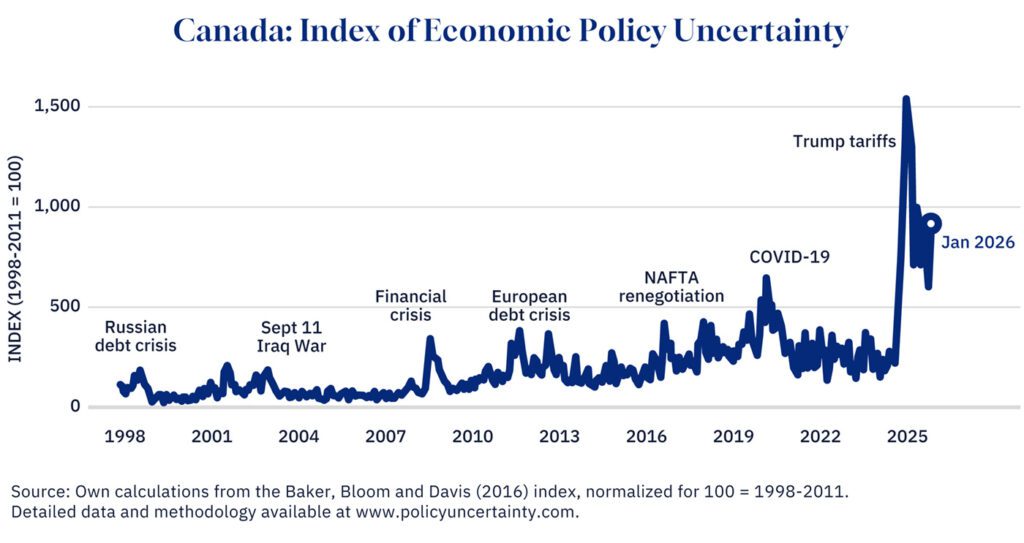
 

This matters for the strength of Canada’s economy and for the number of jobs available to Canadians.

This experience also holds lessons for those supporting separatism in Canada (however real their grievances may be with current arrangements), simply as a supposed costless protest vote. It isn’t. There are real and significant hidden costs of political uncertainty.

What the data show

Many have discussed how uncertainty hurts jobs, investment, trade, and more.

And the effects can be quite large. In 2025, high uncertainty may very well have cost tens of thousands of jobs.

To shed light on this, Statistics Canada researchers Sean Clarke and Andrew Fields compared sectors that depend heavily on U.S. demand for Canadian exports with all other sectors in the economy. They focused on industries where more than 35 percent of jobs rely, directly or indirectly, on exports to the U.S.

They found that employment in U.S.-dependent sectors declined by nearly 18,000 between December 2024 and August 2025, while the rest of the economy experienced growth. Importantly, these job losses were not driven by an increase in layoffs. Instead, they reflected a decline in hiring. Exactly as one would anticipate, businesses regularly cite uncertainty as the top concern they are responding to.

Updating and extending their analysis, I find that payroll employment in sectors dependent on U.S. exports has declined by 2.7 percent since the beginning of 2023, equivalent to more than 45,000 jobs, with most of the decline following the U.S. presidential election. Over the same period, employment in the rest of the economy has increased significantly.
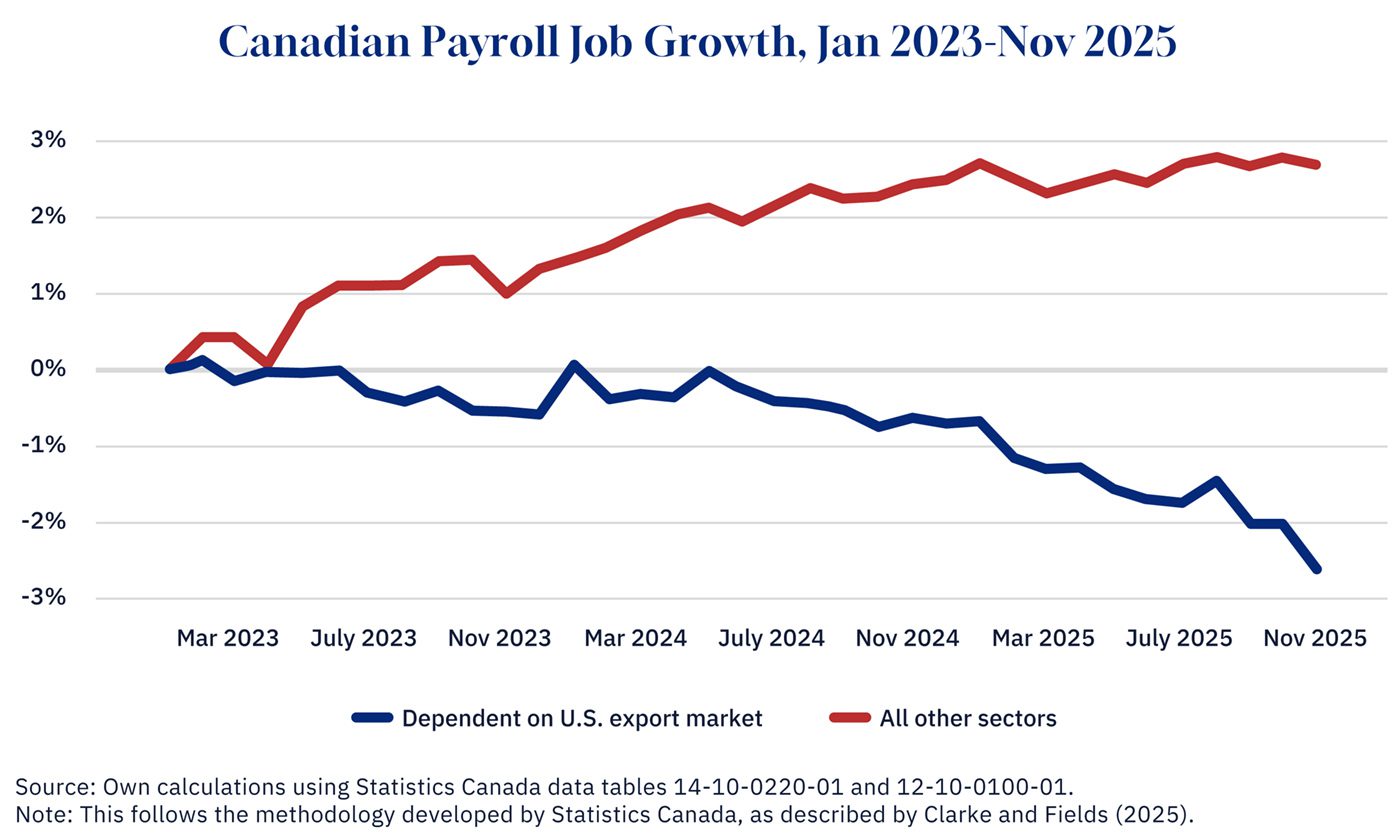
 

Had payroll employment in U.S.-dependent sectors grown at the same pace as the rest of the economy, I estimate total employment in Canada would be nearly 91,000 jobs higher as of November.

The largest declines are in truck transportation, motor vehicle parts manufacturing (subject, it must be said, to real tariffs and not just uncertainty), clothing manufacturing, seafood products, and more. Motion picture and video production has also seen considerable losses, and it was not long ago that President Trump threatened to impose 100 percent tariffs on foreign-made movies.

In total, the decline represents roughly 0.5 percent of all jobs in Canada. While that may seem small, it accounts for nearly one-third of the overall decrease in Canada’s working-age employment rate over the same period.

Uncertainty is clearly a problem.

The lesson for Alberta

There is a lesson here, particularly for those in Alberta who support a separatist referendum merely to express (often legitimate) frustration with how Canada has been functioning.

Trade-related uncertainty can originate domestically just as easily as it can from policy changes abroad. As I have written before, separation could increase the cost of interprovincial trade between Alberta and the rest of Canada. That would have long-run consequences for productivity and living standards.

In the shorter term, it would create risks for jobs currently supported by provincial exports.

A common counterargument I received following those pieces was that an independent Alberta might join the U.S. Given the higher level of productivity in the U.S., closer integration could raise living standards by more than enough to offset increased trade costs with the rest of Canada. That is a valid point.

But many who might support separation, or may vote that way in a referendum, do not necessarily favour independence or becoming a U.S. territory. For some, potentially as high as half of supporters, a vote for separation may be a way to express frustration with federal policy rather than a genuine desire to establish a new country.

For those individuals, it is important to recognise the uncertainty such a vote would create comes with potentially significant costs for their fellow Albertans.

Even the prospect of separation would raise questions about future trade relationships. Businesses operating between Alberta and the rest of Canada would face new risks. And if there were a successful vote, the nature of any post-referendum negotiated outcome would be unclear. Until those uncertainties were resolved, there would be real economic costs. Even a failed vote, there would be lasting uncertainty if the “leave” side saw a non-trivial vote share.

How large could the effects be?

Using the same approach developed by Statistics Canada to measure trade exposure, I estimate that approximately 900,000 Albertans work in sectors where at least 35 percent of jobs depend, directly or indirectly, on exports to other provinces or abroad. If an uncertainty shock similar to the one Canada recently experienced were to occur in Alberta, job losses would be on the order of 50,000.

Even focusing only on interprovincial trade, the exposure is significant. I estimate that roughly 200,000 Albertans are employed in sectors where at least 35 percent of jobs depend on exports to other provinces. If uncertainty reduced hiring across those sectors by a comparable amount, that alone could mean more than 10,000 fewer jobs.

These figures simply illustrate potential orders of magnitude and should be taken with several grains of salt. But the broader point is undeniable: uncertainty significantly affects how businesses invest and hire.

Canada is currently coping with uncertainty driven by policy changes south of the border. But uncertainty created by our own actions can be just as costly.

Those who view separation as a costless protest vote should consider these effects carefully and, perhaps, explore other avenues to advance their concerns.


Trevor Tombe is a professor of economics at the University of Calgary, the Director of Fiscal and Economic Policy at The School of Public Policy, a Senior Fellow at the Macdonald-Laurier Institute, and a Fellow at the Public Policy Forum.

Source: The Hub

Related Posts

The good (and lots of bad) in Canada’s new defence industrial strategy: Richard Shimooka in The Hub
National Defence

The good (and lots of bad) in Canada’s new defence industrial strategy: Richard Shimooka in The Hub

February 19, 2026
Canada should be a mining superpower, too: Heather Exner-Pirot in The Hill Times
Resources

Critical minerals get a nod, steel and aluminium get a push in new Defence Industrial Strategy: Heather Exner-Pirot for The Walrus

February 18, 2026
Trump’s Most Favoured Nation drug pricing risks further delays in Canada for pharmaceuticals: Nigel Rawson in National Newswatch
Health

Trump’s Most Favoured Nation drug pricing risks further delays in Canada for pharmaceuticals: Nigel Rawson in National Newswatch

February 18, 2026

Newsletter Signup

  Thank you for Signing Up
  Please correct the marked field(s) below.
Email Address  *
1,true,6,Contact Email,2
First Name *
1,true,1,First Name,2
Last Name *
1,true,1,Last Name,2
*
*Required Fields

Follow us on

Macdonald-Laurier Institute

323 Chapel Street, Suite #300
Ottawa, Ontario, K1N 7Z2 Canada

613.482.8327

info@macdonaldlaurier.ca
MLI directory

Support Us

Support the Macdonald-Laurier Institute to help ensure that Canada is one of the best governed countries in the world. Click below to learn more or become a sponsor.

Support Us

  • Inside Policy Magazine
  • Annual Reports
  • Jobs
  • Privacy Policy

© 2023 Macdonald-Laurier Institute. All Rights reserved.

No Result
View All Result
  • Home
  • About
    • Who We Are
    • Who Makes MLI Work
    • Fifteenth Anniversary
  • Experts
    • Experts Directory
    • In Memoriam
  • Issues
    • Domestic Policy
      • Economic Policy
      • Justice
      • Rights and Freedoms
      • Assisted Suicide (MAID)
      • Health Care
      • COVID-19
      • Gender Identity
      • Canada’s Political Tradition
      • AI, Technology and Innovation
      • Media and Telecoms
      • Housing
      • Immigration
      • Agriculture and Agri-Food
      • Competition Policy
    • Energy Policy
      • Energy
      • Environment
    • Foreign Policy
      • Israel-Hamas War
      • Ukraine
      • Taiwan
      • China
      • Europe and Russia
      • Indo-Pacific
      • Middle East and North Africa
      • North America
      • Foreign Interference
      • National Defence
      • National Security
      • Foreign Affairs
    • Indigenous Affairs
  • Projects
    • CNAPS (Center for North American Prosperity and Security)
    • The Promised Land
    • Voices that Inspire: The Macdonald-Laurier Vancouver Speaker Series
    • Dragon at the door
    • Canada on top of the world
    • Letter to a minister
    • Justice Report Card
    • The Great Energy Crisis
    • DisInfoWatch.org
    • Managing Indigenous Prosperity
    • Judicial Foundations
    • Landmark Cases Council
    • Defending The Marketplace of Ideas
    • Reforming the University
    • Past Projects
      • Digital Policy & Connectivity
      • Double Trouble
      • Canada and the Indo-Pacific Initiative
      • The Transatlantic Program
      • COVID Misery Index
      • Speak for Ourselves
      • The Eavesdropping Dragon: Huawei
      • Talkin’ in the Free World with Mariam Memarsadeghi
      • An Intellectual Property Strategy for Canada
      • Munk Senior Fellows
      • A Mandate for Canada
      • Confederation Series
      • Fiscal Reform
      • The Canadian Century project
      • Fixing Canadian health care
      • Internal trade
      • From a mandate for change
      • Size of government in Canada
      • Straight Talk
      • Labour Market Report
      • Leading Economic Indicator
      • Centre for Advancing Canada’s Interests Abroad
      • Indigenous Prosperity at a Crossroads
  • Events
    • Upcoming Events
    • Past Events
      • MLI Dinners
      • Great Canadian Debates
  • Latest News
  • Libraries
    • Columns
    • Commentary
    • Papers
    • Books
    • Video
  • Donate

© 2023 Macdonald-Laurier Institute. All Rights reserved.