By Gerard Kennedy and Geoffrey Sigalet
February 18, 2026
From a snail in a bottle of ginger beer to cannibalism to revoking a liquor licence for helping fellow Jehovah’s Witnesses, many seminal law school cases are remembered for their extraordinary facts (Hutchinson 2010). Every so often, however, a case prescribes a legal test that is equally memorable, even when the facts of the case are not. The Supreme Court of Canada’s 1986 decision in R v Oakes is one such case. The iconic “Oakes test” sets out how courts are to determine whether there are “reasonable limits” on rights guaranteed by the Canadian Charter of Rights and Freedoms pursuant to section 1 of the Charter. The test has come to dominate much Charter jurisprudence, as courts frequently use it to evaluate whether or not laws are justifiable as “reasonable limits” on rights under section 1. The test thereby impacts the fundamental approach that courts take to rights under the Charter.
The test has become iconic – and has influenced the law in other countries, particularly in other common law jurisdictions that have adopted bills of rights (the decision was directly influential in South African law in S v Zuma (1995) 2 SA 642, in New Zealand’s rights jurisprudence in R v Hansen [2007] NZSC 7 at paras 20–23, and in Australian law in Momcilovic v The Queen [2001] HCA 34 para 26). The test itself clearly was influenced by the “proportionality” approach to rights in other jurisdictions, which balances rights against government objectives, as it adopted elements similar to doctrines used in other jurisdictions, and there is speculation about whether it is better traced to American or German jurisprudence (Morton and Knopff 2001, 111, 190; Grimm 2007).
Some sort of clear, structured judicial interpretation of the “reasonable limits” clause in section 1 was necessary. The test, however, has significant drawbacks, which we analyze here. Our concerns are that it is unpredictable and undermines section 1’s original purpose of assuring that legislatures share power over the construction of Charter rights. The case’s speaking of “justification” of “infringements” also does not reflect the language of section 1, which refers to “limits” that are “reasonable.” This distinction is not merely rhetorical – it matters in how we conceive of our constitution and the rights it protects, which are unintentionally placed on an uneven footing as a result of the Oakes test. Finally, we seek to unsettle a long-standing presumption – that the government bears the burden of proving that limits are reasonable. This is less obvious than many have assumed and carries significant undesirable consequences flowing from the status quo. We argue that as Oakes is unlikely to be abandoned entirely, it should instead be renovated to accord with the text and purpose of section 1.
The historical purpose of section 1
Although Oakes became the key for understanding section 1, the case failed to discuss the origins of section 1 in the patriation negotiations that led to the Charter in 1982. This is unfortunate because Chief Justice Dickson’s own commitment to “purposive analysis” – interpreting the Charter in light of its underlying purpose – would appear to recommend at least some kind of inquiry into the historical purpose of section 1’s “reasonable limits” clause (Big M Drug Mart, [1985] 1 SCR 295 at para 117).
The absence of historical reasoning in Oakes is also unfortunate because reviewing the purpose of the text of section 1 as it was altered in the negotiations and drafting process can help guide the proper understanding of “reasonable limits.” Historical evidence suggests that section 1 was designed to give legislatures some room to shape how rights would operate in practice, even though the wording of the clause later changed (Dodek 2018; Sigalet 2022). Different interest groups feared that the original limitations clause, which drew on the language of article 3 of the 1971 Victoria Charter – a failed attempt to patriate Canada’s Constitution and entrench a bill of rights more than a decade before the Charter of Rights and Freedoms was finally adopted – would leave too much power in the hands of elected legislatures. In its final form, section 1 continued to reflect the idea that legislatures should retain some authority over how rights are limited. However, interest groups successfully lobbied to ensure that the text did not go as far as earlier drafts in recognizing parliamentary power.
In the negotiations leading to the Charter, Ottawa used the limitations clause as a “carrot” to entice skeptical provinces to accept entrenched rights that federally appointed courts might use to strike down provincial laws. Prime Minister Pierre Trudeau preferred not to include a limitations clause in an entrenched bill of rights, and he did not include such a clause in his original 1968 policy paper A Canadian Charter of Human Rights, which he wrote as the justice minister in the Pearson government (Trudeau 1968). After Trudeau won the Liberal leadership and became prime minister, he faced provincial premiers skeptical of his plan for an entrenched bill of rights. In his first 1969 attempt to win provincial support for the idea, he included a clause allowing rights to be limited in emergencies (Hiebert 1996, 16). The provinces rejected this proposal, and Trudeau offered a more robust role for legislative power in the next round of negotiations that produced the 1971 Victoria Charter. Article 3 of the Victoria Charter contained a clause that recognized legislative power to impose limits on fundamental freedoms in relation to “public safety, order, health or morals, of national security, or of the rights and freedoms” (Proposals on the Constitution 1971–1978 1978, 68). The Victoria Charter was ultimately abandoned after Quebec Premier Robert Bourassa reneged on his support in the face of nationalist opposition in his home province (Russell 2004, 90).
In 1980, Trudeau won an unexpected majority government in the wake of the untimely demise of Joe Clark’s government. He subsequently renewed his efforts to entrench a Charter. Most provinces continued to resist this proposal (only Ontario and New Brunswick supported the idea). Nonetheless, Trudeau submitted a draft Charter to a joint committee of the House of Commons and Senate. The draft included a limitations clause meant to placate provincial concerns about judicial power displacing legislative power over rights questions. The initial limitations clause drew on article 3 of the Victoria Charter:
The Canadian Charter of Rights and Freedoms recognizes the following rights and freedoms subject only to such reasonable limits as are generally accepted in a free and democratic society with a parliamentary system of government. (Bayefsky 1989, 743)
The words “generally accepted” and “parliamentary system of government” were clearly meant to textually anchor a role for legislatures in interpreting and constructing Charter rights. Then Minister of Justice Jean Chrétien explicitly admitted at the committee that this was included “under pressure from the provincial governments” (Dodek 2018, 102). Allan Blakeney, the Premier of Saskatchewan who was skeptical of a Charter, testified at the committee that the (pre-amended) draft of the Charter was “not too bad” because “it has Section 1 which is a kind of non obstante [notwithstanding clause] in advance” (Blakeney 1980, 39).
However, the text of section 1, especially the words “parliamentary system of government,” came under attack from a variety of special interest groups and witnesses (Dodek 2010; Dodek 2018, 83–110). Witnesses argued that the limitations clause would render the Charter similar to Prime Minister John Diefenbaker’s 1960 Canadian Bill of Rights, which they criticized for failing to restrain parliamentary supremacy (the bill of rights was an ordinary federal statute that was only ever used to hold one statutory provision inoperative in R v Drybones, [1970] SCR 282).[1]
One witness captured this sentiment with the vivid imagery of calling the limitations “the Mack Truck clause because a person could drive one right through it” (Dodek 2018, 86–87). As noted, Trudeau and Chrétien had only included section 1 to help mollify provincial opposition, and so Chrétien appeased the critics of the clause by amending it into its final form. Section 1, as enacted, reads:
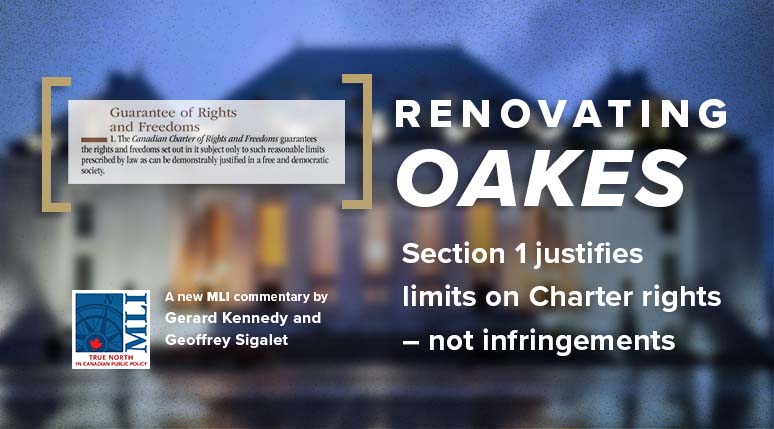
The Canadian Charter of Rights and Freedoms guarantees the rights and freedoms set out in it subject only to such reasonable limits prescribed by law as can be demonstrably justified in a free and democratic society.
This wording followed the recommendations of witnesses who wanted the clause to be less protective of parliamentary sovereignty by eliminating “generally accepted” and “parliamentary system of government.” The text was also amended to add “demonstrably justified,” which witnesses like Walter Tarnopolsky had recommended as a way of indicating that the onus for limitations lay with the government and not litigants challenging laws for rights compliance. However, even after the amendments, Chrétien remained clear that the core purpose of the clause was to “respect the fact that there are legislatures and people have been elected there and they should keep some power of legislation” (Dodek 2018, 102–03). The primary purpose of section 1 remained to preserve legislative power over rights questions, although the amendments meant that it did so less aggressively. The fact that section 1 was amended in this way rendered the Charter even more objectionable to the provinces, and this helped premiers Allan Blakeney of Saskatchewan and Peter Lougheed of Alberta demand the section 33 notwithstanding clause as an additional, and stronger, safeguard for legislative power that would not be subject to judicial review (Sigalet 2022).
Background to Oakes
Prior to Oakes, the Supreme Court did not offer a consistent jurisprudential approach to understanding section 1’s “reasonable limits,” nor any cogent reflections on the historical purpose of section 1. In one early Charter case about Ontario’s citizenship requirement for admittance to the bar and section 6 mobility rights, Law Society of Upper Canada v Skapinker, the Court noted the lack of jurisprudence on section 1 and commented on the need for more than a “minimal” evidentiary record to justify limitations on rights ([1984] 1 SCR 357, para 35). In Singh v Minister of Employment and Immigration, the Court expressed “doubt” that “utilitarian” considerations could be used to justify reasonable limits on rights ([1985] 1 SCR 177, para 70). In Quebec (Attorney General) v Quebec Assn of Protestant School Boards, the Court contrasted matters where laws “collide directly” with rights and constitute “exceptions” to rights, with “limits which can be legitimized by s. 1 of the Charter” ([1984] 2 SCR 66 at 88). This case also argued that the “reasonable limits” allowed by section 1 are distinct from “amendments to the constitution” and contrast with “exceptions” to rights “such as those authorized by s. 33 (1) and (2) of the Charter.” In some of these early cases, such as Singh and Quebec Assn of Protestant School Boards, the Court appeared to interpret reasonable limits justified under section 1 as cases where the right in question “has not been violated.” (Singh at para 65). Finally, in Big M Drug Mart, Justice Dickson presaged the approach he would soon take in Oakes by stating that:
…not every government interest or policy objective is entitled to s. 1 consideration. Principles will have to be developed for recognizing which government objectives are of sufficient importance to warrant overriding a constitutionally protected right or freedom. Once a sufficiently significant government interest is recognized then it must be decided if the means chosen to achieve this interest are reasonable – a form of proportionality test. The court may wish to ask whether the means adopted to achieve the end sought do so by impairing as little as possible the right or freedom in question (R v. Big M Drug Mart, [1985] 1 S.C.R. 177, para. 139).
This teed up the proportionality approach taken in Oakes, including the use of words like “impairing” and “overriding” for section 1 limits on rights. It is worth noting that Big M did not itself consider justified infringements on the section 2(a) freedom of religion because the Court held that the very purpose of the impugned law (the Lord’s Day Act) infringed upon the freedom of religion. Oakes would arguably open the door again to the possibility of a law with a legitimate purpose that violated the core purpose of a right and yet was nevertheless justified as proportionate.
The Oakes Test
By the time the case of David Oakes reached the Supreme Court of Canada, it was clear that some kind of practical structural test was necessary to mitigate the ad hoc reasoning that had come before it. The Court took up the opportunity in a case with some pretty unremarkable facts, albeit ones that remind us of the Charter’s relatively uncontroversial protection of criminal procedure rights.
Oakes had been in possession of a small amount of cannabis (hashish oil) and cash. He was charged for possession of a narcotic for purposes of trafficking. He asserted that the cannabis was for personal use and the cash was from a workers’ compensation cheque. He admitted possessing the cannabis – he had been caught red-handed – but denied that his purpose was to traffic. The problem from his perspective was that the Narcotic Control Act held that, should the Crown prove beyond a reasonable doubt that a person was in possession of a narcotic (which it clearly could in Oakes’s case), the onus moved to him to prove that he did not have the purpose to traffic.
Oakes alleged that this provision in the Narcotic Control Act offended section 11(d) of the Charter, which holds that “Any person charged with an offence has the right […] to be presumed innocent until proven guilty […].” All judges – in the Ontario Provincial Court, Court of Appeal for Ontario, and Supreme Court of Canada – held that the Narcotic Control Act was inconsistent with the presumption of innocence because it required Oakes to prove that he did not have the intent to traffic, rather than placing this burden on Crown prosecutors.
The question thus arose whether this was a reasonable limit on Charter rights. Chief Justice Dickson, writing for the majority of the Supreme Court, held that, once an “infringement” of Charter rights has been established, the government bears the burden of justifying that infringement. To support this claim, he did not look to the drafting history of the amendments to section 1 at the joint committee that introduced the words “demonstrably justified” into the text. He held that, to meet this burden, the government must show a “pressing and substantial objective” that could in principle justify limiting rights. He held that the goal to combat drug trafficking was such an objective in this case. He further held that there must be “proportionality” between the infringement and governmental objective, demonstrated through:
- a rational connection between the objective and the measures;
- the measures being minimally impairing of the right at issue; and
- the salutary benefits of the law outweighing its deleterious effects.
In the case of Oakes, Chief Justice Dickson held that there was no rational connection between combatting drug trafficking and presuming those with a very small amount of narcotics were planning to traffic in drugs. He thus held that the law was not justified under section 1 and declared it of no force and effect. Note that, in tension with the language of earlier cases like Singh and Quebec Assn of Protestant School Boards, Chief Justice Dickson characterized the section 1 inquiry as being “premised on an understanding that the impugned limit violates constitutional rights and freedoms” (Oakes at para 63).
An unpredictable – and utilitarian – framework
Before we dig into the deeper issues with Oakes, it is worth first explaining the problems with how the test was applied in the particular circumstances of the case. Oakes held that there was no rational connection between combatting drug trafficking and presuming those with a small amount of narcotics had the purpose of trafficking. This fails elementary logic. Undoubtedly, some percentage (however small) of those with a small amount of narcotics do intend to traffic: consider a dealer who is about to make his last sale of the day before returning to his supplier. Accordingly, presuming that all persons with small amounts of narcotics intend to traffic will inevitably help combat drug trafficking, even if very modestly. So, while the law was severe, it was not irrational. Law professor Peter Hogg further noted that the Court offered the “widest possible interpretation of the presumption of innocence in section 11(d) and, at the same time, laid down the stringent standards of justification that are supposed to regulate the application of section 1” (Hogg 1990, 823; Hogg 1991). The fact that the Oakes test was seemingly misapplied in Oakes itself should cause us to ask how practical it is as a framework.
To be fair, however, this could be a kink in a new framework being worked out in its early days. Most of the analysis in section 1 quickly came to centre on the “minimal impairment” criterion. This has some merit. Indeed, if the Oakes test has the benefit of prompting legislatures to ask whether they can achieve their policy objectives in ways that better respect rights, that may be a salutary benefit (no pun intended) of the test. This is not a complete response to judicial-legislative disagreements, to be sure. Alberta’s recent invocation of the Charter’s notwithstanding clause to end a teacher’s strike was likely necessary because it would obviously have been less impairing of judicially interpreted freedom of association rights to send the teachers to binding arbitration rather than impose a contract. But that does not rectify the fundamental disagreement with how to interpret freedom of association in light of the Supreme Court of Canada holding that the right to strike is implicit in this freedom, notwithstanding precedent to the contrary (contrasting Saskatchewan Federation of Labour v Saskatchewan, 2015 SCC 4 to Reference re Public Service Employee Relations Act (Alta), [1987] 1 SCR 313).
If we recall the drafting purpose of section 1, i.e. allowing legislatures space to enact limits on the scope of entrenched rights, we can better see the problems Oakes raises. Even if most cases are now decided on the minimal impairment branch of Oakes, there remains the danger that courts will deploy the rational connection test in ways that mischaracterize the relationship between the purpose of the law, how the purpose relates to different views of the nature and scope of the right in question (and perhaps other rights), and the policy means adopted in the law.
Arguably the purpose of section 1 should burden courts with the task of using the rational connection test to understand contextual factors necessary for evaluating if a right has been violated (Miller 2008). If the Court arbitrarily excludes contextual factors relevant to the legislature’s view of the nature and scope of the rights in question, then it runs the risk of failing its duty to assess the legislature’s view of what counts as reasonable limits in a “free and democratic society.” The reality is that Chief Justice Dickson made it unlikely for the Court to adequately fulfill this duty by artificially separating the inquiry into the “infringement” of rights as a “premise” of the rest of the Oakes test. The Court is more likely to use rational connection to make the kind of utilitarian calculation it appeared to reject in Singh, by asking if the law’s purpose justifies limiting a right and how much societal good comes from this limitation. This stands in contrast to using its inquiry into the purpose of the law to understand how the legislature intends to offer its view of the policy goals and nature of the rights in question.
This approach is why in cases like Sauvé v Canada, the majority and the dissent alike fail to appreciate how the purpose of disenfranchising prisoners to enhance social responsibility and punish serious crime can be part of the realizing the purpose of the section 3 “right to vote” in a free and democratic society (Sauvé v Canada, 2002 SCC 68; Frank v Canada (Attorney General), 2019 SCC 1). Doctrinally positing the rational connection test as an instrumental justification of violating rights makes it challenging to defend laws as reasonably limiting rights in the sense of setting their scope in ways that protect rights. In addition, notwithstanding the way Big M teed up the Oakes test, Oakes arguably departs from Big M by allowing for the possibility that a law with the purpose of violating a right could justifiably do so for pressing and substantial purposes by means that are rationally connected, minimally impairing, and proportionate. (This is despite the Court’s claim that Oakes is consistent with Big M in Ross v New Brunswick School District No 15, [1996] 1 SCR 825 at para 74.) The rational connection, in other words, can be to a philosophical understanding of the interpretation of the right. The core holding in Big M is that laws with the very purpose of violating the core purpose of Charter rights cannot be justified as reasonable limits. This problem will be later highlighted in a discussion of Frank v Canada below.
Regarding the minimal impairment inquiry, there are two problems with courts second-guessing legislatures because they can imagine a regime that would be more respectful of how they interpret rights. First, a court looks back on a situation in hindsight and imagines a regime that was difficult to implement or imagine contemporaneously. To be fair, courts are sometimes cognizant of this, particularly in emergencies (the Court of Appeal for Ontario recently recognized this in Jacob v Canada (Attorney General), 2024 ONCA 648), but the risk of overreach is profound.
Second, and more importantly, the alternatives that courts imagine as less minimally impairing often do not achieve the government’s policy goal to the same extent, or it may not charitably reflect the government’s view of how that policy goal should be contextually related to certain trade-offs or other rights.
Sometimes, courts will acknowledge this and uphold a regime that significantly impairs a right because there is no way to achieve the policy goal to the same extent. This is arguably what Chief Justice Beverley McLachlin did in Alberta v Hutterian Brethren of Wilson Colony, where she upheld a requirement that drivers’ licences have photographs over the Hutterites’ religious objections (Alberta v Hutterian Brethren of Wilson Colony, 2009 SCC 37). This was notwithstanding the Hutterites’ alternative suggestions to permit them to have drivers’ licences without photographs. Despite the impacts on the Alberta government’s security concerns being negligible, adopting these alternatives would not have advanced the government’s policy objectives to the same extent. Chief Justice McLachlin nonetheless added that “the court need not be satisfied that the alternative would satisfy the […] objective to exactly the same extent or degree as the impugned measure.” Justices Martin and O’Bonsawin, in a partially dissenting opinion in Dickson v Vuntut Gwitchin First Nation, held that this means that “alternative measures that would ‘give sufficient protection, in all the circumstances, to the government’s goal’ should be considered” (citing Hutterian Brethren). This essentially invites courts to disagree with how the government valued policy trade-offs. This is addressed in more detail below and is particularly challenging when the trade-offs involve matters that cannot readily be compared.
Moreover, the final stage of Oakes adds questionable benefits to the test, whereas it clearly appears to raise philosophical problems. If a measure limits rights reasonably minimally as necessary to achieve its objective, asking a court to compare the law’s salutary and deleterious effects is inappropriate for three reasons. First, and least importantly, it is unclear what this stage adds, as Peter Hogg noted (Hogg 1991, 22). The fact that one of this stage’s rare consequential uses was partially declaring child pornography restrictions unconstitutional as applied to certain types of expression, while characterizing reasonable restrictions as required infringements on rights, should give us pause (R v Sharpe 2001, at paras 2 and 127). Second, and more importantly, this stage asks courts to do things where judicial competence is questionable. Unlike democratic actors, courts will only have evidence of a law’s salutary benefits and deleterious effects that have been placed before it by the parties to it in a proceeding. This is definitionally a narrow slice of the populace, whereas legislatures have far broader inputs. The evidence supplied by the empirical facts established at trial can be misleading and courts may not be qualified to judge certain types of evidence (Yowell 2018). While courts can circumvent this to some extent by liberally granting intervenor status, doing so results in the court looking like a legislature, which is not its role in the constitutional order.
Third, this stage features what legal scholar Francisco Urbina has called proportionality’s “incommensurability problem” (Urbina 2015). The kind of utilitarian calculation the Court tends to make at the final proportionality prong of the Oakes test often involves comparing incommensurable rights interests and public goods or values. Incommensurability means there is no common measure (X) between two things by which to judge whether one thing is more or less (X) (Urbina 2015). How can the Court measure the proportionality of, say, a fiscal “emergency” as a justification for infringing s. 15(1) equality rights by enacting legislation that delayed a pay equity settlement for female public workers (Newfoundland (Treasury Board) v Newfoundland Association of Public Employees, 2004)? We agree with Bradley Miller (now Justice Miller) that there is no “formula” for assessing the proportionality of the trade-offs between different values at stake in such litigation (Miller 2008, 112–14). The more that the values and policy goals being assessed at this stage cannot be compared (the technical term for this is to say that they are incommensurable), the more appropriate it is to defer to the legislature (Webber et al. 2018).
Creating a hierarchy of rights through a shifting burden of proof
Oakes also clarified that the government bears the burden of proof to show that an “infringement” of a right is justified, rather than the claimants proving that the right is not reasonably limited. This was understandable. The language of section 1 refers to the need to “demonstrably justif[y]” limits as reasonable under section 1. Moreover, the drafting history of section 1 noted above offers some support for the idea that the onus of demonstrable justified limits would lie with the government, and the blanket application of reasonable limits to all rights has its own purpose in the Charter. The different sections in the Charter serve different purposes. Rights are only guaranteed on particular terms prescribed in section 2–23 of the Charter. In cases where the particular terms and limits of the right are sparse or underdetermined by the text, section 1 guides courts to be conscious of developing such limits with respect for the legislative participation in this task.
But holding that the government has the burden of proof in section 1 and not sections 2–23 has problems of its own. One is related to the foregoing concern about a utilitarian conception of rights. Many justifications for limits on rights are philosophical and do not easily lend themselves to proof, partly due to the incommensurability problem discussed above. The “demonstrable justification” needs to be understood in terms of how to conceptualize rights and government policy objectives more than a shifting burden. We reject any notion that a “demonstrable justification” must be scientific or even proven with witnesses’ evidence: it can be “demonstrated” in the way that a philosopher would demonstrate.
Moreover, even if it is reasonable to expect the attorney general to defend as reasonable limits of rights prescribed by legislation, individuals often encounter the state through interactions with police officers and other administrative actors. Do we really expect such government actors to use the Oakes test to defend their decisions? Is it even appropriate for them to be buttressing their decisions after the fact? One response has been to give administrative actors an even greater leash in interpreting the Charter, as the Supreme Court did in Doré v Barreau du Quebec, 2012 SCC 12. But this has led to a separate regime criticized for being even more unpredictable and disrespectful of the separation of powers than Oakes (Horner 2014; Lauwers 2019; Mancini 2020).
This shifting burden also has a pragmatic consequence through unintentionally creating a hierarchy of rights in the Charter. An explanation of the Charter’s structure helps us put this in context. Many of the Charter rights are phrased in very broad language and it is not challenging for a litigant to prove they have been “limited” prior to s 1 analysis playing a role. These include broadly worded rights such as “freedom of religion” (section 2(a)), “freedom of expression” (section 2(b)), the “right to vote” (section 3, although only guaranteed to citizens). Essentially, the government bears the burden of proving that limits on these rights are reasonable once a claimant has met a low burden.
Most rights, however, have internal limits within the right that need to be considered prior to addressing section 1 [emphases added]:
- Section 7: “the right to life, liberty, and security of the person and the right not to be deprived thereof except in accordance with the principles of fundamental justice”;
- Section 8: prohibits “unreasonable search and seizure”;
- Section 9: prohibits “arbitrary arrest and detention”;
- Section 12: prohibits “cruel and unusual treatment or punishment”; and
- Section 15: “Every individual is equal before and under the law and has the right to the equal protection and equal benefit of the law without discrimination.”
It is much more difficult to justify limits on these rights under section 1 as courts are loath to find reasonable limits if principles of fundamental justice are contravened, searches are unreasonable, arrest or detention is arbitrary, punishment or treatment is cruel and unusual, or discrimination is present.
By placing the burden on the government under section 1, rights such as sections 2(a), 2(b), and 3 largely require justification from the government. Almost all the work concerning rights such as sections 7, 8, 9, 12, and 15 falls on claimants. Given that rights are not to be ranked hierarchically, this is regrettable. Recognizing that all rights are guaranteed subject to reasonable limits – and there is no “violation” until a claimant has shown that their rights have been unreasonably limited – places all rights on an equal footing. It also accords with the presumption that the government acts lawfully. This further reflects the intentions of the framers in drafting section 1 to protect the legislature’s ability to share in the process of interpreting constitutional rights. That being said, the burden of proof probably has less influence on the emergence of rights hierarchies than other factors, including the conflation of limits and “infringements.”[2]
We grant that there is a very strong argument that the government should bear the burden of proving that limits are reasonable: the language of section 1 refers to limits being “demonstrably justified” and the legislative history suggests this was intentionally chosen to set the onus on the government. The government is clearly better situated to fulfil this burden than claimants. We do, however, suggest that this conclusion is less certain than many have assumed – and there are negative consequences to this holding. Canadian law expects individuals who challenge the lawfulness of administrative action to bear the burden of proving its unlawfulness even when the government actor is better situated to do so (Canada v Vavilov, 2019 SCC 65). This is not an objectionable impediment in this other area of public law, even though the same arguments can be made that the administrative decision-maker is better situated to justify the reasonableness of its decisions. Moreover, the boundary between constitutional law and administrative law can be blurry.
This shifting burden is connected to using the language of “infringement” when “limit” should be used. It is also not in the best interests of the broadly worded rights, however, as they end up being “infringed” but “justified” more easily, as will now be discussed. It may be that by clearing up the conflation of “limits” and “infringements” and relaxing the artificial distinction between the inquiry into the “limit” of a right, and the “justification” of the limit, the problems we raise about the burden of proof could be alleviated.
Back to the text of “reasonable limits”
Perhaps the most regrettable and damaging legacy of Oakes is the conflation it drew between assessing the questions of whether a right is violated and whether it nevertheless constitutes a “reasonable limit” under section 1 (R v Oakes, para 14). As Justices Russell Brown and Suzanne Côté noted in their dissent in Frank v Canada, there remains the clear language of section 1, which does not speak of “infringements” but of “reasonable limits.” All rights are guaranteed – subject to such reasonable limits. A return to the text’s language of “limits” will require revising the artificial distinction Oakes drew between asking if a right is “violated” or “infringed” and asking if it is justifiably limited. We need not abandon the whole Oakes test, but it must be renovated to turn the inquiry towards understanding whether laws respect the reasonable scope and nature of the right(s) in question.
Returning to this language is well-founded. From a principled perspective, it is simply rooted in the text of section 1. A “reasonable limit” of a right is not a denial, infringement, or violation of the right. Reconceptualizing section 1 as a clause about limitations also prevents absurd results, where we need to view a one-year Canadian citizen as having her rights “infringed” or “violated” or “prima facie breached” (all terms used in the case law) by the prohibition on those under 18 voting, even if the so-called “infringement” is justified. Such language of infringement, violation, or breach is only appropriate if the limit is unreasonable. As the dissent in Frank clarified, the rational connection part of Oakes can be used to analyze if the means of the policy in question is connected to the goal in a way that protects and specifies rights, or not (Frank v Canada, paras 160–62).
This language would also place rights on an equal footing in the Canadian constitution. The Supreme Court has constantly reminded us that there is no hierarchy of rights in the Canadian constitution (Dagenais v CBC, [1994] 3 SCR 835; Canadian Council for Refugees v Canada, 2023 SCC 17), and this occasionally means that rights that may appear in tension have to be specified in terms of their scope and value in different contexts, such as freedom of religion sometimes being in tension with equality (Trinity Western University v British Columbia College of Teachers, [2001] 1 SCR 772), or criminal procedure rights of accused persons being in tension with the equality interests of victims of crime (R v Mills, [1999] 3 SCR 668). Having certain rights de facto always needing to have their limits justified under section 1 (such as the right to vote or the freedoms of expression or religion), while others with internal limits do not, means that section 1 is inconsistently deployed across different parts of the constitution. As Justices Côté and Brown put it in their Frank dissent, treating “internal” limits as part of the scope of a right, while treating section 1 “limits” as “infringements,” treats section 1 limits as “dead letter” – existing on the books but no longer enforced or effective – by characterizing them as infringements or violations of rights rather than potential parts of the scope and nature of the rights (Frank v Canada, at paras 142–146).
At the same time, there are many rights, such as freedom of expression and freedom of religion, that frequently have “infringements” justified. This paradoxically gives an impression that infringements are justified more frequently of these rights. Even more worryingly, it may be that in these cases the Court is complicit in the “loss of rights” (Webber 2014). Understanding both “internal” and section 1 limits as part of section 1’s “reasonable limits” exhorts courts to take the legislature’s role more seriously even in the determination of limits on rights, while also underlining that legislatures do not simply have a licence to “infringe” the more abstract rights simply because their limits are not “internally” specified by the text. In both cases, section 1 burdens legislatures with the responsibility of setting reasonable limits on the scope and nature of rights in particular policy areas, while reminding courts that this authorizes legislatures to act as independent interpreters of the Charter. Turning the rational connection test into an inquiry into the scope and purpose of the right as it relates to the purpose and means of the policy could also make the “minimal impairment” inquiry more respectful of the legislature’s reasons for enacting a specific policy scheme to realize a specific conception of rights.
Finally, this educates the public. If rights are too often “violated,” “denied,” or “infringed,” it cheapens rights protection. Legislatures are often unfairly decried as “forums of policy” featuring utilitarian judgments on behalf of the collective, in contrast with courts as “forums of principle” featuring enlightened discussion of individual rights (Dworkin 1977). Not only is the forum of policy/principle distinction unjust to the legislative capacity for reasoning about rights, but it also fails to capture how courts can engage in crude utilitarian policy reasoning (Miller 2008). The legacy of Oakes is to mire courts in the forum of policy without acknowledging or exhorting the ability of legislatures to engage in the principled specification of rights, even and perhaps especially where such specification is complex and rationally underdetermined.[3]
Actual steps forward
An old Irish proverb is germane in this discussion:
Question: “How should I get to Dublin?”
Answer: “Well, I wouldn’t start from here.”
It may be too late in the day to completely depart from the Oakes test, or reverse what the courts have held the government’s burden to be in section 1 case law. They are part of Canadian legal culture. And it is a conservative virtue to depart from precedent only when clearly necessary. The Oakes test has had some benefits, in terms of providing structure to section 1 analysis and asking governments whether they could achieve their objectives in a less rights-limiting manner. We certainly prefer Oakes to Doré, which, as alluded to above, has caused seemingly endless conflict in administrative law. However, it is still worth bearing in mind the limitations of Oakes going forward. While our views of what Oakes should have said may not be implementable at this point, three lessons should nonetheless be borne in mind going forward as opportunities for renovating and revising Oakes present themselves.
First, the language of “limits” should replace the terms “denial,” “infringement,” “breach,” or “violation” in reimagining the relationship between section 1 and the rights guaranteed in sections 2 through 23 of the Charter. The courts themselves have been inconsistent in what language they use in this regard, so implementing some consistency is hardly overturning the apple cart: especially when that language reflects constitutional text. “Reasonable limits” are just that – a “denial,” “infringement,” “breach,” or “violation” only occurs if the limit is unreasonable. This can be underscored when legislative bills of rights, such as Alberta’s, make this clear.
Second, courts should be particularly mindful in the rational connection and minimal impairment stages of Oakes of their role in the constitutional order. Understanding the connection between the purpose of a law and the means is a chance to reflect on and understand the scope and nature of the right as it relates to the law. The court should not assume that the purpose of a law and the means chosen will infringe rights. Imagining a less rights-infringing way to achieve a government policy objective is often easy in hindsight – but challenging in the messy day-to-day trade-offs of legislating. Moreover, such alternatives will also often not advance the government’s policy objective to the same extent as the method chosen. Courts, to their credit, have occasionally recognized this. But this has been inconsistent, suggesting that Oakes is limited in its ability to provide predictability.
Third, courts should consider limiting the use of the pure proportionality prong of the Oakes test so that laws are never or only very rarely invalidated solely for failing this step. The incommensurability problem we explain above means that invalidating laws solely on the basis of their disproportionality is arbitrary and a poor fit to the judicial role. At most, proportionality should be limited to yet another angle for explaining how different understandings of the purpose of a right are served or fail to be rationally connected and minimally impairing to the purpose and means of the impugned law. Ideally, the rational connection test could become the heart of the Oakes inquiry, as it is for Justices Côté and Brown’s dissent in Frank (para 172).
Oakes did not occur in a vacuum. It was necessary to provide some level of predictability to a section of the Charter that required structure to be implemented. However, the level of predictability it has granted has often been wanting. It has also unintentionally created a hierarchy of rights in our constitutional order, and has distorted reasoning about rights based on its emphasis on differences between “infringements” and “justifications” (Sigalet 2020). The language of “reasonable limits” would not only respect the constitution’s language, but also our separation of powers. It also seems more proper. Finally, it accords with the historical purpose of section 1, which is not as a response to emergencies, but to reflect the legislature’s role in constructing rights. Section 1 was drafted to assure legislative power over the principled interpretation of rights. It was not designed to assure judicial power over policy.
About the authors
Gerard J. Kennedy is an associate professor and associate dean of Graduate Studies in the Faculty of Law at the University of Alberta. His research lies at the intersection of procedural law and public law. He is the author of six books and 30 other articles on topics such as civil procedure, administrative law, and constitutional law. His work has been cited by all levels of court in Canada. A member of the Bars of Ontario, Manitoba, and Alberta, he is an active member of the legal profession.
Geoffrey Sigalet is a senior fellow at the Macdonald-Laurier Institute, assistant professor of Political Science at the University of British Columbia’s Okanagan campus and the director of the UBC Research Group for Constitutional Law. His research focuses on questions of constitutional law, judicial politics, federalism, and political theory, and has been published in Publius: The Journal of Federalism, the Canadian Journal of Political Science, the Osgoode Hall Law Journal, the Queen’s Law Journal, and other venues.
References
Bayefsky, Anne. 1989. Canada’s Constitution Act 1982 and Amendments: A Documentary History (Toronto: McGraw-Hill Ryerson).
Blakeney, Alan. 1980. Minutes of Proceedings and Evidence, 32–1, No. 30 (December 19) at 39. Senate and House of Commons, Special Joint Committee on the Constitution of Canada,
Canadian Intergovernmental Conference Secretariat. 1978. Proposals on the Constitution, 1971-1978.
Clarke, Dylan. 2026. “Judicial Activism in Canadian Criminal Law.” Macdonald Laurier Institute, January 9. Available at https://macdonaldlaurier.ca/judicial-activism-in-canadian-criminal-law-the-lasting-legacy-of-irwin-toy-dylan-r-clarke/.
Dodek, Adam. 2010. “Where Did (Section) 1 Come From? The Debates over the Limitations Clause at the Special Joint Committee of the Senate and the House of Commons on the Constitution” National Journal of Constitutional Law 27:77.
Dodek, Adam. 2018. The Charter Debates: The Special Joint Committee on the Constitution, 1980-81, and the Making of the Canadian Charter of Rights and Freedoms (Toronto: University of Toronto Press).
Dworkin, Ronald. 1978. Taking Rights Seriously (Cambridge: Harvard UP).
Grimm, Dieter. 2007. “Proportionality in Canadian and German Constitutional Jurisprudence” University of Toronto Law Journal 57:2 383.
Hiebert, Janet. 1996. Limiting Rights: The Dilemma of Judicial Review (Montreal: McGill-Queen’s University Press).
Hogg, Peter. 1990. “Interpreting the Charter of Rights: Generosity and Justification” Osgoode Hall Law Journal 28:4, 817–838 at 823.
Hogg, Peter. 1991. “Section 1 Revisited” National Journal of Constitutional Law 1:1.
Horner, Matthew. 2014. “Charter Values: The Uncanny Value of Canadian Constitutionalism.” Supreme Court Law Review (2d) 67 361.
Hutchinson, Alan. 2010. Is Eating People Wrong? Great Legal Cases and How They Shaped the World (New York: Cambridge University Press).
Lauwers, The Honourable Peter D. 2019. “What Could Go Wrong with Charter Values?” Supreme Court Law Review (2d) 91 1.
Mancini, Mark. 2020. “The Conceptual Gap Between Doré and Vavilov.” Dalhousie Law Journal 43:2 793.
Miller, Bradley. 2008. “Justification and Rights Limitations” in G. Huscroft ed. Expounding the Constitution (New York: Cambridge University Press).
Morton, F.L., and Rainer Knopff. 2000. The Charter Revolution and the Court Party. University of Toronto Press.
Russell, Peter. 2004. Constitutional Odyssey: Can Canadians Become A Sovereign People? Third Edition (Toronto: University of Toronto Press).
Sigalet, Geoffrey. 2020. “American Rights Jurisprudence Through Canadian Eyes.” University of Pennsylvania Journal of Constitutional Law 23.
Sigalet, Geoffrey. 2022. “The Truck and the Brakes: Understanding the Charter’s Limitations and Notwithstanding Clauses Symmetrically” 105 Supreme Court Law Review (2nd Edition) 194–227
Trudeau, Pierre Elliott. 1968. A Canadian Charter of Human Rights. (Ottawa: Queen’s Printer).
Urbina, Francisco. 2015. “Incommensurability and Balancing.” Oxford Journal of Legal Studies, 35:3, 575–605
Yowell, Paul. 2018. Constitutional Rights and Constitutional Design: Moral and Empirical Reasoning in Judicial Review. (London: Bloomsbury Publishing).
Webber, Grégoire. 2014. “On the Loss of Rights” in Huscroft, Miller, and Webber (eds.) Proportionality and the Rule of Law (Cambridge: Cambridge UP), 155–172.
Webber, Grégoire, Paul Yowell, Richard Ekins, Maris Köpke, Bradley Miller, and Francisco Urbina. 2018. Legislated Rights (Cambridge: Cambridge University Press).
[1] It’s worth noting that at least one witness complained that the problem with the whole text of section 1 was that it granted the Supreme Court “total and complete power to do what it likes, when it likes and how it likes …” (Dodek 2018, 96).
[2] Interestingly, although one might expect that the Court would be more deferential to the government in cases where the burden falls on the claimant, in practice there is empirical evidence that just the opposite holds true. In penal cases where the rights with more significant internal limits in sections 7–12 are in play, the Court is more likely to find that the least intrusive means have not been taken. In non-penal cases, such as in freedom of expression 2(b) rights, the Court is much more likely to find justified limitations (Clarke 2026). Many political scientists would argue that this is likely related to the particular institutional confidence of courts in criminal law matters, but here we suggest that section 1’s burden of proof may help influence the court to take the legislature’s participation setting section 1 reasonable limits more seriously in non-penal cases. Again, we make no strong formalist causal claim here.
[3] The Albertan legislature recently made the exhortatory value of rights as limits, not infringements clear in the Alberta Bill of Rights, which acknowledges that rights have limits – but clarifies that such limits (distinct from overrides) are not a denial of the rights themselves. This is the legislature holding itself to a higher standard of principle than mere utilitarian necessity.