Monday, February 9, 2026
No Result
View All Result
  • Media
Macdonald-Laurier Institute
  • Home
  • About
    • Who We Are
    • Who Makes MLI Work
    • Fifteenth Anniversary
  • Experts
    • Experts Directory
    • In Memoriam
  • Issues
    • Domestic Policy
      • Economic Policy
      • Justice
      • Rights and Freedoms
      • Assisted Suicide (MAID)
      • Health Care
      • COVID-19
      • Gender Identity
      • Canada’s Political Tradition
      • AI, Technology and Innovation
      • Media and Telecoms
      • Housing
      • Immigration
      • Agriculture and Agri-Food
      • Competition Policy
    • Energy Policy
      • Energy
      • Environment
    • Foreign Policy
      • Israel-Hamas War
      • Ukraine
      • Taiwan
      • China
      • Europe and Russia
      • Indo-Pacific
      • Middle East and North Africa
      • North America
      • Foreign Interference
      • National Defence
      • National Security
      • Foreign Affairs
    • Indigenous Affairs
  • Projects
    • CNAPS (Center for North American Prosperity and Security)
    • The Promised Land
    • Voices that Inspire: The Macdonald-Laurier Vancouver Speaker Series
    • Dragon at the door
    • Canada on top of the world
    • Letter to a minister
    • Justice Report Card
    • The Great Energy Crisis
    • DisInfoWatch.org
    • Managing Indigenous Prosperity
    • Judicial Foundations
    • Landmark Cases Council
    • Defending The Marketplace of Ideas
    • Reforming the University
    • Past Projects
      • Digital Policy & Connectivity
      • Double Trouble
      • Canada and the Indo-Pacific Initiative
      • The Transatlantic Program
      • COVID Misery Index
        • Provincial COVID Misery Index
        • Beyond Lockdown
        • COVID and after: A mandate for recovery
      • Speak for Ourselves
      • The Eavesdropping Dragon: Huawei
      • Talkin’ in the Free World with Mariam Memarsadeghi
      • An Intellectual Property Strategy for Canada
      • Munk Senior Fellows
      • A Mandate for Canada
      • Confederation Series
      • Fiscal Reform
      • The Canadian Century project
      • Fixing Canadian health care
      • Internal trade
      • From a mandate for change
      • Size of government in Canada
      • Straight Talk
      • Labour Market Report
      • Leading Economic Indicator
      • Centre for Advancing Canada’s Interests Abroad
      • Indigenous Prosperity at a Crossroads
        • Aboriginal Canada and Natural Resources
  • Events
    • Upcoming Events
    • Past Events
      • MLI Dinners
      • Great Canadian Debates
  • Latest News
  • Libraries
    • Columns
    • Commentary
    • Papers
    • Books
    • Video
  • Donate
  • Home
  • About
    • Who We Are
    • Who Makes MLI Work
    • Fifteenth Anniversary
  • Experts
    • Experts Directory
    • In Memoriam
  • Issues
    • Domestic Policy
      • Economic Policy
      • Justice
      • Rights and Freedoms
      • Assisted Suicide (MAID)
      • Health Care
      • COVID-19
      • Gender Identity
      • Canada’s Political Tradition
      • AI, Technology and Innovation
      • Media and Telecoms
      • Housing
      • Immigration
      • Agriculture and Agri-Food
      • Competition Policy
    • Energy Policy
      • Energy
      • Environment
    • Foreign Policy
      • Israel-Hamas War
      • Ukraine
      • Taiwan
      • China
      • Europe and Russia
      • Indo-Pacific
      • Middle East and North Africa
      • North America
      • Foreign Interference
      • National Defence
      • National Security
      • Foreign Affairs
    • Indigenous Affairs
  • Projects
    • CNAPS (Center for North American Prosperity and Security)
    • The Promised Land
    • Voices that Inspire: The Macdonald-Laurier Vancouver Speaker Series
    • Dragon at the door
    • Canada on top of the world
    • Letter to a minister
    • Justice Report Card
    • The Great Energy Crisis
    • DisInfoWatch.org
    • Managing Indigenous Prosperity
    • Judicial Foundations
    • Landmark Cases Council
    • Defending The Marketplace of Ideas
    • Reforming the University
    • Past Projects
      • Digital Policy & Connectivity
      • Double Trouble
      • Canada and the Indo-Pacific Initiative
      • The Transatlantic Program
      • COVID Misery Index
        • Provincial COVID Misery Index
        • Beyond Lockdown
        • COVID and after: A mandate for recovery
      • Speak for Ourselves
      • The Eavesdropping Dragon: Huawei
      • Talkin’ in the Free World with Mariam Memarsadeghi
      • An Intellectual Property Strategy for Canada
      • Munk Senior Fellows
      • A Mandate for Canada
      • Confederation Series
      • Fiscal Reform
      • The Canadian Century project
      • Fixing Canadian health care
      • Internal trade
      • From a mandate for change
      • Size of government in Canada
      • Straight Talk
      • Labour Market Report
      • Leading Economic Indicator
      • Centre for Advancing Canada’s Interests Abroad
      • Indigenous Prosperity at a Crossroads
        • Aboriginal Canada and Natural Resources
  • Events
    • Upcoming Events
    • Past Events
      • MLI Dinners
      • Great Canadian Debates
  • Latest News
  • Libraries
    • Columns
    • Commentary
    • Papers
    • Books
    • Video
  • Donate
No Result
View All Result
Macdonald-Laurier Institute

Canada is under threat—and the U.S. is not our biggest problem: Richard Shimooka in The Hub

Our military is nowhere near capable of securing our country or projecting real power in the world.

February 9, 2026
in National Security, National Defence, Latest News, Columns, Foreign Policy, In the Media, Richard Shimooka
Reading Time: 5 mins read
A A
Canada is under threat—and the U.S. is not our biggest problem: Richard Shimooka in The Hub

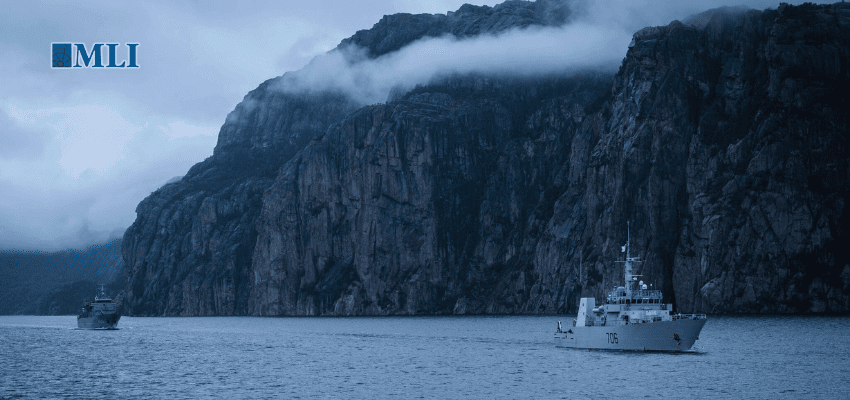
Photo by Sailor Third Class Mckayla Ryce, Canadian Armed Forces Imagery Technician | Combat Camera via Flickr.

This article originally appeared in The Hub.

By Richard Shimooka, February 9, 2026

Every February, the International Institute of Strategic Studies publishes its Military Balance, one of a handful of public resources that catalogues the world’s militaries. It’s an invaluable resource, and I’ll usually spend a day thumbing through its pages and seeing all of the developments once it’s released.

It’s an illuminating insight into which countries are taking their geopolitical positions for granted and which are prepared to be serious actors on the world stage. For the past decade, one can clearly see the contours of a massive military buildup that has emerged among Western states.

Since 2014, for instance, Poland’s government has launched a massive modernization of its military forces, acquiring cutting-edge capabilities to deter or fight a potential war with the Russian Federation. Some of the numbers are staggering, such as going from 600 to 900 tanks between 2015 and 2025, or the addition of 16 Patriot medium-range missile systems. The seeds of Poland’s efforts really can be traced back to political decisions made a decade ago when they first began sensing the urgency of their situation, and which are now bearing fruit. Furthermore, Warsaw often eschewed industrial benefits during this buildup, instead prioritizing low cost and quick delivery of the capabilities they were procuring.

Many of these efforts made by Poland and like-minded nations have come in response to the threat posed by China and Russia, whose growth in terms of modernized capabilities is palpable. Particularly concerning is China, which has started fielding new indigenous designs at scale as part of new force concepts and doctrines that leverage technological innovations.

Enter Canada, whose capabilities over this period have remained largely static, if not declined, due to obsolescence and lack of modernization vis-à-vis our adversaries. A representative case is that Canada’s tactical fighter fleet is in the midst of a major contraction as it retires a large portion of barely serviceable CF-18s in order to transition to the F-35 (which, as documented in these pages, may or may not even happen).

The Canadian Armed Forces’ most significant foreign presence is the 2200 troops currently deployed to Latvia—a pitifully small, embarrassingly ill-equipped force given the economic size of Canada. It is highly reliant on allies to provide it with key capabilities, such as long-range artillery or a large spectrum of air defence capabilities.

The on-the-ground reality, in other words, is at odds with the ambitious agenda Prime Minister Carney has set out over the past several months, culminating in last month’s Davos speech. Describing the rules-based order as a “partial fiction,” it essentially harkens back to older theoretical models of international relations that prioritize the primacy of projected power in determining international relations.

His speech highlighted the need for like-minded states to band together in order to preserve their peace and prosperity from “hegemons,” into which he all but lumped the United States in with other nefarious great powers. While many Canadian commentators applauded the speech, several parts of it simply do not conform to any grounded strategic and military assessment of Canada’s own capabilities.

The first reality is that there’s no potential arrangement of Western states that can effectively band together to counter China without the United States. While Japan, South Korea, Australia, Taiwan, and other asian states have beefed up their defence spending, it is far outmatched by what China can bring to bear militarily. Europe is in a significantly better position vis-à-vis Russia, with its lagging economy and suffering the negative consequences of the war in Ukraine.

What has not been appreciated enough is Moscow and Beijing’s deepening political and military cooperation. Over the past decade, this includes shared military bases in the Arctic and joint exercises, which culminated in combined military drills with nuclear-capable bombers in 2024—a highly ominous development.

Another sign of their deepening engagement was pointed out a few days ago in a U.K. parliamentary committee, which is that Beijing may be bankrolling as much as 60 percent of Russia’s war in Ukraine today. That hardening relationship means their potential threat to Western states can be magnified globally with even limited coordination.

As these international threats increase, Carney’s assertion that Canada’s relationship with the U.S. has been fundamentally altered is cause for significant concern. There is no realistic path for Canada on its own to replace even a modicum of the sovereign defence provided by NORAD. The U.S. provides the preponderance of capabilities and systems essential for Canada to defend the aerospace around and above Canadian territory, which also extends into the maritime domain. The mismatch between the threats and the resources Canada can reasonably provide from an economy of its size is far too great.

That understanding seems completely absent within the Canadian political debate, which seems unable to avert from its naval-gazing of building some sort of “strategic sovereignty” from the United States, as that is now perceived to be the greatest threat to Canada’s security. As mentioned, this has manifested itself in the F-35-Gripen debate. That there is even a discussion between the two fighters is bewildering to actual defence experts inside and outside of Canada.

Our petty preoccupations are completely at odds with the seriousness of the daily threats facing our allies from real adversaries with real intentions to use military force to impose their will on the world.

Perhaps the greatest disconnect between the prime minister’s rhetoric and reality is the lack of alacrity and clarity of purpose in dealing with these security challenges. Rather, there are clear signs that its priorities are elsewhere.

States like Poland get it—they have intrinsically understood these shifts, and have steadily but purposely worked to address their weaknesses. Canada seems unable to diagnose the problem or come up with solutions to address it.

A real “Elbows Up” posture to the threats we face would prioritize, first and foremost, massively improving our military capabilities. But that would require doing more than playacting. There’s little evidence that our political leaders or the public alike are interested in making those hard choices.


Richard Shimooka is a Hub contributing writer and a senior fellow at the Macdonald-Laurier Institute who writes on defence policy.

Source: The Hub

Related Posts

Any new online harms bill must stick to protecting kids – not policing speech: Peter Menzies in the Globe and Mail
Media and Telecoms

Any new online harms bill must stick to protecting kids – not policing speech: Peter Menzies in the Globe and Mail

February 9, 2026
No, Canada didn’t give the U.S. a trillion-dollar gift—but there’s still reason to worry: Trevor Tombe in The Hub
Economic Policy

Trade policy uncertainty is bad for investment and jobs: Jack Mintz in the Financial Post

February 6, 2026
Memo to middle powers – Time for a reality check: Stephen Nagy in the Japan Times
China: The dragon at the door

Memo to middle powers – Time for a reality check: Stephen Nagy in the Japan Times

February 6, 2026
Next Post
Any new online harms bill must stick to protecting kids – not policing speech: Peter Menzies in the Globe and Mail

Any new online harms bill must stick to protecting kids – not policing speech: Peter Menzies in the Globe and Mail

Newsletter Signup

  Thank you for Signing Up
  Please correct the marked field(s) below.
Email Address  *
1,true,6,Contact Email,2
First Name *
1,true,1,First Name,2
Last Name *
1,true,1,Last Name,2
*
*Required Fields

Follow us on

Macdonald-Laurier Institute

323 Chapel Street, Suite #300
Ottawa, Ontario, K1N 7Z2 Canada

613.482.8327

info@macdonaldlaurier.ca
MLI directory

Support Us

Support the Macdonald-Laurier Institute to help ensure that Canada is one of the best governed countries in the world. Click below to learn more or become a sponsor.

Support Us

  • Inside Policy Magazine
  • Annual Reports
  • Jobs
  • Privacy Policy

© 2023 Macdonald-Laurier Institute. All Rights reserved.

This site uses cookies. By continuing to browse the site you are agreeing to our use of cookies.

Privacy Preference Center

Consent Management

Necessary

Advertising

Analytics

Other

No Result
View All Result
  • Home
  • About
    • Who We Are
    • Who Makes MLI Work
    • Fifteenth Anniversary
  • Experts
    • Experts Directory
    • In Memoriam
  • Issues
    • Domestic Policy
      • Economic Policy
      • Justice
      • Rights and Freedoms
      • Assisted Suicide (MAID)
      • Health Care
      • COVID-19
      • Gender Identity
      • Canada’s Political Tradition
      • AI, Technology and Innovation
      • Media and Telecoms
      • Housing
      • Immigration
      • Agriculture and Agri-Food
      • Competition Policy
    • Energy Policy
      • Energy
      • Environment
    • Foreign Policy
      • Israel-Hamas War
      • Ukraine
      • Taiwan
      • China
      • Europe and Russia
      • Indo-Pacific
      • Middle East and North Africa
      • North America
      • Foreign Interference
      • National Defence
      • National Security
      • Foreign Affairs
    • Indigenous Affairs
  • Projects
    • CNAPS (Center for North American Prosperity and Security)
    • The Promised Land
    • Voices that Inspire: The Macdonald-Laurier Vancouver Speaker Series
    • Dragon at the door
    • Canada on top of the world
    • Letter to a minister
    • Justice Report Card
    • The Great Energy Crisis
    • DisInfoWatch.org
    • Managing Indigenous Prosperity
    • Judicial Foundations
    • Landmark Cases Council
    • Defending The Marketplace of Ideas
    • Reforming the University
    • Past Projects
      • Digital Policy & Connectivity
      • Double Trouble
      • Canada and the Indo-Pacific Initiative
      • The Transatlantic Program
      • COVID Misery Index
      • Speak for Ourselves
      • The Eavesdropping Dragon: Huawei
      • Talkin’ in the Free World with Mariam Memarsadeghi
      • An Intellectual Property Strategy for Canada
      • Munk Senior Fellows
      • A Mandate for Canada
      • Confederation Series
      • Fiscal Reform
      • The Canadian Century project
      • Fixing Canadian health care
      • Internal trade
      • From a mandate for change
      • Size of government in Canada
      • Straight Talk
      • Labour Market Report
      • Leading Economic Indicator
      • Centre for Advancing Canada’s Interests Abroad
      • Indigenous Prosperity at a Crossroads
  • Events
    • Upcoming Events
    • Past Events
      • MLI Dinners
      • Great Canadian Debates
  • Latest News
  • Libraries
    • Columns
    • Commentary
    • Papers
    • Books
    • Video
  • Donate

© 2023 Macdonald-Laurier Institute. All Rights reserved.