Friday, January 30, 2026
No Result
View All Result
  • Media
Macdonald-Laurier Institute
  • Home
  • About
    • Who We Are
    • Who Makes MLI Work
    • Fifteenth Anniversary
  • Experts
    • Experts Directory
    • In Memoriam
  • Issues
    • Domestic Policy
      • Economic Policy
      • Justice
      • Rights and Freedoms
      • Assisted Suicide (MAID)
      • Health Care
      • COVID-19
      • Gender Identity
      • Canada’s Political Tradition
      • AI, Technology and Innovation
      • Media and Telecoms
      • Housing
      • Immigration
      • Agriculture and Agri-Food
      • Competition Policy
    • Energy Policy
      • Energy
      • Environment
    • Foreign Policy
      • Israel-Hamas War
      • Ukraine
      • Taiwan
      • China
      • Europe and Russia
      • Indo-Pacific
      • Middle East and North Africa
      • North America
      • Foreign Interference
      • National Defence
      • National Security
      • Foreign Affairs
    • Indigenous Affairs
  • Projects
    • CNAPS (Center for North American Prosperity and Security)
    • The Promised Land
    • Voices that Inspire: The Macdonald-Laurier Vancouver Speaker Series
    • Dragon at the door
    • Canada on top of the world
    • Letter to a minister
    • Justice Report Card
    • The Great Energy Crisis
    • DisInfoWatch.org
    • Managing Indigenous Prosperity
    • Judicial Foundations
    • Landmark Cases Council
    • Defending The Marketplace of Ideas
    • Reforming the University
    • Past Projects
      • Digital Policy & Connectivity
      • Double Trouble
      • Canada and the Indo-Pacific Initiative
      • The Transatlantic Program
      • COVID Misery Index
        • Provincial COVID Misery Index
        • Beyond Lockdown
        • COVID and after: A mandate for recovery
      • Speak for Ourselves
      • The Eavesdropping Dragon: Huawei
      • Talkin’ in the Free World with Mariam Memarsadeghi
      • An Intellectual Property Strategy for Canada
      • Munk Senior Fellows
      • A Mandate for Canada
      • Confederation Series
      • Fiscal Reform
      • The Canadian Century project
      • Fixing Canadian health care
      • Internal trade
      • From a mandate for change
      • Size of government in Canada
      • Straight Talk
      • Labour Market Report
      • Leading Economic Indicator
      • Centre for Advancing Canada’s Interests Abroad
      • Indigenous Prosperity at a Crossroads
        • Aboriginal Canada and Natural Resources
  • Events
    • Upcoming Events
    • Past Events
      • MLI Dinners
      • Great Canadian Debates
  • Latest News
  • Libraries
    • Columns
    • Commentary
    • Papers
    • Books
    • Video
  • Donate
  • Home
  • About
    • Who We Are
    • Who Makes MLI Work
    • Fifteenth Anniversary
  • Experts
    • Experts Directory
    • In Memoriam
  • Issues
    • Domestic Policy
      • Economic Policy
      • Justice
      • Rights and Freedoms
      • Assisted Suicide (MAID)
      • Health Care
      • COVID-19
      • Gender Identity
      • Canada’s Political Tradition
      • AI, Technology and Innovation
      • Media and Telecoms
      • Housing
      • Immigration
      • Agriculture and Agri-Food
      • Competition Policy
    • Energy Policy
      • Energy
      • Environment
    • Foreign Policy
      • Israel-Hamas War
      • Ukraine
      • Taiwan
      • China
      • Europe and Russia
      • Indo-Pacific
      • Middle East and North Africa
      • North America
      • Foreign Interference
      • National Defence
      • National Security
      • Foreign Affairs
    • Indigenous Affairs
  • Projects
    • CNAPS (Center for North American Prosperity and Security)
    • The Promised Land
    • Voices that Inspire: The Macdonald-Laurier Vancouver Speaker Series
    • Dragon at the door
    • Canada on top of the world
    • Letter to a minister
    • Justice Report Card
    • The Great Energy Crisis
    • DisInfoWatch.org
    • Managing Indigenous Prosperity
    • Judicial Foundations
    • Landmark Cases Council
    • Defending The Marketplace of Ideas
    • Reforming the University
    • Past Projects
      • Digital Policy & Connectivity
      • Double Trouble
      • Canada and the Indo-Pacific Initiative
      • The Transatlantic Program
      • COVID Misery Index
        • Provincial COVID Misery Index
        • Beyond Lockdown
        • COVID and after: A mandate for recovery
      • Speak for Ourselves
      • The Eavesdropping Dragon: Huawei
      • Talkin’ in the Free World with Mariam Memarsadeghi
      • An Intellectual Property Strategy for Canada
      • Munk Senior Fellows
      • A Mandate for Canada
      • Confederation Series
      • Fiscal Reform
      • The Canadian Century project
      • Fixing Canadian health care
      • Internal trade
      • From a mandate for change
      • Size of government in Canada
      • Straight Talk
      • Labour Market Report
      • Leading Economic Indicator
      • Centre for Advancing Canada’s Interests Abroad
      • Indigenous Prosperity at a Crossroads
        • Aboriginal Canada and Natural Resources
  • Events
    • Upcoming Events
    • Past Events
      • MLI Dinners
      • Great Canadian Debates
  • Latest News
  • Libraries
    • Columns
    • Commentary
    • Papers
    • Books
    • Video
  • Donate
No Result
View All Result
Macdonald-Laurier Institute

Carney’s Davos speech was “bold” — and wrong: Daniel Dorman & Robert Tyler for New Direction

Carney boldly criticized the US just days after overtly capitulating to China; in quick succession he criticized our most important ally and validated the behaviour of our greatest rival. 

January 30, 2026
in Foreign Affairs, Latest News, Columns, Foreign Policy, In the Media, Daniel Dorman
Reading Time: 7 mins read
A A
Carney’s Davos speech was “bold” — and wrong: Daniel Dorman & Robert Tyler for New Direction

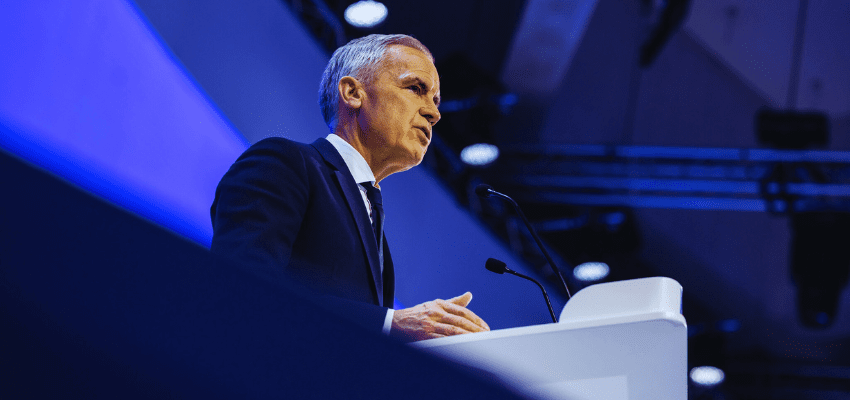
Photo by Ciaran McCrickard / World Economic Forum via Flickr.

This article originally appeared in New Direction.

By Daniel Dorman & Robert Tyler, January 30, 2026

Canadian Prime Minister Mark Carney’s speech at Davos has been widely praised. “By common consent it’s the best speech at Davos this year; perhaps the best speech ever at Davos”, wrote Alan Beattie for the Financial Times. It’s an easy speech to like. In an era where politicians sometimes lack oratory skills, Carney’s speech, which included an erudite rebuke of Thucydides, felt refined and informed. It’s been rightly labelled as “stark” and “bold” — but bold and true are different things.

Carney’s speech wrongly compared American led institutions of the post-war era — those institutions he also acknowledged “helped provide public goods: open sea lanes, a stable financial system, collective security and support for frameworks for resolving disputes” — with totalitarian rule over the Soviet bloc before the fall of the Berlin Wall. According to Carney, the “rules-based order was partially false”, an unjust system where the “strongest would exempt themselves when convenient” and, like Soviet Communism, was only upheld by the willingness of those within the system to perform its “rituals” and perpetuate its lies.

The comparison is terribly misleading, in the first instance because it creates a false equivalence between the Western Democratic world and the tyranny of Soviet rule. Whilst countries choose to be part of the West, the occupied nations of Central and Eastern Europe had no say in whether they belonged to the Soviet bloc or not. This is indeed still true today, where countries choose to be aligned with the West. In the second instance, it belittles the achievements of a system that he had earlier rightly stated guaranteed the very economic stability and security that he  claimed to be looking for.

Carney framed his talk around what he called “the rupture in the world order.” This rupture, Carney claims, means that middle powers like Canada, and many EU Member States, must band together and refuse to live within the lies of accommodation to those great powers that “have begun using economic integration as weapons. Tariffs as leverage. Financial infrastructure as coercion. Supply chains as vulnerabilities to be exploited.”

The whole speech was a thinly veiled expression of frustration towards President Donald Trump, “He never mentioned President Trump by name, but his reference was clear,” wrote Matina Stevis-Gridneff and Ian Austen for the New York Times.

In a particularly telling moment Carney claimed that Canada is “calibrating our relationships so their depth reflects our values.” He enumerated those values as “sovereignty and territorial integrity, the prohibition of the use of force except when consistent with the UN Charter and respect for human rights.”

It’s a good list but not one that Carney can credibly claim to defend given his activities shortly before arriving in Davos. With all the attention on the Davos speech it is easy to forget that Carney delivered it fresh off of signing new partnerships with both Qatar and China.

Qatar, beyond its far from spotless human rights record, is the infamous shelter for the Hamas leaders behind the October 7 terror attacks. Before that, it had played host to the Taliban, flying the leadership back to Afghanistan on their own military aircraft in the aftermath of the Biden Administration’s withdrawal from the country.  Perhaps Carney forgot this when announcing the partnership “to increase trade, investment, and defence cooperation” and claiming that Qatar “is a critical partner to Canada in many shared pursuits of peace and stability, from Ukraine to the Middle East.” Far from calibrating our relationships so they’re depth reflects our values, Carney was arguably following Trump’s transactional approach with Qatar, doing a “deal with the devil.”

Much more significantly, just days before the high-minded speech in Davos, Carney signed onto a “new strategic partnership” with China. The center-piece of the new partnership is a deal for China to significantly reduce tariffs on Canadian canola seeds and a few other exports in exchange for Canada admitting 49,000 Chinese electric vehicles. In fairness to Carney, the terms of the trade deal were sufficiently limited to mitigate risk, and there’s good reason for Canada to diversify its export markets, but it was Carney’s commentary and the 9 related MOU’s which ought to raise the red alarm for Canada and other Western allies.

China, is a genocidal state and the key supporter of Russian President Vladimir Putin’s war of conquest against Ukraine. China does not even begin to share the West’s concern for “sovereignty and territorial integrity, the prohibition of the use of force except when consistent with the UN Charter and respect for human rights”, but rather it views the world as a place to be divided into spheres of influence.

The most distressing area of cooperation articulated in the joint statement is “public security and safety” and the related MOU on “Cooperation in Combating Crimes Between the Royal Canadian Mounted Police and the Ministry of Public Security of the People’s Republic of China.” The readout of the meeting between Carney and Xi characterized the security plans this way, “Prime Minister Carney welcomed plans to deepen engagement on national security issues at senior levels, highlighting opportunities to work together on security issues of mutual concern, including narcotics trafficking and cybercrime.”

As recently as April of 2025 Carney understood that China was the country’s biggest security threat. And a year ago the Hogue Commission, Canada’s public inquiry into foreign interference, made clear that the People’s Republic of China (PRC) “poses the most sophisticated and active cyber threat to Canada.” It shouldn’t need to be said that partnering with China to combat cybercrime is ludicrous. You can’t invite a notorious serial arsonist to help you fight fires.
When asked if he still believes China is Canada’s biggest security threat, Carney’s non-answer was anything but bold.

Worse still, during the official visit, Carney claimed that the progress made in the relationship “sets us up well for the new world order.” Speaking of a “new world order” in China carries a very specific meaning. As Macdonald-Laurier Institute senior fellow Joe Varner explained:

“In Chinese strategic doctrine, a ‘new world order’ is not about reforming globalization. Its real objective is displacing U.S. power, weakening Western alliances, and replacing liberal norms with a hierarchical system built on state control and non-interference that shields authoritarian rule.”

Carney’s trip to China was, in large measure, capitulation to an authoritarian superpower — and that’s what makes Carney’s invocation of Václav Havel, Czech dissident under Soviet Communism turned first President of the Czech Republic, so distasteful.

In The Power of the Powerless, as Carney rightly summarizes, Havel asks the question “How did the communist system sustain itself?” Havel’s answer: Communism’s power came from ordinary people consenting to live within the lies of totalitarianism; like the shopkeeper who places a “Workers of the world, unite!” sign in his window simply to get along.

Applying Havel’s principle, Carney proclaimed: “What would it mean for middle powers to ‘live the truth?’… It means acting consistently, applying the same standards to allies and rivals. When middle powers criticize economic intimidation from one direction but stay silent when it comes from another, we are keeping the sign in the window.”

At Davos, Carney boldly criticized the United States of America just days after overtly capitulating to China; in quick succession he criticized our most important ally and validated the aggressive and coercive behaviour of our greatest rival.

As Globe and Mail columnist Konrad Yakubuski put it:

“That Mr. Carney dared to reference Mr. Havel in a speech just after travelling to Beijing, where he signed a “new strategic partnership” with China, speaks volumes about the Prime Minister’s willingness to put Canada’s values on the back burner as he pursues a mercantilist agenda to diversify our trading partners, regardless of whether or not they oppress their own citizens.”

In June of 1995 Havel met with Taiwanese Premier Lien Chan “despite repeated warnings from the Chinese side” and direct consequences for Czech-Chinese relations. This is what it looks like to “live the truth.” Carney chose a fantastic role model in the former Czech dissident, he utterly failed to apply his principles or to follow him in standing up to Communist tyranny.

Carney’s speech was bold in all the wrong ways.


Daniel Dorman is the managing editor and director of operations at the Macdonald-Laurier Institute.

Robert Tyler is Senior Policy Advisor at New Direction – Foundation for European Conservatism, in Brussels.
Source: New Direction
Tags: Robert Tyler

Related Posts

Breakthrough nation ss.
Latest News

Breakthrough Nation with Karen Restoule: Crystal Smith Series 2, Ep. 8

January 30, 2026
Carney, CUSMA and the perils of calling everything a ‘deal’: David Collins in Canadian Affairs
North America

Carney, CUSMA and the perils of calling everything a ‘deal’: David Collins in Canadian Affairs

January 30, 2026
Why Canada needs a foreign intelligence service: Jonathan Berkshire Miller and Christopher Collins for Inside Policy
National Security

Why Canada needs a foreign intelligence service: Jonathan Berkshire Miller and Christopher Collins for Inside Policy

January 30, 2026
Next Post
Carney, CUSMA and the perils of calling everything a ‘deal’: David Collins in Canadian Affairs

Carney, CUSMA and the perils of calling everything a ‘deal’: David Collins in Canadian Affairs

Newsletter Signup

  Thank you for Signing Up
  Please correct the marked field(s) below.
Email Address  *
1,true,6,Contact Email,2
First Name *
1,true,1,First Name,2
Last Name *
1,true,1,Last Name,2
*
*Required Fields

Follow us on

Macdonald-Laurier Institute

323 Chapel Street, Suite #300
Ottawa, Ontario, K1N 7Z2 Canada

613.482.8327

info@macdonaldlaurier.ca
MLI directory

Support Us

Support the Macdonald-Laurier Institute to help ensure that Canada is one of the best governed countries in the world. Click below to learn more or become a sponsor.

Support Us

  • Inside Policy Magazine
  • Annual Reports
  • Jobs
  • Privacy Policy

© 2023 Macdonald-Laurier Institute. All Rights reserved.

No Result
View All Result
  • Home
  • About
    • Who We Are
    • Who Makes MLI Work
    • Fifteenth Anniversary
  • Experts
    • Experts Directory
    • In Memoriam
  • Issues
    • Domestic Policy
      • Economic Policy
      • Justice
      • Rights and Freedoms
      • Assisted Suicide (MAID)
      • Health Care
      • COVID-19
      • Gender Identity
      • Canada’s Political Tradition
      • AI, Technology and Innovation
      • Media and Telecoms
      • Housing
      • Immigration
      • Agriculture and Agri-Food
      • Competition Policy
    • Energy Policy
      • Energy
      • Environment
    • Foreign Policy
      • Israel-Hamas War
      • Ukraine
      • Taiwan
      • China
      • Europe and Russia
      • Indo-Pacific
      • Middle East and North Africa
      • North America
      • Foreign Interference
      • National Defence
      • National Security
      • Foreign Affairs
    • Indigenous Affairs
  • Projects
    • CNAPS (Center for North American Prosperity and Security)
    • The Promised Land
    • Voices that Inspire: The Macdonald-Laurier Vancouver Speaker Series
    • Dragon at the door
    • Canada on top of the world
    • Letter to a minister
    • Justice Report Card
    • The Great Energy Crisis
    • DisInfoWatch.org
    • Managing Indigenous Prosperity
    • Judicial Foundations
    • Landmark Cases Council
    • Defending The Marketplace of Ideas
    • Reforming the University
    • Past Projects
      • Digital Policy & Connectivity
      • Double Trouble
      • Canada and the Indo-Pacific Initiative
      • The Transatlantic Program
      • COVID Misery Index
      • Speak for Ourselves
      • The Eavesdropping Dragon: Huawei
      • Talkin’ in the Free World with Mariam Memarsadeghi
      • An Intellectual Property Strategy for Canada
      • Munk Senior Fellows
      • A Mandate for Canada
      • Confederation Series
      • Fiscal Reform
      • The Canadian Century project
      • Fixing Canadian health care
      • Internal trade
      • From a mandate for change
      • Size of government in Canada
      • Straight Talk
      • Labour Market Report
      • Leading Economic Indicator
      • Centre for Advancing Canada’s Interests Abroad
      • Indigenous Prosperity at a Crossroads
  • Events
    • Upcoming Events
    • Past Events
      • MLI Dinners
      • Great Canadian Debates
  • Latest News
  • Libraries
    • Columns
    • Commentary
    • Papers
    • Books
    • Video
  • Donate

© 2023 Macdonald-Laurier Institute. All Rights reserved.