Thursday, January 22, 2026
No Result
View All Result
  • Media
Macdonald-Laurier Institute
  • Home
  • About
    • Who We Are
    • Who Makes MLI Work
    • Fifteenth Anniversary
  • Experts
    • Experts Directory
    • In Memoriam
  • Issues
    • Domestic Policy
      • Economic Policy
      • Justice
      • Rights and Freedoms
      • Assisted Suicide (MAID)
      • Health Care
      • COVID-19
      • Gender Identity
      • Canada’s Political Tradition
      • AI, Technology and Innovation
      • Media and Telecoms
      • Housing
      • Immigration
      • Agriculture and Agri-Food
      • Competition Policy
    • Energy Policy
      • Energy
      • Environment
    • Foreign Policy
      • Israel-Hamas War
      • Ukraine
      • Taiwan
      • China
      • Europe and Russia
      • Indo-Pacific
      • Middle East and North Africa
      • North America
      • Foreign Interference
      • National Defence
      • National Security
      • Foreign Affairs
    • Indigenous Affairs
  • Projects
    • CNAPS (Center for North American Prosperity and Security)
    • The Promised Land
    • Voices that Inspire: The Macdonald-Laurier Vancouver Speaker Series
    • Dragon at the door
    • Canada on top of the world
    • Letter to a minister
    • Justice Report Card
    • The Great Energy Crisis
    • DisInfoWatch.org
    • Managing Indigenous Prosperity
    • Judicial Foundations
    • Landmark Cases Council
    • Defending The Marketplace of Ideas
    • Reforming the University
    • Past Projects
      • Digital Policy & Connectivity
      • Double Trouble
      • Canada and the Indo-Pacific Initiative
      • The Transatlantic Program
      • COVID Misery Index
        • Provincial COVID Misery Index
        • Beyond Lockdown
        • COVID and after: A mandate for recovery
      • Speak for Ourselves
      • The Eavesdropping Dragon: Huawei
      • Talkin’ in the Free World with Mariam Memarsadeghi
      • An Intellectual Property Strategy for Canada
      • Munk Senior Fellows
      • A Mandate for Canada
      • Confederation Series
      • Fiscal Reform
      • The Canadian Century project
      • Fixing Canadian health care
      • Internal trade
      • From a mandate for change
      • Size of government in Canada
      • Straight Talk
      • Labour Market Report
      • Leading Economic Indicator
      • Centre for Advancing Canada’s Interests Abroad
      • Indigenous Prosperity at a Crossroads
        • Aboriginal Canada and Natural Resources
  • Events
    • Upcoming Events
    • Past Events
      • MLI Dinners
      • Great Canadian Debates
  • Latest News
  • Libraries
    • Columns
    • Commentary
    • Papers
    • Books
    • Video
  • Donate
  • Home
  • About
    • Who We Are
    • Who Makes MLI Work
    • Fifteenth Anniversary
  • Experts
    • Experts Directory
    • In Memoriam
  • Issues
    • Domestic Policy
      • Economic Policy
      • Justice
      • Rights and Freedoms
      • Assisted Suicide (MAID)
      • Health Care
      • COVID-19
      • Gender Identity
      • Canada’s Political Tradition
      • AI, Technology and Innovation
      • Media and Telecoms
      • Housing
      • Immigration
      • Agriculture and Agri-Food
      • Competition Policy
    • Energy Policy
      • Energy
      • Environment
    • Foreign Policy
      • Israel-Hamas War
      • Ukraine
      • Taiwan
      • China
      • Europe and Russia
      • Indo-Pacific
      • Middle East and North Africa
      • North America
      • Foreign Interference
      • National Defence
      • National Security
      • Foreign Affairs
    • Indigenous Affairs
  • Projects
    • CNAPS (Center for North American Prosperity and Security)
    • The Promised Land
    • Voices that Inspire: The Macdonald-Laurier Vancouver Speaker Series
    • Dragon at the door
    • Canada on top of the world
    • Letter to a minister
    • Justice Report Card
    • The Great Energy Crisis
    • DisInfoWatch.org
    • Managing Indigenous Prosperity
    • Judicial Foundations
    • Landmark Cases Council
    • Defending The Marketplace of Ideas
    • Reforming the University
    • Past Projects
      • Digital Policy & Connectivity
      • Double Trouble
      • Canada and the Indo-Pacific Initiative
      • The Transatlantic Program
      • COVID Misery Index
        • Provincial COVID Misery Index
        • Beyond Lockdown
        • COVID and after: A mandate for recovery
      • Speak for Ourselves
      • The Eavesdropping Dragon: Huawei
      • Talkin’ in the Free World with Mariam Memarsadeghi
      • An Intellectual Property Strategy for Canada
      • Munk Senior Fellows
      • A Mandate for Canada
      • Confederation Series
      • Fiscal Reform
      • The Canadian Century project
      • Fixing Canadian health care
      • Internal trade
      • From a mandate for change
      • Size of government in Canada
      • Straight Talk
      • Labour Market Report
      • Leading Economic Indicator
      • Centre for Advancing Canada’s Interests Abroad
      • Indigenous Prosperity at a Crossroads
        • Aboriginal Canada and Natural Resources
  • Events
    • Upcoming Events
    • Past Events
      • MLI Dinners
      • Great Canadian Debates
  • Latest News
  • Libraries
    • Columns
    • Commentary
    • Papers
    • Books
    • Video
  • Donate
No Result
View All Result
Macdonald-Laurier Institute

Canada’s rush to Beijing is a strategic miscalculation: Stephen Nagy in Real Clear World

Every middle power pulled into China’s economic orbit represents diminished American influence and expanded Chinese leverage for future confrontations.

January 22, 2026
in Foreign Affairs, Latest News, Columns, Foreign Policy, In the Media, Indo-Pacific, Stephen Nagy
Reading Time: 5 mins read
A A
China is not the answer for Canadian prosperity: Ed Fast in The Hub

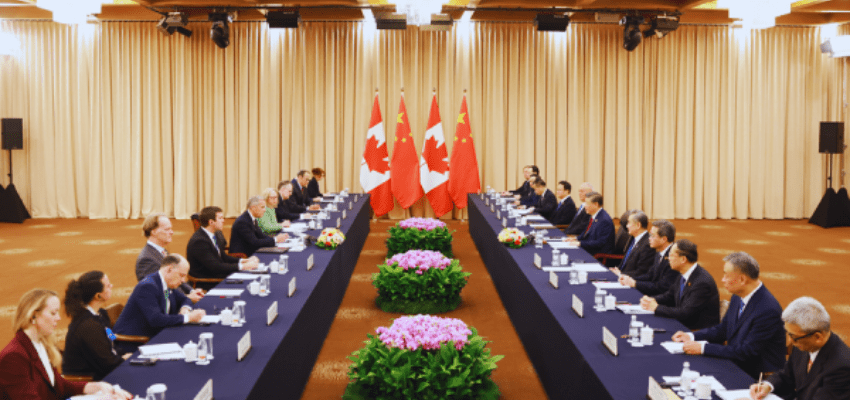
Photo by Ministry of Foreign Affairs, People's Republic of China.

This article originally appeared in Real Clear World.

By Stephen Nagy, January 22, 2026

When Prime Minister Mark Carney touched down in Beijing last week, he carried with him the hopes of western Canadian farmers crushed under Chinese tariffs — as well as the frustrations of a nation battered by President Trump’s economic nationalism. The visit, hailed by some as the “Carney Doctrine” and lauded as nuanced diplomacy, offered immediate relief. China signaled flexibility on agricultural restrictions. Trade delegations exchanged pleasantries. For a country bruised by its southern neighbor’s “51st state” rhetoric and Greenland ambitions, the embrace felt validating.

It was also, in the cold calculus of geopolitics, precisely what Beijing wanted — and precisely the wrong move for Ottawa’s long-term interests.

In the 1970s, Stanford psychologist Walter Mischel presented preschoolers with a simple choice: eat one marshmallow immediately or wait fifteen minutes and receive two. The children who waited — those who distracted themselves, looked away from the treat, or engaged in cognitive avoidance — demonstrated superior outcomes across decades of follow-up studies: higher SAT scores, lower body mass indices, greater self-worth and stress resilience.

Canada just ate the marshmallow.

The parallel is not merely rhetorical. Mischel’s research demonstrated that successful delay of gratification depended critically on “cognitive avoidance or suppression” of immediate temptation. Children who fixated on the treat in front of them capitulated faster. Those who occupied themselves with “non-frustrating or pleasant internal or external stimuli” could sustain the wait. In statecraft terms, Canada fixated on immediate Chinese relief rather than engaging in the harder cognitive work of building alternative coalitions.

Beijing understands this dynamic intimately. As this Atlantic Council report documents, China’s economic inducements are strategically designed to align with “the specific needs of recipient countries and their leaders.” The offers are not overwhelming financial packages or corrupt dealings; rather, Beijing “strategically cultivated political and sectoral interests to incentivize” alignment with its objectives. Western Canadian farmers desperate for canola market access represent precisely the targeted constituency China knows how to exploit.

The immediate appeal is understandable. Trump’s tariffs have compounded Chinese restrictions, creating genuine economic pain across the prairies. The President’s attacks on Venezuela, his transactional approach to allied defense contributions, and his unsettling territorial ambitions toward Greenland have shattered assumptions about American reliability. Canadian Senators like Yuen Pau Woo and analysts like Wenran Jiang argue that Canada must diversify — scrapping the Indo-Pacific Strategy entirely in favor of pragmatic Beijing engagement.

Yet China’s track record demands extreme caution. The Australian Strategic Policy Institute documented 152 cases of Chinese coercive diplomacy between 2010 and 2020, with sharp escalation after 2018. Trade restrictions, tourism bans, arbitrary detentions, and state-issued threats constitute Beijing’s preferred toolkit. The pattern is unmistakable: countries that deepen economic dependence without maintaining leverage become vulnerable to punishment when their policies diverge from Chinese preferences.

Lithuania discovered this when it opened a Taiwanese representative office; imports collapsed by ninety percent within months. Norway endured years of diplomatic freeze and salmon export restrictions after awarding the Nobel Peace Prize to Liu Xiaobo. South Korea suffered $15 billion in tourism losses over THAAD deployment. In each case, the asymmetric dependence China cultivated became the weapon China wielded.

China’s courtship of Canada serves objectives extending far beyond bilateral trade. As the Atlantic Council analysis makes clear, Beijing seeks to “drive a wedge” between the United States and its allies, viewing such division as essential to prevailing in great power competition. Every middle power pulled into China’s economic orbit represents diminished American influence and expanded Chinese leverage for future confrontations.

A Hybrid CoE study of Southeast Asian dynamics reveals this strategy operating at regional scale: China simultaneously employs “carrots and sticks,” rewarding cooperative states while punishing resisters, creating divisions that prevent collective responses to Chinese assertiveness. The Philippines and Vietnam learned that economic inducements came bundled with coercive capacity — tourism restrictions, trade barriers, and maritime harassment deployed tactically against any deviation from Beijing’s preferences.

Canada, in its rush toward relief, risks similar entanglement. The Canadian China Business Council advocates deeper engagement despite documented risks. Pro-Beijing voices promote disengagement from American alliance structures. Each argument fixates on the marshmallow — immediate economic relief — while discounting the strategic vulnerability such dependence creates.

The child who waits thirty minutes receives two marshmallows. Canada could receive something more valuable than Chinese market access: resilient economic security built on partnerships with democracies sharing both interests and values.

A comprehensive economic security framework with Japan, the European Union, South Korea, Australia, Taiwan, and Southeast Asian partners would require patient diplomacy and genuine compromise. It would mean forging agreements harder to negotiate than a Beijing handshake but infinitely more durable. It would demand maintaining American ties despite Trump’s provocations, recognizing that administrations change but geographic realities endure.

This is precisely the cognitive work Mischel’s successful children performed — distracting themselves from immediate temptation, occupying themselves with constructive alternatives, trusting that patience yields superior outcomes.

Trump’s behavior makes this harder. His transactional nationalism and MAGA agenda alienate natural allies and create openings for Chinese influence operations. Yet the solution to American unreliability is not Chinese dependence — it is coalition-building among middle powers capable of presenting unified positions to both Washington and Beijing.

Canada has eaten its marshmallow. The question now is whether it can recognize the strategic error before the second treat becomes permanently unavailable — before dependence on Chinese markets becomes leverage Beijing deploys at will, and before the coalition of democracies that could have offered genuine security moves forward without Ottawa at the table.


Stephen Nagy is a professor of politics and international studies at International Christian University in Tokyo, a senior fellow and China Project lead at the Ottawa-based Macdonald-Laurier Institute and the Center for North American Prosperity and Security in Washington, D.C..

Source: Real Clear World

Related Posts

Chelsee Pettit interview.
Latest News

Breakthrough Nation with Karen Restoule: Chelsee Pettit Series 2, Ep. 5

January 22, 2026
Flashpoints reshaping global power – Venezuela and Iran: Joe Varner on the Brian Crombie Hour
Foreign Affairs

Flashpoints reshaping global power – Venezuela and Iran: Joe Varner on the Brian Crombie Hour

January 21, 2026
Judging the provinces – Charter interpretation and the erosion of provincial autonomy: Dave Snow and Mark Harding
Justice

Judging the provinces – Charter interpretation and the erosion of provincial autonomy: Dave Snow and Mark Harding

January 21, 2026
Next Post
Chelsee Pettit interview.

Breakthrough Nation with Karen Restoule: Chelsee Pettit Series 2, Ep. 5

Newsletter Signup

  Thank you for Signing Up
  Please correct the marked field(s) below.
Email Address  *
1,true,6,Contact Email,2
First Name *
1,true,1,First Name,2
Last Name *
1,true,1,Last Name,2
*
*Required Fields

Follow us on

Macdonald-Laurier Institute

323 Chapel Street, Suite #300
Ottawa, Ontario, K1N 7Z2 Canada

613.482.8327

info@macdonaldlaurier.ca
MLI directory

Support Us

Support the Macdonald-Laurier Institute to help ensure that Canada is one of the best governed countries in the world. Click below to learn more or become a sponsor.

Support Us

  • Inside Policy Magazine
  • Annual Reports
  • Jobs
  • Privacy Policy

© 2023 Macdonald-Laurier Institute. All Rights reserved.

No Result
View All Result
  • Home
  • About
    • Who We Are
    • Who Makes MLI Work
    • Fifteenth Anniversary
  • Experts
    • Experts Directory
    • In Memoriam
  • Issues
    • Domestic Policy
      • Economic Policy
      • Justice
      • Rights and Freedoms
      • Assisted Suicide (MAID)
      • Health Care
      • COVID-19
      • Gender Identity
      • Canada’s Political Tradition
      • AI, Technology and Innovation
      • Media and Telecoms
      • Housing
      • Immigration
      • Agriculture and Agri-Food
      • Competition Policy
    • Energy Policy
      • Energy
      • Environment
    • Foreign Policy
      • Israel-Hamas War
      • Ukraine
      • Taiwan
      • China
      • Europe and Russia
      • Indo-Pacific
      • Middle East and North Africa
      • North America
      • Foreign Interference
      • National Defence
      • National Security
      • Foreign Affairs
    • Indigenous Affairs
  • Projects
    • CNAPS (Center for North American Prosperity and Security)
    • The Promised Land
    • Voices that Inspire: The Macdonald-Laurier Vancouver Speaker Series
    • Dragon at the door
    • Canada on top of the world
    • Letter to a minister
    • Justice Report Card
    • The Great Energy Crisis
    • DisInfoWatch.org
    • Managing Indigenous Prosperity
    • Judicial Foundations
    • Landmark Cases Council
    • Defending The Marketplace of Ideas
    • Reforming the University
    • Past Projects
      • Digital Policy & Connectivity
      • Double Trouble
      • Canada and the Indo-Pacific Initiative
      • The Transatlantic Program
      • COVID Misery Index
      • Speak for Ourselves
      • The Eavesdropping Dragon: Huawei
      • Talkin’ in the Free World with Mariam Memarsadeghi
      • An Intellectual Property Strategy for Canada
      • Munk Senior Fellows
      • A Mandate for Canada
      • Confederation Series
      • Fiscal Reform
      • The Canadian Century project
      • Fixing Canadian health care
      • Internal trade
      • From a mandate for change
      • Size of government in Canada
      • Straight Talk
      • Labour Market Report
      • Leading Economic Indicator
      • Centre for Advancing Canada’s Interests Abroad
      • Indigenous Prosperity at a Crossroads
  • Events
    • Upcoming Events
    • Past Events
      • MLI Dinners
      • Great Canadian Debates
  • Latest News
  • Libraries
    • Columns
    • Commentary
    • Papers
    • Books
    • Video
  • Donate

© 2023 Macdonald-Laurier Institute. All Rights reserved.