Friday, December 5, 2025
No Result
View All Result
  • Media
Macdonald-Laurier Institute
  • Home
  • About
    • Who We Are
    • Who Makes MLI Work
    • Fifteenth Anniversary
  • Experts
    • Experts Directory
    • In Memoriam
  • Issues
    • Domestic Policy
      • Economic Policy
      • Justice
      • Rights and Freedoms
      • Assisted Suicide (MAID)
      • Health Care
      • COVID-19
      • Gender Identity
      • Canada’s Political Tradition
      • AI, Technology and Innovation
      • Media and Telecoms
      • Housing
      • Immigration
      • Agriculture and Agri-Food
      • Competition Policy
    • Energy Policy
      • Energy
      • Environment
    • Foreign Policy
      • Israel-Hamas War
      • Ukraine
      • Taiwan
      • China
      • Europe and Russia
      • Indo-Pacific
      • Middle East and North Africa
      • North America
      • Foreign Interference
      • National Defence
      • National Security
      • Foreign Affairs
    • Indigenous Affairs
  • Projects
    • CNAPS (Center for North American Prosperity and Security)
    • The Promised Land
    • Voices that Inspire: The Macdonald-Laurier Vancouver Speaker Series
    • Dragon at the door
    • Canada on top of the world
    • Letter to a minister
    • Justice Report Card
    • The Great Energy Crisis
    • DisInfoWatch.org
    • Managing Indigenous Prosperity
    • Judicial Foundations
    • Landmark Cases Council
    • Defending The Marketplace of Ideas
    • Reforming the University
    • Past Projects
      • Digital Policy & Connectivity
      • Double Trouble
      • Canada and the Indo-Pacific Initiative
      • The Transatlantic Program
      • COVID Misery Index
        • Provincial COVID Misery Index
        • Beyond Lockdown
        • COVID and after: A mandate for recovery
      • Speak for Ourselves
      • The Eavesdropping Dragon: Huawei
      • Talkin’ in the Free World with Mariam Memarsadeghi
      • An Intellectual Property Strategy for Canada
      • Munk Senior Fellows
      • A Mandate for Canada
      • Confederation Series
      • Fiscal Reform
      • The Canadian Century project
      • Fixing Canadian health care
      • Internal trade
      • From a mandate for change
      • Size of government in Canada
      • Straight Talk
      • Labour Market Report
      • Leading Economic Indicator
      • Centre for Advancing Canada’s Interests Abroad
      • Indigenous Prosperity at a Crossroads
        • Aboriginal Canada and Natural Resources
  • Events
    • Upcoming Events
    • Past Events
      • MLI Dinners
      • Great Canadian Debates
  • Latest News
  • Libraries
    • Columns
    • Commentary
    • Papers
    • Books
    • Video
  • Donate
  • Home
  • About
    • Who We Are
    • Who Makes MLI Work
    • Fifteenth Anniversary
  • Experts
    • Experts Directory
    • In Memoriam
  • Issues
    • Domestic Policy
      • Economic Policy
      • Justice
      • Rights and Freedoms
      • Assisted Suicide (MAID)
      • Health Care
      • COVID-19
      • Gender Identity
      • Canada’s Political Tradition
      • AI, Technology and Innovation
      • Media and Telecoms
      • Housing
      • Immigration
      • Agriculture and Agri-Food
      • Competition Policy
    • Energy Policy
      • Energy
      • Environment
    • Foreign Policy
      • Israel-Hamas War
      • Ukraine
      • Taiwan
      • China
      • Europe and Russia
      • Indo-Pacific
      • Middle East and North Africa
      • North America
      • Foreign Interference
      • National Defence
      • National Security
      • Foreign Affairs
    • Indigenous Affairs
  • Projects
    • CNAPS (Center for North American Prosperity and Security)
    • The Promised Land
    • Voices that Inspire: The Macdonald-Laurier Vancouver Speaker Series
    • Dragon at the door
    • Canada on top of the world
    • Letter to a minister
    • Justice Report Card
    • The Great Energy Crisis
    • DisInfoWatch.org
    • Managing Indigenous Prosperity
    • Judicial Foundations
    • Landmark Cases Council
    • Defending The Marketplace of Ideas
    • Reforming the University
    • Past Projects
      • Digital Policy & Connectivity
      • Double Trouble
      • Canada and the Indo-Pacific Initiative
      • The Transatlantic Program
      • COVID Misery Index
        • Provincial COVID Misery Index
        • Beyond Lockdown
        • COVID and after: A mandate for recovery
      • Speak for Ourselves
      • The Eavesdropping Dragon: Huawei
      • Talkin’ in the Free World with Mariam Memarsadeghi
      • An Intellectual Property Strategy for Canada
      • Munk Senior Fellows
      • A Mandate for Canada
      • Confederation Series
      • Fiscal Reform
      • The Canadian Century project
      • Fixing Canadian health care
      • Internal trade
      • From a mandate for change
      • Size of government in Canada
      • Straight Talk
      • Labour Market Report
      • Leading Economic Indicator
      • Centre for Advancing Canada’s Interests Abroad
      • Indigenous Prosperity at a Crossroads
        • Aboriginal Canada and Natural Resources
  • Events
    • Upcoming Events
    • Past Events
      • MLI Dinners
      • Great Canadian Debates
  • Latest News
  • Libraries
    • Columns
    • Commentary
    • Papers
    • Books
    • Video
  • Donate
No Result
View All Result
Macdonald-Laurier Institute

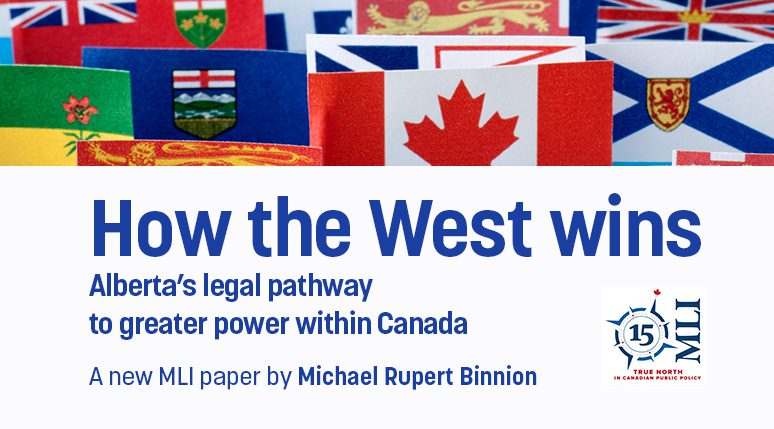
How the West wins: Alberta’s legal pathway to greater power within Canada

Alberta’s path to greater sovereignty cannot just be aspirational – it must be actionable. Any proposals must be grounded in historical precedent, constitutional texts, Supreme Court rulings, and international law.

September 18, 2025
in Domestic Policy, Latest News, Intergovernmental Affairs, Political Tradition, Papers
Reading Time: 5 mins read
A A
How the West wins: Alberta’s legal pathway to greater power within Canada

By Michael Rupert Binnion

September 18, 2025

PDF of paper

Executive Summary | Sommaire (le français suit)

If Alberta hopes to achieve greater autonomy within Confederation, it will be won not through grievance or defiance but by lawful and responsible assertion of political will within Canada’s existing constitutional framework. By framing autonomy as an exercise of responsible government – a core doctrine of Canada’s constitutional tradition – the discourse will shift from political protest to institutional legitimacy.

This paper is not a manifesto, but a constitutional blueprint for a more sovereign Alberta within a strong and united Canada. Alberta has both the authority and the opportunity to lead Canada’s next federal evolution. However, its future will not be granted – it must be governed into being through the lawful exercise of political will.

The current political climate – one that sees decision-making power largely monopolized by Central Canada – underscores the necessity for action. With demographic trends increasing the political weight of Western Canada (Alberta now exceeds five million in population), and escalating federal-provincial friction being amplified by media and public attention, moves to assert provincial rights are both timely and unavoidable.

Several provinces have joined lawsuits challenging federal laws and expressing concern over policies such as equalization, immigration, and taxation authority. Alberta and Saskatchewan have gone further, introducing sovereignty legislation to directly confront perceived federal overreach. This is a path blazed by Quebec for two generations.

Canada’s constitutional evolution and judicial precedents offer a clear roadmap for Alberta, or any like-minded province, which seeks to lawfully pursue greater autonomy. Indeed, constitutional evolution, under the “Responsible Government Convention,” is a well-established and enduring tradition in Canadian governance.

However, Supreme Court rulings and federal fiscal tools have shifted the balance of power to the federal government, in effect changing the Constitution without formal negotiation. These developments underscore why Alberta must act within its own powers to demonstrate capacity for responsible self-government.

The Constitution Act, 1867, entrenches provincial sovereignty by delineating the division of powers between federal and provincial governments. Sections 91 and 92 establish provincial sovereignty within their jurisdiction over health, education, natural resources, and taxation. These entrenched rights provide a foundation for increased autonomy, demonstrating that responsible self-government is both lawful and institutionally feasible.

Alberta’s path to greater sovereignty cannot just be aspirational – it must be actionable. Any proposals must be grounded in historical precedent, constitutional texts, Supreme Court rulings, and international law. Given this, Alberta can begin by:

• Exercising its authority over taxation, pensions, immigration, and policing, as demonstrated by Quebec.

• Building institutional capacity at the provincial level, before pursuing constitutional reform.

• Using demonstrated responsible governance to establish leverage in federal negotiations for greater autonomy.

As Alberta charts a path towards greater autonomy, it is vital to avoid hypotheticals and partisan rhetoric. It must embrace the tools of responsible government not as a protest, but as a principled assertion of its constitutional rights.

The province stands at a pivotal moment – armed with legal precedent, institutional capacity, and growing demographic influence. If Alberta leads with legitimacy, not defiance, it can reshape the country from within, forging a stronger, more balanced Canada where provincial sovereignty is not only respected, but revitalized.


Si l’Alberta souhaite gagner en autonomie au sein de la Confédération, elle doit affirmer sa volonté politique sans contestation ni défiance, de manière légale et responsable et dans le respect du cadre constitutionnel canadien actuel. En définissant l’autonomie en tant qu’exercice d’un gouvernement responsable – une doctrine clé de la tradition constitutionnelle canadienne – la rhétorique contestataire pourra se transformer en une approche basée sur la légitimité institutionnelle.

Ce document n’est pas un manifeste, mais un modèle constitutionnel pour la souveraineté accrue de l’Alberta au sein d’un Canada uni et fort. L’Alberta dispose à la fois de l’autorité et de l’occasion de façonner la future fédération. Néanmoins, son avenir n’est pas acquis – pour se construire, il doit être assujetti à une volonté politique forte et respectueuse des lois.

Le climat politique actuel – qui voit le pouvoir décisionnel largement concentré au Canada central – illustre avec force la nécessité d’agir. Les revendications de l’Alberta à l’égard de ses droits se révèlent à la fois pertinentes et inéluctables, compte tenu de l’impact du poids démographique de l’Ouest canadien (plus de cinq millions d’habitants en Alberta) et des tensions croissantes – accentuées par l’attention des médias et du public – entre le palier fédéral et provincial.

Plusieurs provinces ont intenté des actions en justice contre certaines lois fédérales et ont exprimé leurs préoccupations en ce qui a trait à la péréquation, l’immigration et le pouvoir de taxation. En adoptant une loi sur la souveraineté, l’Alberta et la Saskatchewan ont franchi une étape supplémentaire pour s’opposer de manière directe à l’ingérence fédérale excessive perçue. À cet égard, le Québec ouvre la voie depuis deux générations.

L’évolution constitutionnelle du Canada, ainsi que les précédents judiciaires offrent à l’Alberta – et aux autres provinces partageant les mêmes idées – une feuille de route claire pour obtenir une autonomie accrue en toute légalité. En effet, l’évolution constitutionnelle est une tradition bien établie et inaltérable dans la gouvernance canadienne, conforme aux principes d’un gouvernement responsable.

Toutefois, les décisions de la Cour suprême et les instruments financiers fédéraux ont rééquilibré le pouvoir en faveur du gouvernement fédéral et effectivement modifié la Constitution sans négociation formelle. L’Alberta se doit donc d’agir en fonction de ses compétences propres afin de témoigner de sa capacité à s’autodéterminer de manière responsable.

La Loi constitutionnelle de 1867 consacre la souveraineté des provinces en répartissant les compétences entre le gouvernement fédéral et les gouvernements provinciaux. Les articles 91 et 92 confirment la souveraineté des provinces en matière de santé, d’éducation, de ressources naturelles et de taxation. Ces droits enchâssés, fondement d’une autonomie accrue, prouvent que l’autodétermination responsable est légale et réalisable institutionnellement.

Le chemin vers une souveraineté accrue pour l’Alberta doit se concrétiser – et ne pas seulement être une aspiration. Toute proposition doit se fonder sur les antécédents historiques, les textes constitutionnels, les décisions de la Cour suprême et le droit international. Dans cette perspective, l’Alberta peut commencer comme suit :

• En exerçant son autorité en matière de taxation, de retraites, d’immigration et de maintien de l’ordre, comme le Québec.

• En consolidant ses capacités institutionnelles, et ce, avant la réforme constitutionnelle à venir.

• En pratiquant une gouvernance responsable pour tirer parti des négociations fédérales et acquérir plus d’autonomie.

Il est crucial pour l’Alberta d’éviter les questions hypothétiques et la rhétorique partisane, alors qu’elle vise une plus grande autonomie. Elle doit adopter les instruments d’un gouvernement responsable, non pas par le biais de la contestation, mais en réaffirmant le principe de ses droits constitutionnels.

La province est à un tournant décisif, forte de ses antécédents juridiques, de ses compétences institutionnelles et de son influence démographique croissante. En adoptant une posture de légitimité plutôt que de défiance, l’Alberta peut transformer le pays de l’intérieur, contribuant ainsi à la création d’un Canada plus fort et plus équilibré, où la souveraineté provinciale est non seulement respectée, mais également revitalisée.

 

Tags: Michael Rupert Binnion

Related Posts

Property rights are “precarious” in Canada: Paul Warchuk and Peter Copeland for Inside Policy Talks
Domestic Policy

Property rights are “precarious” in Canada: Paul Warchuk and Peter Copeland for Inside Policy Talks

December 4, 2025
Harvard eschews ingrained ideology in order to tackle ‘genuinely hard problems’: Peter MacKinnon in the National Post
Reforming Universities

Harvard eschews ingrained ideology in order to tackle ‘genuinely hard problems’: Peter MacKinnon in the National Post

December 3, 2025
Risking public backlash? Canadian universities and demographic-based faculty hiring
Education

Risking public backlash? Canadian universities and demographic-based faculty hiring

December 3, 2025
Next Post
How the West wins: Alberta’s legal pathway to greater power within Canada

Canada's Constitution empowers Alberta to demand more

Newsletter Signup

  Thank you for Signing Up
  Please correct the marked field(s) below.
Email Address  *
1,true,6,Contact Email,2
First Name *
1,true,1,First Name,2
Last Name *
1,true,1,Last Name,2
*
*Required Fields

Follow us on

Macdonald-Laurier Institute

323 Chapel Street, Suite #300
Ottawa, Ontario, K1N 7Z2 Canada

613.482.8327

info@macdonaldlaurier.ca
MLI directory

Support Us

Support the Macdonald-Laurier Institute to help ensure that Canada is one of the best governed countries in the world. Click below to learn more or become a sponsor.

Support Us

  • Inside Policy Magazine
  • Annual Reports
  • Jobs
  • Privacy Policy

© 2023 Macdonald-Laurier Institute. All Rights reserved.

No Result
View All Result
  • Home
  • About
    • Who We Are
    • Who Makes MLI Work
    • Fifteenth Anniversary
  • Experts
    • Experts Directory
    • In Memoriam
  • Issues
    • Domestic Policy
      • Economic Policy
      • Justice
      • Rights and Freedoms
      • Assisted Suicide (MAID)
      • Health Care
      • COVID-19
      • Gender Identity
      • Canada’s Political Tradition
      • AI, Technology and Innovation
      • Media and Telecoms
      • Housing
      • Immigration
      • Agriculture and Agri-Food
      • Competition Policy
    • Energy Policy
      • Energy
      • Environment
    • Foreign Policy
      • Israel-Hamas War
      • Ukraine
      • Taiwan
      • China
      • Europe and Russia
      • Indo-Pacific
      • Middle East and North Africa
      • North America
      • Foreign Interference
      • National Defence
      • National Security
      • Foreign Affairs
    • Indigenous Affairs
  • Projects
    • CNAPS (Center for North American Prosperity and Security)
    • The Promised Land
    • Voices that Inspire: The Macdonald-Laurier Vancouver Speaker Series
    • Dragon at the door
    • Canada on top of the world
    • Letter to a minister
    • Justice Report Card
    • The Great Energy Crisis
    • DisInfoWatch.org
    • Managing Indigenous Prosperity
    • Judicial Foundations
    • Landmark Cases Council
    • Defending The Marketplace of Ideas
    • Reforming the University
    • Past Projects
      • Digital Policy & Connectivity
      • Double Trouble
      • Canada and the Indo-Pacific Initiative
      • The Transatlantic Program
      • COVID Misery Index
      • Speak for Ourselves
      • The Eavesdropping Dragon: Huawei
      • Talkin’ in the Free World with Mariam Memarsadeghi
      • An Intellectual Property Strategy for Canada
      • Munk Senior Fellows
      • A Mandate for Canada
      • Confederation Series
      • Fiscal Reform
      • The Canadian Century project
      • Fixing Canadian health care
      • Internal trade
      • From a mandate for change
      • Size of government in Canada
      • Straight Talk
      • Labour Market Report
      • Leading Economic Indicator
      • Centre for Advancing Canada’s Interests Abroad
      • Indigenous Prosperity at a Crossroads
  • Events
    • Upcoming Events
    • Past Events
      • MLI Dinners
      • Great Canadian Debates
  • Latest News
  • Libraries
    • Columns
    • Commentary
    • Papers
    • Books
    • Video
  • Donate

© 2023 Macdonald-Laurier Institute. All Rights reserved.