Friday, December 5, 2025
No Result
View All Result
  • Media
Macdonald-Laurier Institute
  • Home
  • About
    • Who We Are
    • Who Makes MLI Work
    • Fifteenth Anniversary
  • Experts
    • Experts Directory
    • In Memoriam
  • Issues
    • Domestic Policy
      • Economic Policy
      • Justice
      • Rights and Freedoms
      • Assisted Suicide (MAID)
      • Health Care
      • COVID-19
      • Gender Identity
      • Canada’s Political Tradition
      • AI, Technology and Innovation
      • Media and Telecoms
      • Housing
      • Immigration
      • Agriculture and Agri-Food
      • Competition Policy
    • Energy Policy
      • Energy
      • Environment
    • Foreign Policy
      • Israel-Hamas War
      • Ukraine
      • Taiwan
      • China
      • Europe and Russia
      • Indo-Pacific
      • Middle East and North Africa
      • North America
      • Foreign Interference
      • National Defence
      • National Security
      • Foreign Affairs
    • Indigenous Affairs
  • Projects
    • CNAPS (Center for North American Prosperity and Security)
    • The Promised Land
    • Voices that Inspire: The Macdonald-Laurier Vancouver Speaker Series
    • Dragon at the door
    • Canada on top of the world
    • Letter to a minister
    • Justice Report Card
    • The Great Energy Crisis
    • DisInfoWatch.org
    • Managing Indigenous Prosperity
    • Judicial Foundations
    • Landmark Cases Council
    • Defending The Marketplace of Ideas
    • Reforming the University
    • Past Projects
      • Digital Policy & Connectivity
      • Double Trouble
      • Canada and the Indo-Pacific Initiative
      • The Transatlantic Program
      • COVID Misery Index
        • Provincial COVID Misery Index
        • Beyond Lockdown
        • COVID and after: A mandate for recovery
      • Speak for Ourselves
      • The Eavesdropping Dragon: Huawei
      • Talkin’ in the Free World with Mariam Memarsadeghi
      • An Intellectual Property Strategy for Canada
      • Munk Senior Fellows
      • A Mandate for Canada
      • Confederation Series
      • Fiscal Reform
      • The Canadian Century project
      • Fixing Canadian health care
      • Internal trade
      • From a mandate for change
      • Size of government in Canada
      • Straight Talk
      • Labour Market Report
      • Leading Economic Indicator
      • Centre for Advancing Canada’s Interests Abroad
      • Indigenous Prosperity at a Crossroads
        • Aboriginal Canada and Natural Resources
  • Events
    • Upcoming Events
    • Past Events
      • MLI Dinners
      • Great Canadian Debates
  • Latest News
  • Libraries
    • Columns
    • Commentary
    • Papers
    • Books
    • Video
  • Donate
  • Home
  • About
    • Who We Are
    • Who Makes MLI Work
    • Fifteenth Anniversary
  • Experts
    • Experts Directory
    • In Memoriam
  • Issues
    • Domestic Policy
      • Economic Policy
      • Justice
      • Rights and Freedoms
      • Assisted Suicide (MAID)
      • Health Care
      • COVID-19
      • Gender Identity
      • Canada’s Political Tradition
      • AI, Technology and Innovation
      • Media and Telecoms
      • Housing
      • Immigration
      • Agriculture and Agri-Food
      • Competition Policy
    • Energy Policy
      • Energy
      • Environment
    • Foreign Policy
      • Israel-Hamas War
      • Ukraine
      • Taiwan
      • China
      • Europe and Russia
      • Indo-Pacific
      • Middle East and North Africa
      • North America
      • Foreign Interference
      • National Defence
      • National Security
      • Foreign Affairs
    • Indigenous Affairs
  • Projects
    • CNAPS (Center for North American Prosperity and Security)
    • The Promised Land
    • Voices that Inspire: The Macdonald-Laurier Vancouver Speaker Series
    • Dragon at the door
    • Canada on top of the world
    • Letter to a minister
    • Justice Report Card
    • The Great Energy Crisis
    • DisInfoWatch.org
    • Managing Indigenous Prosperity
    • Judicial Foundations
    • Landmark Cases Council
    • Defending The Marketplace of Ideas
    • Reforming the University
    • Past Projects
      • Digital Policy & Connectivity
      • Double Trouble
      • Canada and the Indo-Pacific Initiative
      • The Transatlantic Program
      • COVID Misery Index
        • Provincial COVID Misery Index
        • Beyond Lockdown
        • COVID and after: A mandate for recovery
      • Speak for Ourselves
      • The Eavesdropping Dragon: Huawei
      • Talkin’ in the Free World with Mariam Memarsadeghi
      • An Intellectual Property Strategy for Canada
      • Munk Senior Fellows
      • A Mandate for Canada
      • Confederation Series
      • Fiscal Reform
      • The Canadian Century project
      • Fixing Canadian health care
      • Internal trade
      • From a mandate for change
      • Size of government in Canada
      • Straight Talk
      • Labour Market Report
      • Leading Economic Indicator
      • Centre for Advancing Canada’s Interests Abroad
      • Indigenous Prosperity at a Crossroads
        • Aboriginal Canada and Natural Resources
  • Events
    • Upcoming Events
    • Past Events
      • MLI Dinners
      • Great Canadian Debates
  • Latest News
  • Libraries
    • Columns
    • Commentary
    • Papers
    • Books
    • Video
  • Donate
No Result
View All Result
Macdonald-Laurier Institute

India’s diplomatic dance – Cosmetic rapprochement and an enduring rivalry: Jonathan Berkshire Miller in the Japan Times

The recent SCO summit made it clear that New Delhi will follow its own path.

September 4, 2025
in Foreign Affairs, Latest News, Columns, Foreign Policy, In the Media, Indo-Pacific, Jonathan Berkshire Miller
Reading Time: 3 mins read
A A
India’s diplomatic dance – Cosmetic rapprochement and an enduring rivalry: Jonathan Berkshire Miller in the Japan Times

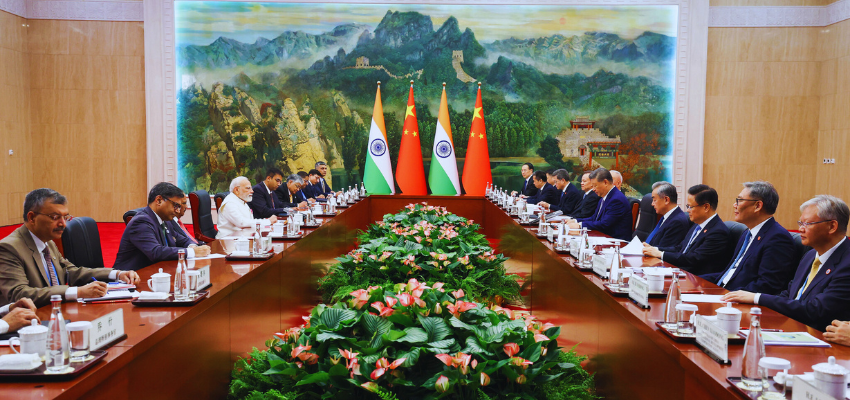
Photo by Indian Ministry of External Affairs via Flickr.

This article originally appeared in the Japan Times.

By Jonathan Berkshire Miller, September 4, 2025

At first glance, the Shanghai Cooperation Organization (SCO) summit this past week in Tianjin, China, looked like a thaw between New Delhi and Beijing.

Indian Prime Minister Narendra Modi’s first visit to China in seven years, his staged embrace with Vladimir Putin and the friendly photos with Xi Jinping all created an image of reconciliation and concern that New Delhi may be at risk of being wrested away by the emerging authoritarian axis.

For Beijing, it was an opportunity to present its leadership and a united SCO behind China’s vision of a different world order. For Moscow, it was a reminder that it still matters despite the costly war in Ukraine.

But New Delhi’s optics deserve a closer look.

Xi used the moment to unveil ambitious plans: an SCO development bank, deeper cooperation on energy and artificial intelligence, $1.4 billion in financial commitments and greater access to China’s BeiDou satellite system. It’s Beijing’s push to give the SCO more institutional weight and position as an alternative to the U.S.-led order. Modi’s presence gave those plans a veneer of legitimacy — even though Sino-Indian ties are still riddled with mistrust and border tensions.

India, however, played a subtler game. New Delhi again refused to endorse the Belt and Road initiative, the SCO’s signature China-backed project. Russia, Iran, Pakistan and the Central Asian states voiced support; India did not.

The reason is simple: BRI’s flagship, the China-Pakistan Economic Corridor, passes through territory that India claims. Backing BRI would have meant abandoning a long-held principle of sovereignty. That steady refusal shows that beneath the warm gestures, deep suspicion remains.

Modi’s attendance should also be viewed against worsening ties with Washington. U.S. tariffs on Indian steel and aluminum and a more transactional trade stance have strained what many hoped would be a cornerstone of the Indo-Pacific order. As U.S. Treasury Secretary Scott Bessent called the summit “largely performative,” the pictures of Modi with Xi and Putin nonetheless carry weight in Washington. In that light, Modi’s actions signaled both India’s independence and a warning that New Delhi won’t be ignored.

There are, however, hard limits to any improvement with China. Repeated crises along the Line of Actual Control that divides the two countries in recent years have damaged trust. Even as both sides look for ways to disengage, they haven’t resolved the deeper differences over power and intent. China hasn’t shown it’s ready to treat India as an equal in Asia and India isn’t prepared to sacrifice its interests for China’s aims. Modi’s Tianjin remarks — calls for counterterrorism cooperation and veiled warnings about double standards — were aimed partly at Pakistan and partly at a domestic audience to underline that sovereignty matters.

So, India’s moves at the SCO were neither a tilt toward Beijing nor a retreat from the West. They showed the balancing act that defines Indian strategy: Engage but remain cautious. The hug with Putin reminded everyone that Russia is still seen as a useful partner (as abhorrent as it is to many of us in the West) in New Delhi, even as it grows closer to China. The smiles with Xi acknowledged the need to keep talking, not to suddenly rebuild trust. And saying no to BRI made clear that India still has red lines.

That balancing act, however, has risks. To China and Russia, India’s presence strengthens the SCO as a counter to the West. In Washington, it can look like drift. In reality, India is trying to keep its options open — asserting independence, using multilateral forums and avoiding binary choices in a new Cold War. But this flexibility comes at a cost. U.S. tariffs, an assertive China and Russia’s growing reliance on Beijing all narrow India’s room for maneuver.

Still, India isn’t ready to drop its balancing act. Rejecting BRI wasn’t mere symbolism; it was a firm statement that India won’t trade sovereignty for diplomatic ease. The handshakes and smiles in Tianjin may ease the temperature for a while, but they won’t heal deeper wounds.

For Japan and other Indo-Pacific partners, the takeaway is clear: India’s diplomacy is pragmatic and self-interested. Engaging China in multilateral settings doesn’t equal trust — it’s recognition that interaction is unavoidable in today’s unsettled world.

The SCO summit exposed a central tension in India’s foreign policy: a desire to be everywhere but not tied down. That necessity-driven flexibility brings advantages, but it also blurs India’s message. Whether this balancing act can hold as U.S.-China tensions rise is unclear. What Tianjin made most evident is that India will keep following its own path — cautiously, one handshake at a time.


Jonathan Berkshire Miller is a co-founder and principal of Pendulum Geopolitical Advisory and a senior fellow at the Macdonald-Laurier Institute in Ottawa


Source: The Japan Times

Related Posts

Iran pushing the Middle East to the brink of war: Joe Varner for National Security Journal
Middle East and North Africa

Iran pushing the Middle East to the brink of war: Joe Varner for National Security Journal

December 5, 2025
Property rights are “precarious” in Canada: Paul Warchuk and Peter Copeland for Inside Policy Talks
Domestic Policy

Property rights are “precarious” in Canada: Paul Warchuk and Peter Copeland for Inside Policy Talks

December 4, 2025
Harvard eschews ingrained ideology in order to tackle ‘genuinely hard problems’: Peter MacKinnon in the National Post
Reforming Universities

Harvard eschews ingrained ideology in order to tackle ‘genuinely hard problems’: Peter MacKinnon in the National Post

December 3, 2025
Next Post
Woke may have peaked, but on campus, it’s far from dead: Christopher Dummitt in The Line

Woke may have peaked, but on campus, it's far from dead: Christopher Dummitt in The Line

Newsletter Signup

  Thank you for Signing Up
  Please correct the marked field(s) below.
Email Address  *
1,true,6,Contact Email,2
First Name *
1,true,1,First Name,2
Last Name *
1,true,1,Last Name,2
*
*Required Fields

Follow us on

Macdonald-Laurier Institute

323 Chapel Street, Suite #300
Ottawa, Ontario, K1N 7Z2 Canada

613.482.8327

info@macdonaldlaurier.ca
MLI directory

Support Us

Support the Macdonald-Laurier Institute to help ensure that Canada is one of the best governed countries in the world. Click below to learn more or become a sponsor.

Support Us

  • Inside Policy Magazine
  • Annual Reports
  • Jobs
  • Privacy Policy

© 2023 Macdonald-Laurier Institute. All Rights reserved.

No Result
View All Result
  • Home
  • About
    • Who We Are
    • Who Makes MLI Work
    • Fifteenth Anniversary
  • Experts
    • Experts Directory
    • In Memoriam
  • Issues
    • Domestic Policy
      • Economic Policy
      • Justice
      • Rights and Freedoms
      • Assisted Suicide (MAID)
      • Health Care
      • COVID-19
      • Gender Identity
      • Canada’s Political Tradition
      • AI, Technology and Innovation
      • Media and Telecoms
      • Housing
      • Immigration
      • Agriculture and Agri-Food
      • Competition Policy
    • Energy Policy
      • Energy
      • Environment
    • Foreign Policy
      • Israel-Hamas War
      • Ukraine
      • Taiwan
      • China
      • Europe and Russia
      • Indo-Pacific
      • Middle East and North Africa
      • North America
      • Foreign Interference
      • National Defence
      • National Security
      • Foreign Affairs
    • Indigenous Affairs
  • Projects
    • CNAPS (Center for North American Prosperity and Security)
    • The Promised Land
    • Voices that Inspire: The Macdonald-Laurier Vancouver Speaker Series
    • Dragon at the door
    • Canada on top of the world
    • Letter to a minister
    • Justice Report Card
    • The Great Energy Crisis
    • DisInfoWatch.org
    • Managing Indigenous Prosperity
    • Judicial Foundations
    • Landmark Cases Council
    • Defending The Marketplace of Ideas
    • Reforming the University
    • Past Projects
      • Digital Policy & Connectivity
      • Double Trouble
      • Canada and the Indo-Pacific Initiative
      • The Transatlantic Program
      • COVID Misery Index
      • Speak for Ourselves
      • The Eavesdropping Dragon: Huawei
      • Talkin’ in the Free World with Mariam Memarsadeghi
      • An Intellectual Property Strategy for Canada
      • Munk Senior Fellows
      • A Mandate for Canada
      • Confederation Series
      • Fiscal Reform
      • The Canadian Century project
      • Fixing Canadian health care
      • Internal trade
      • From a mandate for change
      • Size of government in Canada
      • Straight Talk
      • Labour Market Report
      • Leading Economic Indicator
      • Centre for Advancing Canada’s Interests Abroad
      • Indigenous Prosperity at a Crossroads
  • Events
    • Upcoming Events
    • Past Events
      • MLI Dinners
      • Great Canadian Debates
  • Latest News
  • Libraries
    • Columns
    • Commentary
    • Papers
    • Books
    • Video
  • Donate

© 2023 Macdonald-Laurier Institute. All Rights reserved.