
This article originally appeared in The Hub.
By Richard Shimooka, August 22, 2025
British Columbia has always operated at a remove from the rest of Canada. It is a beautiful, isolated enclave, far from the business and political hubs in the East. That has often made it an incubator for innovative policies—but it can also result in blinkered outcomes that lack any appreciation of other potentially more critical national considerations.
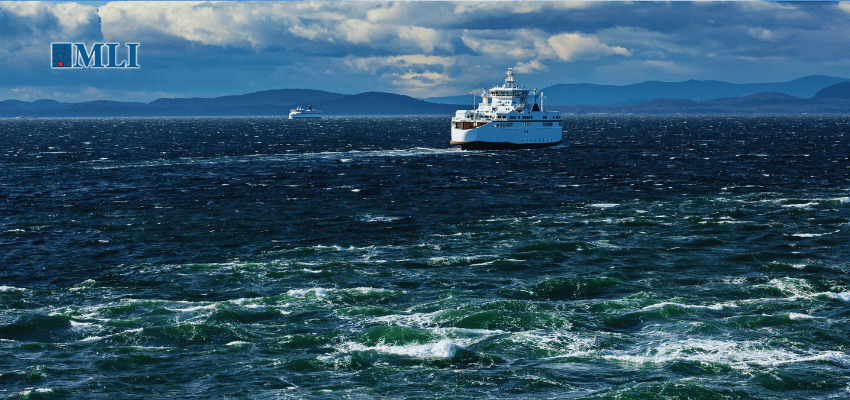
This has been plainly exemplified in the recent controversy surrounding B.C. Ferries’ plans to procure four new ferries from a Chinese state-owned shipbuilding firm, CMI Weihai Shipyards. B.C. Ferries, a private company owned by the province, prioritized CMI over bids from both domestic competitors and companies from allied nations for the shipbuilding contract that will ultimately deliver replacements for the aging fleet.
This story parallels another not-too-distant ferry replacement in another often overlooked part of the country, when Marine Atlantic, a federal Crown corporation, leased a new passenger ferry that was built in a Chinese state-owned shipyard. This happened in 2021, at a time when the two Michaels were still in Chinese captivity, though it drew significantly less attention than the current scandal has.
There is no other way to say it: B.C. going through this purchase is deeply foolish and naive in every respect. Beijing is a clear strategic, geopolitical, and economic competitor to Canada; it has continually pursued aggressive policies that directly challenge this country’s interests, whether in the recent trade tariffs devastating Western Canadian farmers, interference in our country’s elections, or directly challenging Canada’s partners in Asia.
Perhaps B.C. Ferries understands how they were courting controversy with the selection, which is why it has resisted transparency around the decision, tightly controlling the release of information to best suit its argument. Financial considerations have clearly loomed large, with the company stating that CMI had the lowest cost technically compliant bid, one that allows for B.C. to purchase a fourth vessel to round out the fleet. There is every reason to believe that with added scrutiny, other aspects of the deal will look less appealing when revealed.
In one sense, it’s not surprising that Chinese shipyard companies would be viable candidates for the contract in a financial sense. Through judicious use of subsidies and market-distorting policies, the People’s Republic of China has become the world’s largest civil shipbuilder and has leveraged that position to further expand its naval production capacity. As a recent report by the respected Center for Strategic and International Studies in Washington, DC, argued:
Foreign companies, including firms based in many U.S.-allied countries, purchase 75 percent of ships built at China’s dual-use shipyards, funneling billions of dollars in revenue and transferring key technologies into the country’s naval industrial base.
But on the other hand, there are more than just market-based considerations at play here. There are serious security concerns that must be accounted for—and so far, the response by the Eby government has been far from adequate.
Perhaps B.C. Ferries’ most ridiculous assertion has come in response to the cybersecurity concerns related to purchasing a vessel from a Chinese state-owned manufacturer.
This matters. The B.C. ferry system is a critical piece of Canada’s national infrastructure, linking nearly a million people to the mainland, as well as several key military bases and strategic industries on Vancouver Island. Vulnerabilities can be used to disable vessels or pry sensitive data about their operations.
And China has not shown it can be a trusted actor when it comes to such important matters. PRC-sponsored actors have been directly observed attempting to penetrate other major pieces of Canadian infrastructure. Allowing the construction of these vessels in China will essentially give them every opportunity to build in vulnerabilities that can be exploited. The PRC is an exceptionally sophisticated cybersecurity actor, and the ferry corporation’s claim that they can manage the cyber security risk of a Chinese-produced vessel is utter folly to any expert in this area. There is no “safe” level of PRC involvement in critical infrastructure.
Nevertheless, despite the considerable outcry since the announcement, including Prime Minister Carney and members of his cabinet, Premier Eby and B.C. Ferries seem dead set on continuing down this path.

Given that the federal government clearly does not want this deal to be executed, one can imagine what pressure is being put to bear behind the scenes. In the end, Carney does hold much of the leverage and can scupper the deal simply by cancelling the project’s federal financing, which comes in the form of a $1-billion loan from the Canada Infrastructure Bank for the new electric-diesel ships.
The most logical next step would be for Ottawa to increase the size of the loan or provide direct funding to enable B.C. Ferries to select one of the other more expensive bids. The reality is that this would likely mean purchasing ferries constructed in South Korea, Japan, or Europe, not Canada. There is no domestic capacity to produce these vessels: all three of the major Canadian shipyards’ order books are full for at least the next five years with work for the National Shipbuilding Strategy. The backlog is significant. Several East Coast ferries were ordered in 2019 by the federal government, but six years on, no production contract has been signed or delivery date set.
Ottawa can also placate the unions and local shipbuilders, who have waged a public campaign throughout this saga advocating for the repatriation of shipbuilding, by announcing the construction of additional Joint Support Ships at Seaspan shipyards in North Vancouver, which would guarantee federal shipbuilding dollars flowing into the region for the next decade.
Publicly, the Eby government and B.C. Ferries remain in denial about the gravity of the situation. At the end of the day, the security ramifications are too seismic to ignore, and the sooner Carney and the federal government can impress that upon them and induce a course reversal, the better. The risk is simply not worth whatever savings are being used to justify the purchase. This is not the issue for Eby and his NDP compatriots to finally find religion on the importance of sound fiscal management.
Yes, it may be more expensive in the short term to go with an alternative option, but the costs of selling out Canada’s security and trusting China with this country’s critical infrastructure will be too high a bill to bear in the long term.
Richard Shimooka is a Hub contributing writer and a senior fellow at the Macdonald-Laurier Institute who writes on defence policy.