Saturday, December 13, 2025
No Result
View All Result
  • Media
Macdonald-Laurier Institute
  • Home
  • About
    • Who We Are
    • Who Makes MLI Work
    • Fifteenth Anniversary
  • Experts
    • Experts Directory
    • In Memoriam
  • Issues
    • Domestic Policy
      • Economic Policy
      • Justice
      • Rights and Freedoms
      • Assisted Suicide (MAID)
      • Health Care
      • COVID-19
      • Gender Identity
      • Canada’s Political Tradition
      • AI, Technology and Innovation
      • Media and Telecoms
      • Housing
      • Immigration
      • Agriculture and Agri-Food
      • Competition Policy
    • Energy Policy
      • Energy
      • Environment
    • Foreign Policy
      • Israel-Hamas War
      • Ukraine
      • Taiwan
      • China
      • Europe and Russia
      • Indo-Pacific
      • Middle East and North Africa
      • North America
      • Foreign Interference
      • National Defence
      • National Security
      • Foreign Affairs
    • Indigenous Affairs
  • Projects
    • CNAPS (Center for North American Prosperity and Security)
    • The Promised Land
    • Voices that Inspire: The Macdonald-Laurier Vancouver Speaker Series
    • Dragon at the door
    • Canada on top of the world
    • Letter to a minister
    • Justice Report Card
    • The Great Energy Crisis
    • DisInfoWatch.org
    • Managing Indigenous Prosperity
    • Judicial Foundations
    • Landmark Cases Council
    • Defending The Marketplace of Ideas
    • Reforming the University
    • Past Projects
      • Digital Policy & Connectivity
      • Double Trouble
      • Canada and the Indo-Pacific Initiative
      • The Transatlantic Program
      • COVID Misery Index
        • Provincial COVID Misery Index
        • Beyond Lockdown
        • COVID and after: A mandate for recovery
      • Speak for Ourselves
      • The Eavesdropping Dragon: Huawei
      • Talkin’ in the Free World with Mariam Memarsadeghi
      • An Intellectual Property Strategy for Canada
      • Munk Senior Fellows
      • A Mandate for Canada
      • Confederation Series
      • Fiscal Reform
      • The Canadian Century project
      • Fixing Canadian health care
      • Internal trade
      • From a mandate for change
      • Size of government in Canada
      • Straight Talk
      • Labour Market Report
      • Leading Economic Indicator
      • Centre for Advancing Canada’s Interests Abroad
      • Indigenous Prosperity at a Crossroads
        • Aboriginal Canada and Natural Resources
  • Events
    • Upcoming Events
    • Past Events
      • MLI Dinners
      • Great Canadian Debates
  • Latest News
  • Libraries
    • Columns
    • Commentary
    • Papers
    • Books
    • Video
  • Donate
  • Home
  • About
    • Who We Are
    • Who Makes MLI Work
    • Fifteenth Anniversary
  • Experts
    • Experts Directory
    • In Memoriam
  • Issues
    • Domestic Policy
      • Economic Policy
      • Justice
      • Rights and Freedoms
      • Assisted Suicide (MAID)
      • Health Care
      • COVID-19
      • Gender Identity
      • Canada’s Political Tradition
      • AI, Technology and Innovation
      • Media and Telecoms
      • Housing
      • Immigration
      • Agriculture and Agri-Food
      • Competition Policy
    • Energy Policy
      • Energy
      • Environment
    • Foreign Policy
      • Israel-Hamas War
      • Ukraine
      • Taiwan
      • China
      • Europe and Russia
      • Indo-Pacific
      • Middle East and North Africa
      • North America
      • Foreign Interference
      • National Defence
      • National Security
      • Foreign Affairs
    • Indigenous Affairs
  • Projects
    • CNAPS (Center for North American Prosperity and Security)
    • The Promised Land
    • Voices that Inspire: The Macdonald-Laurier Vancouver Speaker Series
    • Dragon at the door
    • Canada on top of the world
    • Letter to a minister
    • Justice Report Card
    • The Great Energy Crisis
    • DisInfoWatch.org
    • Managing Indigenous Prosperity
    • Judicial Foundations
    • Landmark Cases Council
    • Defending The Marketplace of Ideas
    • Reforming the University
    • Past Projects
      • Digital Policy & Connectivity
      • Double Trouble
      • Canada and the Indo-Pacific Initiative
      • The Transatlantic Program
      • COVID Misery Index
        • Provincial COVID Misery Index
        • Beyond Lockdown
        • COVID and after: A mandate for recovery
      • Speak for Ourselves
      • The Eavesdropping Dragon: Huawei
      • Talkin’ in the Free World with Mariam Memarsadeghi
      • An Intellectual Property Strategy for Canada
      • Munk Senior Fellows
      • A Mandate for Canada
      • Confederation Series
      • Fiscal Reform
      • The Canadian Century project
      • Fixing Canadian health care
      • Internal trade
      • From a mandate for change
      • Size of government in Canada
      • Straight Talk
      • Labour Market Report
      • Leading Economic Indicator
      • Centre for Advancing Canada’s Interests Abroad
      • Indigenous Prosperity at a Crossroads
        • Aboriginal Canada and Natural Resources
  • Events
    • Upcoming Events
    • Past Events
      • MLI Dinners
      • Great Canadian Debates
  • Latest News
  • Libraries
    • Columns
    • Commentary
    • Papers
    • Books
    • Video
  • Donate
No Result
View All Result
Macdonald-Laurier Institute

A second Munich in Alaska? Joe Varner in Real Clear World

The cost of sacrificing Ukrainian territory will not be stability, but a larger war—one in which another European capital becomes the next target.

August 14, 2025
in Foreign Affairs, Latest News, Columns, Foreign Policy, In the Media, Europe and Russia, Ukraine, Joe Varner
Reading Time: 3 mins read
A A
A second Munich in Alaska? Joe Varner in Real Clear World

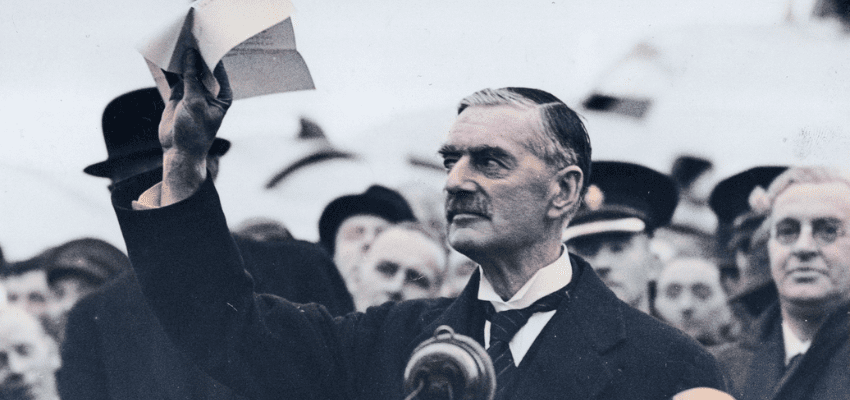
Photo from the national archive of Poland, via Wikimedia Commons.

This article originally appeared in Real Clear World.

By Joe Varner, August 14, 2025

Eighty-seven years after Neville Chamberlain’s fateful handshake with Adolf Hitler, the West stands on the brink of another Munich—only this time, the map on the table is Ukraine.

In 1938, Great Britain and France convened in Munich with Adolf Hitler and Benito Mussolini—without Czechoslovakia or its Soviet ally—to negotiate the fate of the Sudetenland. The result was a capitulation dressed as diplomacy. British Prime Minister Neville Chamberlain, seeking to “buy time,” ceded the fortified and defensible Sudetenland to Hitler. That sacrifice left Czechoslovakia vulnerable, undermined its security, and paved the way for its total occupation within months. Chamberlain, an honourable man who misjudged his adversaries, went down in history as the symbol of appeasement.

Nearly nine decades later, history is threatening to repeat itself. The victim this time is not Czechoslovakia, but Ukraine. Russian President Vladimir Putin has never abandoned his maximalist objectives: Ukraine’s demilitarization, exclusion from NATO, regime change on Moscow’s terms, and the formal annexation of Crimea, Kherson, Zaporizhzhia, Donetsk, and Luhansk. Moscow’s latest demands—already framed as the starting point for “peace” talks—include Ukraine’s withdrawal from its remaining footholds in Donetsk and Luhansk, handing over civilians to almost certain reprisals.

Reports differ on the role of U.S. Envoy Steve Witkoff during his recent visit to Moscow, but whether through confusion, misdirection, or acquiescence, he has set the stage for a Trump–Putin summit on August 15 in Alaska—a meeting that, incredibly, Ukraine and its European allies may be excluded from. President Donald Trump has pledged to “end the war” and appears prepared to do so at a steep cost. The terms being floated are nothing short of “Munich-like”: a ceasefire in exchange for Ukraine ceding its most defensible ground.

Foremost among the sacrifices would be Ukraine’s Fortress City Belt in Donetsk—four fortified urban centers strung along the H-20 highway between Kostyantynivka and Slovyansk. This network has withstood repeated Russian assaults since 2014. Its loss would force Ukraine to build new defensive lines between Kharkiv and Dnipropetrovsk, on ground ill-suited for defence, leaving the country open to renewed Russian offensives from the north or south. Worse, Russian forces could mass along these new frontiers under the cover of a ceasefire, bypassing Ukrainian positions in any future war.

A ceasefire under these conditions would not be peace—it would be a pause, buying Moscow time to consolidate gains, rearm, and prepare the next phase of conquest. U.S. and NATO fatigue with the war would likely curtail military aid, further eroding Ukraine’s ability to resist.

Ukraine’s President Volodymyr Zelenskyy has flatly rejected territorial concessions. Most European allies—especially the Baltic states, Poland, Romania, Sweden, and Finland—understand the stakes: if Ukraine falls, they may be next. Yet, as of now, only Putin and Trump are poised to decide Ukraine’s fate.

The stakes for NATO could not be higher. A “peace at any price” deal would fracture the alliance’s credibility, embolden the Kremlin, and invite further aggression. At a minimum, European and Canadian leaders must press Washington to ensure Ukraine and Europe have seats at the table. If the U.S. insists on a land-for-peace deal, NATO’s answer should be immediate: accelerate Ukraine’s full membership and extend Article Five guarantees to deter further Russian advances.

Appeasement did not work in 1938, and it will not work in 2025. The cost of sacrificing Ukrainian territory will not be stability, but a larger war—one in which another European capital becomes the next target. And while the Alaska venue is symbolic for Washington, in the minds of Russian nationalists it may be more than that—another piece of “lost” imperial territory to be reclaimed in Moscow’s imagined future.

This is not just a test of Ukraine’s survival. It is a test of the West’s ability to recognize—and resist—the oldest trap in diplomacy: mistaking the surrender of others’ lands for peace. If Alaska becomes this century’s Munich, it will not mark the end of the Ukraine war—it will mark the beginning of the next, and the collapse of the West’s ability to deter it.


Joe Varner is a senior fellow at the Macdonald-Laurier Institute in Ottawa and the Center for North American Prosperity and Security in Washington, D.C.

Source: Real Clear World

Related Posts

Breakthrough Nation with Karen Restoule: Crystal Smith, Ep. 1
Energy

Breakthrough Nation with Karen Restoule: Crystal Smith, Ep. 1

December 12, 2025
Asia Map
Latest News

Survival in Trump, Xi and Putin’s ‘great power’ world: Stephen Nagy in the Japan Times

December 12, 2025
Westminster parliament
Domestic Policy

Dec. 11 is the day Canada gained autonomy. Progressives want us to forget: Christopher Dummitt in the National Post

December 11, 2025
Next Post
Canada must pay attention to Russia’s Arctic ambitions: Alex Dalziel and Christopher Coates for Inside Policy Talks

Canada must pay attention to Russia’s Arctic ambitions: Alex Dalziel and Christopher Coates for Inside Policy Talks

Newsletter Signup

  Thank you for Signing Up
  Please correct the marked field(s) below.
Email Address  *
1,true,6,Contact Email,2
First Name *
1,true,1,First Name,2
Last Name *
1,true,1,Last Name,2
*
*Required Fields

Follow us on

Macdonald-Laurier Institute

323 Chapel Street, Suite #300
Ottawa, Ontario, K1N 7Z2 Canada

613.482.8327

info@macdonaldlaurier.ca
MLI directory

Support Us

Support the Macdonald-Laurier Institute to help ensure that Canada is one of the best governed countries in the world. Click below to learn more or become a sponsor.

Support Us

  • Inside Policy Magazine
  • Annual Reports
  • Jobs
  • Privacy Policy

© 2023 Macdonald-Laurier Institute. All Rights reserved.

No Result
View All Result
  • Home
  • About
    • Who We Are
    • Who Makes MLI Work
    • Fifteenth Anniversary
  • Experts
    • Experts Directory
    • In Memoriam
  • Issues
    • Domestic Policy
      • Economic Policy
      • Justice
      • Rights and Freedoms
      • Assisted Suicide (MAID)
      • Health Care
      • COVID-19
      • Gender Identity
      • Canada’s Political Tradition
      • AI, Technology and Innovation
      • Media and Telecoms
      • Housing
      • Immigration
      • Agriculture and Agri-Food
      • Competition Policy
    • Energy Policy
      • Energy
      • Environment
    • Foreign Policy
      • Israel-Hamas War
      • Ukraine
      • Taiwan
      • China
      • Europe and Russia
      • Indo-Pacific
      • Middle East and North Africa
      • North America
      • Foreign Interference
      • National Defence
      • National Security
      • Foreign Affairs
    • Indigenous Affairs
  • Projects
    • CNAPS (Center for North American Prosperity and Security)
    • The Promised Land
    • Voices that Inspire: The Macdonald-Laurier Vancouver Speaker Series
    • Dragon at the door
    • Canada on top of the world
    • Letter to a minister
    • Justice Report Card
    • The Great Energy Crisis
    • DisInfoWatch.org
    • Managing Indigenous Prosperity
    • Judicial Foundations
    • Landmark Cases Council
    • Defending The Marketplace of Ideas
    • Reforming the University
    • Past Projects
      • Digital Policy & Connectivity
      • Double Trouble
      • Canada and the Indo-Pacific Initiative
      • The Transatlantic Program
      • COVID Misery Index
      • Speak for Ourselves
      • The Eavesdropping Dragon: Huawei
      • Talkin’ in the Free World with Mariam Memarsadeghi
      • An Intellectual Property Strategy for Canada
      • Munk Senior Fellows
      • A Mandate for Canada
      • Confederation Series
      • Fiscal Reform
      • The Canadian Century project
      • Fixing Canadian health care
      • Internal trade
      • From a mandate for change
      • Size of government in Canada
      • Straight Talk
      • Labour Market Report
      • Leading Economic Indicator
      • Centre for Advancing Canada’s Interests Abroad
      • Indigenous Prosperity at a Crossroads
  • Events
    • Upcoming Events
    • Past Events
      • MLI Dinners
      • Great Canadian Debates
  • Latest News
  • Libraries
    • Columns
    • Commentary
    • Papers
    • Books
    • Video
  • Donate

© 2023 Macdonald-Laurier Institute. All Rights reserved.