Friday, December 5, 2025
No Result
View All Result
  • Media
Macdonald-Laurier Institute
  • Home
  • About
    • Who We Are
    • Who Makes MLI Work
    • Fifteenth Anniversary
  • Experts
    • Experts Directory
    • In Memoriam
  • Issues
    • Domestic Policy
      • Economic Policy
      • Justice
      • Rights and Freedoms
      • Assisted Suicide (MAID)
      • Health Care
      • COVID-19
      • Gender Identity
      • Canada’s Political Tradition
      • AI, Technology and Innovation
      • Media and Telecoms
      • Housing
      • Immigration
      • Agriculture and Agri-Food
      • Competition Policy
    • Energy Policy
      • Energy
      • Environment
    • Foreign Policy
      • Israel-Hamas War
      • Ukraine
      • Taiwan
      • China
      • Europe and Russia
      • Indo-Pacific
      • Middle East and North Africa
      • North America
      • Foreign Interference
      • National Defence
      • National Security
      • Foreign Affairs
    • Indigenous Affairs
  • Projects
    • CNAPS (Center for North American Prosperity and Security)
    • The Promised Land
    • Voices that Inspire: The Macdonald-Laurier Vancouver Speaker Series
    • Dragon at the door
    • Canada on top of the world
    • Letter to a minister
    • Justice Report Card
    • The Great Energy Crisis
    • DisInfoWatch.org
    • Managing Indigenous Prosperity
    • Judicial Foundations
    • Landmark Cases Council
    • Defending The Marketplace of Ideas
    • Reforming the University
    • Past Projects
      • Digital Policy & Connectivity
      • Double Trouble
      • Canada and the Indo-Pacific Initiative
      • The Transatlantic Program
      • COVID Misery Index
        • Provincial COVID Misery Index
        • Beyond Lockdown
        • COVID and after: A mandate for recovery
      • Speak for Ourselves
      • The Eavesdropping Dragon: Huawei
      • Talkin’ in the Free World with Mariam Memarsadeghi
      • An Intellectual Property Strategy for Canada
      • Munk Senior Fellows
      • A Mandate for Canada
      • Confederation Series
      • Fiscal Reform
      • The Canadian Century project
      • Fixing Canadian health care
      • Internal trade
      • From a mandate for change
      • Size of government in Canada
      • Straight Talk
      • Labour Market Report
      • Leading Economic Indicator
      • Centre for Advancing Canada’s Interests Abroad
      • Indigenous Prosperity at a Crossroads
        • Aboriginal Canada and Natural Resources
  • Events
    • Upcoming Events
    • Past Events
      • MLI Dinners
      • Great Canadian Debates
  • Latest News
  • Libraries
    • Columns
    • Commentary
    • Papers
    • Books
    • Video
  • Donate
  • Home
  • About
    • Who We Are
    • Who Makes MLI Work
    • Fifteenth Anniversary
  • Experts
    • Experts Directory
    • In Memoriam
  • Issues
    • Domestic Policy
      • Economic Policy
      • Justice
      • Rights and Freedoms
      • Assisted Suicide (MAID)
      • Health Care
      • COVID-19
      • Gender Identity
      • Canada’s Political Tradition
      • AI, Technology and Innovation
      • Media and Telecoms
      • Housing
      • Immigration
      • Agriculture and Agri-Food
      • Competition Policy
    • Energy Policy
      • Energy
      • Environment
    • Foreign Policy
      • Israel-Hamas War
      • Ukraine
      • Taiwan
      • China
      • Europe and Russia
      • Indo-Pacific
      • Middle East and North Africa
      • North America
      • Foreign Interference
      • National Defence
      • National Security
      • Foreign Affairs
    • Indigenous Affairs
  • Projects
    • CNAPS (Center for North American Prosperity and Security)
    • The Promised Land
    • Voices that Inspire: The Macdonald-Laurier Vancouver Speaker Series
    • Dragon at the door
    • Canada on top of the world
    • Letter to a minister
    • Justice Report Card
    • The Great Energy Crisis
    • DisInfoWatch.org
    • Managing Indigenous Prosperity
    • Judicial Foundations
    • Landmark Cases Council
    • Defending The Marketplace of Ideas
    • Reforming the University
    • Past Projects
      • Digital Policy & Connectivity
      • Double Trouble
      • Canada and the Indo-Pacific Initiative
      • The Transatlantic Program
      • COVID Misery Index
        • Provincial COVID Misery Index
        • Beyond Lockdown
        • COVID and after: A mandate for recovery
      • Speak for Ourselves
      • The Eavesdropping Dragon: Huawei
      • Talkin’ in the Free World with Mariam Memarsadeghi
      • An Intellectual Property Strategy for Canada
      • Munk Senior Fellows
      • A Mandate for Canada
      • Confederation Series
      • Fiscal Reform
      • The Canadian Century project
      • Fixing Canadian health care
      • Internal trade
      • From a mandate for change
      • Size of government in Canada
      • Straight Talk
      • Labour Market Report
      • Leading Economic Indicator
      • Centre for Advancing Canada’s Interests Abroad
      • Indigenous Prosperity at a Crossroads
        • Aboriginal Canada and Natural Resources
  • Events
    • Upcoming Events
    • Past Events
      • MLI Dinners
      • Great Canadian Debates
  • Latest News
  • Libraries
    • Columns
    • Commentary
    • Papers
    • Books
    • Video
  • Donate
No Result
View All Result
Macdonald-Laurier Institute

Supreme Court has no right to soften child porn laws: Kerry Sun in the National Post

The court has undermined the ability of public institutions to punish the evil of sexual abuse. The notwithstanding clause is the answer.

November 3, 2025
in Domestic Policy, Columns, Latest News, In the Media, Political Tradition, Justice, Judicial Foundations
Reading Time: 8 mins read
A A
Supreme Court has no right to soften child porn laws: Kerry Sun in the National Post

Image via Canva.

This article originally appeared in the National Post.

By Kerry Sun, November 3, 2025

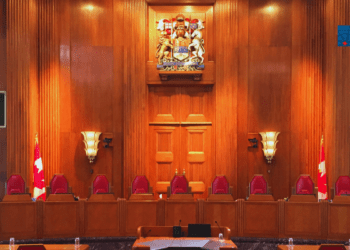
It’s a reflection of the sorry state of Canadian justice: last Friday, the Supreme Court of Canada ruled that the one-year mandatory minimum sentences for the offences of possessing and accessing child pornography are unconstitutional. The case, Quebec (Attorney General) v. Senneville, involved two offenders who admitted to possessing 475 and 805 files, respectively, depicting children being sexually abused in horrific ways. Despite this, the court held, 5–4, that the mandatory minimums constituted “cruel and unusual punishment” contrary to Section 12 of the Charter.

The backlash has been swift and justly deserved. Several provincial premiers, joined by federal opposition leader Pierre Poilievre, immediately endorsed the use of Section 33 of the Charter, also known as the notwithstanding clause, to reverse the court’s ruling and restore the mandatory minimums. This is a welcome first step.

As envisioned by its framers, the notwithstanding clause is a mechanism to prevent overreaching judicial interpretations of rights from undermining the common good. If there were ever a decision that warranted the use of Section 33, it would be one that undermines the ability of our public institutions to protect children and punish the evil of sexual abuse.

It would be a mistake, however, to think that a single deployment of Section 33 will be sufficient to address the problems afflicting criminal sentencing in Canada. The reality is that Friday’s Supreme Court decision is far from an isolated phenomenon.

Only two years ago, in R. v. Bertrand Marchand, the Supreme Court ruled that the one-year mandatory minimum for child luring was “cruel and unusual punishment.” In R. v. Hills (2023), it struck down the four-year mandatory minimum for the reckless discharge of a firearm. And in R. v. Bissonnette (2022), the court decided that it was unconstitutional to impose consecutive life sentences on a multiple murderer.

These results can be traced to an unsound legal doctrine that the Supreme Court of Canada has embraced, called the “reasonable hypothetical scenarios” doctrine. First posited in 1987, but reaffirmed more stringently only a decade ago, the concept of “reasonable hypotheticals” permits courts to test a mandatory minimum for constitutionality not only against the facts before them, but also other scenarios to which the sentencing law under challenge could hypothetically apply.

The “reasonable hypothetical scenarios” doctrine allows criminal offenders to argue that a mandatory minimum sentence shouldn’t apply to them, not because it is inappropriate for their case, but because it amounts to “cruel and unusual punishment” for some hypothetical person. Thus, in the Senneville case, the offenders successfully claimed that the one-year minimum for possessing child pornography was unconstitutional, on the grounds that an 18-year-old who received a “sext” from his friend’s 17-year-old girlfriend could theoretically be subjected to the same penalty.

This kind of reasoning, based on hypothetical scenarios, lay behind the earlier decisions in Bertrand Marchand and Hills striking down the child luring and firearms sentencing laws. It was also present to a limited extent in the Bissonnette case, where the court held that life imprisonment without the possibility of parole was “cruel and unusual punishment.”

The defects of the reasonable hypotheticals doctrine are manifold, not least because it accords great scope to judges to invent or endorse “reasonable” hypothetical scenarios that would trigger a remedy. To comply with the rigours of the doctrine, Parliament would have to do the impossible, namely, anticipate and devise solutions for all manner of hypothetical scenarios in crafting a mandatory minimum sentence. In effect, it negates much of Parliament’s legitimate authority to set the criminal sentencing agenda.

These difficulties are only exacerbated by the Supreme Court’s use of an amorphous conception of “human dignity” to determine what counts as a “cruel and unusual punishment.” In the case of Alexandre Bissonnette, who opened fire into a mosque and murdered six people, the court went so far as to equate respect for “dignity” with the requirement that “Parliament must leave a door open for rehabilitation,” no matter how heinous the crime. Yet, this simplistic and one-sided view virtually denies that criminal punishment, by treating the offender as a responsible human being, is itself justified and even required by the offender’s dignity.

Unfortunately, the majority’s reasons in last Friday’s decision signal no intention to withdraw or reconsider these problematic doctrines. To the contrary, the Supreme Court has announced its intention to double down on them.

According to Justice Mary Moreau, who wrote the majority judgment, “effective constitutional review” and “the rule of law” depend upon the court’s ability to ruminate over hypothetical scenarios in criminal sentencing appeals. While the court has not said so explicitly, it is hard to see statements like these as affirming anything less than an outright prohibition on mandatory minimum sentences of any kind.

But there is good reason to question the rationales offered for the ongoing encroachment upon Parliament’s criminal sentencing authority. While the Charter has accorded judges some power to review Parliament’s law-making choices, that power does not license them to speculate upon the wisdom of a law or how it might apply to future or hypothetical cases, rather than deciding upon the actual case before them.

Under our constitutional order, the judiciary is charged not with interpreting laws in the abstract, but resolving disputes according to law. Thus, as one perceptive appellate judge put it, “there is no principled basis for taking into account” whether “a make-believe offender” would suffer a “cruel and unusual punishment.” One might add that the “rule of law” does not require inventing make-believe offenders, either.

Should a genuine case arise where a mandatory minimum might constitute “cruel and unusual punishment,” the courts should consider then and there whether the sentencing law captures the offender and whether an exemption might be granted. But if Canadian legislators wish to enact laws to ensure that sex offenders receive at least a semblance of the punishment they deserve — with minimums as low as six months or one year’s imprisonment — it is not for the courts to frustrate that law-making choice by appealing to hypothetical scenarios.

In the face of the Supreme Court’s persistence with its wayward approach on criminal sentencing, the most reliable, if not the only, option for the political branches is to invoke the notwithstanding clause — and to do it as often as may be required to restore the legitimate allocation of lawmaking authority. The maintenance of a rightful system of criminal justice, and the preservation of the common good, may very well demand it.


Kerry Sun is a doctoral student at the University of Oxford and a member of the Macdonald-Laurier Institute’s Judicial Foundations Project.
Source: National Post
Tags: Kerry Sun

Related Posts

Property rights are “precarious” in Canada: Paul Warchuk and Peter Copeland for Inside Policy Talks
Domestic Policy

Property rights are “precarious” in Canada: Paul Warchuk and Peter Copeland for Inside Policy Talks

December 4, 2025
Harvard eschews ingrained ideology in order to tackle ‘genuinely hard problems’: Peter MacKinnon in the National Post
Reforming Universities

Harvard eschews ingrained ideology in order to tackle ‘genuinely hard problems’: Peter MacKinnon in the National Post

December 3, 2025
Risking public backlash? Canadian universities and demographic-based faculty hiring
Education

Risking public backlash? Canadian universities and demographic-based faculty hiring

December 3, 2025
Next Post
Canada’s MAiD consultation misleads the public in its framing: Ramona Coelho in National Newswatch

Canada’s MAiD consultation misleads the public in its framing: Ramona Coelho in National Newswatch

Newsletter Signup

  Thank you for Signing Up
  Please correct the marked field(s) below.
Email Address  *
1,true,6,Contact Email,2
First Name *
1,true,1,First Name,2
Last Name *
1,true,1,Last Name,2
*
*Required Fields

Follow us on

Macdonald-Laurier Institute

323 Chapel Street, Suite #300
Ottawa, Ontario, K1N 7Z2 Canada

613.482.8327

info@macdonaldlaurier.ca
MLI directory

Support Us

Support the Macdonald-Laurier Institute to help ensure that Canada is one of the best governed countries in the world. Click below to learn more or become a sponsor.

Support Us

  • Inside Policy Magazine
  • Annual Reports
  • Jobs
  • Privacy Policy

© 2023 Macdonald-Laurier Institute. All Rights reserved.

No Result
View All Result
  • Home
  • About
    • Who We Are
    • Who Makes MLI Work
    • Fifteenth Anniversary
  • Experts
    • Experts Directory
    • In Memoriam
  • Issues
    • Domestic Policy
      • Economic Policy
      • Justice
      • Rights and Freedoms
      • Assisted Suicide (MAID)
      • Health Care
      • COVID-19
      • Gender Identity
      • Canada’s Political Tradition
      • AI, Technology and Innovation
      • Media and Telecoms
      • Housing
      • Immigration
      • Agriculture and Agri-Food
      • Competition Policy
    • Energy Policy
      • Energy
      • Environment
    • Foreign Policy
      • Israel-Hamas War
      • Ukraine
      • Taiwan
      • China
      • Europe and Russia
      • Indo-Pacific
      • Middle East and North Africa
      • North America
      • Foreign Interference
      • National Defence
      • National Security
      • Foreign Affairs
    • Indigenous Affairs
  • Projects
    • CNAPS (Center for North American Prosperity and Security)
    • The Promised Land
    • Voices that Inspire: The Macdonald-Laurier Vancouver Speaker Series
    • Dragon at the door
    • Canada on top of the world
    • Letter to a minister
    • Justice Report Card
    • The Great Energy Crisis
    • DisInfoWatch.org
    • Managing Indigenous Prosperity
    • Judicial Foundations
    • Landmark Cases Council
    • Defending The Marketplace of Ideas
    • Reforming the University
    • Past Projects
      • Digital Policy & Connectivity
      • Double Trouble
      • Canada and the Indo-Pacific Initiative
      • The Transatlantic Program
      • COVID Misery Index
      • Speak for Ourselves
      • The Eavesdropping Dragon: Huawei
      • Talkin’ in the Free World with Mariam Memarsadeghi
      • An Intellectual Property Strategy for Canada
      • Munk Senior Fellows
      • A Mandate for Canada
      • Confederation Series
      • Fiscal Reform
      • The Canadian Century project
      • Fixing Canadian health care
      • Internal trade
      • From a mandate for change
      • Size of government in Canada
      • Straight Talk
      • Labour Market Report
      • Leading Economic Indicator
      • Centre for Advancing Canada’s Interests Abroad
      • Indigenous Prosperity at a Crossroads
  • Events
    • Upcoming Events
    • Past Events
      • MLI Dinners
      • Great Canadian Debates
  • Latest News
  • Libraries
    • Columns
    • Commentary
    • Papers
    • Books
    • Video
  • Donate

© 2023 Macdonald-Laurier Institute. All Rights reserved.